

On July 7, 2026, CISA published an industrial control systems advisory warning that vulnerabilities in Hydro-Québec’s Le Circuit Électrique charging-station backend could allow privilege escalation or denial-of-service attacks against Canada-deployed EV charging infrastructure. The advisory is narrow in its confirmed facts but broad in its implications: EV charging networks are no longer just roadside conveniences, they are distributed cyber-physical systems. For WindowsForum readers, the story is not that a Canadian charging network has a scary CVSS score; it is that authentication, session handling, and backend exposure have become transportation-infrastructure problems. The same security failures that would be unacceptable in an enterprise web portal look much more consequential when they sit behind a public charging network used by drivers, municipalities, fleet operators, and roaming partners.
CISA’s advisory, identified as ICSA-26-188-01 and published on July 7, places the affected Hydro-Québec Le Circuit Électrique charging-station backend in the Transportation Systems critical infrastructure sector. That classification matters. It moves the discussion away from the familiar consumer-tech language of “app bugs” and toward the harsher vocabulary of operational resilience.
Le Circuit Électrique is Hydro-Québec’s public EV charging network, a system that has grown from a regional electrification initiative into a practical dependency for drivers across Québec and parts of eastern Canada. Hydro-Québec’s own public materials describe the network as a major public charging effort, with websites and mobile apps used to locate stations, initiate sessions, and track availability as new chargers are commissioned. Third-party charging directories such as ChargeHub describe it as one of the largest EV charging networks in Québec and eastern Ontario.
That scale changes the risk model. A single charger going offline is an inconvenience. A backend failure that affects authentication, session handling, or station availability can become a regional operations problem, especially when drivers are already relying on apps, roaming agreements, mobile support, and station-status data to make travel decisions.
CISA says successful exploitation could lead to privilege escalation or denial of service. The agency also says it has no known reports of public exploitation specifically targeting these vulnerabilities at the time of publication. That combination is important: the advisory is not evidence of a live attack campaign, but it is a warning that the defensive window is open now.
Those are basic web-security categories, but “basic” does not mean “minor.” Access-control mistakes are how users become administrators, tenants see other tenants’ data, and limited service accounts gain operational power they were never meant to have. Weak throttling around authentication attempts is how attackers turn login systems into guessing machines. Poor session expiration is how yesterday’s trust becomes today’s foothold.
The CVSS v3 score listed in the CISA material is 9.8, which puts the issue in the critical range. CVSS scores are imperfect instruments; they compress a lot of assumptions into one number and can exaggerate or understate real-world urgency depending on exposure. But a 9.8 attached to a transportation-sector backend is not the kind of number a serious operator can shrug off.
The vendor equipment named in the advisory is the Hydro-Québec Le Circuit Électrique charging-station backend. CISA’s summary does not provide a patch version, compensating-control matrix, or detailed exploit chain in the supplied text. That absence should not be read as comfort. In ICS advisories, sparse public detail is often intentional because defenders need enough information to act without handing attackers a cookbook.
That hybrid nature makes backend vulnerabilities especially uncomfortable. A conventional web app can fail in ways that expose data or interrupt service. A charging backend can fail in ways that strand drivers, corrupt operational status, disrupt billing, or interfere with station control. Even if a flaw never touches the electrical grid itself, it can still damage trust in the public charging layer that EV adoption depends on.
CISA’s recommended practices read like classic industrial-control advice: minimize network exposure, avoid direct internet accessibility for control systems, place control-system networks and remote devices behind firewalls, isolate them from business networks, and use secure remote access such as updated VPNs when remote connectivity is required. Those recommendations are old because they remain correct.
The hard part is applying them to modern charging infrastructure. Public charging systems often need cloud connectivity, mobile-app integration, roaming relationships, remote diagnostics, and near-real-time availability updates. “Do not expose it to the internet” is easy advice for a plant-floor PLC. It is harder for a distributed charging network whose business model depends on networked convenience.
That is why session expiration and authentication controls matter so much. A charging station backend must know which station is speaking, which user is authorized, which session is active, which command is legitimate, and which stale credential should no longer work. If those boundaries blur, the system’s state becomes negotiable.
The most obvious fear is denial of service: chargers unavailable, sessions unable to start, or backend resources exhausted by repeated attempts. That is bad enough in ordinary conditions. It becomes worse during holiday travel, cold weather, emergency response, or power-outage scenarios where charging availability is already a planning constraint.
Privilege escalation is more subtle but potentially more serious. Depending on the architecture and authorization model, elevated access could affect administrative functions, station management, account operations, session control, or data integrity. CISA’s public summary does not say which privileges are reachable, so responsible analysis has to stop short of imagining a Hollywood grid attack. But in transportation infrastructure, unauthorized control-plane access is already a high-severity outcome.
That ecosystem is exactly what makes charging networks useful. It is also what makes them complicated to secure. Every partner portal, roaming integration, station identifier, support workflow, and backend service becomes a possible seam.
Municipal programs add another layer. Hydro-Québec’s grant materials for charging stations describe requirements for connected stations and integration into the Electric Circuit network. Connectivity is not an optional feature; it is part of how the network becomes visible, manageable, billable, and useful.
The security bill arrives after the convenience has already been promised. That is not unique to EV charging. Cloud computing, remote work, smart buildings, and industrial IoT all followed a similar path: connect first, govern later. The CISA advisory is a reminder that transportation electrification cannot afford to repeat that pattern indefinitely.
That last caveat is doing a lot of work. VPNs are not magic tunnels; they are authentication and routing systems that can themselves become attack paths if credentials, endpoints, or appliances are compromised. For charging operators, “use a VPN” cannot mean “put everything behind one shared remote-access appliance and call it done.” It has to mean strong identity, patching, device posture, logging, and least privilege.
CISA also tells organizations to perform impact analysis and risk assessment before deploying defensive measures. That sentence often reads like boilerplate, but it is critical in operational environments. A firewall rule that protects one service can accidentally break station telemetry. A forced password reset can lock out a field team. An aggressive rate limit can interrupt legitimate chargers reconnecting after a cellular outage.
The operational lesson is that mitigation has to be engineered, not improvised. Charging networks need incident playbooks that assume both cyber and physical effects: unavailable stations, confused users, inaccurate maps, support-call spikes, partner notifications, and field dispatch.
The difference is the operating context. In a corporate environment, an access-control bug may expose documents or internal tools. In a charging network, access-control failures may affect infrastructure that nontechnical users treat as part of the transportation landscape. The public does not distinguish between “the app is down,” “the charger is down,” and “the backend rejected the station’s session.” They experience all of it as broken infrastructure.
That is why identity deserves center stage. Charging systems need identity for users, stations, maintainers, partners, APIs, and administrative staff. Each identity type has different privileges, lifetimes, and risk. A driver account should not behave like a station credential. A station credential should not behave like an administrator. A support workflow should not become an undocumented privilege-escalation channel.
The enterprise world has learned this through painful repetition. Multifactor authentication, rate limiting, session rotation, token revocation, conditional access, privileged-access management, and centralized logging are not luxuries. They are the boring scaffolding that prevents ordinary bugs from becoming systemic incidents.
That is why denial of service matters in this advisory. A DoS condition against a charging backend does not have to be permanent to be damaging. Short outages at the wrong time can create cascading inconvenience, particularly along corridors where charger density is limited or where fast chargers are clustered in a few key sites.
The public also tends to judge charging networks against gasoline infrastructure, even though the operating models are completely different. A gas pump can have payment-network problems, but fuel logistics and dispensing are mature, visible, and redundant in ways public fast charging often is not. EV charging depends much more heavily on software-mediated station discovery, session initiation, account authentication, and remote monitoring.
That dependency does not make EV charging fragile by definition. It does mean that software availability is part of transportation reliability. CISA’s advisory makes that point without saying it outright.
The disclosure path also matters. CISA credits an anonymous researcher with reporting the vulnerabilities. That suggests at least one outside party had enough visibility into the backend’s behavior to identify and report the flaws. Responsible disclosure is the best-case version of that story. It is also proof that the attack surface is discoverable.
Organizations connected to Le Circuit Électrique should not wait for exploit code, social-media chatter, or a public incident before acting. The advisory gives enough to begin triage: identify affected assets, review exposure, verify mitigations from Hydro-Québec or service partners, examine authentication and session logs, and confirm remote-access controls.
For municipalities and site hosts, the practical work may be less technical but still important. They should know who operates the chargers, who receives vendor security notices, who can take a station offline, who communicates with drivers, and what happens if the backend is degraded. The worst incident-response plan is the one that starts by figuring out who owns the problem.
The network’s credibility rests on reliability. Drivers trust that the app’s map is meaningful, that a listed charger will respond, that a session will start, that billing will be accurate, and that support can intervene when something goes wrong. Backend security is invisible until it fails, and then it becomes the whole product.
Hydro-Québec’s public charging role is unusual compared with many private charging networks. As a government-owned utility with a high-profile electrification mission, it is not merely selling convenience. It is helping normalize EV travel and shaping expectations for public charging in Québec. That raises the standard for transparency and operational discipline.
The advisory does not say whether Hydro-Québec has already deployed fixes, what versions are remediated, or whether customers must take specific action beyond defensive practices. That lack of detail leaves operators and observers dependent on direct vendor communication. For infrastructure this visible, the follow-through matters almost as much as the vulnerability notice itself.
Open Charge Point Protocol deployments and WebSocket-based station communications have drawn increasing scrutiny because they encode trust relationships between physical chargers and central systems. The exact implementation details vary by vendor and network, and the CISA advisory does not provide enough detail to map Hydro-Québec’s flaw to any specific protocol behavior. Still, the broader lesson is familiar: distributed devices are only as trustworthy as the backend identity model that binds them.
Charging networks also sit in a competitive and interoperable market. Roaming agreements let drivers use one account across multiple networks, and public directories aggregate station data. That interoperability is good for users, but every integration needs clear boundaries around authentication, authorization, and data sharing.
The industry’s challenge is to make roaming and convenience compatible with zero-trust assumptions. A station should not be trusted merely because it knows a name. A session should not live forever because disconnection is inconvenient. A partner integration should not inherit more access than it needs because engineering deadlines were tight.
That split can obscure accountability. If a vulnerability affects the backend, the site host may not know whether it needs to act. If a charger goes offline, the driver may blame the host. If a mitigation breaks availability, the operator may need physical access or local coordination. The clean lines in contracts are rarely clean during incidents.
Site hosts should ask operators for concrete security assurances, not marketing generalities. They need to know whether chargers are reachable from the public internet, how station identities are protected, whether administrative access uses MFA, how logs are retained, how vulnerabilities are communicated, and what service-level expectations apply during cyber incidents.
This is not about turning every municipality into a security operations center. It is about making sure public charging contracts include the questions that public infrastructure now requires. A charging station is no longer just an electrical installation with a network connection attached. It is a managed endpoint in a transportation service.
In a charging backend, these controls have to be tuned carefully. Too little rate limiting invites brute-force attempts or resource exhaustion. Too much can punish legitimate reconnect storms after cellular disruptions. Sessions that never expire create persistent risk. Sessions that expire too aggressively can interrupt operations or create support burdens.
That is why secure design in infrastructure systems is a balancing act, not a compliance exercise. The right answer is not simply “short sessions” or “maximum lockouts.” It is context-aware authentication, device-specific identity, secure token rotation, replay protection, anomaly detection, and operational fallback.
Modern infrastructure security succeeds when these controls are boring and automatic. Nobody should need to think about whether a stale session can still act like a charger. Nobody should need to hope that repeated authentication failures are noticed. Nobody should need to discover during an incident that administrative roles were broader than expected.
Segmentation should cover not only traditional control networks but also cloud services, partner APIs, support portals, and administrative consoles. Remote access should include vendor technicians, municipal staff, third-party support, and managed service providers. Monitoring should understand station behavior, not just server logs.
A useful detection strategy would look for anomalies that are specific to charging operations: repeated failed authentication for station identities, simultaneous or unusual session patterns, unexpected administrative changes, abnormal reconnect rates, station-command failures, and discrepancies between physical status and backend status. Generic SIEM rules are not enough if they cannot distinguish a normal fleet reconnect from a suspicious event.
Incident response also needs a public-facing plan. If stations are unavailable, drivers need accurate information. If the map is stale, support teams need a script. If a region is affected, partners need notification. Cybersecurity, in this context, includes the communications discipline required to prevent confusion from becoming a second outage.
This does not mean public maps should disappear. A hidden charging network would be useless. It means operators need to assume that public-facing data can be harvested, correlated, and used to guide attacks or nuisance campaigns.
The same is true of station identifiers, support workflows, QR codes, and roaming metadata. Anything printed on a charger, exposed through an app, or returned by an API should be treated as public. Security should not depend on an attacker failing to learn the name or identifier of a station.
That principle is well understood in mature IT environments but still unevenly applied in operational systems. Public infrastructure must be designed as if observation is inevitable. The secret should not be the station’s existence; the secret should be the credential, and the credential should be revocable, scoped, monitored, and short-lived.
The fix is not a single patch. It is a program. Asset inventory, identity governance, least privilege, MFA, logging, patch cadence, vulnerability disclosure, incident drills, and vendor accountability are all part of the answer. That may sound dull, but dull is what keeps public systems working.
The Windows ecosystem learned this through worms, ransomware, exposed RDP, weak VPNs, misconfigured Active Directory, and cloud identity sprawl. Each generation of infrastructure insists it is different until the same control failures reappear in a new costume. EV charging is now old enough, connected enough, and important enough to stop pretending it is exempt.
The practical question for IT pros is where their own organization touches this ecosystem. Corporate fleets, municipal parking, workplace chargers, retail sites, campus deployments, and public-private partnerships all create dependencies. Even if Hydro-Québec’s advisory is geographically specific, the risk pattern is not.
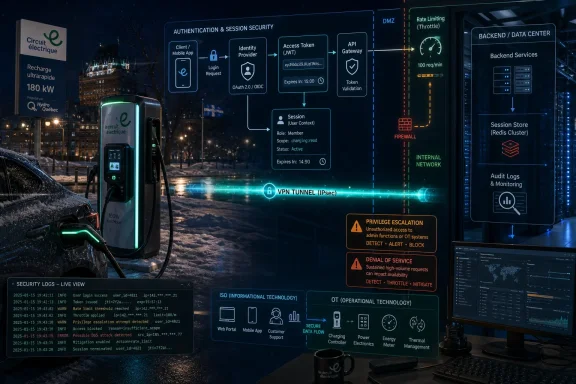 A Charging Network Becomes Critical Infrastructure the Moment Drivers Depend on It
CISA’s advisory, identified as ICSA-26-188-01 and published on July 7, places the affected Hydro-Québec Le Circuit Électrique charging-station backend in the Transportation Systems critical infrastructure sector. That classification matters. It moves the discussion away from the familiar consumer-tech language of “app bugs” and toward the harsher vocabulary of operational resilience.Le Circuit Électrique is Hydro-Québec’s public EV charging network, a system that has grown from a regional electrification initiative into a practical dependency for drivers across Québec and parts of eastern Canada. Hydro-Québec’s own public materials describe the network as a major public charging effort, with websites and mobile apps used to locate stations, initiate sessions, and track availability as new chargers are commissioned. Third-party charging directories such as ChargeHub describe it as one of the largest EV charging networks in Québec and eastern Ontario.
That scale changes the risk model. A single charger going offline is an inconvenience. A backend failure that affects authentication, session handling, or station availability can become a regional operations problem, especially when drivers are already relying on apps, roaming agreements, mobile support, and station-status data to make travel decisions.
CISA says successful exploitation could lead to privilege escalation or denial of service. The agency also says it has no known reports of public exploitation specifically targeting these vulnerabilities at the time of publication. That combination is important: the advisory is not evidence of a live attack campaign, but it is a warning that the defensive window is open now.
The Vulnerabilities Are Boring in the Way Dangerous Bugs Often Are
The listed weaknesses are not exotic. CISA names improper access control, improper restriction of excessive authentication attempts, and insufficient session expiration. In plain English, that means the backend may not be strict enough about who gets access, how many times an actor can try to authenticate, and when a session should be considered dead.Those are basic web-security categories, but “basic” does not mean “minor.” Access-control mistakes are how users become administrators, tenants see other tenants’ data, and limited service accounts gain operational power they were never meant to have. Weak throttling around authentication attempts is how attackers turn login systems into guessing machines. Poor session expiration is how yesterday’s trust becomes today’s foothold.
The CVSS v3 score listed in the CISA material is 9.8, which puts the issue in the critical range. CVSS scores are imperfect instruments; they compress a lot of assumptions into one number and can exaggerate or understate real-world urgency depending on exposure. But a 9.8 attached to a transportation-sector backend is not the kind of number a serious operator can shrug off.
The vendor equipment named in the advisory is the Hydro-Québec Le Circuit Électrique charging-station backend. CISA’s summary does not provide a patch version, compensating-control matrix, or detailed exploit chain in the supplied text. That absence should not be read as comfort. In ICS advisories, sparse public detail is often intentional because defenders need enough information to act without handing attackers a cookbook.
EV Charging Is Where IT, OT, and Payments Collide
EV charging networks sit at an awkward intersection. They look like consumer services because drivers interact with phone apps, RFID cards, receipts, maps, and account balances. They look like enterprise platforms because operators need portals, reporting, partner access, telemetry, billing, and identity systems. They look like operational technology because physical devices in public places dispense power, report status, and receive remote commands.That hybrid nature makes backend vulnerabilities especially uncomfortable. A conventional web app can fail in ways that expose data or interrupt service. A charging backend can fail in ways that strand drivers, corrupt operational status, disrupt billing, or interfere with station control. Even if a flaw never touches the electrical grid itself, it can still damage trust in the public charging layer that EV adoption depends on.
CISA’s recommended practices read like classic industrial-control advice: minimize network exposure, avoid direct internet accessibility for control systems, place control-system networks and remote devices behind firewalls, isolate them from business networks, and use secure remote access such as updated VPNs when remote connectivity is required. Those recommendations are old because they remain correct.
The hard part is applying them to modern charging infrastructure. Public charging systems often need cloud connectivity, mobile-app integration, roaming relationships, remote diagnostics, and near-real-time availability updates. “Do not expose it to the internet” is easy advice for a plant-floor PLC. It is harder for a distributed charging network whose business model depends on networked convenience.
The Backend Is the New Roadside Cabinet
A driver sees a pedestal, a connector, a payment flow, and a charging curve. An attacker sees identifiers, APIs, sessions, user roles, remote commands, and backend assumptions. The roadside cabinet is visible, but the backend is where scale lives.That is why session expiration and authentication controls matter so much. A charging station backend must know which station is speaking, which user is authorized, which session is active, which command is legitimate, and which stale credential should no longer work. If those boundaries blur, the system’s state becomes negotiable.
The most obvious fear is denial of service: chargers unavailable, sessions unable to start, or backend resources exhausted by repeated attempts. That is bad enough in ordinary conditions. It becomes worse during holiday travel, cold weather, emergency response, or power-outage scenarios where charging availability is already a planning constraint.
Privilege escalation is more subtle but potentially more serious. Depending on the architecture and authorization model, elevated access could affect administrative functions, station management, account operations, session control, or data integrity. CISA’s public summary does not say which privileges are reachable, so responsible analysis has to stop short of imagining a Hollywood grid attack. But in transportation infrastructure, unauthorized control-plane access is already a high-severity outcome.
Canada’s EV Charging Buildout Now Has a Security Bill Attached
Hydro-Québec’s charging network is part of a larger public-policy push. The Electric Circuit has been promoted for years as an enabler of EV adoption, with Hydro-Québec materials describing partnerships with municipalities, businesses, institutions, and suppliers. Public announcements over the years have named suppliers such as AddEnergie and ABB for fast-charge deployments, while Hydro-Québec materials have described mobile apps, websites, locator services, support lines, and roaming arrangements.That ecosystem is exactly what makes charging networks useful. It is also what makes them complicated to secure. Every partner portal, roaming integration, station identifier, support workflow, and backend service becomes a possible seam.
Municipal programs add another layer. Hydro-Québec’s grant materials for charging stations describe requirements for connected stations and integration into the Electric Circuit network. Connectivity is not an optional feature; it is part of how the network becomes visible, manageable, billable, and useful.
The security bill arrives after the convenience has already been promised. That is not unique to EV charging. Cloud computing, remote work, smart buildings, and industrial IoT all followed a similar path: connect first, govern later. The CISA advisory is a reminder that transportation electrification cannot afford to repeat that pattern indefinitely.
CISA’s Advice Is Conservative Because the Architecture Is Unforgiving
CISA’s mitigation language is deliberately conservative. The agency recommends minimizing network exposure, keeping control systems off the internet, isolating control-system networks behind firewalls, separating them from business networks, and using secure remote access such as VPNs when needed. It also reminds organizations that VPNs are only as secure as the devices connected through them.That last caveat is doing a lot of work. VPNs are not magic tunnels; they are authentication and routing systems that can themselves become attack paths if credentials, endpoints, or appliances are compromised. For charging operators, “use a VPN” cannot mean “put everything behind one shared remote-access appliance and call it done.” It has to mean strong identity, patching, device posture, logging, and least privilege.
CISA also tells organizations to perform impact analysis and risk assessment before deploying defensive measures. That sentence often reads like boilerplate, but it is critical in operational environments. A firewall rule that protects one service can accidentally break station telemetry. A forced password reset can lock out a field team. An aggressive rate limit can interrupt legitimate chargers reconnecting after a cellular outage.
The operational lesson is that mitigation has to be engineered, not improvised. Charging networks need incident playbooks that assume both cyber and physical effects: unavailable stations, confused users, inaccurate maps, support-call spikes, partner notifications, and field dispatch.
The WindowsForum Angle Is Not Windows, It Is Identity
This is not a Windows vulnerability, and there is no indication in the advisory that Microsoft software is implicated. But WindowsForum’s sysadmin audience should still recognize the pattern immediately. The failure modes CISA lists are the same ones enterprise IT has been cleaning up for decades: broken access control, weak authentication defense, and stale sessions.The difference is the operating context. In a corporate environment, an access-control bug may expose documents or internal tools. In a charging network, access-control failures may affect infrastructure that nontechnical users treat as part of the transportation landscape. The public does not distinguish between “the app is down,” “the charger is down,” and “the backend rejected the station’s session.” They experience all of it as broken infrastructure.
That is why identity deserves center stage. Charging systems need identity for users, stations, maintainers, partners, APIs, and administrative staff. Each identity type has different privileges, lifetimes, and risk. A driver account should not behave like a station credential. A station credential should not behave like an administrator. A support workflow should not become an undocumented privilege-escalation channel.
The enterprise world has learned this through painful repetition. Multifactor authentication, rate limiting, session rotation, token revocation, conditional access, privileged-access management, and centralized logging are not luxuries. They are the boring scaffolding that prevents ordinary bugs from becoming systemic incidents.
Public Chargers Make Availability a Security Property
Security teams tend to think first about confidentiality and integrity. EV charging forces availability to the front. If a charger cannot authenticate to its backend, if a driver cannot start a session, or if a management platform can be knocked over by repeated authentication attempts, the result is not merely an error log. It is a queue of cars and people making alternate plans.That is why denial of service matters in this advisory. A DoS condition against a charging backend does not have to be permanent to be damaging. Short outages at the wrong time can create cascading inconvenience, particularly along corridors where charger density is limited or where fast chargers are clustered in a few key sites.
The public also tends to judge charging networks against gasoline infrastructure, even though the operating models are completely different. A gas pump can have payment-network problems, but fuel logistics and dispensing are mature, visible, and redundant in ways public fast charging often is not. EV charging depends much more heavily on software-mediated station discovery, session initiation, account authentication, and remote monitoring.
That dependency does not make EV charging fragile by definition. It does mean that software availability is part of transportation reliability. CISA’s advisory makes that point without saying it outright.
The Absence of Known Exploitation Is Not a Reason to Wait
CISA states that no known public exploitation specifically targeting these vulnerabilities had been reported to the agency at the time of the advisory. That is good news, but it is not the end of the story. Many industrial and infrastructure advisories land before exploitation is observed publicly because the goal is to close exposure before attackers operationalize it.The disclosure path also matters. CISA credits an anonymous researcher with reporting the vulnerabilities. That suggests at least one outside party had enough visibility into the backend’s behavior to identify and report the flaws. Responsible disclosure is the best-case version of that story. It is also proof that the attack surface is discoverable.
Organizations connected to Le Circuit Électrique should not wait for exploit code, social-media chatter, or a public incident before acting. The advisory gives enough to begin triage: identify affected assets, review exposure, verify mitigations from Hydro-Québec or service partners, examine authentication and session logs, and confirm remote-access controls.
For municipalities and site hosts, the practical work may be less technical but still important. They should know who operates the chargers, who receives vendor security notices, who can take a station offline, who communicates with drivers, and what happens if the backend is degraded. The worst incident-response plan is the one that starts by figuring out who owns the problem.
Hydro-Québec’s Strength Is Also Its Risk
Hydro-Québec has spent years making Le Circuit Électrique feel like public infrastructure rather than a novelty. That is the achievement. It is also why vulnerabilities in the backend deserve attention beyond the security press.The network’s credibility rests on reliability. Drivers trust that the app’s map is meaningful, that a listed charger will respond, that a session will start, that billing will be accurate, and that support can intervene when something goes wrong. Backend security is invisible until it fails, and then it becomes the whole product.
Hydro-Québec’s public charging role is unusual compared with many private charging networks. As a government-owned utility with a high-profile electrification mission, it is not merely selling convenience. It is helping normalize EV travel and shaping expectations for public charging in Québec. That raises the standard for transparency and operational discipline.
The advisory does not say whether Hydro-Québec has already deployed fixes, what versions are remediated, or whether customers must take specific action beyond defensive practices. That lack of detail leaves operators and observers dependent on direct vendor communication. For infrastructure this visible, the follow-through matters almost as much as the vulnerability notice itself.
The Industry Keeps Rediscovering Backend Trust
EV charging security discussions often gravitate toward the charger hardware: tamper resistance, cable damage, card readers, displays, and local firmware. Those concerns are real, but the more scalable failures often live in the backend. The backend decides what the station is, what it may do, and who is allowed to ask.Open Charge Point Protocol deployments and WebSocket-based station communications have drawn increasing scrutiny because they encode trust relationships between physical chargers and central systems. The exact implementation details vary by vendor and network, and the CISA advisory does not provide enough detail to map Hydro-Québec’s flaw to any specific protocol behavior. Still, the broader lesson is familiar: distributed devices are only as trustworthy as the backend identity model that binds them.
Charging networks also sit in a competitive and interoperable market. Roaming agreements let drivers use one account across multiple networks, and public directories aggregate station data. That interoperability is good for users, but every integration needs clear boundaries around authentication, authorization, and data sharing.
The industry’s challenge is to make roaming and convenience compatible with zero-trust assumptions. A station should not be trusted merely because it knows a name. A session should not live forever because disconnection is inconvenient. A partner integration should not inherit more access than it needs because engineering deadlines were tight.
Site Hosts Need Better Security Language From Operators
Many charging stations are hosted by municipalities, retailers, workplaces, universities, and public agencies that do not operate the backend themselves. These organizations may own the parking lot, the electrical work, or the customer relationship, but they often depend on a charging-network operator for software, billing, support, and remote management.That split can obscure accountability. If a vulnerability affects the backend, the site host may not know whether it needs to act. If a charger goes offline, the driver may blame the host. If a mitigation breaks availability, the operator may need physical access or local coordination. The clean lines in contracts are rarely clean during incidents.
Site hosts should ask operators for concrete security assurances, not marketing generalities. They need to know whether chargers are reachable from the public internet, how station identities are protected, whether administrative access uses MFA, how logs are retained, how vulnerabilities are communicated, and what service-level expectations apply during cyber incidents.
This is not about turning every municipality into a security operations center. It is about making sure public charging contracts include the questions that public infrastructure now requires. A charging station is no longer just an electrical installation with a network connection attached. It is a managed endpoint in a transportation service.
Rate Limits and Session Expiry Are Small Controls With Big Consequences
The vulnerability categories named by CISA sound like checklist items, but they are foundational. Rate limits change the economics of attack. Session expiry limits the lifespan of stolen or misused trust. Access control defines the blast radius when something goes wrong.In a charging backend, these controls have to be tuned carefully. Too little rate limiting invites brute-force attempts or resource exhaustion. Too much can punish legitimate reconnect storms after cellular disruptions. Sessions that never expire create persistent risk. Sessions that expire too aggressively can interrupt operations or create support burdens.
That is why secure design in infrastructure systems is a balancing act, not a compliance exercise. The right answer is not simply “short sessions” or “maximum lockouts.” It is context-aware authentication, device-specific identity, secure token rotation, replay protection, anomaly detection, and operational fallback.
Modern infrastructure security succeeds when these controls are boring and automatic. Nobody should need to think about whether a stale session can still act like a charger. Nobody should need to hope that repeated authentication failures are noticed. Nobody should need to discover during an incident that administrative roles were broader than expected.
The CISA Playbook Still Applies, But It Needs EV-Specific Muscle
CISA’s recommended practices are rooted in industrial control-system security: defense in depth, segmentation, firewalls, secure remote access, risk assessment, and incident reporting. For EV charging, those practices need translation into the language of cloud-connected field infrastructure.Segmentation should cover not only traditional control networks but also cloud services, partner APIs, support portals, and administrative consoles. Remote access should include vendor technicians, municipal staff, third-party support, and managed service providers. Monitoring should understand station behavior, not just server logs.
A useful detection strategy would look for anomalies that are specific to charging operations: repeated failed authentication for station identities, simultaneous or unusual session patterns, unexpected administrative changes, abnormal reconnect rates, station-command failures, and discrepancies between physical status and backend status. Generic SIEM rules are not enough if they cannot distinguish a normal fleet reconnect from a suspicious event.
Incident response also needs a public-facing plan. If stations are unavailable, drivers need accurate information. If the map is stale, support teams need a script. If a region is affected, partners need notification. Cybersecurity, in this context, includes the communications discipline required to prevent confusion from becoming a second outage.
The Charger Map Is Becoming Part of the Attack Surface
Charging apps and station maps are not just user conveniences. They reveal where infrastructure exists, whether it is online, how busy it is, and sometimes what type of hardware is deployed. That information is valuable for drivers, but it can also help attackers understand the topology of a network.This does not mean public maps should disappear. A hidden charging network would be useless. It means operators need to assume that public-facing data can be harvested, correlated, and used to guide attacks or nuisance campaigns.
The same is true of station identifiers, support workflows, QR codes, and roaming metadata. Anything printed on a charger, exposed through an app, or returned by an API should be treated as public. Security should not depend on an attacker failing to learn the name or identifier of a station.
That principle is well understood in mature IT environments but still unevenly applied in operational systems. Public infrastructure must be designed as if observation is inevitable. The secret should not be the station’s existence; the secret should be the credential, and the credential should be revocable, scoped, monitored, and short-lived.
Windows Admins Have Seen This Movie Before
For sysadmins, the advisory’s most useful message is that infrastructure keeps inheriting enterprise IT’s oldest sins. Broken authorization, weak authentication defenses, and bad session management remain stubborn because they are architectural habits, not one-off mistakes.The fix is not a single patch. It is a program. Asset inventory, identity governance, least privilege, MFA, logging, patch cadence, vulnerability disclosure, incident drills, and vendor accountability are all part of the answer. That may sound dull, but dull is what keeps public systems working.
The Windows ecosystem learned this through worms, ransomware, exposed RDP, weak VPNs, misconfigured Active Directory, and cloud identity sprawl. Each generation of infrastructure insists it is different until the same control failures reappear in a new costume. EV charging is now old enough, connected enough, and important enough to stop pretending it is exempt.
The practical question for IT pros is where their own organization touches this ecosystem. Corporate fleets, municipal parking, workplace chargers, retail sites, campus deployments, and public-private partnerships all create dependencies. Even if Hydro-Québec’s advisory is geographically specific, the risk pattern is not.
The July 7 Advisory Leaves a Short List of Real Work
CISA’s Hydro-Québec advisory is brief, but it gives defenders a clear direction of travel. The uncertainty is not whether authentication and session controls matter; the uncertainty is how quickly every affected operator can verify its own exposure and apply vendor guidance.- Organizations that operate or host Le Circuit Électrique charging stations should confirm directly with Hydro-Québec or their service channel whether their backend exposure is affected and what remediation is available.
- Network defenders should review whether charging infrastructure, support portals, and remote-management paths are segmented from business networks and shielded from unnecessary internet exposure.
- Security teams should examine authentication logs, station reconnect patterns, administrative activity, and session anomalies for signs of probing or misuse around the advisory date of July 7, 2026.
- Municipalities and site hosts should identify who owns incident communication, station shutdown decisions, field dispatch, and driver-facing notices if backend availability is degraded.
- Operators should treat rate limiting, access control, and session expiration as resilience controls, not merely application-security hygiene.
- The lack of known public exploitation reported by CISA should be treated as time to act, not evidence that the risk is theoretical.
References
- Primary source: CISA
Published: 2026-07-07T12:00:00+00:00
Loading…
www.cisa.gov - Related coverage: lecircuitelectrique.com
Loading…
www.lecircuitelectrique.com - Related coverage: chargehub.com
Loading…
chargehub.com - Related coverage: nouvelles.hydroquebec.com
Loading…
nouvelles.hydroquebec.com - Related coverage: news.hydroquebec.com
Loading…
news.hydroquebec.com - Related coverage: hydroquebec.com
Loading…
www.hydroquebec.com