

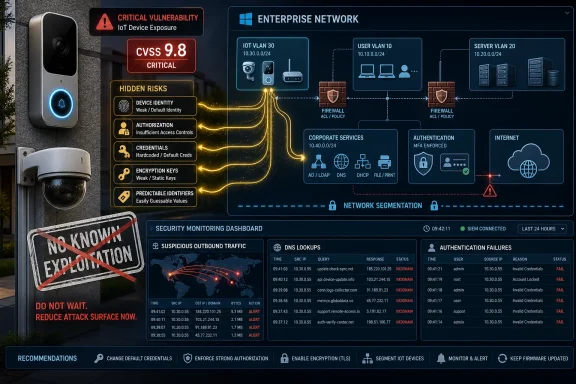
CISA on June 11, 2026, published an industrial control systems advisory for Naxclow IoT Platform products used worldwide, warning that Smart Doorbell X3, X Smart Home, V720, and ix cam versions are affected by critical vulnerabilities rated CVSS 9.8. The headline is not merely that another low-cost connected camera stack has weak security. It is that the weaknesses sit exactly where consumer IoT keeps pretending trust can be outsourced: device identity, authorization, credentials, cryptographic keys, and predictable identifiers. For WindowsForum readers, the lesson is bigger than one vendor’s advisory: unmanaged “smart” devices are now part of the enterprise attack surface whether IT bought them or not.
The Naxclow advisory lands in an awkward category: formally, it is an industrial control systems notice affecting the commercial facilities sector; practically, it describes the kind of internet-connected camera and doorbell ecosystem that shows up in offices, warehouses, shops, apartment buildings, managed properties, and home networks alike. That ambiguity matters. The device may look like consumer electronics, but the deployment pattern often resembles infrastructure.
CISA says successful exploitation could let attackers impersonate devices, intercept or manipulate communications, harvest sensitive credentials at scale, or gain unauthorized access. That is a broad impact statement, but it is not vague. It points to a trust model in which the thing on the wall, the mobile app in a user’s hand, and the cloud service in the middle may all be leaning on assumptions that an attacker can spoof or break.
The affected names are familiar to anyone who has administered a network where procurement did not always ask IT first. Smart Doorbell X3, X Smart Home, V720, and ix cam are not the sort of assets that usually receive the same scrutiny as a firewall, domain controller, or VPN concentrator. That is precisely why advisories like this deserve more attention than their product names may suggest.
The most important phrase in the advisory is not “critical.” It is “all versions.” When an advisory covers every listed version of multiple products, defenders should treat the problem less like a patch Tuesday nuisance and more like a design-level exposure. A firmware update may arrive, a vendor statement may clarify scope, or mitigations may reduce risk, but the burden shifts immediately to inventory and isolation.
Authorization bypass through a user-controlled key is especially corrosive because it undermines the basic premise that the service, not the client, decides who can do what. If the user or device can influence the key material used to prove identity, attackers may be able to turn the platform’s own logic against it. That is the difference between guessing a password and convincing the system that the password ceremony was unnecessary.
Missing authorization is the simpler failure, and often the more damaging one. It means an endpoint, action, or resource may be reachable without a proper permission check. In IoT systems, where APIs often bridge mobile apps, cloud services, and embedded devices, one missing check can become a remote control path.
Hard-coded cryptographic keys are another sign of a platform struggling with scale. A shared secret embedded across products is not a secret in the meaningful sense; it is a recall waiting to happen. Once extracted from one app, firmware image, or device, it can become a skeleton key for a fleet.
Predictable identifiers complete the pattern. If device IDs, tokens, file names, session values, or pairing artifacts can be guessed, attackers do not need cinematic hacking skills. They need automation, patience, and a target space large enough to reward enumeration.
A compromised IoT camera can offer an attacker persistence, visibility, and a foothold inside a segmented-but-not-really-segmented environment. It may sit on the same Wi-Fi as point-of-sale systems, badge readers, printers, thermostats, or staff laptops. It may communicate freely with cloud services while administrators assume outbound traffic is harmless.
The better adversaries understand this. Edge and IoT devices are attractive because they are numerous, inconsistently patched, rarely monitored, and often administered outside central IT. They also tend to be physically distributed. A retail chain may know exactly how many Windows endpoints it manages while having only a rough idea of how many smart cameras, doorbells, and mobile-app-managed devices are plugged into remote sites.
For Windows administrators, this is where the story becomes familiar. The endpoint stack can be hardened, EDR can be deployed, privileged access can be tightened, and identity logs can be watched. None of that prevents a cheap camera on a guest network from becoming a staging point if the network design treats “not Windows” as “not my problem.”
Attackers do not need a named campaign to make use of weak authorization or exposed credentials. Botnet operators, credential harvesters, access brokers, and low-skill scanners all thrive on repeatable mistakes across large populations of devices. A vulnerability class that enables device impersonation or credential harvesting at scale naturally invites automation.
The phrase “specifically targeting” also does a lot of work. It means CISA has not reported exploitation tied to these exact vulnerabilities. It does not mean exposed devices are invisible, that related platforms are safe, or that attackers have not been probing similar services. In practice, defenders should read “no known exploitation” as a timestamp, not a guarantee.
This is one reason the CVSS 9.8 rating is meaningful. A score that high usually reflects a path that is remotely exploitable, low complexity, and capable of severe confidentiality, integrity, and availability impact. CVSS is not a business-risk oracle, but it is useful shorthand here: if the affected device is reachable by an attacker, assume the risk is urgent.
That supply-chain mess is why asset identification becomes so difficult. An administrator may search for “Naxclow” and miss a device enrolled through V720. A facilities manager may know the doorbell model but not the platform behind it. A managed service provider may inherit sites where cameras were installed years earlier by a contractor who left no usable inventory.
The affected list includes product and app-style names, which should push defenders to look beyond vendor branding. The practical search should include device names, mobile apps, cloud domains, DHCP hostnames, MAC address vendors, open ports, and procurement records. If users installed the app on personal phones to manage a lobby camera, that is part of the exposure story too.
This is also where privacy and security overlap. A platform that can leak sensitive information through externally accessible files may expose credentials, configuration data, identifiers, or logs that help an attacker pivot. The attacker does not need to “hack the camera” in the cinematic sense if the platform has placed secrets where the internet can read them.
A vulnerable camera does not need to run Windows to threaten Windows assets. It needs network reach, stolen credentials, shared Wi-Fi, weak segmentation, or an admin who logs into a management interface from a domain-joined laptop. From there, the old playbook applies: observe, harvest, pivot, persist.
The credential angle is particularly ugly. CISA’s warning about harvesting sensitive credentials at scale suggests defenders should think about more than one device compromise. If the same credentials, keys, or identifiers work across multiple deployments, attackers can turn a local weakness into a platform-level campaign. That is how a doorbell issue becomes a fleet issue.
The Windows-specific response is not to install another agent on a device that cannot run one. It is to make sure the surrounding environment assumes the device can be hostile. That means VLANs that actually restrict east-west traffic, firewall rules that limit outbound destinations, DNS monitoring, DHCP inventory, and alerting on unusual connections from camera networks.
The first move should be exposure reduction. If any affected device or management service is directly reachable from the internet, that is the emergency. Pull it back behind a firewall, restrict access, or disconnect it until the vendor provides credible remediation. Remote convenience is not a compensating control.
The second move is segmentation. Cameras and doorbells should not be able to reach domain controllers, file servers, admin workstations, point-of-sale systems, or building-management systems by default. If video needs to flow to a recorder or cloud service, allow that path explicitly and deny the rest.
The third move is credential hygiene. Shared passwords, reused installer accounts, default credentials, app-level secrets, and contractor-managed accounts should be reviewed. If a platform weakness may expose secrets, assume anything used to manage the affected environment is already suspect and rotate accordingly.
The fourth move is monitoring. Many organizations cannot patch IoT devices quickly, and some may never receive a satisfactory fix. That makes detection essential: unexpected outbound traffic, DNS lookups to unfamiliar infrastructure, connections between camera VLANs and corporate networks, and repeated authentication failures all become useful signals.
Facilities teams often buy cameras for physical security. Small offices buy doorbells for convenience. Property managers buy app-connected systems because they are cheap and fast to deploy. MSPs inherit them. Security teams are asked to bless them after the fact. None of those decisions are malicious, but together they create a blind spot.
For organizations with mature asset management, this advisory is a chance to test the completeness of IoT inventory. Search DHCP leases, wireless controllers, switch MAC tables, procurement systems, expense reports, mobile-device app inventories, and firewall logs. The point is not merely to find “Naxclow” by name; it is to find the ecosystem around the affected products.
For smaller businesses and home labs, the answer is more direct. If you use one of the named apps or devices, assume exposure until proven otherwise. Remove internet exposure, check for firmware or app updates, change associated account passwords, and consider replacing the device if the vendor cannot provide a clear fix.
This creates a cultural problem for IT. Users and facilities teams do not think of a doorbell as an endpoint. They think of it as a thing that rings, records, and opens in an app. The security model is hidden inside QR-code pairing, cloud relay services, and mobile notifications.
The industry has encouraged that mindset. Consumer IoT products often sell frictionless setup as the product’s defining feature. Scan a code, connect Wi-Fi, share access, watch video. The security work that should sit behind that simplicity is difficult, expensive, and invisible until an advisory reveals what was missing.
The result is a market where buyers cannot easily distinguish a well-designed device from a fragile one. Certifications help at the margins, but they do not solve lifecycle management, vendor transparency, or cloud dependency. Until buyers demand longer support windows and clearer security commitments, low-cost IoT will keep externalizing risk onto networks that did not choose it.
This matters because attackers have spent years proving that the perimeter is full of neglected machines. Firewalls, VPN appliances, routers, cameras, and other edge devices make attractive targets because they sit near trust boundaries and often escape normal endpoint controls. The same logic applies to smart doorbells and camera platforms once they are installed in business environments.
A strict reading of “critical infrastructure” may make a doorbell sound trivial. A practical reading says commercial facilities depend on physical access, surveillance, tenant safety, staff workflows, and network availability. If a camera platform can be abused to impersonate devices, manipulate communications, or harvest credentials, then the risk is not confined to video.
This is the uncomfortable truth of connected infrastructure: the cheapest devices can carry the least visible risk. A compromised camera may not stop production or encrypt a file server by itself. But it can become the foothold that lets someone else do it.
Hard-coded cryptographic keys are especially difficult to remediate cleanly. If the same key is embedded across many devices or apps, replacing it may require coordinated firmware, app, and server-side changes. If old devices remain active with old keys, attackers may still have a path. If compatibility is preserved too generously, the vulnerability may survive the “fix.”
The same is true for predictable identifiers. A vendor can change generation logic for new devices, but existing identifiers may remain guessable unless migrated or wrapped in stronger authorization. Fixing the symptom without changing the trust boundary merely moves the weakness.
Customers should look for vendor communication that distinguishes between mitigation, patching, and full remediation. “Update the app” may be necessary but insufficient. “We have blocked unauthenticated access server-side and rotated affected keys” would be more meaningful. Silence should be treated as a risk signal.
A well-designed environment should be able to tolerate a hostile IoT device. That does not mean the device compromise is harmless; video and privacy still matter. But it should not permit easy movement into identity infrastructure, file servers, management planes, or staff endpoints.
The test is simple in concept and painful in execution. Can a camera VLAN initiate connections to corporate subnets? Can it resolve internal hostnames? Can it reach administrative interfaces? Can a compromised device talk to printers, NAS boxes, RDP endpoints, SMB shares, or hypervisors? Can it exfiltrate freely to arbitrary destinations?
If the answer is “we do not know,” that is the project. Not because Naxclow is uniquely important, but because the next advisory may name a different vendor using the same network assumptions. The brand changes; the blast radius remains.
CISA’s Naxclow warning should push IT teams to stop treating small connected devices as exceptions to security architecture. The future Windows network is not just Windows endpoints, cloud identities, and managed servers; it is also the cheap camera above the loading dock, the doorbell at the front desk, and the mobile app someone installed to make them work. The organizations that handle this advisory well will not be the ones that merely find one vulnerable product line, but the ones that use it to build networks where the next vulnerable gadget has nowhere useful to go.
 CISA’s Warning Turns a Doorbell Problem Into an Infrastructure Problem
The Naxclow advisory lands in an awkward category: formally, it is an industrial control systems notice affecting the commercial facilities sector; practically, it describes the kind of internet-connected camera and doorbell ecosystem that shows up in offices, warehouses, shops, apartment buildings, managed properties, and home networks alike. That ambiguity matters. The device may look like consumer electronics, but the deployment pattern often resembles infrastructure.CISA says successful exploitation could let attackers impersonate devices, intercept or manipulate communications, harvest sensitive credentials at scale, or gain unauthorized access. That is a broad impact statement, but it is not vague. It points to a trust model in which the thing on the wall, the mobile app in a user’s hand, and the cloud service in the middle may all be leaning on assumptions that an attacker can spoof or break.
The affected names are familiar to anyone who has administered a network where procurement did not always ask IT first. Smart Doorbell X3, X Smart Home, V720, and ix cam are not the sort of assets that usually receive the same scrutiny as a firewall, domain controller, or VPN concentrator. That is precisely why advisories like this deserve more attention than their product names may suggest.
The most important phrase in the advisory is not “critical.” It is “all versions.” When an advisory covers every listed version of multiple products, defenders should treat the problem less like a patch Tuesday nuisance and more like a design-level exposure. A firmware update may arrive, a vendor statement may clarify scope, or mitigations may reduce risk, but the burden shifts immediately to inventory and isolation.
The Vulnerabilities Read Like a Checklist of IoT’s Oldest Mistakes
The listed weakness classes are depressingly familiar: authorization bypass through a user-controlled key, missing authorization, lack of password aging, hard-coded cryptographic keys, predictable numbers or identifiers, and sensitive information exposed in externally accessible files or directories. Each one is bad. In combination, they describe a platform that may have trusted convenience mechanisms as if they were security boundaries.Authorization bypass through a user-controlled key is especially corrosive because it undermines the basic premise that the service, not the client, decides who can do what. If the user or device can influence the key material used to prove identity, attackers may be able to turn the platform’s own logic against it. That is the difference between guessing a password and convincing the system that the password ceremony was unnecessary.
Missing authorization is the simpler failure, and often the more damaging one. It means an endpoint, action, or resource may be reachable without a proper permission check. In IoT systems, where APIs often bridge mobile apps, cloud services, and embedded devices, one missing check can become a remote control path.
Hard-coded cryptographic keys are another sign of a platform struggling with scale. A shared secret embedded across products is not a secret in the meaningful sense; it is a recall waiting to happen. Once extracted from one app, firmware image, or device, it can become a skeleton key for a fleet.
Predictable identifiers complete the pattern. If device IDs, tokens, file names, session values, or pairing artifacts can be guessed, attackers do not need cinematic hacking skills. They need automation, patience, and a target space large enough to reward enumeration.
The Camera Is Often the Beachhead, Not the Prize
It is tempting to frame this as a privacy story: doorbells and cameras can expose video, audio, and household routines. That is true, and it is serious. But in commercial and mixed-use environments, the camera itself may be less valuable than the network position it occupies.A compromised IoT camera can offer an attacker persistence, visibility, and a foothold inside a segmented-but-not-really-segmented environment. It may sit on the same Wi-Fi as point-of-sale systems, badge readers, printers, thermostats, or staff laptops. It may communicate freely with cloud services while administrators assume outbound traffic is harmless.
The better adversaries understand this. Edge and IoT devices are attractive because they are numerous, inconsistently patched, rarely monitored, and often administered outside central IT. They also tend to be physically distributed. A retail chain may know exactly how many Windows endpoints it manages while having only a rough idea of how many smart cameras, doorbells, and mobile-app-managed devices are plugged into remote sites.
For Windows administrators, this is where the story becomes familiar. The endpoint stack can be hardened, EDR can be deployed, privileged access can be tightened, and identity logs can be watched. None of that prevents a cheap camera on a guest network from becoming a staging point if the network design treats “not Windows” as “not my problem.”
“No Known Exploitation” Is Reassuring Only Until the First Scan Hits
CISA says it has not received reports of known public exploitation specifically targeting these vulnerabilities. That is good news, but it should not be misread as a reason to wait. In the IoT world, the distance between advisory publication and opportunistic scanning can be very short.Attackers do not need a named campaign to make use of weak authorization or exposed credentials. Botnet operators, credential harvesters, access brokers, and low-skill scanners all thrive on repeatable mistakes across large populations of devices. A vulnerability class that enables device impersonation or credential harvesting at scale naturally invites automation.
The phrase “specifically targeting” also does a lot of work. It means CISA has not reported exploitation tied to these exact vulnerabilities. It does not mean exposed devices are invisible, that related platforms are safe, or that attackers have not been probing similar services. In practice, defenders should read “no known exploitation” as a timestamp, not a guarantee.
This is one reason the CVSS 9.8 rating is meaningful. A score that high usually reflects a path that is remotely exploitable, low complexity, and capable of severe confidentiality, integrity, and availability impact. CVSS is not a business-risk oracle, but it is useful shorthand here: if the affected device is reachable by an attacker, assume the risk is urgent.
The Vendor Boundary Is Too Neat for the Real Supply Chain
Naxclow is listed as the vendor, with company headquarters in China and worldwide deployment. But modern IoT products often travel through a maze of white-label hardware, mobile apps, cloud backends, firmware branches, OEM relationships, and reseller branding. The name on the box is not always the name in the app, and the app is not always the entity controlling the cloud service.That supply-chain mess is why asset identification becomes so difficult. An administrator may search for “Naxclow” and miss a device enrolled through V720. A facilities manager may know the doorbell model but not the platform behind it. A managed service provider may inherit sites where cameras were installed years earlier by a contractor who left no usable inventory.
The affected list includes product and app-style names, which should push defenders to look beyond vendor branding. The practical search should include device names, mobile apps, cloud domains, DHCP hostnames, MAC address vendors, open ports, and procurement records. If users installed the app on personal phones to manage a lobby camera, that is part of the exposure story too.
This is also where privacy and security overlap. A platform that can leak sensitive information through externally accessible files may expose credentials, configuration data, identifiers, or logs that help an attacker pivot. The attacker does not need to “hack the camera” in the cinematic sense if the platform has placed secrets where the internet can read them.
The Windows Network Still Owns the Blast Radius
Many WindowsForum readers will look at an IoT advisory and mentally file it under “facilities” or “consumer gadgets.” That instinct is understandable and dangerous. Windows environments often absorb the consequences of non-Windows compromises because Active Directory, file shares, management consoles, and user workstations remain the economic center of the network.A vulnerable camera does not need to run Windows to threaten Windows assets. It needs network reach, stolen credentials, shared Wi-Fi, weak segmentation, or an admin who logs into a management interface from a domain-joined laptop. From there, the old playbook applies: observe, harvest, pivot, persist.
The credential angle is particularly ugly. CISA’s warning about harvesting sensitive credentials at scale suggests defenders should think about more than one device compromise. If the same credentials, keys, or identifiers work across multiple deployments, attackers can turn a local weakness into a platform-level campaign. That is how a doorbell issue becomes a fleet issue.
The Windows-specific response is not to install another agent on a device that cannot run one. It is to make sure the surrounding environment assumes the device can be hostile. That means VLANs that actually restrict east-west traffic, firewall rules that limit outbound destinations, DNS monitoring, DHCP inventory, and alerting on unusual connections from camera networks.
CISA’s Mitigations Are Boring Because the Boring Controls Still Work
CISA’s recommended practices are familiar: minimize network exposure, keep control systems and remote devices off the public internet, place them behind firewalls, isolate them from business networks, use VPNs for remote access, and update VPNs because they have vulnerabilities too. There is no magic in that advice. Its value is that it forces organizations back to architecture.The first move should be exposure reduction. If any affected device or management service is directly reachable from the internet, that is the emergency. Pull it back behind a firewall, restrict access, or disconnect it until the vendor provides credible remediation. Remote convenience is not a compensating control.
The second move is segmentation. Cameras and doorbells should not be able to reach domain controllers, file servers, admin workstations, point-of-sale systems, or building-management systems by default. If video needs to flow to a recorder or cloud service, allow that path explicitly and deny the rest.
The third move is credential hygiene. Shared passwords, reused installer accounts, default credentials, app-level secrets, and contractor-managed accounts should be reviewed. If a platform weakness may expose secrets, assume anything used to manage the affected environment is already suspect and rotate accordingly.
The fourth move is monitoring. Many organizations cannot patch IoT devices quickly, and some may never receive a satisfactory fix. That makes detection essential: unexpected outbound traffic, DNS lookups to unfamiliar infrastructure, connections between camera VLANs and corporate networks, and repeated authentication failures all become useful signals.
The Hard Part Is Knowing Whether You Own the Problem
The most difficult phase of an advisory like this is not remediation. It is discovery. A company either knows where these devices are, who manages them, what networks they touch, and how they authenticate, or it discovers during the incident that nobody owned the asset in the first place.Facilities teams often buy cameras for physical security. Small offices buy doorbells for convenience. Property managers buy app-connected systems because they are cheap and fast to deploy. MSPs inherit them. Security teams are asked to bless them after the fact. None of those decisions are malicious, but together they create a blind spot.
For organizations with mature asset management, this advisory is a chance to test the completeness of IoT inventory. Search DHCP leases, wireless controllers, switch MAC tables, procurement systems, expense reports, mobile-device app inventories, and firewall logs. The point is not merely to find “Naxclow” by name; it is to find the ecosystem around the affected products.
For smaller businesses and home labs, the answer is more direct. If you use one of the named apps or devices, assume exposure until proven otherwise. Remove internet exposure, check for firmware or app updates, change associated account passwords, and consider replacing the device if the vendor cannot provide a clear fix.
Security Cameras Have Become the New Shadow IT
Shadow IT used to mean a department signing up for a SaaS tool without approval. Now it can mean a camera, doorbell, baby monitor, badge reader, smart display, or Wi-Fi-enabled appliance quietly joining a network that also carries business data. The device may be physically obvious and logically invisible.This creates a cultural problem for IT. Users and facilities teams do not think of a doorbell as an endpoint. They think of it as a thing that rings, records, and opens in an app. The security model is hidden inside QR-code pairing, cloud relay services, and mobile notifications.
The industry has encouraged that mindset. Consumer IoT products often sell frictionless setup as the product’s defining feature. Scan a code, connect Wi-Fi, share access, watch video. The security work that should sit behind that simplicity is difficult, expensive, and invisible until an advisory reveals what was missing.
The result is a market where buyers cannot easily distinguish a well-designed device from a fragile one. Certifications help at the margins, but they do not solve lifecycle management, vendor transparency, or cloud dependency. Until buyers demand longer support windows and clearer security commitments, low-cost IoT will keep externalizing risk onto networks that did not choose it.
The Policy Signal Is Bigger Than One Advisory
CISA’s placement of this advisory in the control systems stream is itself a signal. The agency is treating connected devices in commercial facilities as part of operational risk, not just consumer inconvenience. That aligns with the broader federal emphasis on edge-device lifecycle management and reducing exposure from unsupported or poorly maintained network-connected systems.This matters because attackers have spent years proving that the perimeter is full of neglected machines. Firewalls, VPN appliances, routers, cameras, and other edge devices make attractive targets because they sit near trust boundaries and often escape normal endpoint controls. The same logic applies to smart doorbells and camera platforms once they are installed in business environments.
A strict reading of “critical infrastructure” may make a doorbell sound trivial. A practical reading says commercial facilities depend on physical access, surveillance, tenant safety, staff workflows, and network availability. If a camera platform can be abused to impersonate devices, manipulate communications, or harvest credentials, then the risk is not confined to video.
This is the uncomfortable truth of connected infrastructure: the cheapest devices can carry the least visible risk. A compromised camera may not stop production or encrypt a file server by itself. But it can become the foothold that lets someone else do it.
The Vendor’s Next Move Must Be More Than a Patch Note
For Naxclow and any associated platform operators, the minimum acceptable response is not a vague security update. The advisory points to architectural weaknesses, so customers need clarity: which services are affected, whether cloud-side fixes have been deployed, whether firmware updates are required, whether mobile apps need replacement, and whether previously exposed credentials or keys must be considered compromised.Hard-coded cryptographic keys are especially difficult to remediate cleanly. If the same key is embedded across many devices or apps, replacing it may require coordinated firmware, app, and server-side changes. If old devices remain active with old keys, attackers may still have a path. If compatibility is preserved too generously, the vulnerability may survive the “fix.”
The same is true for predictable identifiers. A vendor can change generation logic for new devices, but existing identifiers may remain guessable unless migrated or wrapped in stronger authorization. Fixing the symptom without changing the trust boundary merely moves the weakness.
Customers should look for vendor communication that distinguishes between mitigation, patching, and full remediation. “Update the app” may be necessary but insufficient. “We have blocked unauthenticated access server-side and rotated affected keys” would be more meaningful. Silence should be treated as a risk signal.
The Doorbell Advisory Becomes a Network-Design Exam
The practical lesson for administrators is blunt: if a smart camera compromise would put your Windows estate at risk, the camera was already overtrusted. This advisory is an opportunity to grade the network design before an attacker does.A well-designed environment should be able to tolerate a hostile IoT device. That does not mean the device compromise is harmless; video and privacy still matter. But it should not permit easy movement into identity infrastructure, file servers, management planes, or staff endpoints.
The test is simple in concept and painful in execution. Can a camera VLAN initiate connections to corporate subnets? Can it resolve internal hostnames? Can it reach administrative interfaces? Can a compromised device talk to printers, NAS boxes, RDP endpoints, SMB shares, or hypervisors? Can it exfiltrate freely to arbitrary destinations?
If the answer is “we do not know,” that is the project. Not because Naxclow is uniquely important, but because the next advisory may name a different vendor using the same network assumptions. The brand changes; the blast radius remains.
The Concrete Work Starts Before the Exploit Shows Up
The most useful response now is not panic, but disciplined reduction of uncertainty. Treat the advisory as a trigger for inventory, segmentation, credential review, and vendor validation. Waiting for confirmed exploitation is how organizations turn public warnings into incident reports.- Organizations should identify whether Smart Doorbell X3, X Smart Home, V720, or ix cam devices or apps are present anywhere in their environment.
- Affected devices should be removed from direct internet exposure and isolated from business networks while remediation options are assessed.
- Administrators should review firewall, DNS, DHCP, and wireless-controller logs for unexpected traffic from camera or doorbell networks.
- Passwords, installer accounts, shared app credentials, and related cloud-service accounts should be rotated if they were used with affected products.
- Buyers should press the vendor or reseller for specific remediation details, not just a generic instruction to update firmware or reinstall an app.
- If the vendor cannot provide a credible fix path, replacement may be safer than indefinite containment.
CISA’s Naxclow warning should push IT teams to stop treating small connected devices as exceptions to security architecture. The future Windows network is not just Windows endpoints, cloud identities, and managed servers; it is also the cheap camera above the loading dock, the doorbell at the front desk, and the mobile app someone installed to make them work. The organizations that handle this advisory well will not be the ones that merely find one vulnerable product line, but the ones that use it to build networks where the next vulnerable gadget has nowhere useful to go.
References
- Primary source: CISA
Published: 2026-06-11T12:00:00+00:00

Naxclow IoT Platform | CISA
www.cisa.gov
- Related coverage: thehackernews.com
CISA Orders Removal of Unsupported Edge Devices to Reduce Federal Network Risk
CISA orders federal agencies to inventory, upgrade, and remove unsupported edge devices within 12–18 months to reduce cyber-espionage risk.thehackernews.com
- Related coverage: waterisac.org
(TLP:CLEAR) CISA Releases BOD 26-02: Mitigating Risk from End-of-Support Edge Devices - WaterISAC
... Read More www.waterisac.org
- Related coverage: guidepointsecurity.com
What is CISA BOD 26-02? | GuidePoint Security
Learn what CISA BOD 26-02 requires and how it helps reduce risk by eliminating unsupported, internet-facing edge devices. www.guidepointsecurity.com
- Related coverage: labs.cloudsecurityalliance.org
CSA research note cisa institutional capacity systemic risk 20260603 csa styled
PDF documentlabs.cloudsecurityalliance.org
- Related coverage: cyber.gc.ca
[Control systems] CISA ICS security advisories (AV26–151) - Canadian Centre for Cyber Security
[Control systems] CISA ICS security advisories (AV26–151)www.cyber.gc.ca
- Related coverage: marbersecurity.com
CISA Releases Ten Industrial Control Systems Advisories - Marber Security
CISA released ten Industrial Control Systems (ICS) advisories on June 12, 2025. These advisories provide timely information about current security issues, vulnerabilities, and exploits surrounding ICS. ICSA-25-162-01 Siemens Tecnomatix Plant Simulation ICSA-25-162-02 Siemens RUGGEDCOM APE1808... marbersecurity.com
