

On July 2, 2026, CISA published an industrial control systems advisory for Gardyn IoT Hub vulnerabilities that could let unauthenticated attackers access and control Gardyn-managed devices in the United States food and agriculture sector. The advisory assigns the issue a maximum CVSS v3 severity of 10, the kind of score that turns an otherwise niche smart-garden product into a broader lesson about cloud-managed hardware. The affected components include Gardyn Home firmware, Gardyn Studio firmware, and Gardyn Cloud API versions before 2.12.2026. The story is not that a connected planter had bugs; it is that consumerized agriculture hardware is now close enough to operational technology that its security failures deserve OT-grade scrutiny.
Gardyn sits in an awkward category. To consumers, it is a sleek indoor growing appliance: cameras, lights, pumps, sensors, mobile controls, and cloud services packaged as a countertop-adjacent gardening system. To CISA, however, the IoT Hub belongs in the food and agriculture critical infrastructure sector, which immediately changes the stakes.
That classification is not bureaucratic theater. The device may not resemble a refinery controller or a municipal water PLC, but the security pattern is familiar: a local device talks to a cloud service, receives commands, manages attached hardware, and becomes trusted infrastructure once it is deployed at scale. When that control plane is vulnerable, the attacker is not merely stealing an app session; they may be reaching into the system that coordinates physical behavior.
The advisory says successful exploitation could allow unauthenticated users to access and control IoT Hub managed devices. That phrasing is deliberately dry, but the operational meaning is sharp. If a hub is the bridge between cloud logic and physical device behavior, then unauthorized access to the hub is unauthorized influence over the environment it manages.
For WindowsForum readers, the Windows angle is not that this is a Windows bug. It is that Windows administrators increasingly inherit these devices as part of the real network, whether they asked for them or not. The shadow edge is no longer just printers and conference room displays; it is appliance-class IoT with cloud APIs, embedded firmware, and enough trust to become a lateral-risk headache.
A CVSS v3 score of 10 is the loudest possible signal the scoring system can emit. It generally implies exploitation that is network-reachable, low-complexity, requires no privileges, requires no user interaction, and can produce severe confidentiality, integrity, and availability impact. In plainer language: if the vulnerable surface is reachable, the attacker may not need much else.
Hard-coded credentials are especially damning because they are not merely a mistake in validation logic. They are a design shortcut that collapses identity, deployment, and trust into a secret that is often shared too broadly and rotated too slowly. Once discovered, such credentials become less like a password and more like a skeleton key that cannot be meaningfully protected by user hygiene.
The exposure of sensitive system information to an unauthorized control sphere points to a second failure mode: the system may be leaking operational details to places or actors that should not receive them. In IoT, that can mean device identifiers, configuration data, tokens, connection metadata, or other glue that helps an attacker move from observation to control. The precise mechanics matter to exploit developers, but the administrative lesson is simpler: leaked control-plane information often becomes a map.
The HTTP header neutralization issue rounds out the picture. Header handling sounds unglamorous until it becomes a scripting or injection pathway in a web-facing service. Cloud APIs, device portals, and management dashboards all live or die by consistent input handling; when they get it wrong, the web layer can become an entry point into hardware trust.
For administrators, that makes mitigation less satisfying than it would be for conventional software. You cannot always “patch the box” in the old sense. Firmware may update automatically, cloud APIs may change without customer visibility, and mobile apps may mediate setup or management in ways that blur where the vulnerable state actually lives.
Gardyn’s version marker, Cloud API before 2.12.2026, suggests the cloud component has a fixed point after which the vendor considers the issue addressed. That is useful, but it also raises the classic cloud-IoT question: how does a customer independently verify their real exposure? In many smart-device ecosystems, customers can see an app version but not the backend API version, and they may have only limited visibility into firmware build strings.
This is where enterprise IT’s discomfort with managed IoT becomes rational rather than reactionary. Cloud-managed devices are operationally convenient because the vendor can patch centrally. They are also opaque because the customer may not control, inspect, or stage the change. The best case is fast remediation; the worst case is a hidden dependency whose risk profile changes without appearing in the normal asset inventory.
That matters because attackers do not respect marketing categories. A device sold as lifestyle hardware can still expose an API, maintain persistent cloud connectivity, and sit on the same network as laptops, NAS appliances, POS systems, or back-office Windows machines. The attacker’s question is not “is this industrial?” The attacker’s question is “does this device trust something useful?”
The Gardyn advisory is therefore less absurd than it first appears. It is an example of how the control-system mindset is being forced into domains that used to be treated as consumer electronics. The smart garden has cameras and automation; the commercial grow system has cameras and automation. The difference is often scale, support contract, and procurement channel, not fundamental architecture.
Food and agriculture also has a peculiar risk profile. Many deployments are distributed, under-resourced, and physically exposed. Farms, small producers, labs, restaurants, and educational facilities may all adopt connected growing systems without operating a formal security program. That makes default exposure and credential design more consequential, because there may be no compensating controls downstream.
The problem is that attackers benefit from the same convenience. If a credential is embedded in firmware, discoverable through an API response, or recoverable through reverse engineering, it will eventually be treated as public. IoT history is littered with products that assumed obscurity would stretch longer than it did.
Sensitive information exposure follows the same pattern. Engineering teams frequently over-share operational data because it helps debugging, telemetry, support, or device orchestration. In a closed lab, verbose responses feel harmless. On the public Internet or inside a hostile network, those same responses can become reconnaissance output.
Header sanitization flaws are the web-app cousin of this story. They often arise at the seams between convenience and trust: proxies, dashboards, API gateways, authentication flows, and device-management layers. The more the IoT product behaves like a web service, the more it inherits the web’s oldest failure modes.
The lesson is uncomfortable because none of these categories is exotic. This is not a speculative side-channel attack or a quantum-era cryptographic break. It is credential handling, information exposure, and input neutralization — the blocking and tackling of secure software engineering. A CVSS 10 advisory built on fundamentals is an indictment of process as much as implementation.
In conventional enterprise software, exploitation often leaves logs, alerts, crashed services, help-desk tickets, or EDR traces. In a smart appliance ecosystem, the evidence may be weaker. A device behaves strangely, drops offline, resets, or produces odd telemetry; the owner blames Wi-Fi, the app, or the vendor cloud. The absence of known exploitation can simply mean the absence of detection.
The CISA language also narrows the claim: no known public exploitation specifically targeting these vulnerabilities has been reported to CISA. That does not prove nobody has probed the exposed surfaces, attempted credential reuse, scraped APIs, or reverse-engineered firmware. It means CISA has no confirmed report of exploitation targeting this set.
That distinction matters for defenders deciding whether to act. A vulnerability does not need a known botnet campaign to justify containment when the severity is critical and exploitation is unauthenticated. The responsible posture is to reduce exposure first and wait for perfect evidence never.
The advice can sound generic, but generic is not the same as useless. In IoT incidents, segmentation is often the difference between a compromised appliance and a compromised environment. If the device is on the same flat network as Windows workstations, domain-joined systems, file shares, and administrative consoles, the blast radius expands dramatically.
For home users, the practical version is an isolated IoT network or guest VLAN, with local access restricted where possible. For small businesses, it is a firewall policy that treats these devices as untrusted endpoints, not as harmless appliances. For larger organizations, it is asset inventory, egress monitoring, DNS visibility, and a change-management process that includes firmware and cloud-managed device status.
The harder challenge is remote access. Vendors often design IoT products around outbound cloud connectivity precisely to avoid asking customers to open inbound ports. That is better than exposing a management interface directly, but it does not remove risk; it moves risk into the vendor cloud, device identity, and update pipeline. If the cloud API is part of the vulnerable surface, customers need vendor remediation as well as local segmentation.
In a Windows-heavy environment, the immediate concern is not that the Gardyn hub will exploit Windows directly. It is that a compromised or remotely controllable hub could become a foothold, observation point, or nuisance device inside a trusted subnet. It may see broadcast traffic, reach internal services, query DNS, communicate with cloud endpoints, or interact with management systems that were never designed with hostile IoT neighbors in mind.
Security teams should therefore inventory these devices in the same way they inventory printers, cameras, badge systems, smart TVs, and building controls. The old mental model — “if it is not a PC or server, it is facilities’ problem” — no longer works. Facilities buys the hardware, users install the app, the vendor runs the cloud, and IT inherits the network risk.
Windows Defender for Endpoint and other EDR platforms may not run on the device itself, but surrounding telemetry still matters. DNS logs, firewall events, switch port data, DHCP leases, and NAC systems can reveal what the hub talks to and whether behavior changes. The point is not to turn every Windows admin into an embedded reverse engineer; it is to stop pretending unmanaged devices are outside the security perimeter.
This is why cloud-managed hardware can be both safer and riskier than old standalone devices. A responsible vendor can patch a cloud API quickly and protect many customers without waiting for manual updates. But if the vendor cloud contains systemic weaknesses, every connected deployment can share the same failure mode.
For buyers, that should change procurement questions. It is not enough to ask whether the device has an app or whether it supports automatic updates. Organizations should ask how credentials are provisioned, whether secrets are unique per device, how firmware versions are exposed to customers, how long devices receive updates, whether security advisories are public, and how cloud API changes are communicated.
For vendors, the lesson is equally blunt. If your product controls hardware, stores secrets, and depends on cloud orchestration, you are in the security business whether or not your brand identity says so. The market may call the product smart home, agtech, wellness, or lifestyle; attackers will call it infrastructure.
CISA’s role is also important. The agency’s ICS advisories translate individual vulnerabilities into operational guidance, especially for sectors that may lack dedicated security teams. The legal notice and recommended practices are boilerplate, but the effect is not: an obscure device ecosystem is placed into a national vulnerability-management frame.
That frame can be uncomfortable for vendors. A CVSS 10 advisory is not a marketing event. It compresses technical detail, public accountability, and customer anxiety into a single page. But public vulnerability handling is now part of product maturity, especially for devices that touch physical processes.
The better vendors will learn from this pattern. They will publish clearer version status, expose update state in the customer interface, avoid shared secrets, and make security posture visible without requiring customers to scrape forums or reverse-engineer mobile apps. The worse vendors will treat advisories as reputational accidents rather than design feedback.
An indoor growing system is a good example because it involves physical automation but arrives through consumer channels. It may be used in homes, schools, offices, small food businesses, labs, or demonstration farms. It may share components, cloud patterns, and firmware assumptions with more commercial products. It may be administered by someone who has never read a CISA advisory.
The result is a governance gap. Consumer buyers expect convenience and support. Enterprise security teams expect inventories and controls. Vendors optimize for activation, subscription retention, and remote support. Nobody owns the risk cleanly until a critical advisory forces the conversation.
That gap is exactly where hard-coded credentials thrive. If a product is not treated as infrastructure, the infrastructure-grade disciplines arrive late: unique identity, secret rotation, secure boot, signed updates, customer-visible patch levels, and independent disclosure channels. The device becomes operationally important before it becomes operationally governed.
Administrators should also revisit network placement. If a Gardyn device or similar IoT hub is on a primary business LAN, now is the time to move it. If it has unrestricted outbound access, now is the time to decide what destinations are actually required. If it shares a network with Windows endpoints, now is the time to ask whether that was a conscious design or simply the default Wi-Fi password doing its usual damage.
Credential hygiene deserves attention even if the specific flaw involves vendor-managed secrets rather than user passwords. Owners should rotate account passwords, enable any available multifactor authentication, and review who has app access. If a product ecosystem allows shared household or team accounts, those accounts should be treated like any other privileged access path.
Finally, organizations should document the exception. A one-off response that lives in a Slack thread or help-desk ticket will be forgotten. A lightweight asset record — device type, owner, network segment, vendor account, update status, and retirement plan — turns this from a scare into a durable improvement.
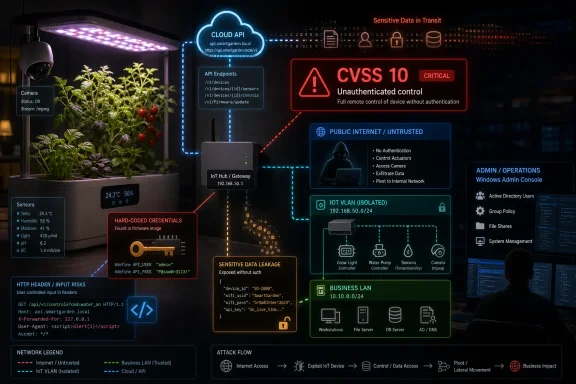 A Smart Garden Becomes an Industrial Control Problem
Gardyn sits in an awkward category. To consumers, it is a sleek indoor growing appliance: cameras, lights, pumps, sensors, mobile controls, and cloud services packaged as a countertop-adjacent gardening system. To CISA, however, the IoT Hub belongs in the food and agriculture critical infrastructure sector, which immediately changes the stakes.That classification is not bureaucratic theater. The device may not resemble a refinery controller or a municipal water PLC, but the security pattern is familiar: a local device talks to a cloud service, receives commands, manages attached hardware, and becomes trusted infrastructure once it is deployed at scale. When that control plane is vulnerable, the attacker is not merely stealing an app session; they may be reaching into the system that coordinates physical behavior.
The advisory says successful exploitation could allow unauthenticated users to access and control IoT Hub managed devices. That phrasing is deliberately dry, but the operational meaning is sharp. If a hub is the bridge between cloud logic and physical device behavior, then unauthorized access to the hub is unauthorized influence over the environment it manages.
For WindowsForum readers, the Windows angle is not that this is a Windows bug. It is that Windows administrators increasingly inherit these devices as part of the real network, whether they asked for them or not. The shadow edge is no longer just printers and conference room displays; it is appliance-class IoT with cloud APIs, embedded firmware, and enough trust to become a lateral-risk headache.
The CVSS 10 Score Is a Warning About Architecture, Not Just Code
CISA lists three vulnerability categories for this advisory: use of hard-coded credentials, exposure of sensitive system information to an unauthorized control sphere, and improper neutralization of HTTP headers for scripting syntax. The CVE identifiers named in the advisory are CVE-2026-13768, CVE-2026-55726, and CVE-2026-54477. The affected cloud API version is listed as earlier than 2.12.2026.A CVSS v3 score of 10 is the loudest possible signal the scoring system can emit. It generally implies exploitation that is network-reachable, low-complexity, requires no privileges, requires no user interaction, and can produce severe confidentiality, integrity, and availability impact. In plainer language: if the vulnerable surface is reachable, the attacker may not need much else.
Hard-coded credentials are especially damning because they are not merely a mistake in validation logic. They are a design shortcut that collapses identity, deployment, and trust into a secret that is often shared too broadly and rotated too slowly. Once discovered, such credentials become less like a password and more like a skeleton key that cannot be meaningfully protected by user hygiene.
The exposure of sensitive system information to an unauthorized control sphere points to a second failure mode: the system may be leaking operational details to places or actors that should not receive them. In IoT, that can mean device identifiers, configuration data, tokens, connection metadata, or other glue that helps an attacker move from observation to control. The precise mechanics matter to exploit developers, but the administrative lesson is simpler: leaked control-plane information often becomes a map.
The HTTP header neutralization issue rounds out the picture. Header handling sounds unglamorous until it becomes a scripting or injection pathway in a web-facing service. Cloud APIs, device portals, and management dashboards all live or die by consistent input handling; when they get it wrong, the web layer can become an entry point into hardware trust.
The Cloud API Is the Device Now
The affected product list splits the problem across Home firmware, Studio firmware, and the Gardyn Cloud API. That split is important because it reflects how modern IoT products are actually built. The device is not the plastic enclosure, the app is not the product, and the cloud is not merely a convenience. Together, they form the product’s real security boundary.For administrators, that makes mitigation less satisfying than it would be for conventional software. You cannot always “patch the box” in the old sense. Firmware may update automatically, cloud APIs may change without customer visibility, and mobile apps may mediate setup or management in ways that blur where the vulnerable state actually lives.
Gardyn’s version marker, Cloud API before 2.12.2026, suggests the cloud component has a fixed point after which the vendor considers the issue addressed. That is useful, but it also raises the classic cloud-IoT question: how does a customer independently verify their real exposure? In many smart-device ecosystems, customers can see an app version but not the backend API version, and they may have only limited visibility into firmware build strings.
This is where enterprise IT’s discomfort with managed IoT becomes rational rather than reactionary. Cloud-managed devices are operationally convenient because the vendor can patch centrally. They are also opaque because the customer may not control, inspect, or stage the change. The best case is fast remediation; the worst case is a hidden dependency whose risk profile changes without appearing in the normal asset inventory.
Food and Agriculture Is Becoming a Software Supply Chain
CISA’s food and agriculture designation may surprise anyone who thinks of Gardyn as a home-garden gadget. But the sector has been absorbing software-defined control for years: environmental systems, irrigation, cold storage, fleet telematics, livestock monitoring, greenhouse automation, and subscription-managed appliances. The boundary between commercial agriculture technology and premium consumer hardware is increasingly porous.That matters because attackers do not respect marketing categories. A device sold as lifestyle hardware can still expose an API, maintain persistent cloud connectivity, and sit on the same network as laptops, NAS appliances, POS systems, or back-office Windows machines. The attacker’s question is not “is this industrial?” The attacker’s question is “does this device trust something useful?”
The Gardyn advisory is therefore less absurd than it first appears. It is an example of how the control-system mindset is being forced into domains that used to be treated as consumer electronics. The smart garden has cameras and automation; the commercial grow system has cameras and automation. The difference is often scale, support contract, and procurement channel, not fundamental architecture.
Food and agriculture also has a peculiar risk profile. Many deployments are distributed, under-resourced, and physically exposed. Farms, small producers, labs, restaurants, and educational facilities may all adopt connected growing systems without operating a formal security program. That makes default exposure and credential design more consequential, because there may be no compensating controls downstream.
The Old IoT Sins Are Still the New IoT Sins
Hard-coded credentials should have been retired as a class of mistake years ago. They persist because they solve painful manufacturing and support problems. A vendor can onboard devices faster, recover systems more easily, and simplify field operations if there is a shared credential or embedded secret somewhere in the stack.The problem is that attackers benefit from the same convenience. If a credential is embedded in firmware, discoverable through an API response, or recoverable through reverse engineering, it will eventually be treated as public. IoT history is littered with products that assumed obscurity would stretch longer than it did.
Sensitive information exposure follows the same pattern. Engineering teams frequently over-share operational data because it helps debugging, telemetry, support, or device orchestration. In a closed lab, verbose responses feel harmless. On the public Internet or inside a hostile network, those same responses can become reconnaissance output.
Header sanitization flaws are the web-app cousin of this story. They often arise at the seams between convenience and trust: proxies, dashboards, API gateways, authentication flows, and device-management layers. The more the IoT product behaves like a web service, the more it inherits the web’s oldest failure modes.
The lesson is uncomfortable because none of these categories is exotic. This is not a speculative side-channel attack or a quantum-era cryptographic break. It is credential handling, information exposure, and input neutralization — the blocking and tackling of secure software engineering. A CVSS 10 advisory built on fundamentals is an indictment of process as much as implementation.
“No Known Exploitation” Is Not the Same as “Low Risk”
CISA says it has not received reports of public exploitation specifically targeting these vulnerabilities. That is reassuring, but it is not exculpatory. Publicly known exploitation is a lagging indicator, especially for niche IoT devices where telemetry is sparse and owners may not know what compromise looks like.In conventional enterprise software, exploitation often leaves logs, alerts, crashed services, help-desk tickets, or EDR traces. In a smart appliance ecosystem, the evidence may be weaker. A device behaves strangely, drops offline, resets, or produces odd telemetry; the owner blames Wi-Fi, the app, or the vendor cloud. The absence of known exploitation can simply mean the absence of detection.
The CISA language also narrows the claim: no known public exploitation specifically targeting these vulnerabilities has been reported to CISA. That does not prove nobody has probed the exposed surfaces, attempted credential reuse, scraped APIs, or reverse-engineered firmware. It means CISA has no confirmed report of exploitation targeting this set.
That distinction matters for defenders deciding whether to act. A vulnerability does not need a known botnet campaign to justify containment when the severity is critical and exploitation is unauthenticated. The responsible posture is to reduce exposure first and wait for perfect evidence never.
Network Exposure Remains the One Control Customers Actually Own
CISA’s recommended practices are familiar because they remain effective. Minimize network exposure. Keep control system devices off the public Internet. Place control networks and remote devices behind firewalls. Separate them from business networks. Use VPNs for remote access, while remembering that VPNs are not magic and must be maintained like any other exposed software.The advice can sound generic, but generic is not the same as useless. In IoT incidents, segmentation is often the difference between a compromised appliance and a compromised environment. If the device is on the same flat network as Windows workstations, domain-joined systems, file shares, and administrative consoles, the blast radius expands dramatically.
For home users, the practical version is an isolated IoT network or guest VLAN, with local access restricted where possible. For small businesses, it is a firewall policy that treats these devices as untrusted endpoints, not as harmless appliances. For larger organizations, it is asset inventory, egress monitoring, DNS visibility, and a change-management process that includes firmware and cloud-managed device status.
The harder challenge is remote access. Vendors often design IoT products around outbound cloud connectivity precisely to avoid asking customers to open inbound ports. That is better than exposing a management interface directly, but it does not remove risk; it moves risk into the vendor cloud, device identity, and update pipeline. If the cloud API is part of the vulnerable surface, customers need vendor remediation as well as local segmentation.
Windows Admins Should Treat the Hub Like an Untrusted Edge Device
A Gardyn IoT Hub probably will not appear in Active Directory, Intune, Configuration Manager, or the tools Windows admins use to feel in control. That invisibility is exactly why it deserves attention. The unmanaged device is often the most interesting device on the network.In a Windows-heavy environment, the immediate concern is not that the Gardyn hub will exploit Windows directly. It is that a compromised or remotely controllable hub could become a foothold, observation point, or nuisance device inside a trusted subnet. It may see broadcast traffic, reach internal services, query DNS, communicate with cloud endpoints, or interact with management systems that were never designed with hostile IoT neighbors in mind.
Security teams should therefore inventory these devices in the same way they inventory printers, cameras, badge systems, smart TVs, and building controls. The old mental model — “if it is not a PC or server, it is facilities’ problem” — no longer works. Facilities buys the hardware, users install the app, the vendor runs the cloud, and IT inherits the network risk.
Windows Defender for Endpoint and other EDR platforms may not run on the device itself, but surrounding telemetry still matters. DNS logs, firewall events, switch port data, DHCP leases, and NAC systems can reveal what the hub talks to and whether behavior changes. The point is not to turn every Windows admin into an embedded reverse engineer; it is to stop pretending unmanaged devices are outside the security perimeter.
Vendor Trust Is Now a Runtime Dependency
The Gardyn advisory also illustrates a deeper shift in product trust. Customers are not just trusting the firmware image they bought; they are trusting the vendor’s cloud operations, API design, credential management, disclosure process, and update cadence. That trust is continuous.This is why cloud-managed hardware can be both safer and riskier than old standalone devices. A responsible vendor can patch a cloud API quickly and protect many customers without waiting for manual updates. But if the vendor cloud contains systemic weaknesses, every connected deployment can share the same failure mode.
For buyers, that should change procurement questions. It is not enough to ask whether the device has an app or whether it supports automatic updates. Organizations should ask how credentials are provisioned, whether secrets are unique per device, how firmware versions are exposed to customers, how long devices receive updates, whether security advisories are public, and how cloud API changes are communicated.
For vendors, the lesson is equally blunt. If your product controls hardware, stores secrets, and depends on cloud orchestration, you are in the security business whether or not your brand identity says so. The market may call the product smart home, agtech, wellness, or lifestyle; attackers will call it infrastructure.
Disclosure Turns a Product Bug Into a Governance Test
The advisory credits Michael Groberman with reporting the vulnerabilities to CISA. That detail matters because coordinated disclosure is often the only reason these issues surface in a form customers can act on. Without a public advisory, many affected users would have no vocabulary for the risk and no reason to question whether a smart garden belonged in their threat model.CISA’s role is also important. The agency’s ICS advisories translate individual vulnerabilities into operational guidance, especially for sectors that may lack dedicated security teams. The legal notice and recommended practices are boilerplate, but the effect is not: an obscure device ecosystem is placed into a national vulnerability-management frame.
That frame can be uncomfortable for vendors. A CVSS 10 advisory is not a marketing event. It compresses technical detail, public accountability, and customer anxiety into a single page. But public vulnerability handling is now part of product maturity, especially for devices that touch physical processes.
The better vendors will learn from this pattern. They will publish clearer version status, expose update state in the customer interface, avoid shared secrets, and make security posture visible without requiring customers to scrape forums or reverse-engineer mobile apps. The worse vendors will treat advisories as reputational accidents rather than design feedback.
The Gardyn Case Shows Why “Consumer IoT” Is the Wrong Box
One reason these incidents keep surprising people is that our categories are obsolete. “Consumer IoT” suggests devices that are individually trivial and socially optional. “Industrial control system” suggests ruggedized equipment in plants, utilities, and factories. Modern connected devices increasingly sit between those poles.An indoor growing system is a good example because it involves physical automation but arrives through consumer channels. It may be used in homes, schools, offices, small food businesses, labs, or demonstration farms. It may share components, cloud patterns, and firmware assumptions with more commercial products. It may be administered by someone who has never read a CISA advisory.
The result is a governance gap. Consumer buyers expect convenience and support. Enterprise security teams expect inventories and controls. Vendors optimize for activation, subscription retention, and remote support. Nobody owns the risk cleanly until a critical advisory forces the conversation.
That gap is exactly where hard-coded credentials thrive. If a product is not treated as infrastructure, the infrastructure-grade disciplines arrive late: unique identity, secret rotation, secure boot, signed updates, customer-visible patch levels, and independent disclosure channels. The device becomes operationally important before it becomes operationally governed.
The Patch Is Only the Beginning of the Cleanup
The advisory points to affected versions and CISA’s standard mitigations, but the operational work does not end with assuming the cloud API is now fixed. Owners should verify firmware status where the product allows it, update associated mobile applications, and check whether any devices have been offline long enough to miss automatic updates. The weakest device is often the one in a closet, lab corner, or remote site that nobody remembered existed.Administrators should also revisit network placement. If a Gardyn device or similar IoT hub is on a primary business LAN, now is the time to move it. If it has unrestricted outbound access, now is the time to decide what destinations are actually required. If it shares a network with Windows endpoints, now is the time to ask whether that was a conscious design or simply the default Wi-Fi password doing its usual damage.
Credential hygiene deserves attention even if the specific flaw involves vendor-managed secrets rather than user passwords. Owners should rotate account passwords, enable any available multifactor authentication, and review who has app access. If a product ecosystem allows shared household or team accounts, those accounts should be treated like any other privileged access path.
Finally, organizations should document the exception. A one-off response that lives in a Slack thread or help-desk ticket will be forgotten. A lightweight asset record — device type, owner, network segment, vendor account, update status, and retirement plan — turns this from a scare into a durable improvement.
The Real Harvest From This Advisory Is Operational Discipline
The Gardyn advisory is narrow, but the useful response is broader. It gives Windows shops, small businesses, and security-conscious home users a concrete reason to re-evaluate the devices that sit just outside normal management. The following points are the ones that should survive after the headline fades.- Gardyn Home firmware, Gardyn Studio firmware, and Gardyn Cloud API versions before 2.12.2026 are the affected components named in CISA’s July 2, 2026 advisory.
- The advisory describes a critical unauthenticated risk that could allow access to and control of IoT Hub managed devices.
- The vulnerability classes include hard-coded credentials, sensitive information exposure, and unsafe handling of HTTP header content.
- CISA says it has not received reports of known public exploitation specifically targeting these vulnerabilities, but that should not be treated as proof of safety.
- The most practical customer controls are patch verification, IoT network isolation, restricted remote access, and better inventory of cloud-managed hardware.
- Windows administrators should treat smart appliances as untrusted edge devices when they share networks with business systems.
References
- Primary source: CISA
Published: 2026-07-02T12:00:00+00:00
Gardyn IoT Hub | CISA
www.cisa.gov
- Related coverage: cyber.gc.ca
[Control systems] CISA ICS security advisories (AV26–183) - Canadian Centre for Cyber Security
[Control systems] CISA ICS security advisories (AV26–183)www.cyber.gc.ca - Related coverage: db.gcve.eu
Vulnerability-Lookup
Vulnerability-Lookup - Fast vulnerability lookup correlation from different sources.db.gcve.eu - Related coverage: community.itbible.org
Gardyn Home Kit - Security Bulletins - I.T. Bible - Community
View CSAF Summary Successful exploitation of these vulnerabilities could allow unauthenticated users to access and control edge devices, access cloud-based devices and user information without authentication, and pivot … community.itbible.org
- Related coverage: beyondmachines.net
Critical Vulnerabilities in Gardyn Home Kit Allow Remote Device Takeover
Gardyn patched four critical vulnerabilities in its Home Kit ecosystem, including OS command injection and hard-coded credentials, which allowed unauthenticated attackers to hijack smart gardening devices and access cloud data.beyondmachines.net
