

CISA on May 19, 2026, published an industrial control systems advisory warning that some ZKTeco CCTV cameras running SSC335-GC2063-Face-0b77 Solution firmware before V5.0.1.2.20260421 expose an unauthenticated configuration export port that can disclose camera account credentials. The advisory gives the bug a CVSS 3.1 score of 9.1, which is the kind of number that should move this out of the “camera maintenance” pile and into the “credential exposure” queue. ZKTeco says patched firmware is available, but the more uncomfortable lesson is that a security camera can become an unguarded password vending machine when vendors leave alternate management paths reachable on the network. For WindowsForum readers, the story is not merely about one Chinese surveillance vendor; it is about how often physical security gear becomes invisible IT infrastructure until CISA gives it a CVE.
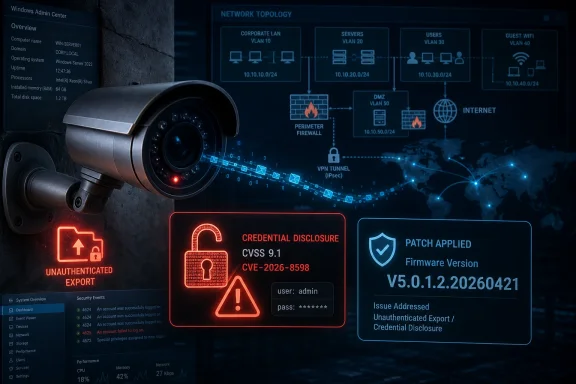
The vulnerability, tracked as CVE-2026-8598, is described as an authentication bypass using an alternate path or channel. In plainer language, the affected cameras expose an undocumented configuration export port that does not require login before handing over sensitive configuration data. That data can include open services and, more importantly, camera account credentials.
That distinction matters. Many camera vulnerabilities are framed around viewing feeds, changing settings, or knocking a device offline. This one lands closer to the credential-theft side of the house: the attacker does not need to defeat the normal web login if another service is willing to export secrets without asking who is calling.
The advisory names the affected product as ZKTeco CCTV Cameras, specifically the SSC335-GC2063-Face-0b77 Solution line before firmware version V5.0.1.2.20260421. ZKTeco has patched the issue in that version and recommends upgrading to that release or later. CISA says it has not received reports of known public exploitation specifically targeting the vulnerability at the time of publication.
That last sentence should comfort no one too much. “No known public exploitation” is not the same as “not exploitable,” and it is certainly not the same as “not already being probed.” Once an advisory identifies an unauthenticated network service that can disclose credentials, the gap between disclosure and opportunistic scanning tends to collapse quickly.
CWE-288, the weakness category attached to this advisory, is built around that exact failure mode. A product may enforce authentication in the obvious path while forgetting to enforce it through another path. The result is a security boundary that exists only when users interact with the product the way the vendor expected.
In an enterprise network, that is a dangerous assumption. Cameras are often deployed by facilities teams, integrators, or security contractors whose primary success metric is whether the lobby, loading bay, and parking lot appear on the monitor wall. The VLAN, firmware lifecycle, credential rotation policy, and exposure to adjacent corporate systems may be treated as secondary chores.
That is how a CCTV flaw becomes an IT incident. If the exported configuration contains valid camera account credentials, an attacker may gain privileged access to the device’s own management interface. If those credentials have been reused across camera fleets, NVRs, vendor portals, or adjacent systems, the blast radius expands beyond the original model number.
In practice, CCTV systems are everywhere. They sit in corporate networks, branch offices, schools, warehouses, medical-adjacent buildings, and municipal environments. Even when a camera is not itself part of an industrial control process, it can still be part of a broader operational technology estate because it is physically installed, remotely managed, and often expected to stay online for years.
The “worldwide” deployment note is also important because camera procurement is rarely uniform. Large organizations may inherit devices through acquisitions, leased offices, local integrators, and regional facilities contracts. A central IT team may have an asset inventory for laptops and servers while the camera estate lives in spreadsheets, invoices, or the memory of whoever installed it five years ago.
That inventory gap is where this advisory becomes practical. The first response is not glamorous reverse engineering. It is finding out whether the organization owns any ZKTeco SSC335-GC2063-Face-0b77 devices, whether their firmware is older than V5.0.1.2.20260421, and whether any management or export services are reachable from networks that should never see them.
Many CCTV deployments are sensitive to downtime, compatibility, and integrator support. A camera tied into access-control workflows, monitoring centers, analytics tools, or recording systems may need testing before a firmware rollout. Smaller organizations may not have a clean maintenance window or even a clear path to update every unit.
That is why CISA’s generic ICS guidance remains relevant even when a vendor patch is available. Minimize network exposure. Keep control-system and remote devices behind firewalls. Isolate them from business networks. Use VPNs for remote access, and keep those VPNs patched because they are not magic tunnels; they are software too.
The order of operations matters. Patch the affected firmware, but do not let the patch become an excuse to leave cameras reachable from the Internet or flatly routable from every employee workstation. A patched device on a segmented network is a managed risk. An unpatched camera with an unauthenticated credential export path on an exposed segment is an incident waiting for a scanner.
If the exported configuration reveals a local administrator password, the obvious risk is unauthorized access to the camera. But the more serious operational risk is credential reuse. Many camera deployments are built from templates, and many templates are built for speed rather than uniqueness. One exposed configuration file can reveal a password that works across dozens or hundreds of devices.
There is also a human factor. Facilities teams and integrators sometimes reuse passwords because camera management has historically been treated as low-risk infrastructure. That attitude made more sense when cameras were closed coaxial systems. It makes far less sense when they are IP devices with web servers, cloud connectors, analytics stacks, and network-visible management services.
For defenders, the correct response is to assume that patching closes the leak but does not erase what may already have leaked. If a vulnerable camera was reachable from untrusted networks, credentials should be rotated after the firmware upgrade. Logs should be reviewed where available, and adjacent systems should be checked for shared passwords or suspicious authentication attempts.
Unlike laptops, cameras do not sit in front of users who complain when something feels wrong. Unlike servers, they may not be managed by teams with mature vulnerability workflows. Unlike mobile devices, they often do not receive frequent, frictionless over-the-air updates. They are installed, aimed, connected, and then forgotten until the feed goes dark.
That invisibility is exactly why attackers like them. A compromised camera can offer reconnaissance, persistence, or a stepping stone into a poorly segmented network. Even when the device cannot run a full attacker toolchain, it can leak credentials, expose internal topology, or serve as a foothold for additional probing.
The ZKTeco advisory sits in that long-running pattern. It is not a flashy remote-code-execution headline, and it does not need to be. A quiet unauthenticated export interface can be enough, especially if it hands over the keys to the device and maps the services around it.
A vulnerable camera is unlikely to compromise Active Directory by itself. But it can become part of the route toward systems that matter. If camera credentials are reused for an NVR running on Windows, a vendor management workstation, or a browser-saved password profile on a facilities PC, the device bug can intersect with the Windows environment quickly.
There is also the monitoring angle. Many organizations manage cameras from Windows desktops in security offices. Those machines may run vendor tools, browser plugins, video clients, or legacy software that does not receive the same scrutiny as endpoint management agents. If the camera environment is compromised, the Windows systems used to administer it become part of the investigation.
The practical takeaway is simple: do not draw the boundary of Windows security at the Windows logo. In a real organization, Windows security includes the devices that Windows users administer, the credentials they reuse, the browser sessions they maintain, and the networks their machines can reach.
Vendors often build hidden channels for legitimate reasons. Installers need fast provisioning. Support teams need diagnostics. Manufacturing lines need test hooks. Developers need ways to export state when debugging. The problem begins when those conveniences ship into production networks and remain reachable without strong controls.
Security engineering is supposed to collapse those shortcuts before release. If a device can export configuration, the export path should be documented, authenticated, logged, and restricted. If it is meant only for factory or service use, it should not be listening on production network interfaces in customer environments.
This is where buyers should push harder. Procurement language for cameras should not stop at resolution, storage, night vision, facial recognition, or ONVIF support. It should ask how firmware is updated, how services are documented, whether hidden debug interfaces exist, how credentials are stored, and whether the vendor has a public security bulletin process with timely patches.
The key word is exposure. An unauthenticated service is dangerous; an unauthenticated service reachable from the Internet is far worse. Even internal exposure matters if the internal network is flat, guest-accessible, contractor-accessible, or easily reached from compromised endpoints.
Network segmentation is not glamorous, but it changes the economics of exploitation. A camera management interface that can be reached only from a hardened management subnet is still a risk, but it is a smaller and more auditable risk. A camera that can be reached from every conference-room jack and every compromised laptop is a liability.
Remote access deserves special skepticism. VPNs are better than naked Internet exposure, but a VPN does not make a vulnerable camera safe. It merely shifts the access-control question to the VPN, the user’s endpoint, and the account used to connect. If those are weak, the camera network remains exposed through a different door.
That window may be short. The advisory already discloses the broad product family, affected firmware threshold, weakness class, and impact. It says an unauthenticated configuration export port is involved. That is enough information for defenders to prioritize, and potentially enough for researchers and attackers to begin looking for exposed devices.
Organizations should avoid the two predictable extremes. Panic is not helpful; there is no public evidence in the advisory of active exploitation. Complacency is worse; credential disclosure bugs are easy to underestimate until they become lateral-movement stories.
A mature response lands in the middle. Identify affected assets, restrict reachability, apply firmware, rotate exposed credentials, and check whether logs or network telemetry show suspicious access to camera services. If the cameras were never reachable from untrusted networks, the residual risk is lower. If they were Internet-exposed, treat the situation more seriously.
That incentive structure creates predictable outcomes. Devices ship with too many services enabled. Support channels remain obscure. Firmware update mechanisms vary by model and region. Asset owners discover advisories only when a national cyber agency publishes them.
The commercial facilities sector is especially exposed to this mismatch. Its security technology is physical, local, and operational, but its risk is now digital and networked. A building manager may think of cameras as safety equipment, while an attacker sees embedded Linux boxes with credentials, services, and reachable interfaces.
The right buyer response is not to ban one vendor and declare victory. It is to demand a higher baseline from all camera vendors: documented services, signed firmware, reliable update channels, vulnerability disclosure programs, transparent security advisories, and configuration defaults that assume hostile networks. Surveillance vendors want to sell trust. They should be asked to prove they can secure it.
The affected product name, SSC335-GC2063-Face-0b77 Solution, is not exactly memorable. That is normal in embedded-device land, where board identifiers, sensor packages, firmware branches, and vendor-facing product names can diverge. It also makes discovery harder.
Administrators should not assume that the name printed on a housing, invoice, or web interface will perfectly match the advisory language. The safer approach is to check vendor firmware identifiers directly on devices or through the camera management platform, then confirm with ZKTeco’s bulletin or support channel if there is ambiguity. In mixed fleets, integrators may need to assist.
This is also the moment to record who owns the camera lifecycle. If IT owns patching, facilities owns placement, security owns monitoring, and a third-party integrator owns configuration, nobody owns the risk unless the responsibility is written down. A critical advisory is a bad time to discover that every team thought another team was handling firmware.
It also means looking for shadow administration. Are cameras managed from a shared Windows workstation in a security office? Does that workstation use a local admin account? Are passwords stored in a browser, a spreadsheet, or a vendor tool? Does the NVR have the same password as the cameras? Are contractors still able to connect?
These questions can feel mundane, but they decide whether a camera vulnerability stays a camera vulnerability. The danger is not only that an attacker reads one configuration export. The danger is that the export reveals a password, the password opens more devices, and the management workstation bridges the camera network back into the business network.
A good remediation ticket should therefore include verification steps, not just an update instruction. Confirm the firmware version after patching. Confirm that unauthenticated export behavior is no longer present. Confirm that camera management is not reachable from the Internet. Confirm that credentials have changed where exposure was possible. Confirm that the asset inventory now contains the model and firmware details needed for the next advisory.
A CCTV camera is supposed to reduce uncertainty, not add another unmanaged credential source to the network. CVE-2026-8598 is the kind of advisory that should push organizations to stop treating physical security devices as appliances and start treating them as long-lived, networked computers with all the obligations that implies. The next camera advisory will arrive with a different vendor name, a different firmware string, and a different CVE, but the organizations that already know where their cameras are, who owns them, and how they are isolated will be the ones reading it as maintenance rather than crisis.
 The Camera Was Watching, but So Was the Network
The vulnerability, tracked as CVE-2026-8598, is described as an authentication bypass using an alternate path or channel. In plainer language, the affected cameras expose an undocumented configuration export port that does not require login before handing over sensitive configuration data. That data can include open services and, more importantly, camera account credentials.That distinction matters. Many camera vulnerabilities are framed around viewing feeds, changing settings, or knocking a device offline. This one lands closer to the credential-theft side of the house: the attacker does not need to defeat the normal web login if another service is willing to export secrets without asking who is calling.
The advisory names the affected product as ZKTeco CCTV Cameras, specifically the SSC335-GC2063-Face-0b77 Solution line before firmware version V5.0.1.2.20260421. ZKTeco has patched the issue in that version and recommends upgrading to that release or later. CISA says it has not received reports of known public exploitation specifically targeting the vulnerability at the time of publication.
That last sentence should comfort no one too much. “No known public exploitation” is not the same as “not exploitable,” and it is certainly not the same as “not already being probed.” Once an advisory identifies an unauthenticated network service that can disclose credentials, the gap between disclosure and opportunistic scanning tends to collapse quickly.
Authentication Bypass Is Worse When It Bypasses the Mental Model
Security teams tend to think about cameras through the interfaces they can see: the web console, the mobile app, the NVR, the ONVIF endpoint, maybe an RTSP stream. The problem with alternate-channel bugs is that they live outside that mental model. The door is not unlocked in the lobby; it is unlocked in the loading dock that facilities never told IT existed.CWE-288, the weakness category attached to this advisory, is built around that exact failure mode. A product may enforce authentication in the obvious path while forgetting to enforce it through another path. The result is a security boundary that exists only when users interact with the product the way the vendor expected.
In an enterprise network, that is a dangerous assumption. Cameras are often deployed by facilities teams, integrators, or security contractors whose primary success metric is whether the lobby, loading bay, and parking lot appear on the monitor wall. The VLAN, firmware lifecycle, credential rotation policy, and exposure to adjacent corporate systems may be treated as secondary chores.
That is how a CCTV flaw becomes an IT incident. If the exported configuration contains valid camera account credentials, an attacker may gain privileged access to the device’s own management interface. If those credentials have been reused across camera fleets, NVRs, vendor portals, or adjacent systems, the blast radius expands beyond the original model number.
CISA’s Commercial Facilities Label Should Not Make Anyone Relax
The advisory places the deployment context in the Commercial Facilities sector and says affected products are deployed worldwide. That can sound narrower than it really is. Commercial facilities include offices, campuses, malls, hotels, arenas, mixed-use buildings, and the security infrastructure wrapped around them.In practice, CCTV systems are everywhere. They sit in corporate networks, branch offices, schools, warehouses, medical-adjacent buildings, and municipal environments. Even when a camera is not itself part of an industrial control process, it can still be part of a broader operational technology estate because it is physically installed, remotely managed, and often expected to stay online for years.
The “worldwide” deployment note is also important because camera procurement is rarely uniform. Large organizations may inherit devices through acquisitions, leased offices, local integrators, and regional facilities contracts. A central IT team may have an asset inventory for laptops and servers while the camera estate lives in spreadsheets, invoices, or the memory of whoever installed it five years ago.
That inventory gap is where this advisory becomes practical. The first response is not glamorous reverse engineering. It is finding out whether the organization owns any ZKTeco SSC335-GC2063-Face-0b77 devices, whether their firmware is older than V5.0.1.2.20260421, and whether any management or export services are reachable from networks that should never see them.
The Patch Exists, but the Patch Is Not the Whole Fix
ZKTeco’s remediation is straightforward: upgrade to firmware V5.0.1.2.20260421 or later. That is the cleanest answer for the specific flaw, and organizations running affected devices should treat it as the preferred fix. But camera firmware updates are rarely as frictionless as Windows cumulative updates, even on a good day.Many CCTV deployments are sensitive to downtime, compatibility, and integrator support. A camera tied into access-control workflows, monitoring centers, analytics tools, or recording systems may need testing before a firmware rollout. Smaller organizations may not have a clean maintenance window or even a clear path to update every unit.
That is why CISA’s generic ICS guidance remains relevant even when a vendor patch is available. Minimize network exposure. Keep control-system and remote devices behind firewalls. Isolate them from business networks. Use VPNs for remote access, and keep those VPNs patched because they are not magic tunnels; they are software too.
The order of operations matters. Patch the affected firmware, but do not let the patch become an excuse to leave cameras reachable from the Internet or flatly routable from every employee workstation. A patched device on a segmented network is a managed risk. An unpatched camera with an unauthenticated credential export path on an exposed segment is an incident waiting for a scanner.
Credential Exposure Turns a Device Bug Into an Identity Problem
The most important phrase in the advisory is not “CCTV camera.” It is “camera account credentials.” Credentials are portable damage. They move across interfaces, devices, and sometimes entire vendor ecosystems.If the exported configuration reveals a local administrator password, the obvious risk is unauthorized access to the camera. But the more serious operational risk is credential reuse. Many camera deployments are built from templates, and many templates are built for speed rather than uniqueness. One exposed configuration file can reveal a password that works across dozens or hundreds of devices.
There is also a human factor. Facilities teams and integrators sometimes reuse passwords because camera management has historically been treated as low-risk infrastructure. That attitude made more sense when cameras were closed coaxial systems. It makes far less sense when they are IP devices with web servers, cloud connectors, analytics stacks, and network-visible management services.
For defenders, the correct response is to assume that patching closes the leak but does not erase what may already have leaked. If a vulnerable camera was reachable from untrusted networks, credentials should be rotated after the firmware upgrade. Logs should be reviewed where available, and adjacent systems should be checked for shared passwords or suspicious authentication attempts.
The Internet Has a Long Memory for Camera Mistakes
CCTV and IP camera security has been a recurring weak point for more than a decade. Default passwords, exposed feeds, unauthenticated APIs, hardcoded credentials, and command injection bugs have all appeared in various vendor ecosystems. The recurring pattern is not that cameras are uniquely bad; it is that cameras combine embedded-device constraints with high deployment volume and long replacement cycles.Unlike laptops, cameras do not sit in front of users who complain when something feels wrong. Unlike servers, they may not be managed by teams with mature vulnerability workflows. Unlike mobile devices, they often do not receive frequent, frictionless over-the-air updates. They are installed, aimed, connected, and then forgotten until the feed goes dark.
That invisibility is exactly why attackers like them. A compromised camera can offer reconnaissance, persistence, or a stepping stone into a poorly segmented network. Even when the device cannot run a full attacker toolchain, it can leak credentials, expose internal topology, or serve as a foothold for additional probing.
The ZKTeco advisory sits in that long-running pattern. It is not a flashy remote-code-execution headline, and it does not need to be. A quiet unauthenticated export interface can be enough, especially if it hands over the keys to the device and maps the services around it.
Windows Shops Should Care Even If the Camera Is Not Running Windows
WindowsForum readers may reasonably ask why a CCTV camera advisory belongs in a Windows community. The answer is that Windows estates do not exist in clean isolation. The same network that carries domain-joined workstations, file servers, management consoles, and backup infrastructure often carries “non-IT” devices that were never onboarded into the same security program.A vulnerable camera is unlikely to compromise Active Directory by itself. But it can become part of the route toward systems that matter. If camera credentials are reused for an NVR running on Windows, a vendor management workstation, or a browser-saved password profile on a facilities PC, the device bug can intersect with the Windows environment quickly.
There is also the monitoring angle. Many organizations manage cameras from Windows desktops in security offices. Those machines may run vendor tools, browser plugins, video clients, or legacy software that does not receive the same scrutiny as endpoint management agents. If the camera environment is compromised, the Windows systems used to administer it become part of the investigation.
The practical takeaway is simple: do not draw the boundary of Windows security at the Windows logo. In a real organization, Windows security includes the devices that Windows users administer, the credentials they reuse, the browser sessions they maintain, and the networks their machines can reach.
The Undocumented Port Is the Real Indictment
Every vulnerability has a proximate cause, but this one also has a design smell. An undocumented configuration export port is not merely a bug in an authentication check; it suggests a support, provisioning, testing, or manufacturing pathway that survived into deployable firmware without the same scrutiny as the public interface.Vendors often build hidden channels for legitimate reasons. Installers need fast provisioning. Support teams need diagnostics. Manufacturing lines need test hooks. Developers need ways to export state when debugging. The problem begins when those conveniences ship into production networks and remain reachable without strong controls.
Security engineering is supposed to collapse those shortcuts before release. If a device can export configuration, the export path should be documented, authenticated, logged, and restricted. If it is meant only for factory or service use, it should not be listening on production network interfaces in customer environments.
This is where buyers should push harder. Procurement language for cameras should not stop at resolution, storage, night vision, facial recognition, or ONVIF support. It should ask how firmware is updated, how services are documented, whether hidden debug interfaces exist, how credentials are stored, and whether the vendor has a public security bulletin process with timely patches.
CISA’s Advice Is Boring Because the Right Answer Usually Is
CISA’s recommended practices read like the standard defensive checklist for industrial and operational technology: minimize exposure, use firewalls, isolate control networks, secure remote access, perform impact analysis, and report suspected malicious activity. That advice can feel boilerplate, but boilerplate becomes boilerplate because organizations keep needing it.The key word is exposure. An unauthenticated service is dangerous; an unauthenticated service reachable from the Internet is far worse. Even internal exposure matters if the internal network is flat, guest-accessible, contractor-accessible, or easily reached from compromised endpoints.
Network segmentation is not glamorous, but it changes the economics of exploitation. A camera management interface that can be reached only from a hardened management subnet is still a risk, but it is a smaller and more auditable risk. A camera that can be reached from every conference-room jack and every compromised laptop is a liability.
Remote access deserves special skepticism. VPNs are better than naked Internet exposure, but a VPN does not make a vulnerable camera safe. It merely shifts the access-control question to the VPN, the user’s endpoint, and the account used to connect. If those are weak, the camera network remains exposed through a different door.
The Absence of Known Exploitation Is a Deadline, Not a Reprieve
CISA’s note that no known public exploitation has been reported is useful, but it should be read as a timing signal rather than a reason to wait. Public advisories accelerate attacker awareness. They also give defenders a rare window in which the fix is known before widespread exploitation is confirmed.That window may be short. The advisory already discloses the broad product family, affected firmware threshold, weakness class, and impact. It says an unauthenticated configuration export port is involved. That is enough information for defenders to prioritize, and potentially enough for researchers and attackers to begin looking for exposed devices.
Organizations should avoid the two predictable extremes. Panic is not helpful; there is no public evidence in the advisory of active exploitation. Complacency is worse; credential disclosure bugs are easy to underestimate until they become lateral-movement stories.
A mature response lands in the middle. Identify affected assets, restrict reachability, apply firmware, rotate exposed credentials, and check whether logs or network telemetry show suspicious access to camera services. If the cameras were never reachable from untrusted networks, the residual risk is lower. If they were Internet-exposed, treat the situation more seriously.
The Security Camera Supply Chain Still Runs on Trust It Has Not Earned
ZKTeco is not the first surveillance vendor to face a serious security advisory, and it will not be the last. The broader market has long rewarded feature velocity, price competition, and deployment convenience more consistently than secure lifecycle engineering. Buyers want cameras that work in bad lighting, integrate with existing systems, and fit the budget. Security often becomes a line item after the purchase order is signed.That incentive structure creates predictable outcomes. Devices ship with too many services enabled. Support channels remain obscure. Firmware update mechanisms vary by model and region. Asset owners discover advisories only when a national cyber agency publishes them.
The commercial facilities sector is especially exposed to this mismatch. Its security technology is physical, local, and operational, but its risk is now digital and networked. A building manager may think of cameras as safety equipment, while an attacker sees embedded Linux boxes with credentials, services, and reachable interfaces.
The right buyer response is not to ban one vendor and declare victory. It is to demand a higher baseline from all camera vendors: documented services, signed firmware, reliable update channels, vulnerability disclosure programs, transparent security advisories, and configuration defaults that assume hostile networks. Surveillance vendors want to sell trust. They should be asked to prove they can secure it.
The Firmware Number Belongs in Your Asset Inventory
For administrators, the most useful part of this advisory may be the firmware version: V5.0.1.2.20260421. That string should move from the advisory into asset management systems, ticket queues, and validation scripts. If your organization cannot determine whether deployed cameras are below that version, the vulnerability has exposed an inventory problem even before it exposes a credential problem.The affected product name, SSC335-GC2063-Face-0b77 Solution, is not exactly memorable. That is normal in embedded-device land, where board identifiers, sensor packages, firmware branches, and vendor-facing product names can diverge. It also makes discovery harder.
Administrators should not assume that the name printed on a housing, invoice, or web interface will perfectly match the advisory language. The safer approach is to check vendor firmware identifiers directly on devices or through the camera management platform, then confirm with ZKTeco’s bulletin or support channel if there is ambiguity. In mixed fleets, integrators may need to assist.
This is also the moment to record who owns the camera lifecycle. If IT owns patching, facilities owns placement, security owns monitoring, and a third-party integrator owns configuration, nobody owns the risk unless the responsibility is written down. A critical advisory is a bad time to discover that every team thought another team was handling firmware.
The Response Should Extend Past One CVE
The immediate work is clear, but the useful work goes further. Organizations should treat CVE-2026-8598 as a prompt to audit the camera environment as a whole. That means identifying exposed services, reviewing credential practices, checking segmentation, and validating whether remote management paths match policy.It also means looking for shadow administration. Are cameras managed from a shared Windows workstation in a security office? Does that workstation use a local admin account? Are passwords stored in a browser, a spreadsheet, or a vendor tool? Does the NVR have the same password as the cameras? Are contractors still able to connect?
These questions can feel mundane, but they decide whether a camera vulnerability stays a camera vulnerability. The danger is not only that an attacker reads one configuration export. The danger is that the export reveals a password, the password opens more devices, and the management workstation bridges the camera network back into the business network.
A good remediation ticket should therefore include verification steps, not just an update instruction. Confirm the firmware version after patching. Confirm that unauthenticated export behavior is no longer present. Confirm that camera management is not reachable from the Internet. Confirm that credentials have changed where exposure was possible. Confirm that the asset inventory now contains the model and firmware details needed for the next advisory.
The ZKTeco Fix Is Small; the Operational Lesson Is Not
The concrete remediation for affected ZKTeco cameras is narrow, but the operational lesson is broader than one firmware branch. This advisory is a reminder that embedded security debt often hides in places organizations consider peripheral until those devices begin leaking credentials.- Organizations running ZKTeco SSC335-GC2063-Face-0b77 Solution firmware earlier than V5.0.1.2.20260421 should upgrade to V5.0.1.2.20260421 or later.
- Security teams should verify whether camera management or configuration services are reachable from the Internet, user networks, guest networks, or unmanaged contractor segments.
- Administrators should rotate camera credentials if vulnerable devices were exposed to untrusted networks or if there is any sign the configuration export service was accessed.
- Asset inventories should record camera model identifiers, firmware versions, network locations, owners, and update responsibilities.
- Facilities, physical security, and IT teams should agree on who owns firmware patching and who is accountable for segmentation and remote access controls.
- Remote access to camera networks should be limited, logged, and treated as privileged access rather than routine convenience.
A CCTV camera is supposed to reduce uncertainty, not add another unmanaged credential source to the network. CVE-2026-8598 is the kind of advisory that should push organizations to stop treating physical security devices as appliances and start treating them as long-lived, networked computers with all the obligations that implies. The next camera advisory will arrive with a different vendor name, a different firmware string, and a different CVE, but the organizations that already know where their cameras are, who owns them, and how they are isolated will be the ones reading it as maintenance rather than crisis.
References
- Primary source: CISA
Published: 2026-05-19T12:00:00+00:00

ZKTeco CCTV Cameras | CISA
www.cisa.gov
- Related coverage: vpncentral.com
CISA Warns: Honeywell CCTV Flaw Enables Remote Account Takeover
CISA issued advisory ICSA-26-048-04 on February 17, 2026, warning of critical CVE-2026-1670 affecting Honeywell CCTV cameras. The authentication bypass (CVSS 9.8) lets unauthenticated attackers change password recovery email addresses remotely. Attackers gain admin access to live camera feeds... vpncentral.com
- Related coverage: zkteco.com
Security Bulletins
ZKTeco focuses on Biometric Identification development, including verification with fingerprints, faces, finger vein patterns, and iris, in different aspects such as time & atten... www.zkteco.com
- Related coverage: cve.circl.lu
Vulnerability-Lookup
Vulnerability-Lookup - Fast vulnerability lookup correlation from different sources.cve.circl.lu - Related coverage: assurantcyber.com
TP-Link Systems Inc. VIGI Series IP Camera - ASSURANT™
TP-Link Systems Inc. VIGI Series IP Camera All CISA Advisories, CISA, February 5, 2026 View CSAF Summary Successful exploitation of this vulnerability could result in unauthorized users gaining administrative access to affected closed circuit television cameras. The following versions of TP-Link... www.assurantcyber.com
- Related coverage: honeywell.com
- Related coverage: hivepro.com
- Related coverage: caloes.ca.gov
Cal CSIC Cyber Advisory Critical Zero day Vulnerability in PTZ Cameras
PDF documentwww.caloes.ca.gov
