

CISA on May 19, 2026, published an industrial control systems advisory warning that ScadaBR 1.2.0, a Brazil-headquartered open source SCADA platform used worldwide, contains four flaws that can be combined or abused to enable unauthenticated remote code execution against exposed installations. The agency says the affected software appears in critical manufacturing, dams, chemical, energy, and water and wastewater environments. That makes this less a niche open source bug report than a reminder that web-era assumptions keep leaking into operational technology. The practical lesson is blunt: if ScadaBR is reachable from the internet or a flat corporate network, the problem is not only patching; it is architecture.
ScadaBR sits in the category of tools that many WindowsForum readers will recognize even if they have never administered it directly: a browser-accessed SCADA system built to supervise remote processes, collect data, display graphical screens, and talk to industrial protocols such as Modbus, DNP3, MQTT, HTTP, SQL, OPC, and others. It is free, open source, Java-based, and commonly deployed on systems that look much more like ordinary IT servers than traditional closed industrial appliances.
That dual identity is what makes the advisory serious. To a plant engineer, ScadaBR may be the HMI layer for a water system, an energy monitor, a factory line, or a building automation project. To an attacker scanning the internet, it may simply be another web application with a Tomcat footprint, legacy dependencies, and privileged access to process data.
CISA’s advisory names four vulnerabilities affecting ScadaBR 1.2.0: CVE-2026-8602, CVE-2026-8603, CVE-2026-8604, and CVE-2026-8605. The weakness classes are familiar and ugly: missing authentication for a critical function, OS command injection, cross-site request forgery, and hard-coded credentials. The vendor-assigned CVSS v3 score is 9.1, which places the issue squarely in critical territory.
The phrase “unauthenticated remote code execution” tends to flatten the important details. The real danger is not that a single magic packet necessarily knocks over every instance. It is that the affected product appears to expose enough unsafe functionality, trust assumptions, and credential handling mistakes that a remote attacker may not need a valid account before reaching execution paths that should never have been reachable in the first place.
A SCADA system is a mediator between software and physical process. It may not directly open a valve or trip a breaker in every deployment, but it often has visibility into, and sometimes influence over, the workflows that make those decisions. Even where the most dangerous control functions are isolated elsewhere, the monitoring layer can still become a pivot point, a credential store, a source of process intelligence, or a foothold inside a network that defenders assumed was quiet.
That is why the authentication flaw matters as much as the command injection. Command injection is the headline because it suggests a shell. Missing authentication is the architectural indictment because it suggests that the shell-adjacent path may have been guarded by assumptions rather than enforceable access control.
The CSRF component adds a more old-school web security angle. In a normal enterprise application, CSRF might mean tricking a logged-in user into making an unwanted change. In a SCADA context, the impact depends heavily on what the interface permits and how operators interact with it. If administrative actions, configuration changes, or data source operations can be driven through forged browser requests, the operator’s browser becomes part of the attack surface.
Hard-coded credentials complete the familiar chain. They are convenient for installers, demos, scripts, embedded defaults, and support workflows. They are also a gift to attackers because they turn one vendor mistake into a fleet-wide secret. Once discovered, a hard-coded credential does not fail one site at a time; it fails as a pattern.
The same flexibility complicates defense. A product that can be installed manually, deployed with a WAR file, run under Tomcat, use Derby by default or another database by configuration, and operate on Windows or Linux is not one uniform appliance. It is a stack. Each deployment inherits the security posture of the host OS, Java runtime, Tomcat configuration, database choice, firewall policy, service account model, and whatever convenience decisions were made during commissioning.
For Windows-heavy environments, that matters. ScadaBR may be “industrial software,” but the host could be a familiar Windows Server or workstation-class box sitting in a closet, on a plant floor, or in a virtualized environment managed by IT. If the system was installed years ago and then left alone because “it works,” the advisory becomes a prompt to rediscover who owns the asset.
The project’s current public materials describe ScadaBR 1.2 CE as an official version released in 2021 and compatible with Java 8 and Tomcat 9. That is not ancient by industrial standards, but in web application terms it is mature enough to deserve careful dependency and configuration review. Java 8, Tomcat, browser interfaces, and industrial protocols are all manageable pieces; unmanaged together, they become a museum of assumptions.
This is one reason open source in OT is a double-edged instrument. The code can be inspected, forked, taught, adapted, and supported by a community. But open source does not automatically mean someone is accountable for emergency patch delivery, fleet inventory, or safety validation when a critical advisory lands.
There is a temptation to treat that language as boilerplate. It is not wrong to notice the repetition. It is wrong to ignore why the repetition exists.
The industrial security community keeps returning to segmentation because segmentation is what converts a critical software flaw from a crisis into a maintenance event. If an attacker cannot reach ScadaBR from the internet, cannot reach it from the ordinary corporate LAN, cannot reach it from a contractor laptop without a controlled path, and cannot reach it from user workstations that browse email, then the exploit story changes dramatically. The vulnerability may still matter, but it no longer has a direct runway.
The hard truth is that many smaller industrial environments do not have pristine Purdue-model networks. Remote access gets added because vendors need support. Browser interfaces get exposed because managers want dashboards. Windows hosts are joined to domains because IT wants backup, monitoring, and antivirus. Flat networks persist because outages are expensive and downtime windows are scarce.
That is why this advisory should not be read only as “apply a fix when available.” It should trigger a search for ScadaBR instances, exposed Tomcat services, unusual port forwards, stale VPN accounts, forgotten engineering workstations, and firewall exceptions that nobody has reviewed since commissioning.
A CVE entry with “command injection” in the description is not subtle. A product name, version number, and web-accessed deployment model give attackers enough to begin reconnaissance. Even if no public proof-of-concept exists on day one, the advisory itself tells defenders and attackers where to look.
This is especially important for software with a community and training footprint. Tutorials, installation guides, Docker experiments, GitHub forks, old installers, and classroom deployments all leave traces across the internet. Some are harmless labs. Some are production systems wearing lab-like configurations. Search engines do not care which is which.
The right defender mindset is not panic; it is triage. An internally isolated ScadaBR instance behind a jump host, with strong access control and no direct process write capability, is a different risk from a public Tomcat server exposing an old SCADA interface over HTTP. The same CVSS score lands differently depending on topology, privilege, and operational role.
But “no known exploitation” should never be translated as “wait until next month.” It means defenders have a window in which they may be able to fix the exposure before criminals, hacktivists, or curious researchers make the window smaller.
That split causes predictable failures. IT may not know the application’s operational importance. OT may not track software CVEs the way IT tracks Microsoft security updates. Integrators may have built the system and moved on. The person who knows the login may no longer work there. The host may be excluded from normal vulnerability scans because “scanning breaks things.”
This is where the advisory becomes an organizational test. If an IT team can answer within hours whether ScadaBR 1.2.0 is present, where it is hosted, who administers it, whether it is internet reachable, what version of Java and Tomcat it uses, and what firewall rules protect it, the environment is probably in decent shape. If answering those questions requires archaeology, the vulnerability is only one symptom.
Windows administrators should also resist the false comfort of perimeter tooling. Endpoint detection and response can help if an attacker lands on a Windows host, but SCADA compromise often begins through web application logic, credential exposure, and network trust. By the time a command shell launches, the attacker may already have learned what the system monitors and how operators use it.
Patch management matters, but identity and segmentation may matter more. Remote access accounts should be reviewed. Local administrator reuse should be eliminated. Service accounts should be scoped tightly. Firewall rules should be documented in language that both IT and engineering can understand. Backups should be tested not only for file restoration but for process recovery.
ScadaBR’s openness has real value. Communities can adapt it, teach it, translate it, and keep it useful in places where commercial SCADA licensing would be impractical. For education, prototyping, small automation projects, and constrained budgets, that matters.
But openness does not remove the need for disciplined product security. A SCADA tool is not a hobby script once it supervises water pressure, energy generation, chemical process data, or manufacturing equipment. The fact that a system is free does not make the downtime free. The fact that code is available does not mean every operator has the expertise, time, or authorization to audit it.
The hard-coded credential finding is particularly damaging in this context because it suggests a gap between community convenience and production hygiene. Defaults, built-in accounts, and embedded secrets often survive because they make installation smoother. In industrial deployments, smooth installation has a way of becoming permanent configuration.
The future of open source industrial software depends on closing that gap. Projects need threat models, release discipline, secure defaults, documented upgrade paths, and a culture that treats reported vulnerabilities as product work rather than public relations noise. Users, meanwhile, need to stop treating open source SCADA as exempt from the governance they would demand of a commercial vendor.
Still, the threat model has moved. Internet-scale scanning is routine. Credential stuffing is cheap. Browser-based administration panels are cataloged. Attackers increasingly understand that industrial systems are politically, economically, and operationally sensitive. Even when they do not intend physical sabotage, they know that disruption in OT-adjacent environments creates leverage.
A five-year-old SCADA stack must therefore be judged not only by whether it still performs its process role, but by whether its security assumptions still hold. Was it designed with internet exposure in mind? Were administrative actions protected against cross-site request abuse? Were system commands safely handled? Were secrets generated per installation or embedded at build time? Were unauthenticated users kept away from critical functions by default?
CISA’s advisory suggests that at least some of those answers are uncomfortable for ScadaBR 1.2.0. The productive response is not to sneer at the software. It is to recognize how many industrial environments are running similarly aged stacks whose value comes from reliability and whose risk comes from stagnation.
For many operators, replacement may not be immediate or even desirable. The better near-term approach is containment: reduce reachability, harden the host, review application accounts, disable unnecessary functions, monitor access logs, and build a migration or upgrade plan that does not depend on a crisis.
A ScadaBR host may have configuration files, database credentials, historical process data, alarm routing details, email settings, network routes, scripts, device addresses, and operator-created screens that reveal the shape of the process. Even if direct control is limited, that information can help an attacker plan more targeted actions.
The host may also sit at a useful network crossroads. It may communicate with PLCs, historians, databases, engineering stations, email servers, or remote access tools. It may be trusted by other systems because it has always been there. In OT, trust often accretes over time until nobody can explain it cleanly.
This is why containment should include post-compromise thinking even before compromise is observed. Defenders should know what credentials are present on the ScadaBR host, what outbound connections it is allowed to make, what inbound systems can reach it, and what logs would show suspicious activity. If the answer is “we would have to look,” now is the time to look.
The operational impact analysis CISA recommends is not bureaucratic filler. Some defensive measures can break production visibility or interrupt remote operations if applied hastily. But impact analysis should not become a veto. It should be the bridge between urgency and safe execution.
Water and wastewater operators are a particularly important audience because they often run with constrained budgets, small technical teams, and a heavy reliance on integrators. A free SCADA system can be attractive in precisely the environments least able to absorb a security emergency. That does not mean those operators made bad choices; it means national cyber risk often accumulates in places with the least spare capacity.
Critical manufacturing faces a different version of the same problem. Production lines are built around uptime. If a SCADA interface supervises a machine cell or utility process, operators may be reluctant to touch it. Attackers understand that reluctance, and ransomware crews in particular have learned that operational disruption increases pressure.
Energy and chemical environments raise the stakes further because even read-only visibility can be sensitive. Process data, alarms, and configuration details can reveal dependencies, bottlenecks, and safety-relevant behavior. The line between cyber intrusion and operational consequence can be thinner than executives expect.
Dams and other infrastructure systems bring another challenge: long lifecycles. Control environments may outlive multiple generations of IT policy. A 2021 software release can be “new” in the context of a facility whose automation architecture was planned years before that, and “old” in the context of web application security.
The first task is inventory. Determine whether ScadaBR is present and whether the affected version is ScadaBR 1.2.0. Include lab, training, staging, and abandoned systems, because attackers do not politely ignore forgotten instances. Check Windows hosts, Linux hosts, Tomcat deployments, VM templates, old installers, and integrator-maintained servers.
The second task is exposure review. Confirm whether the application is reachable from the internet, from business networks, from wireless networks, from vendor VPN pools, or from general user subnets. If the system must be remotely reachable, place it behind controlled access paths and ensure that access is logged, time-bounded, and tied to named users.
The third task is credential hygiene. Hard-coded credentials are not always removable by configuration, but defenders can still rotate surrounding secrets, remove default accounts where possible, limit account privileges, and watch for authentication attempts that suggest public knowledge of defaults. If the software embeds a secret that cannot be changed, network controls become even more important.
The fourth task is monitoring. Tomcat logs, Windows event logs, Linux auth logs, firewall logs, reverse proxy logs, database logs, and EDR telemetry can all help reconstruct whether suspicious access occurred. Monitoring should be specific enough to notice unexpected administrative requests, unusual process execution, and new outbound connections.
The final task is planning. If ScadaBR remains operationally necessary, identify whether a maintained upgrade path, compensating control, fork, vendor-supported version, or replacement architecture is appropriate. That decision belongs jointly to IT, OT, safety, and management, not to whoever happened to read the advisory first.
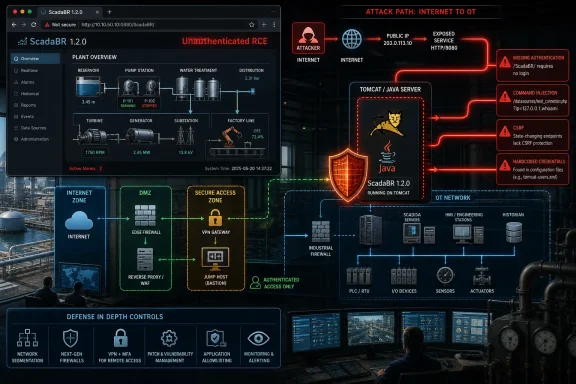 The ScadaBR Advisory Is Really About Exposure
ScadaBR sits in the category of tools that many WindowsForum readers will recognize even if they have never administered it directly: a browser-accessed SCADA system built to supervise remote processes, collect data, display graphical screens, and talk to industrial protocols such as Modbus, DNP3, MQTT, HTTP, SQL, OPC, and others. It is free, open source, Java-based, and commonly deployed on systems that look much more like ordinary IT servers than traditional closed industrial appliances.That dual identity is what makes the advisory serious. To a plant engineer, ScadaBR may be the HMI layer for a water system, an energy monitor, a factory line, or a building automation project. To an attacker scanning the internet, it may simply be another web application with a Tomcat footprint, legacy dependencies, and privileged access to process data.
CISA’s advisory names four vulnerabilities affecting ScadaBR 1.2.0: CVE-2026-8602, CVE-2026-8603, CVE-2026-8604, and CVE-2026-8605. The weakness classes are familiar and ugly: missing authentication for a critical function, OS command injection, cross-site request forgery, and hard-coded credentials. The vendor-assigned CVSS v3 score is 9.1, which places the issue squarely in critical territory.
The phrase “unauthenticated remote code execution” tends to flatten the important details. The real danger is not that a single magic packet necessarily knocks over every instance. It is that the affected product appears to expose enough unsafe functionality, trust assumptions, and credential handling mistakes that a remote attacker may not need a valid account before reaching execution paths that should never have been reachable in the first place.
Industrial Software Keeps Inheriting Web-App Failure Modes
The ScadaBR bug cluster is not exotic. Missing authentication, command injection, CSRF, and hard-coded credentials are old problems, old enough that they should be embarrassing in any internet-facing product. But industrial systems have a way of making ordinary software flaws more consequential, because the application’s job is not merely to render dashboards or store business records.A SCADA system is a mediator between software and physical process. It may not directly open a valve or trip a breaker in every deployment, but it often has visibility into, and sometimes influence over, the workflows that make those decisions. Even where the most dangerous control functions are isolated elsewhere, the monitoring layer can still become a pivot point, a credential store, a source of process intelligence, or a foothold inside a network that defenders assumed was quiet.
That is why the authentication flaw matters as much as the command injection. Command injection is the headline because it suggests a shell. Missing authentication is the architectural indictment because it suggests that the shell-adjacent path may have been guarded by assumptions rather than enforceable access control.
The CSRF component adds a more old-school web security angle. In a normal enterprise application, CSRF might mean tricking a logged-in user into making an unwanted change. In a SCADA context, the impact depends heavily on what the interface permits and how operators interact with it. If administrative actions, configuration changes, or data source operations can be driven through forged browser requests, the operator’s browser becomes part of the attack surface.
Hard-coded credentials complete the familiar chain. They are convenient for installers, demos, scripts, embedded defaults, and support workflows. They are also a gift to attackers because they turn one vendor mistake into a fleet-wide secret. Once discovered, a hard-coded credential does not fail one site at a time; it fails as a pattern.
The Product’s Strengths Also Widen the Blast Radius
ScadaBR’s appeal is obvious. It is free, open source, browser-accessed, and able to run across operating systems that support Java and Tomcat. Its own project materials describe it as a full SCADA platform with graphical screens, real-time visualization, alarms, reporting, scripts, and acquisition through more than 20 protocols. That is exactly the kind of flexible tool that small operators, integrators, labs, universities, and cost-conscious industrial teams often gravitate toward.The same flexibility complicates defense. A product that can be installed manually, deployed with a WAR file, run under Tomcat, use Derby by default or another database by configuration, and operate on Windows or Linux is not one uniform appliance. It is a stack. Each deployment inherits the security posture of the host OS, Java runtime, Tomcat configuration, database choice, firewall policy, service account model, and whatever convenience decisions were made during commissioning.
For Windows-heavy environments, that matters. ScadaBR may be “industrial software,” but the host could be a familiar Windows Server or workstation-class box sitting in a closet, on a plant floor, or in a virtualized environment managed by IT. If the system was installed years ago and then left alone because “it works,” the advisory becomes a prompt to rediscover who owns the asset.
The project’s current public materials describe ScadaBR 1.2 CE as an official version released in 2021 and compatible with Java 8 and Tomcat 9. That is not ancient by industrial standards, but in web application terms it is mature enough to deserve careful dependency and configuration review. Java 8, Tomcat, browser interfaces, and industrial protocols are all manageable pieces; unmanaged together, they become a museum of assumptions.
This is one reason open source in OT is a double-edged instrument. The code can be inspected, forked, taught, adapted, and supported by a community. But open source does not automatically mean someone is accountable for emergency patch delivery, fleet inventory, or safety validation when a critical advisory lands.
CISA’s Mitigations Are Boring Because the Right Answer Is Boring
CISA’s recommended practices will sound familiar to anyone who has read an ICS advisory in the last decade: minimize network exposure, keep control systems off the internet, place them behind firewalls, isolate them from business networks, and use secure remote access methods such as VPNs when remote connectivity is unavoidable. The agency also reminds organizations that VPNs themselves must be maintained and that VPN security is only as strong as the devices allowed to connect.There is a temptation to treat that language as boilerplate. It is not wrong to notice the repetition. It is wrong to ignore why the repetition exists.
The industrial security community keeps returning to segmentation because segmentation is what converts a critical software flaw from a crisis into a maintenance event. If an attacker cannot reach ScadaBR from the internet, cannot reach it from the ordinary corporate LAN, cannot reach it from a contractor laptop without a controlled path, and cannot reach it from user workstations that browse email, then the exploit story changes dramatically. The vulnerability may still matter, but it no longer has a direct runway.
The hard truth is that many smaller industrial environments do not have pristine Purdue-model networks. Remote access gets added because vendors need support. Browser interfaces get exposed because managers want dashboards. Windows hosts are joined to domains because IT wants backup, monitoring, and antivirus. Flat networks persist because outages are expensive and downtime windows are scarce.
That is why this advisory should not be read only as “apply a fix when available.” It should trigger a search for ScadaBR instances, exposed Tomcat services, unusual port forwards, stale VPN accounts, forgotten engineering workstations, and firewall exceptions that nobody has reviewed since commissioning.
No Known Exploitation Is Not a Permission Slip
CISA says it has not received reports of known public exploitation specifically targeting these vulnerabilities at the time of the advisory. That is good news, but it is not a comfort blanket. In industrial security, the time between advisory publication and opportunistic scanning can be short, particularly when the weakness classes are easy to understand.A CVE entry with “command injection” in the description is not subtle. A product name, version number, and web-accessed deployment model give attackers enough to begin reconnaissance. Even if no public proof-of-concept exists on day one, the advisory itself tells defenders and attackers where to look.
This is especially important for software with a community and training footprint. Tutorials, installation guides, Docker experiments, GitHub forks, old installers, and classroom deployments all leave traces across the internet. Some are harmless labs. Some are production systems wearing lab-like configurations. Search engines do not care which is which.
The right defender mindset is not panic; it is triage. An internally isolated ScadaBR instance behind a jump host, with strong access control and no direct process write capability, is a different risk from a public Tomcat server exposing an old SCADA interface over HTTP. The same CVSS score lands differently depending on topology, privilege, and operational role.
But “no known exploitation” should never be translated as “wait until next month.” It means defenders have a window in which they may be able to fix the exposure before criminals, hacktivists, or curious researchers make the window smaller.
The Windows Angle Is Asset Ownership, Not Just Patch Tuesday
For a Windows audience, the most useful framing is not whether ScadaBR itself is a Windows product. It is whether Windows shops understand that industrial applications often live in the gaps between IT and OT ownership. A ScadaBR installation may run on Windows, be backed up by Windows tooling, authenticate through Windows-adjacent processes, or be reachable from Windows desktops, while still being treated as “the plant’s system” rather than an enterprise server.That split causes predictable failures. IT may not know the application’s operational importance. OT may not track software CVEs the way IT tracks Microsoft security updates. Integrators may have built the system and moved on. The person who knows the login may no longer work there. The host may be excluded from normal vulnerability scans because “scanning breaks things.”
This is where the advisory becomes an organizational test. If an IT team can answer within hours whether ScadaBR 1.2.0 is present, where it is hosted, who administers it, whether it is internet reachable, what version of Java and Tomcat it uses, and what firewall rules protect it, the environment is probably in decent shape. If answering those questions requires archaeology, the vulnerability is only one symptom.
Windows administrators should also resist the false comfort of perimeter tooling. Endpoint detection and response can help if an attacker lands on a Windows host, but SCADA compromise often begins through web application logic, credential exposure, and network trust. By the time a command shell launches, the attacker may already have learned what the system monitors and how operators use it.
Patch management matters, but identity and segmentation may matter more. Remote access accounts should be reviewed. Local administrator reuse should be eliminated. Service accounts should be scoped tightly. Firewall rules should be documented in language that both IT and engineering can understand. Backups should be tested not only for file restoration but for process recovery.
The Open Source Question Cuts Both Ways
It would be easy, and wrong, to make this a morality play about open source being unsafe. Proprietary industrial products regularly ship with hard-coded credentials, missing authentication, command injection bugs, and brittle web consoles. The difference with open source is not that the mistakes are unique; it is that the support model is often more transparent and more uneven.ScadaBR’s openness has real value. Communities can adapt it, teach it, translate it, and keep it useful in places where commercial SCADA licensing would be impractical. For education, prototyping, small automation projects, and constrained budgets, that matters.
But openness does not remove the need for disciplined product security. A SCADA tool is not a hobby script once it supervises water pressure, energy generation, chemical process data, or manufacturing equipment. The fact that a system is free does not make the downtime free. The fact that code is available does not mean every operator has the expertise, time, or authorization to audit it.
The hard-coded credential finding is particularly damaging in this context because it suggests a gap between community convenience and production hygiene. Defaults, built-in accounts, and embedded secrets often survive because they make installation smoother. In industrial deployments, smooth installation has a way of becoming permanent configuration.
The future of open source industrial software depends on closing that gap. Projects need threat models, release discipline, secure defaults, documented upgrade paths, and a culture that treats reported vulnerabilities as product work rather than public relations noise. Users, meanwhile, need to stop treating open source SCADA as exempt from the governance they would demand of a commercial vendor.
A 2021 Stack in a 2026 Threat Model
ScadaBR 1.2 CE’s public materials describe a 2021 release, Java 8 compatibility, and Tomcat 9 deployment. None of that is inherently reckless. Industrial environments prize stability, and a working SCADA system is not something responsible engineers casually replace because a newer framework exists.Still, the threat model has moved. Internet-scale scanning is routine. Credential stuffing is cheap. Browser-based administration panels are cataloged. Attackers increasingly understand that industrial systems are politically, economically, and operationally sensitive. Even when they do not intend physical sabotage, they know that disruption in OT-adjacent environments creates leverage.
A five-year-old SCADA stack must therefore be judged not only by whether it still performs its process role, but by whether its security assumptions still hold. Was it designed with internet exposure in mind? Were administrative actions protected against cross-site request abuse? Were system commands safely handled? Were secrets generated per installation or embedded at build time? Were unauthenticated users kept away from critical functions by default?
CISA’s advisory suggests that at least some of those answers are uncomfortable for ScadaBR 1.2.0. The productive response is not to sneer at the software. It is to recognize how many industrial environments are running similarly aged stacks whose value comes from reliability and whose risk comes from stagnation.
For many operators, replacement may not be immediate or even desirable. The better near-term approach is containment: reduce reachability, harden the host, review application accounts, disable unnecessary functions, monitor access logs, and build a migration or upgrade plan that does not depend on a crisis.
Remote Code Execution Is the Beginning of the Story
Remote code execution is usually described as the finish line for an attacker. In an industrial environment, it is often the beginning. Once code runs on a SCADA server, the attacker’s next question is what that server can see, what it can change, and whom it can impersonate.A ScadaBR host may have configuration files, database credentials, historical process data, alarm routing details, email settings, network routes, scripts, device addresses, and operator-created screens that reveal the shape of the process. Even if direct control is limited, that information can help an attacker plan more targeted actions.
The host may also sit at a useful network crossroads. It may communicate with PLCs, historians, databases, engineering stations, email servers, or remote access tools. It may be trusted by other systems because it has always been there. In OT, trust often accretes over time until nobody can explain it cleanly.
This is why containment should include post-compromise thinking even before compromise is observed. Defenders should know what credentials are present on the ScadaBR host, what outbound connections it is allowed to make, what inbound systems can reach it, and what logs would show suspicious activity. If the answer is “we would have to look,” now is the time to look.
The operational impact analysis CISA recommends is not bureaucratic filler. Some defensive measures can break production visibility or interrupt remote operations if applied hastily. But impact analysis should not become a veto. It should be the bridge between urgency and safe execution.
The Advisory Lands in Sectors That Cannot Afford Ambiguity
CISA lists critical manufacturing, dams, chemical, energy, and water and wastewater among the affected deployment sectors. Those categories are broad, and the advisory does not say every sector has confirmed vulnerable production instances. Still, the list tells us where the software may plausibly appear and why defenders should take the issue seriously.Water and wastewater operators are a particularly important audience because they often run with constrained budgets, small technical teams, and a heavy reliance on integrators. A free SCADA system can be attractive in precisely the environments least able to absorb a security emergency. That does not mean those operators made bad choices; it means national cyber risk often accumulates in places with the least spare capacity.
Critical manufacturing faces a different version of the same problem. Production lines are built around uptime. If a SCADA interface supervises a machine cell or utility process, operators may be reluctant to touch it. Attackers understand that reluctance, and ransomware crews in particular have learned that operational disruption increases pressure.
Energy and chemical environments raise the stakes further because even read-only visibility can be sensitive. Process data, alarms, and configuration details can reveal dependencies, bottlenecks, and safety-relevant behavior. The line between cyber intrusion and operational consequence can be thinner than executives expect.
Dams and other infrastructure systems bring another challenge: long lifecycles. Control environments may outlive multiple generations of IT policy. A 2021 software release can be “new” in the context of a facility whose automation architecture was planned years before that, and “old” in the context of web application security.
The Vendor Fix Is Only One Layer of the Response
The submitted advisory excerpt emphasizes defensive measures but does not include a clear vendor patch instruction in the provided text. That absence matters. When a fix is not obvious, operators must avoid two bad reactions: assuming there is nothing to do, or improvising dangerous changes on production systems.The first task is inventory. Determine whether ScadaBR is present and whether the affected version is ScadaBR 1.2.0. Include lab, training, staging, and abandoned systems, because attackers do not politely ignore forgotten instances. Check Windows hosts, Linux hosts, Tomcat deployments, VM templates, old installers, and integrator-maintained servers.
The second task is exposure review. Confirm whether the application is reachable from the internet, from business networks, from wireless networks, from vendor VPN pools, or from general user subnets. If the system must be remotely reachable, place it behind controlled access paths and ensure that access is logged, time-bounded, and tied to named users.
The third task is credential hygiene. Hard-coded credentials are not always removable by configuration, but defenders can still rotate surrounding secrets, remove default accounts where possible, limit account privileges, and watch for authentication attempts that suggest public knowledge of defaults. If the software embeds a secret that cannot be changed, network controls become even more important.
The fourth task is monitoring. Tomcat logs, Windows event logs, Linux auth logs, firewall logs, reverse proxy logs, database logs, and EDR telemetry can all help reconstruct whether suspicious access occurred. Monitoring should be specific enough to notice unexpected administrative requests, unusual process execution, and new outbound connections.
The final task is planning. If ScadaBR remains operationally necessary, identify whether a maintained upgrade path, compensating control, fork, vendor-supported version, or replacement architecture is appropriate. That decision belongs jointly to IT, OT, safety, and management, not to whoever happened to read the advisory first.
The ScadaBR Warning Turns Into an Inventory Drill
The immediate message for administrators is concrete: treat this as an exposure and ownership problem before treating it as a narrow vulnerability ticket. ScadaBR’s role in a plant or utility may be small, but the privileges and visibility of a SCADA server make small systems worth finding quickly.- Organizations should identify every ScadaBR deployment, including training labs, engineering workstations, abandoned virtual machines, and integrator-maintained servers.
- Administrators should assume ScadaBR 1.2.0 is high risk until they have confirmed version, reachability, host configuration, and compensating controls.
- Exposed web access should be removed or placed behind tightly controlled remote access, because CISA’s advisory centers on unauthenticated remote code execution risk.
- Network segmentation should be verified in practice, not just on a diagram, because flat access from business desktops can turn a phishing incident into an OT incident.
- Credential review should include default, shared, embedded, local, service, database, and VPN accounts associated with the ScadaBR host.
- Operators should preserve and review logs before making disruptive changes, because the absence of known public exploitation does not prove that a local environment was untouched.
References
- Primary source: CISA
Published: 2026-05-19T12:00:00+00:00

ScadaBR | CISA
www.cisa.gov
- Related coverage: scadabr.org
Início - ScadaBR
 scadabr.org
- Related coverage: scadabr.com.br
ScadaBR
 www.scadabr.com.br
- Official source: github.com
ScadaBR (ScadaBR) · GitHub
Conta oficial do projeto ScadaBR. ScadaBR has 4 repositories available. Follow their code on GitHub. github.com
- Related coverage: scada.com.br
Curso ScadaBR Online Gratuito!
Curso Completo do ScadaBR Online Grátis. Do básico ao avançado. Assista no Youtube.scada.com.br - Related coverage: openhub.net
The scadabr Open Source Project on Open Hub
 openhub.net
- Related coverage: celsoautomacao.com.br
Curso ScadaBR 1.2 - Celso Automação
Curso completo sobre ScadaBR 1.2. Aprenda a utilizar este poderoso software de supervisão e controle de processos com o melhor curso gratuito disponível em português.celsoautomacao.com.br - Related coverage: labirito.com
Portal Labirito - ScadaBR
ScadaBR é um projeto de código aberto para implementar um sistema S.C.A.D.A. em indústrias, e outros ambientes automatizados. O site oficial do ScadaBR é http://www.scadabr.com.br/. O código pode ser obtido no Sourceforge https://sourceforge.net/projects/scadabr/. Há um post no Laboratório Dewww.labirito.com
- Related coverage: armbasedsolutions.com
ScadaBR: Free and Open Source SCADA System
ScadaBR is a open source SCADA system for remote monitoring systems, industrial and residential automation, and the IoT. Summary graphical screens can be created directly from the browser. armbasedsolutions.com
