

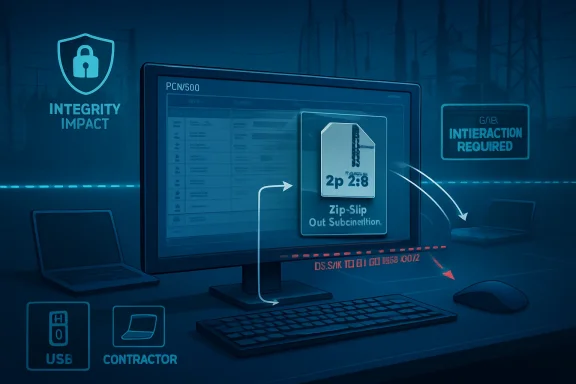
A Medium-Severity Bug Lands in a High-Consequence Neighborhood
Hitachi Energy PCM600 is not a consumer app and not a random utility buried on a forgotten desktop. It is the Protection and Control IED Manager used around intelligent electronic devices in substations and related energy environments, including Hitachi Energy’s Relion families and associated products. That context changes how defenders should read the advisory.
The vulnerability is CVE-2018-1002208, a SharpZipLib issue better known by the catchy and unfortunately durable name Zip Slip. The bug is conceptually simple: a malicious archive can contain filenames with path traversal sequences, and vulnerable extraction logic can write those files somewhere outside the directory the user or application expected. In ordinary desktop software, that might mean a poisoned archive overwrites a configuration file. In an engineering toolchain, the same class of bug has a more awkward blast radius because the workstation often has privileged access to project files, device configurations, and trusted operational workflows.
The advisory says successful exploitation can affect the integrity of the product. That wording matters. This is not described as a remote wormable vulnerability, and the CVSS vector is not screaming “drop everything.” But integrity is the crown jewel for tools that prepare, import, export, and manage configuration material for grid automation environments.
The affected list is broad enough to catch both sides of a product transition. PCM600 Legacy version 2.11 and earlier are listed, as are PCM600 3.0, 3.0 HF1, 3.0 HF2, 3.0 HF3, 3.1, 3.1 SP1, 3.1 SP2, and 3.1 SP3. Hitachi Energy’s planned vendor fix is PCM600 3.1 SP4, while the immediate advice is to follow deployment hardening guidance, eliminate default credentials, and maintain industrial-control segmentation practices.
That creates the basic tension of this advisory: the vulnerability is old, the affected environments are conservative, and the fix path is not as simple as telling every plant to click “update” before lunch.
Zip Slip Refuses to Stay in 2018
Zip Slip became widely discussed in 2018 because it exposed a mundane assumption that developers had been making for years. ZIP archives look like containers of files, but the paths inside those containers are data supplied by whoever created the archive. If extraction code simply joins the target directory with the archive entry name, ../../ stops being a string and starts being an instruction.
SharpZipLib was one of many libraries pulled into that broader wave of archive-extraction vulnerabilities. The underlying weakness is categorized as CWE-22, improper limitation of a pathname to a restricted directory. Security engineers have been warning about this pattern for decades, yet it keeps returning because file import features are everywhere and archive handling is treated as plumbing.
That is why this Hitachi Energy advisory should not be read as an isolated embarrassment for one vendor. It is a case study in how long-lived industrial products inherit long-lived third-party dependencies, and how those dependencies can outlast the security assumptions of the era in which they were selected. A library can be patched upstream and still remain embedded in validated application stacks for years.
In enterprise IT, stale dependencies are annoying. In operational technology, they are structural. Vendors validate software against specific devices, operating systems, connectivity packages, engineering processes, and customer deployments that are often expected to remain stable for years. The result is a patching culture where “known vulnerable” does not always translate into “immediately replaceable.”
That does not excuse leaving known bugs unresolved. It does explain why vulnerabilities like this one keep showing up in industrial advisories long after the CVE date has faded from memory. The problem is not that nobody has heard of Zip Slip. The problem is that industrial software ages in place.
The Attack Path Is Local, but the Trust Boundary Is Real
The CVSS 3.1 vector in the advisory is CVSS:3.1/AV:L/AC:H/PR:L/UI:R/S:U/C:N/I:H/A:N, with a base score of 4.4. In plain English, the attack is local, relatively difficult, requires low privileges, and requires user interaction. It does not directly affect confidentiality or availability as scored, but it has a high integrity impact.
That profile is exactly the sort of thing that gets lost in vulnerability triage. A medium-severity local flaw requiring interaction will usually sit below remote-code-execution bugs, exploited VPN flaws, and exposed management interfaces. For a Windows administrator responsible for hundreds of endpoints, that instinct is rational.
But PCM600 is not just another endpoint application. It lives in the engineering layer, where imported projects, configuration packages, and removable media can be part of normal work. If a user with access to the tool opens or imports a crafted archive as part of a believable workflow, the question is not whether the internet can directly reach PCM600. The question is whether the attacker can get malicious input into a trusted engineering process.
That is the recurring lesson of OT security in the 2020s. Air gaps, where they exist at all, are porous around maintenance. Vendors, contractors, laptops, USB media, project exports, and remote-support paths all act as bridges between corporate IT and industrial engineering environments. A vulnerability requiring user interaction can still matter if the user is an engineer performing a routine task with privileged tooling.
The advisory’s focus on integrity also points to a subtler risk. Arbitrary file write does not need to become dramatic code execution to create operational concern. Overwriting a project file, planting a startup artifact, corrupting a configuration component, or manipulating supporting files may be enough to undermine trust in an engineering workstation.
That is why defenders should treat the advisory as a workflow problem, not merely a software version problem. The vulnerable operation is tied to archive extraction. The defensive conversation must therefore include where project archives come from, how they are scanned, which accounts open them, and whether engineering workstations are treated as sensitive assets or just inconvenient Windows PCs behind a firewall.
The Product Split Makes the Patch Story Messier
The most interesting part of the advisory is the ownership boundary between ABB-era PCM600 2.x and Hitachi Energy’s PCM600 3.x line. Hitachi Energy notes that PCM600 versions 2.11 and earlier were distributed under ABB’s organization before the acquisition context changed, and that ABB continues to maintain the 2.x product line. Hitachi Energy says it now exclusively maintains and distributes PCM600 3.x.
That split is not just corporate trivia. It determines who can validate a fix, who can promise compatibility, and who an operator should trust when the engineering tool touches devices still deployed in the field. Hitachi Energy explicitly says it cannot assess or guarantee compatibility of ABB’s recommended updates with other Hitachi Energy IEDs such as Relion 670 series, 650 series, SAM600, and PWC600.
For customers, that creates a practical fork. The legacy branch may have vendor guidance from ABB, but Hitachi Energy is steering users toward PCM600 3.x, which it maintains and validates. The planned remediation is PCM600 3.1 SP4, not a universal patch for every historical deployment.
That sounds clean on paper and messy in plants. Industrial operators rarely run a single pristine version everywhere. A large utility may have old substations, newer digital substations, lab environments, field laptops, contractor images, and archived project material that depends on older tooling. Some machines may exist precisely because an old tool version is needed to support an old device or historical configuration.
Hitachi Energy’s 2023 PCM600 3.0 release language helps explain the direction of travel. Version 3.0 was positioned as replacing previous PCM600 versions, while still being installable in parallel with older releases such as 2.11 and earlier. Parallel installation is operationally useful, but from a security standpoint it can preserve vulnerable code paths long after a newer version is available.
That is the part CISOs and OT managers should watch. Migration is not the same as eradication. A workstation can have PCM600 3.x installed and still retain older vulnerable tooling for compatibility or habit. If the vulnerable extractor remains reachable through a legacy workflow, the risk has not actually left the building.
Engineering Workstations Are the New Soft Underbelly
Industrial-control security used to be narrated around controllers and HMIs. Increasingly, the more interesting target is the engineering workstation: the Windows system that administrators use to configure, update, document, and troubleshoot the devices that actually run the process. It is powerful, trusted, and often less standardized than corporate endpoints.
PCM600 sits squarely in that world. It is used across the life cycle of protection and control devices, which means it can touch engineering project data and device-facing workflows that ordinary IT software never sees. That makes it valuable not because it is exposed to the internet, but because it is exposed to trust.
The advisory’s recommended practices read like standard ICS hygiene because, in this context, standard hygiene is the compensating control. Keep control-system networks away from the internet. Put remote devices behind firewalls. Separate control networks from business networks. Use more secure remote access methods such as VPNs, and keep those remote-access components patched. Scan removable media before it touches control systems.
These recommendations may sound generic, but they line up well with Zip Slip’s actual operating conditions. The vulnerable content has to arrive somehow. It may arrive as a project archive, an update package, a contractor handoff, or a file moved across a trust boundary. Blocking that pathway is often more realistic than assuming every engineering stack can be upgraded instantly.
The other notable mitigation is credential hygiene. Hitachi Energy tells users to ensure that no default credentials are in use, or that exceptions are mitigated with adequate countermeasures. At first glance, default passwords and ZIP extraction look unrelated. In real attacks, they are often adjacent.
An attacker who can plant or modify files on an engineering machine may still need a credentialed path to do something useful. Conversely, weak credentials can turn a small file-handling bug into a more serious foothold. The advisory is implicitly telling customers not to look at this as one isolated defect but as part of a layered defensive posture.
The CVSS Score Undersells the Operational Choreography
CVSS is useful because it gives teams a shared scoring language. CVSS is dangerous when it becomes a substitute for understanding the environment. A 4.4 medium vulnerability in a generic desktop utility and a 4.4 medium vulnerability in an engineering tool used around electrical protection systems are not the same management problem.
The score says local access, high complexity, low privileges, and user interaction. It does not say whether an engineer routinely imports archives from vendors. It does not say whether a contractor laptop is allowed to connect to both corporate email and an OT maintenance network. It does not say whether project files are version-controlled, signed, backed up, and reviewed before deployment.
That missing context is where operational risk lives. In a well-run environment, a malicious archive should have to pass through email filtering, malware scanning, media controls, file provenance checks, least-privilege accounts, endpoint monitoring, and change-management review before it can matter. In a weaker environment, a ZIP file on a USB stick may be treated as normal field work.
This is why the advisory’s “user interaction required” condition should not be comforting by itself. Social engineering exists because user interaction is abundant. Engineering staff are trained to solve problems under time pressure, and maintenance windows are short. A file named like a project export, relay settings backup, or vendor support bundle can be more persuasive than a generic phishing lure.
The better way to read the CVSS score is as a prioritization input, not a risk conclusion. Organizations should not treat this like an emergency remote exploit unless their own environment makes it one. But they also should not dismiss it because the score is medium. The real question is whether vulnerable PCM600 installations sit on trusted workstations that process untrusted or weakly trusted archives.
Old Dependencies Are Now Industrial Debt
The Windows ecosystem has spent years learning the pain of dependency management. Developers import libraries, libraries import libraries, and every binary becomes a small museum of past decisions. In cloud software, those decisions are increasingly visible because scanners, SBOMs, and automated pipelines keep yelling about them.
Industrial software has the same dependency problem, but the feedback loop is slower. Products are validated more conservatively, customers patch more carefully, and support matrices can be entangled with devices that have long field lives. A third-party library bug can therefore become a kind of industrial debt, accruing interest quietly until an advisory forces everyone to reopen the ledger.
PCM600’s SharpZipLib issue fits that pattern. The upstream vulnerability dates to 2018. The advisory appears in 2026 for affected Hitachi Energy product versions. That eight-year gap is not necessarily evidence of active exploitation or negligence in a simple sense. It is evidence that the security industry’s ability to name a vulnerability and the industrial ecosystem’s ability to retire every exposed instance operate on different clocks.
This matters because regulators and insurers are increasingly asking operators to prove they know what is in their software. The software bill of materials movement is not just bureaucratic paperwork; it is a response to the reality that old components keep reappearing in consequential systems. If a utility cannot rapidly answer which engineering workstations use a vulnerable archive library through PCM600, it has an asset-management problem before it has a patching problem.
The advisory also shows why vendor validation remains essential. In IT, replacing a vulnerable library may be a build-and-test exercise. In OT, the upgrade path may affect compatibility with connectivity packages, relay families, project formats, or engineering procedures. The fix has to be secure, but it also has to be boring in the field.
That is the hard bargain industrial vendors are trying to strike. Move too slowly, and known vulnerabilities linger. Move too quickly, and customers fear breaking the tools that keep protection systems manageable. The only sustainable answer is not heroic patching after each advisory, but disciplined lifecycle management before the advisory arrives.
CISA’s Republication Turns a Vendor Notice Into an Operator Signal
CISA’s role here is visibility. The advisory itself is a republication of Hitachi Energy’s CSAF advisory, with CISA making clear that it is provided as-is and that technical questions belong with Hitachi Energy. That distinction is legally important, but operationally the republication still changes the audience.
A vendor advisory may be read by product owners and support contacts. A CISA ICS advisory is more likely to cross the desks of security operations teams, regulatory staff, managed service providers, and executives who track federal industrial-control alerts. The same vulnerability becomes part of a broader risk conversation.
The revision history is also telling. Hitachi Energy’s initial public release was dated April 28, 2026, and CISA’s republication followed on May 5, 2026. That is a short window, but it still means operators may encounter the issue through different channels at different times. Some will have seen the vendor notice first; others will see the CISA advisory and ask why their asset inventory did not already flag affected PCM600 versions.
CSAF is supposed to help with that. Structured advisories make it easier for tools to ingest affected products, versions, CVEs, scores, remediations, and status fields. In theory, the machine-readable advisory should shorten the distance between vendor disclosure and operator action.
In practice, the value depends on the quality of the asset inventory on the receiving end. A beautifully structured advisory does little for an organization that cannot tell which field laptop has PCM600 3.1 SP2, which engineering VM still has 2.11 installed, or which contractor maintains its own image. The publication format is modern; many OT inventories are not.
That is the hidden theme beneath CISA’s republication. The industry is getting better at distributing vulnerability intelligence. It is still uneven at turning that intelligence into specific, local decisions about real machines in real substations.
The Fix Is a Version, but the Remediation Is a Program
Hitachi Energy’s vendor-fix line points to PCM600 3.1 SP4 as the planned update. That is the cleanest answer for maintained 3.x environments once the update is available and validated for the customer’s deployment. For legacy 2.x environments, the path runs through ABB’s advisory and the uncomfortable compatibility caveat Hitachi Energy has attached.
Security teams should resist the urge to collapse those paths into one spreadsheet cell labeled “patch.” A maintained PCM600 3.x workstation awaiting SP4, a legacy 2.11 workstation supporting older assets, and an offline engineering VM used twice a year are different remediation cases. They share a CVE, not necessarily a timeline.
The immediate actions are therefore more procedural than glamorous. Confirm deployment guidance has been followed. Remove default credentials. Harden control-system network boundaries. Limit exposure. Scan removable media. Keep remote-access tooling current. Maintain supported product versions and follow maintenance releases.
None of that sounds like a thrilling security breakthrough. It is, however, the work that determines whether a medium local file-write bug remains a constrained defect or becomes an incident ingredient. Most industrial compromises are not magic. They are chains of ordinary weaknesses that were allowed to meet.
The archive-handling angle deserves special attention in day-to-day procedure. Engineering teams should treat imported archives and project packages as potentially dangerous content, even when they arrive through familiar channels. That means provenance checks, malware scanning, least-privilege handling, and controlled staging before files are opened in trusted engineering applications.
There is also a backup and integrity angle. If the risk is unauthorized file writing, then organizations should care about detecting unauthorized file changes. Version-controlled project repositories, cryptographic hashes for critical packages, known-good backups, and review gates before deployment can reduce the chance that a tampered engineering artifact quietly becomes an operational artifact.
Windows Admins Should Recognize the Pattern
WindowsForum readers do not need to operate a substation to recognize the shape of this problem. It is the same old Windows endpoint story with higher stakes: a trusted desktop application parses a file, a dependency mishandles paths, and the security outcome depends on user context, local permissions, and what that workstation can reach.
The Windows-specific angle is not that Windows is uniquely at fault. It is that industrial engineering environments often depend on Windows workstations because the toolchains, drivers, documentation, and vendor support models have grown up around them. Those machines may not look like production servers, but they can be just as sensitive.
That makes endpoint management a serious OT control. Application inventory, software version tracking, local admin reduction, controlled removable media, endpoint detection, and patch governance are not merely corporate IT chores. They are part of the safety margin around engineering tools.
The harder cultural shift is persuading OT teams that the engineering workstation is not exempt from modern security expectations just because it supports fragile systems. The correct response is not to apply consumer-style auto-updates blindly. It is to build a tested, staged, vendor-aware maintenance process that can move faster than the multi-year dependency lag this advisory illustrates.
Security teams also need to respect the operational reasons old versions persist. If a field engineer keeps PCM600 2.11 around, it may be because a real device, project, or compatibility matrix requires it. Shaming that reality does not remove the risk. Documenting it, isolating it, and wrapping it in controls might.
The Practical Reading for Operators Running PCM600
The advisory’s plain message is narrow: affected PCM600 versions include legacy 2.11 and earlier as well as multiple 3.0 and 3.1 builds up to 3.1 SP3, and the planned Hitachi Energy remediation is PCM600 3.1 SP4. The operational message is wider: find the software, understand the workflows, and reduce the number of ways a malicious archive can cross into trusted engineering space.
This is especially important for organizations that have treated PCM600 as “just an engineering tool” rather than a managed security asset. Tools that configure protection-and-control equipment deserve the same seriousness as the systems they support. If they are not inventoried, monitored, and governed, attackers do not need to compromise the controller first.
A useful response starts with discovery. Identify every workstation, VM, jump host, and contractor-managed system that runs PCM600. Record the exact version and whether older releases are installed in parallel. Determine which systems process project archives, exports, SCD files, connectivity packages, or vendor support bundles.
Then comes segmentation and handling. Engineering machines should not browse the internet, read ordinary email, or act as general-purpose office PCs. Files moving into the environment should pass through controlled transfer points, scanning, and approval. Remote access should be limited, logged, and patched.
Finally, organizations should plan the migration rather than merely wait for SP4. If PCM600 3.x is the maintained Hitachi Energy branch, the long-term direction is clear. Legacy 2.x use should become an explicitly documented exception with a business owner, a technical reason, compensating controls, and a retirement plan.
That is how a medium advisory becomes useful. Not by generating panic, but by forcing a review of assumptions that probably should have been revisited anyway.
The Five Things PCM600 Shops Should Do Before SP4 Lands
This advisory is not a reason to tear apart a working substation environment overnight. It is a reason to stop treating engineering-tool patching as an informal craft process and start treating it as a controlled security program.
- Inventory every PCM600 installation, including lab systems, offline virtual machines, contractor laptops, and older versions installed in parallel with newer releases.
- Treat project archives and vendor-supplied ZIP files as untrusted input until they have passed through scanning, provenance checks, and controlled staging.
- Move maintained environments toward PCM600 3.x and prepare to validate PCM600 3.1 SP4 when Hitachi Energy releases the planned remediation.
- Keep legacy PCM600 2.x deployments on an exception register that records why they still exist, who owns the risk, and which compensating controls apply.
- Review engineering-workstation controls, including default credentials, removable-media scanning, network segmentation, remote-access hygiene, and backups of known-good project files.
The deeper lesson is that industrial security is increasingly about the boring connective tissue between devices, workstations, vendors, files, and maintenance habits. A 2018 Zip Slip flaw appearing in a 2026 ICS advisory is not an anomaly; it is a preview of the dependency archaeology operators will keep confronting as digital substations and aging software estates overlap. The winners will not be the organizations that pretend every medium CVE is a crisis, but the ones that can quickly prove where the vulnerable code is, how it is reached, and how fast they can retire it without breaking the systems they are trying to protect.