
That tension is the real news. ABB PCM600 is not a consumer utility or a forgotten tray app; it is engineering software used around protection and control relays, the kind of tooling that lives close to substations, industrial sites, and the configuration workflows that keep electrical infrastructure predictable. A CVSS 4.4 score says “medium.” The environment says “treat with care.”
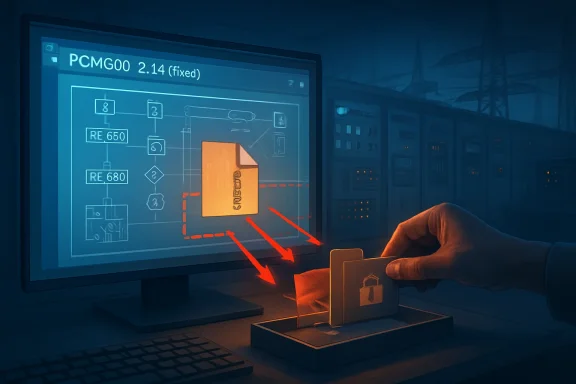 A Medium Bug Lands in a High-Consequence Neighborhood
The vulnerability tracked as CVE-2018-1002208 is not new in the software world. It is the old Zip Slip class of failure: archive extraction logic mishandles pathnames, allowing a malicious archive entry to escape the directory where files are supposed to land. In plain terms, a file that should be unpacked into a safe folder can be written somewhere else if the software trusts paths it should normalize, constrain, or reject.
That kind of bug has been known for years, and the affected SharpZipLib component predates ABB’s latest advisory. The notable development is the way this older library issue has surfaced in PCM600, ABB’s Protection and Control IED Manager, and the way CISA has now folded ABB’s PSIRT notice into the U.S. industrial-control advisory stream.
In conventional IT, path traversal bugs are common enough that they can blur together. In operational technology, the surrounding workflow matters more than the vulnerability category. PCM600 is described by ABB as a configuration and communication engineering tool for ABB Relion protection and control relays, with support for IEC 61850-oriented engineering workflows. That puts it in the administrative and engineering plane of power-system equipment, not in the disposable edge of the enterprise.
CISA’s advisory says successful exploitation could allow an attacker to send specially crafted messages to the system node, causing insertion and running of arbitrary code. The agency also says the flaw is not remotely exploitable, carries high attack complexity, requires local access, low privileges, and user interaction, and has no known public exploitation specifically targeting it as of the advisory’s publication. Those qualifiers matter. They also do not make the issue ignorable.
The point is not that every PCM600 workstation is suddenly one phish away from compromise. It is that engineering tools are attractive places for old dependency bugs to hide, and once they are found, the remediation path can collide with the physical reality of installed industrial equipment.
The Fix Is Simple Until the Relay Fleet Says Otherwise
ABB’s preferred remediation is straightforward: move to Protection and Control IED Manager PCM600 version 2.14. According to ABB’s public PCM600 page, version 2.14 is now the current release package, while older versions such as 2.13 and 2.11 remain visible in the download history and supporting materials. On paper, this is the classic industrial software hygiene story: a vulnerable bundled component is corrected in a newer product release, and operators should update at the earliest convenience.
Then comes the note that changes the whole operational calculus. ABB says RE_630 protection relays are not compatible with PCM600 2.14. Customers using earlier PCM600 versions with RE_630 therefore cannot simply take the fixed version and call the job complete. They must instead mitigate the known vulnerability through system-level defenses and follow ABB’s broader security recommendations.
That compatibility exception is not a footnote for the people who own it. It is the difference between a patch management task and a risk acceptance process. If a site depends on RE_630 relays, the “fixed version” may be fixed only in the abstract; the usable engineering baseline may remain an affected PCM600 release, protected not by code correction but by segmentation, access control, workstation hardening, and disciplined import workflows.
This is where industrial cybersecurity departs from the rhythms of desktop patching. Windows admins may grumble when a driver, VPN client, or line-of-business plug-in delays an update, but the enterprise norm is still to converge toward the vendor’s current build. In substations and manufacturing sites, a management tool may be tied to a relay generation, a tested engineering procedure, a regulatory change window, or a vendor support matrix that moves more slowly than the vulnerability feed.
That does not excuse inaction. It does mean the right question is not simply “Are you patched?” The better question is: “For every PCM600 installation that cannot move to 2.14, what compensating controls make exploitation realistically difficult, detectable, and recoverable?”
Zip Slip Is Boring, Which Is Exactly Why It Keeps Working
There is a tendency to reserve serious attention for vulnerabilities that sound exotic: protocol flaws, pre-authentication remote code execution, kernel escapes, or clever supply-chain compromises. Zip Slip is less glamorous. It is a failure of pathname handling during archive extraction, a category every secure coding guide has warned about for years.
That familiarity is precisely why it deserves attention. Archive processing sits in the overlap between user convenience and file-system authority. Engineering tools need to import packages, projects, device descriptions, updates, relay configurations, disturbance records, and vendor-supplied data. The moment a tool accepts structured files from outside its own trust boundary, it becomes a parser, and parsers are where assumptions go to die.
In a Zip Slip-style attack, the dangerous payload is not necessarily a dramatic exploit chain. It can be a crafted filename embedded inside an archive, one that uses traversal sequences to push a write operation outside the intended extraction directory. If that write lands in a sensitive startup path, plug-in location, configuration directory, or executable search path, the bug can graduate from arbitrary file write to code execution.
CISA’s description for the ABB case uses the phrase arbitrary code execution, but its CVSS vector keeps the bug grounded: local attack vector, high complexity, low privileges, required user interaction, high integrity impact, no confidentiality impact, and no availability impact. That is not the profile of a wormable internet-facing flaw. It is the profile of a workflow-dependent compromise, the kind that becomes dangerous when a malicious file, crafted package, or compromised engineering process intersects with a trusted workstation.
For defenders, that distinction should sharpen rather than dull the response. The bad day does not begin with a magic packet from the internet. It begins with a laptop, a project file, a removable drive, a shared folder, a remote support session, or an engineering station that has quietly become a bridge between corporate IT and the control environment.
Engineering Workstations Are the Soft Underbelly of Hard Infrastructure
Industrial security discussions often focus on controllers, relays, HMIs, historians, and network appliances. Engineering workstations can get treated as tools rather than assets. That is a mistake. The machine used to configure, communicate with, or update critical devices frequently has more practical authority than many production systems that receive far more monitoring.
PCM600’s role illustrates the point. ABB markets it as a tool for managing protection and control relays, including configuration, signal mapping, parameter handling, monitoring, disturbance information retrieval, and report generation. These are not incidental tasks. They are the workflows by which field equipment is understood, changed, and validated.
A compromised engineering workstation does not need to “hack the grid” in cinematic fashion to create risk. It may be enough to alter project data, tamper with configuration files, stage malicious payloads for later execution, capture credentials, or create uncertainty about the integrity of engineering artifacts. In OT, uncertainty has operational cost. If a team cannot trust a workstation or its project repository, it may have to slow maintenance, revalidate configurations, or isolate equipment while investigating.
This is why medium-severity advisories in the engineering-tool layer deserve a different reading than medium-severity advisories for ordinary productivity software. The severity score measures the vulnerability mechanics. It does not fully capture the social and operational authority of the affected asset.
The lesson for Windows-heavy industrial shops is uncomfortable but familiar: your most important OT endpoint may look like a standard Windows workstation with a vendor tool installed. It may sit on a maintenance cart, in a relay room, in a contractor’s kit, or on an engineering desk. It may not be internet-exposed, but it may touch files and people from many directions.
CISA’s Advice Is Generic Because the Real Control Is Local
CISA’s recommended practices are the familiar industrial-control canon: minimize exposure, keep control-system devices away from the internet, separate control networks from business networks, use firewalls, update VPNs, conduct impact analysis, and maintain defense-in-depth. None of that is surprising. None of it is optional.
The reason the advice sounds generic is that CISA cannot know the architecture of every PCM600 deployment. One site may run PCM600 on a tightly managed engineering workstation with no email, no general browsing, controlled removable media, and audited file transfers. Another may run it on a general-purpose Windows machine that also handles vendor portals, office documents, remote meetings, and file shares. The CVE is the same; the risk is not.
For the affected PCM600 versions, the most important defensive boundary is around what reaches the engineering workstation and who can persuade the workstation to process it. Since exploitation requires user interaction and is not remotely exploitable in the ordinary internet sense, social engineering and contaminated project artifacts become part of the threat model. CISA explicitly reminds users not to click unsolicited links or open unexpected attachments, but OT operators should translate that into engineering-specific controls.
That translation starts with treating PCM600 project imports, archive files, relay-related packages, and vendor-delivered materials as untrusted until proven otherwise. It continues with separating email and web browsing from engineering workstations wherever possible. It ends with the boring but critical discipline of logging, backups, least privilege, and the ability to rebuild a trusted engineering image quickly.
ABB’s own advisory language points in the same direction. The company recommends isolating special-purpose automation networks, using firewalls, separating them from general-purpose networks, applying physical access controls, avoiding unnecessary network connections for programming software, scanning imported data, minimizing internet exposure, keeping software and operating systems patched, and using secure remote access methods when remote access is required. That is not a clever workaround for a vulnerable DLL. It is a reminder that industrial security is a system property.
The CVSS Score Understates the Governance Problem
The vendor score of 4.4 medium is defensible from a strict scoring perspective. The advisory says the attack vector is local, the complexity is high, privileges are required, and the user must interact. Those are meaningful constraints, and defenders should not inflate every OT advisory into a crisis.
But CVSS is a poor proxy for governance friction. The score does not tell you how many engineering stations still run PCM600 2.13 because a site standardized on it last year. It does not tell you how many installations must stay below 2.14 because of RE_630 compatibility. It does not tell you whether the engineering workstation is domain-joined, whether removable media is controlled, whether contractors bring their own laptops, or whether relay project files move through ordinary corporate email.
This is the real weakness exposed by the advisory: not necessarily a catastrophic software defect, but an asset-management challenge. To respond responsibly, an organization needs to know where PCM600 is installed, which versions are present, which relay families each installation supports, whether version 2.14 is compatible with those workflows, and what compensating controls exist where it is not.
Many organizations will not have that answer ready. OT software inventories are often less mature than server and endpoint inventories, especially for engineering tools that are installed episodically, used by specialists, or managed outside standard corporate software deployment systems. A vulnerability like this forces a simple but revealing exercise: find every copy, identify its operational dependency, and decide whether it can move.
The danger is not that every affected copy will be exploited. The danger is that some affected copies will be invisible. Invisible engineering tools tend to be poorly monitored, poorly patched, and overly trusted by the people and systems around them.
The RE_630 Exception Is a Case Study in Patch Reality
The compatibility warning for RE_630 relays deserves more attention than the CVE number. It is an unusually clear example of the industrial patching bind: the vendor has produced a corrected software version, but part of the installed ecosystem cannot use it. That does not make ABB unusual. It makes the advisory honest.
From an enterprise IT perspective, compatibility exceptions are temporary annoyances. From an OT perspective, they can be long-lived operating conditions. A relay family may remain in service for years or decades, and the engineering toolchain that supports it may be constrained by firmware, project formats, certification, internal procedures, or support boundaries that are not easy to unwind.
This is why asset owners should avoid the lazy binary of “patched” versus “unpatched.” A better model has three states. First, systems that can update to PCM600 2.14 should be scheduled and moved through normal change control. Second, systems that cannot update because of RE_630 or other validated constraints should be formally documented as mitigated exceptions. Third, systems whose status is unknown should be treated as uncontrolled risk until the inventory is complete.
The middle category is where mature OT programs distinguish themselves. A mitigated exception is not a forgotten exception. It has an owner, a reason, a review date, a set of compensating controls, and a detection strategy. It is not a sticky note on an engineer’s monitor saying “do not update.”
For Windows administrators supporting OT teams, this advisory is a reminder that patch management cannot be delegated entirely to the vendor updater or the monthly endpoint dashboard. The application dependency map matters. So does the relay fleet. So does the maintenance process by which files reach the machine.
Windows Is the Workbench, Not the Boundary
Because PCM600 runs in the familiar world of Windows engineering workstations, there is a temptation to view this as a normal endpoint-management problem. In one sense, it is. The affected tool is software, the vulnerable component is a library, the fixed version is an installer, and many of the controls are recognizable to any Windows admin: local privilege restriction, application control, endpoint detection, patching, removable-media policy, backups, and network segmentation.
But the Windows machine is not the whole boundary. It is the workbench on which operational trust is assembled. If that workbench handles relay configuration data, communicates with devices, stores engineering projects, and imports vendor packages, then its integrity has operational meaning beyond the host itself.
Application control is especially relevant here. If arbitrary code execution depends on writing or staging executable content in a place the system will later run, then reducing where code can execute and under whose authority becomes valuable. Windows Defender Application Control, AppLocker in legacy environments, controlled folder access, constrained local admin rights, and disciplined software allowlisting can turn an arbitrary-write condition into a less useful foothold.
So can basic separation of duties. The account used to browse email should not be the account used to run engineering tools. The engineering workstation should not double as a general-purpose internet terminal. File transfers into the OT engineering environment should be deliberate, logged, scanned, and reversible. None of this is glamorous, but it is exactly the kind of friction that matters when the exploit path depends on a user handling crafted content.
The risk also argues for preserving clean installation media and known-good project backups. If a PCM600 workstation is suspected of processing a malicious package, the fastest safe recovery path may be a rebuild, not a forensic guessing game on a production support machine. In OT, recovery planning is part of vulnerability management, not an afterthought.
Old Dependencies Are Now an Industrial Security Story
One reason this advisory feels larger than its score is that it sits at the intersection of two long-running trends: software supply-chain inheritance and OT digitization. Industrial tools increasingly depend on third-party libraries, frameworks, archive handlers, update managers, databases, and web components. Those dependencies age whether or not the relay cabinet does.
CVE-2018-1002208 was published years before CISA’s 2026 republication of the ABB issue. That timeline is not scandalous by itself; products bundle components, vendors validate fixes, advisories are coordinated, and industrial release cycles move deliberately. But it underscores a hard truth: a vulnerability’s disclosure date and a site’s exposure date are often different things.
The software world has spent the last several years preaching software bills of materials, dependency tracking, and rapid component updates. OT vendors and asset owners are being pulled into that same discipline, but with more constraints and higher consequences for sloppy change. A vulnerable compression library inside an engineering tool is not just a developer hygiene issue. It is part of the trust chain for field operations.
For customers, the lesson is to ask vendors better questions. Which third-party components are bundled? How are they tracked? How quickly can a vulnerable library be updated? How are compatibility exceptions communicated? How long will older relay families require older engineering tools? What compensating controls does the vendor recommend when the fixed version is not usable?
Those questions are not antagonistic. They are the new baseline for running software-defined industrial infrastructure.
The Practical Test Is Whether Operators Can Name Their Exposure
The immediate response to this advisory should not be panic. It should be inventory. Organizations that use ABB protection and control relays should identify every PCM600 installation, record the version, determine whether it falls between 1.5 and 2.13, and assess whether the workstation can move to 2.14 without breaking required relay support.
For sites without RE_630 constraints, the path is relatively clean: test PCM600 2.14 in the relevant engineering workflow, validate project handling and relay communication, then deploy through change control. For sites with RE_630 dependencies, the work is more architectural. The affected PCM600 version may need to remain, but it should live in a more restrictive environment than an ordinary office workstation.
That may mean dedicated machines, no general browsing, no email, limited removable media, network isolation, jump-host workflows, strict local admin control, and file-scanning procedures for imported materials. It may mean requiring project packages to be staged through a controlled transfer point before they touch the engineering station. It may mean documenting that a particular workstation is intentionally held at a vulnerable version because relay compatibility demands it.
The advisory also calls for impact analysis before defensive measures are deployed, and that warning is not boilerplate. In industrial environments, a security control that interrupts engineering access at the wrong moment can create its own operational risk. The point is not to bolt enterprise controls onto OT blindly. The point is to design controls that reduce exploitability without undermining maintainability.
The best response will come from a small group rather than a single owner: OT engineering, Windows endpoint administrators, network security, the asset owner, and the ABB support channel. The vulnerability sits across all of their jurisdictions. So should the remediation plan.
The ABB Advisory Rewards the Shops That Already Did the Boring Work
The organizations best positioned to handle this issue are not necessarily the ones with the most expensive security tooling. They are the ones that already know where their engineering software runs, who uses it, what it connects to, and how files enter the environment. In other words, the winners are the shops that did the boring work before the advisory arrived.
They will be able to answer whether PCM600 is installed on standard corporate endpoints, dedicated engineering laptops, virtual machines, or vendor-managed systems. They will know whether any RE_630 relay support blocks the move to 2.14. They will know whether project files are stored on controlled shares, passed through email, carried on USB drives, or exchanged with contractors through ad hoc channels.
The less prepared shops will discover that the vulnerability is also an audit of their operational habits. They may find outdated installers in shared folders, engineering tools on machines with local admin sprawl, undocumented relay support dependencies, or workstations that move between office and field networks with few controls. In that sense, CVE-2018-1002208 is not just a path traversal flaw. It is a flashlight.
This is the recurring pattern in OT security. A specific CVE prompts a specific patch, but the durable value comes from the inventory and architecture improvements that remain after the patch cycle closes. If the response to this advisory produces a cleaner engineering workstation standard, stricter import process, and better mapping between software versions and relay families, the organization will be safer long after this SharpZipLib issue fades from the queue.
The Concrete Moves Behind the Medium-Severity Label
For teams triaging the advisory this week, the useful path is narrower than the anxiety around industrial vulnerabilities usually suggests. The bug is real, the fixed version is known, and the compatibility exception is explicit. That makes the response manageable if the organization resists both complacency and theater.
- Organizations running ABB PCM600 versions 1.5 through 2.13 should treat those installations as affected until they are upgraded or formally documented as mitigated exceptions.
- PCM600 2.14 is the corrected version for CVE-2018-1002208, but sites using RE_630 protection relays must account for ABB’s stated incompatibility before updating.
- The vulnerability is not remotely exploitable according to CISA, but crafted files, messages, and engineering workflows still deserve tight handling because user interaction is part of the exploit path.
- Engineering workstations running PCM600 should be separated from general-purpose browsing, email, and uncontrolled removable-media use wherever operationally feasible.
- Sites that cannot upgrade should lean on layered controls: network isolation, least privilege, file scanning, application control, physical access restrictions, and documented change procedures.
- The lasting remediation is a complete map of PCM600 installations, relay dependencies, software versions, and the paths by which outside data reaches the engineering environment.
The ABB PCM600 advisory is not the loudest industrial cybersecurity warning CISA will publish this year, but it is a useful one because it exposes the seam between patch theory and operational reality. A medium-severity path traversal flaw in a bundled library becomes more important when the affected tool helps manage protection relays and when a subset of users cannot simply install the fixed release. The forward path is therefore not panic, but discipline: update where the ecosystem allows it, isolate and document where it does not, and treat engineering workstations as critical infrastructure assets in their own right.
