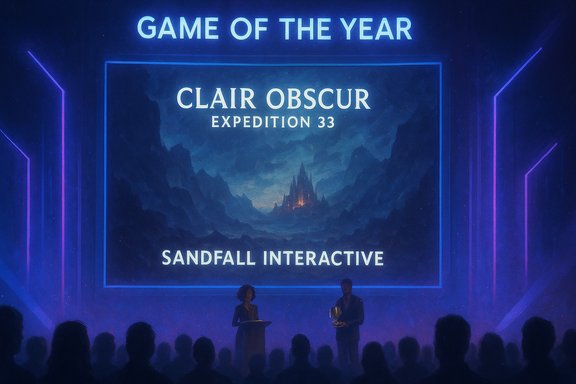
Clair Obscur: Expedition 33 walked away as the dominant story of the night at The Game Awards 2025, taking home the ceremony’s highest honor, Game of the Year, and picking up a sweeping collection of major prizes that underlined the unexpected power of an independently developed narrative RPG.
Background
The Game Awards 2025 unfolded at the Peacock Theater in Los Angeles on December 11, drawing global attention for both its prize roll call and the industry premieres that traditionally accompany the event. The ceremony was produced and hosted by Geoff Keighley and streamed across multiple platforms, continuing the show's role as the year’s most visible industry awards spectacle. This year’s nominations were notable for one runaway candidate: Sandfall Interactive’s debut title, Clair Obscur: Expedition 33, led the pack with a record number of nominations and converted that momentum into a historic haul of wins across major creative and technical categories. That dominance — and the implications for indie development, awards credibility, and platform politics — is the central thread of this analysis.What happened — the winners at a glance
The headline winners are straightforward and decisive: Clair Obscur: Expedition 33 earned Game of the Year as well as top honors in direction, narrative, art direction, score and music, and multiple indie-specific categories. The game’s success was amplified across performance and technical categories, making it the most awarded title of the night. Other category winners that shaped the evening included:- Battlefield 6 — Best Audio Design.
- Hades II — Best Action Game.
- Hollow Knight: Silksong — Best Action/Adventure Game.
- No Man’s Sky — Best Ongoing Game.
- MoistCr1TiKaL — Content Creator of the Year.
- Grand Theft Auto 6 — Most Anticipated Game.
Overview: Why Clair Obscur’s sweep matters
An indie triumph at scale
Clair Obscur’s trajectory from modest studio debut to awards juggernaut is notable for several reasons. First, it demonstrates that an independent studio can compete — and win — across categories traditionally dominated by larger publishers. Sandfall Interactive’s achievement challenges assumptions about production scale being a gating factor for awards recognition. Second, the game’s wins across narrative, direction, and technical categories indicate broad critical appreciation that spans both craft (writing, acting, music) and execution (art direction, audio design). This breadth matters: awards concentrated in a single domain (for example, only indie or only audio) tell a different story than cross-category recognition that names a game as the year’s best overall experience.The cultural and commercial ripple effects
A high-profile awards sweep translates directly into discoverability and sales momentum. Awards and the associated press coverage create renewed visibility in storefronts, influencer feeds, and “best of year” lists, which often trigger long-tail interest and extended commercial legs for narrative-driven titles. For an indie studio, that can mean the difference between a respectable run and long-term sustainability. The immediate deployment of an update after the ceremony is a practical signal that Sandfall intended to capitalize on the attention and resolve last-minute issues or add player-requested content.Deep dive: Major categories and what they reveal
Game of the Year — Clair Obscur: Expedition 33
Awarding Game of the Year to Clair Obscur signals an important editorial position from the jurors and voting public: the game’s narrative ambition and aesthetic voice outweighed the commercial heft and marketing reach of several big-budget contemporaries. The final set of nominees — including Death Stranding 2: On the Beach, Donkey Kong Bananza, Hades II, Hollow Knight: Silksong, and Kingdom Come: Deliverance II — represented a diverse field of blockbuster, AA, and auteur-led works, making the win a genuine consensus moment rather than a default pick. What to take from the choice:- The jury rewarded cohesion across design, story, and presentation.
- Narrative-driven, single-player games continue to command cultural weight.
- Independent developers with focused creative vision can outcompete bigger budgets in critical recognition.
Best Game Direction and Best Narrative — dual validation
Clair Obscur’s wins for Best Game Direction and Best Narrative effectively validated the studio’s creative leadership and writing. Direction awards tend to favor titles that show a unified voice in mechanical, pacing, and thematic choices; narrative prizes reward both script and the way story is delivered across systems and performances. Winning both is a strong indicator that judges saw the game as a crafted artistic whole rather than a collection of standout parts.Best Score & Music — orchestration as identity
Composer Lorien Testard’s award for Best Score and Music (for Clair Obscur) underscores the ascendancy of music as a defining element of modern narrative games. The distinction places the soundtrack as a storytelling tool, not merely incidental accompaniment, and recognizes how sonic texture can establish historical context, mood, and character identity. This win sits alongside recognition for Christopher Larkin (Hollow Knight: Silksong) and Darren Korb (Hades II) on a shortlist that blended indie staples and auteur composers.Audio design and performance — bridging craft and impact
Best Audio Design (won by Battlefield 6 this year) highlights the technical complexity and broadcast-scale expectations for immersive audio in contemporary games, while Best Performance (Jennifer English’s win for Maelle in Clair Obscur) signals that voice acting — and the emotional richness it can convey — remains a decisive component of narrative games. Together, these awards map how technical craft and human performance co-elevate a title’s emotional resonance.The broader awards landscape: notable winners and surprises
Ongoing games and live services
No Man’s Sky’s recognition as Best Ongoing Game reflects the long-term developer-to-community relationship model that yields awards traction over years rather than weeks. A title’s ability to evolve, add meaningful content, and retain player engagement are the hallmarks of this category, and Hello Games’ consistent post-launch investment has made No Man’s Sky a perennial contender in ongoing-service conversations.Indies, debuts, and discoverability
Sandfall’s success was mirrored in indie-specific categories: Best Independent Game and Best Debut Indie Game both contained Clair Obscur among nominees, and the game’s wins there reinforce a growing industry narrative: indies remain a primary engine of innovation and emotional risk-taking in the medium. That pattern benefits platform discoverability algorithms, storefront curation, and festival programming in the year ahead.Esports and content creators
Esports categories went to established competitive titles — Counter-Strike 2 for Best Esports Game and Chovy for Best Esports Athlete — while Content Creator of the Year recognized MoistCr1TiKaL, reflecting the persistent influence of individual creators in driving awareness and cultural conversation about games. These awards speak to the bifurcated nature of the industry: high-production, repeat-play competitive ecosystems operate alongside auteur-driven single-player experiences.Critical analysis: strengths, risks, and open questions
Strengths
- A clear win for artistic risk — The Game Awards’ choice of Clair Obscur rewards narrative ambition and stylistic distinctiveness, sending an industry signal that creative risk can be commercially and critically successful.
- Indie development visibility — The sweep will likely funnel attention, investment, and player curiosity toward smaller studios and narrative-driven projects.
- Recognition across craft — When one title wins both creative (narrative, score) and technical categories (art direction), it confirms that judges weighed holistic quality rather than isolated bells and whistles.
Risks and potential headaches
- Awards concentration and perception of bias — A single title collecting a large fraction of high-profile awards can create a perception that juries favored one aesthetic or campaign, which may prompt questions about nomination diversity and voting mechanics. Repeated dominations risk diminishing the awards’ perceived spread of recognition across genres and scales.
- Discoverability dependence — For other deserving titles, an awards sweep by one game can overshadow nominees in storefronts and feeds, reducing the promotional lift those runners-up would otherwise receive.
- Platform politics and press cycles — High-profile wins invite scrutiny of marketing, publisher influence, and jury composition. While there’s no evidence that the outcomes were improperly influenced, concentrated success raises legitimate public curiosity that award organizers must be prepared to address.
Unverifiable or weakly substantiated claims — flagged
A handful of statements floating in rapid post-show coverage require cautious treatment:- Reported nomination counts sometimes differ between outlets (the record 12 vs. 13 nomination figures), indicating small discrepancies in counting across categories and regional listings; these should be treated as proximate rather than exact until the official Game Awards press release is reviewed. Where exact nomination totals are material, consult the awards’ official nominees page for confirmation.
- Immediate commercial impacts (e.g., exact sales lifts or specific revenue figures after the ceremony) are typically not disclosed in real time and should be treated as estimations unless publishers release hard numbers.
What this means for developers, publishers, and players
For developers
A narrative-led indie can win the cultural loudspeaker. That suggests:- Publish and polish at launch: releases that are tightly focused on narrative and craft can outcompete in critical conversations even if marketing budgets are smaller.
- Build for longevity: post-launch updates, community engagement, and rapid responsiveness to player feedback extend an indie’s visibility window and can compound awards-season momentum.
For publishers
Recognize the trade-off between portfolio breadth and concentrated support. Smaller publishers can amplify a breakout hit by coordinating PR and community-facing updates timed with awards seasons.For players and communities
Expect renewed interest in single-player, story-first games and a potential influx of new players to titles that win high-profile awards. Community creators and streamers will play a crucial role in translating awards into long-term player engagement.Post-show behavior and the follow-up update
A noteworthy procedural detail: Sandfall Interactive shipped a previously promised update for Clair Obscur at the conclusion of the ceremony, a tactical move that leveraged the attention spike to deliver fresh content and fixes to new players. This kind of coordinated delivery — awards visibility + content update — is an effective marketing rhythm that other studios may emulate.Looking forward: trends to watch in 2026
- Continued elevation of indie auteurs: expect more boutique studios to chase narrative, artistic, and sonic distinction rather than technological spectacle.
- Awards season sequencing: publishers that plan targeted updates and timed patches around awards announcements will increasingly game the visibility cycle.
- Jury and voting mechanics scrutiny: as media attention concentrates around surprising picks or sweeping winners, organizers may be pressured to publish more transparent selection criteria and juror composition details to preserve credibility.
- Cross-platform discoverability strategies: winners will see immediate storefront elevation; designers must optimize not just the game but the product metadata, trailers, and review snapshots that appear when players search for “Game of the Year” and related SEO phrases.
Conclusion
The Game Awards 2025 reaffirmed a core dynamic that has animated the medium for years: artful, tightly focused games can still break through the noise and define the cultural conversation. Clair Obscur: Expedition 33’s sweep is both a creative victory for Sandfall Interactive and a practical demonstration of how storytelling, performance, and design coalesce to make a title stand out in a crowded marketplace. At the same time, the concentration of awards raises useful questions about distribution of recognition, the mechanics of juried prizes, and how visibility is allocated across the industry’s many deserving creators. The night’s winners offer both cause for celebration and a productive prompt for organizers, publishers, and players to think about how awards can best represent the medium’s diversity while still honoring exceptional achievement.Source: Windows Central https://www.windowscentral.com/gaming/the-game-awards-2025-winners/