

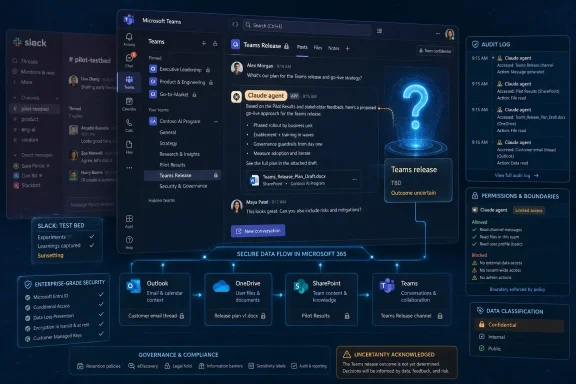
Anthropic is reportedly preparing a Claude agent for Microsoft Teams after launching Claude Tag for Slack on June 23, 2026, but neither Anthropic nor Microsoft has announced a Teams release date, confirmed the product, or explained how it would fit Microsoft 365 governance. That uncertainty is the story, not a footnote. A Teams-bound Claude would not merely be another chatbot tab; it would put a third-party agent inside the place where enterprise work is assigned, debated, approved, and remembered. For Windows shops, the question is less whether Claude can answer in a channel and more whether Microsoft will let a rival assistant operate meaningfully inside the collaboration layer it has spent years enclosing with Copilot.
The old enterprise AI pitch was simple: open a browser, ask a model a question, paste the answer back into your work. That was useful, but it was also peripheral. The more ambitious pitch now is that the agent should sit inside the shared workspace, watch the context accumulate, and accept work where humans already hand it off to one another.
Claude Tag is Anthropic’s clearest move in that direction. In Slack, it lets Team and Enterprise customers mention Claude inside approved channels, assign work, and receive results in the thread where the work began. Anthropic describes it as a multiplayer version of Claude rather than a private chat session, which is a subtle but important repositioning.
A private assistant belongs to a user. A channel agent belongs to a workspace, or at least appears to. That changes the security model, the billing model, the social model, and the way employees perceive its authority.
That is why the reported Microsoft Teams angle matters. Teams is not just chat for many organizations; it is the front door to Microsoft 365, meetings, files, approvals, calls, calendars, Power Platform workflows, SharePoint content, and line-of-business integrations. If Claude arrives there as a taggable participant, it steps into Microsoft’s most valuable enterprise context stream.
Anthropic says administrators can decide which tools and information Claude can access in which channels. It also presents the system as a set of separate Claude identities, with context and memory scoped to the channels and use cases administrators define. In theory, that prevents a sales-focused Claude from carrying information into an engineering context, or an engineering Claude from seeing commercial material it should not touch.
That design is an acknowledgment that workplace AI is now less about prompt quality than boundaries. The agent that can write a good summary is helpful. The agent that knows which documents it may read, which systems it may touch, which budget it may burn, and which rooms it may enter is deployable.
Slack is a natural starting point because it has a long history as an extensible collaboration hub. Teams is a more politically charged target because it sits inside Microsoft’s own productivity empire. A Claude agent in Slack competes with Salesforce’s ecosystem and the broader enterprise search field; a Claude agent in Teams competes more directly with Microsoft’s Copilot ambitions.
That is model choice, and Microsoft can sell it. Azure customers want access to frontier models without building separate procurement, identity, and networking arrangements for every AI provider. Foundry gives Microsoft a way to make money even when the model is not from OpenAI or Microsoft itself.
Assistant choice is different. A model in Foundry is a component. An agent in Teams is a presence. The former sits behind an application; the latter competes for user attention in Microsoft’s own workspace.
This is the central tension. Microsoft can profit from Anthropic models running inside Azure while still preferring Copilot to own the user-facing assistant layer. The company has spent heavily to make Copilot the connective tissue across Windows, Office, Edge, Teams, GitHub, and Azure. A third-party Claude teammate inside Teams would test how open that connective tissue really is.
Teams channels routinely contain customer names, contract language, unreleased product plans, HR discussions, incident reports, source code snippets, financial forecasts, and credentials that should not have been pasted there but inevitably were. An AI agent that can read channel history and act through approved tools inherits the messiness of real collaboration. The cleaner the demo, the less it resembles production.
Claude Tag’s Slack model suggests Anthropic understands this. Admins can set token-spend limits, scope access, and view logs of what Claude has done and who requested it. Slack conversations with Claude are also treated separately from ordinary Claude chat history, with deletion behavior tied to disconnecting or uninstalling the integration.
But Teams would raise Microsoft-specific questions. Would Claude be governed through Microsoft Entra ID consent flows, Teams app policies, Purview retention, eDiscovery, sensitivity labels, audit logs, and conditional access? Would channel data processed by Claude remain inside Microsoft-controlled infrastructure, Anthropic infrastructure, or a mix depending on the model and deployment path? Would administrators be able to enforce different rules for private channels, shared channels, external guests, and regulated departments?
Those details will matter more than any launch-day claim about productivity. Enterprise buyers have learned that the first demo of an AI agent is usually the easy part. The hard part begins when legal, security, finance, and operations ask what the agent saw, why it acted, who authorized it, and how to prove it did not leak context across boundaries.
That has advantages. A shared agent can preserve context, reduce repeated explanations, draft follow-ups, summarize unresolved threads, and help new team members catch up. It can become a lightweight project coordinator for the kind of messy work that never quite makes it into Jira, Planner, or ServiceNow.
It also creates ambiguity. If Claude suggests a course of action in a channel, is that merely generated text, or does it carry the implied authority of the person who tagged it? If it summarizes a disagreement, whose framing does it privilege? If it follows up on a stale task, is it helping the team or quietly changing the power dynamics of accountability?
This is where the phrase AI teammate does both useful and misleading work. It helps users understand that the system is persistent and collaborative. It also risks making an automated service feel like a participant with judgment, loyalty, and responsibility it does not actually possess.
The best enterprise deployments will be explicit about that distinction. Claude can be assigned work, but it should not become an invisible manager. It can draft, search, analyze, and propose, but organizations still need clear human owners for decisions, approvals, and consequences.
That home field advantage becomes stronger as Microsoft adds more agentic features to its own ecosystem. Microsoft has been moving Copilot from a prompt-and-response assistant toward delegated work, custom agents, business process automation, and role-specific copilots. The long-term goal is obvious: make Microsoft 365 not just where work is documented, but where work is increasingly performed by human-agent teams.
A Teams Claude would have to prove it is not redundant. For some organizations, the answer may be model preference. Developers and analysts who like Claude’s style, coding ability, or long-context behavior may want it available where conversations happen. For others, Claude may be attractive as a second opinion against Copilot, especially in high-value writing, reasoning, coding, or review workflows.
But the more deeply a task depends on Microsoft 365-native context, the harder it is for a third-party assistant to match Copilot without privileged integration. Microsoft can expose APIs and connectors, but it still controls the platform, the defaults, the admin center, and the packaging. In enterprise software, defaults are destiny more often than vendors like to admit.
But Foundry does not answer every Teams question. Running a Claude model through a Microsoft enterprise AI platform is not the same as allowing Claude to inhabit Teams channels as an agentic collaborator. One is a backend deployment option. The other is an interface, permission, and data-flow problem inside the daily workplace.
This distinction is easy to miss because vendors increasingly blur models, agents, copilots, connectors, and apps into one AI story. Administrators should resist that blur. A model endpoint has one risk profile; a channel agent with tool access has another.
The Foundry relationship may make a Teams integration more plausible. It gives Microsoft and Anthropic a commercial and technical bridge. It also gives Microsoft a way to insist that enterprise customers use governed deployment paths rather than consumer-style integrations.
Still, the platform politics remain. Microsoft may be comfortable selling Claude as a model choice inside Foundry while being more cautious about letting Claude become a first-class workplace assistant inside Teams. The economic incentives line up in one layer and collide in another.
Teams is valuable because it contains live context. SharePoint has the files, Outlook has the commitments, CRM systems have the pipeline, GitHub has the code, ServiceNow has the incidents, and databases have the facts. But chat has the intent: the messy human layer where priorities are negotiated and tasks are actually handed off.
That is why tagging an agent in a channel feels powerful. It collapses the distance between conversation and execution. Instead of translating a discussion into a ticket, a prompt, a workflow, and a report, the team can ask the agent to move while the context is still warm.
The danger is that context is not the same as permission. Just because an agent can infer what the team wants does not mean it should act. Just because a channel contains relevant information does not mean every participant, guest, connector, or downstream tool should inherit access to it.
This is the enterprise AI paradox. The more context an agent has, the more useful it becomes. The more useful it becomes, the more dangerous sloppy boundaries become.
Microsoft 365 tenants are not uniform. Some organizations run relatively open collaboration spaces with permissive sharing. Others use sensitivity labels, conditional access, retention policies, private channels, external collaboration controls, privileged access workflows, and strict data-loss prevention rules. A Teams agent that cannot map cleanly onto those differences will be hard to approve.
The same applies to billing. Token-spend limits sound mundane until a busy workspace turns a helpful assistant into an unpredictable cost center. Claude Tag’s Slack beta includes organization and channel-level spend limits, which is exactly the kind of feature Teams administrators would expect from day one.
Auditability is just as critical. If an AI agent generates a proposal, modifies a document, calls an internal tool, or summarizes a compliance discussion, admins need to know who requested the action and what the agent did. Without that record, the organization gets automation without accountability.
The best version of a Teams Claude would behave like a well-governed enterprise app: visible to administrators, constrained by policy, clear about its identity, limited by role, and boring in all the right places. The worst version would behave like a consumer bot smuggled into the tenant through convenience.
Adding an agent to that environment can help, but it can also amplify dysfunction. If a process has unclear ownership, the agent may produce activity without resolution. If a team has poor data hygiene, the agent may retrieve stale or contradictory information more efficiently. If approvals are informal, the agent may make the ambiguity harder to see.
This is why the agentic AI conversation is slowly moving from “What can the model do?” to “What should the organization delegate?” The answer will vary by department. A support team may benefit from an agent that drafts responses and pulls known fixes. A security team may use one to triage indicators and assemble incident timelines. A finance team may want analysis drafts but insist on human approval for anything external.
The companies that get value will not simply drop Claude or Copilot into every channel. They will pick bounded workflows, define allowed tools, document escalation paths, and measure whether the agent reduces handoff friction without creating new review burdens. That is less glamorous than an ambient AI teammate, but it is how enterprise software survives contact with reality.
A shallow integration would be politically safe but strategically limited. It would give Claude a Teams presence while leaving Copilot as the real agentic layer. A deeper integration would be more useful to customers but more threatening to Microsoft’s assistant strategy.
Microsoft has incentives on both sides. Regulators, enterprise customers, and developers all prefer credible platform openness. But Microsoft also wants Copilot to become the default assistant for work, and defaults are easier to defend when rivals are present but constrained.
This is where the history of Windows and Office looms over the AI era. Microsoft often wins not by excluding competitors outright, but by owning the surface where users spend time and making its own services feel native. If Claude comes to Teams, the question will be whether it feels native enough to matter.
The answer is uneven. Some organizations have mature identity, access, retention, and audit practices. Others still rely on informal channel naming, inconsistent file storage, and tribal knowledge. AI agents will expose those differences quickly.
A Claude Teams integration would force uncomfortable but necessary conversations. Which channels are safe for AI participation? Which tools may an agent use autonomously? Which data classes are off-limits? Who pays for agent activity? Who reviews outputs? What happens when the agent is wrong but plausible?
These questions are not anti-AI. They are the path to making AI useful in environments that have consequences. The alternative is a wave of pilots that impress executives, irritate security teams, confuse employees, and stall before production.
 Anthropic Is Chasing the Room Where Work Actually Happens
The old enterprise AI pitch was simple: open a browser, ask a model a question, paste the answer back into your work. That was useful, but it was also peripheral. The more ambitious pitch now is that the agent should sit inside the shared workspace, watch the context accumulate, and accept work where humans already hand it off to one another.Claude Tag is Anthropic’s clearest move in that direction. In Slack, it lets Team and Enterprise customers mention Claude inside approved channels, assign work, and receive results in the thread where the work began. Anthropic describes it as a multiplayer version of Claude rather than a private chat session, which is a subtle but important repositioning.
A private assistant belongs to a user. A channel agent belongs to a workspace, or at least appears to. That changes the security model, the billing model, the social model, and the way employees perceive its authority.
That is why the reported Microsoft Teams angle matters. Teams is not just chat for many organizations; it is the front door to Microsoft 365, meetings, files, approvals, calls, calendars, Power Platform workflows, SharePoint content, and line-of-business integrations. If Claude arrives there as a taggable participant, it steps into Microsoft’s most valuable enterprise context stream.
Slack Was the Test Bed, Not the Destination
Claude Tag’s Slack beta gives us the best available picture of what Anthropic may want to bring to Teams. The product is built around channel-level participation, administrative provisioning, tool access, organizational billing, and scoped memory. Those are not decorative enterprise features; they are the minimum viable controls for putting an agent in rooms where sensitive work happens.Anthropic says administrators can decide which tools and information Claude can access in which channels. It also presents the system as a set of separate Claude identities, with context and memory scoped to the channels and use cases administrators define. In theory, that prevents a sales-focused Claude from carrying information into an engineering context, or an engineering Claude from seeing commercial material it should not touch.
That design is an acknowledgment that workplace AI is now less about prompt quality than boundaries. The agent that can write a good summary is helpful. The agent that knows which documents it may read, which systems it may touch, which budget it may burn, and which rooms it may enter is deployable.
Slack is a natural starting point because it has a long history as an extensible collaboration hub. Teams is a more politically charged target because it sits inside Microsoft’s own productivity empire. A Claude agent in Slack competes with Salesforce’s ecosystem and the broader enterprise search field; a Claude agent in Teams competes more directly with Microsoft’s Copilot ambitions.
Microsoft Wants Model Choice, but Not Necessarily Assistant Choice
Microsoft’s relationship with Anthropic is already more complicated than a simple partner-versus-rival story. Claude models are available through Microsoft Foundry, giving Azure customers a way to consume Anthropic models through Microsoft’s enterprise AI platform. Microsoft documentation distinguishes between Claude models hosted on Azure infrastructure and those hosted on Anthropic infrastructure, and it frames the Foundry path around enterprise deployment, authentication, billing, quotas, and agent support.That is model choice, and Microsoft can sell it. Azure customers want access to frontier models without building separate procurement, identity, and networking arrangements for every AI provider. Foundry gives Microsoft a way to make money even when the model is not from OpenAI or Microsoft itself.
Assistant choice is different. A model in Foundry is a component. An agent in Teams is a presence. The former sits behind an application; the latter competes for user attention in Microsoft’s own workspace.
This is the central tension. Microsoft can profit from Anthropic models running inside Azure while still preferring Copilot to own the user-facing assistant layer. The company has spent heavily to make Copilot the connective tissue across Windows, Office, Edge, Teams, GitHub, and Azure. A third-party Claude teammate inside Teams would test how open that connective tissue really is.
The Governance Fight Starts Before the Bot Says Hello
For IT departments, a Teams integration would live or die on governance details that sound boring until they fail. Channel access, tool permissions, retention, audit logs, cost ceilings, admin consent, tenant boundaries, and data residency are not implementation trivia. They are the difference between a useful automation layer and a compliance incident with a friendly avatar.Teams channels routinely contain customer names, contract language, unreleased product plans, HR discussions, incident reports, source code snippets, financial forecasts, and credentials that should not have been pasted there but inevitably were. An AI agent that can read channel history and act through approved tools inherits the messiness of real collaboration. The cleaner the demo, the less it resembles production.
Claude Tag’s Slack model suggests Anthropic understands this. Admins can set token-spend limits, scope access, and view logs of what Claude has done and who requested it. Slack conversations with Claude are also treated separately from ordinary Claude chat history, with deletion behavior tied to disconnecting or uninstalling the integration.
But Teams would raise Microsoft-specific questions. Would Claude be governed through Microsoft Entra ID consent flows, Teams app policies, Purview retention, eDiscovery, sensitivity labels, audit logs, and conditional access? Would channel data processed by Claude remain inside Microsoft-controlled infrastructure, Anthropic infrastructure, or a mix depending on the model and deployment path? Would administrators be able to enforce different rules for private channels, shared channels, external guests, and regulated departments?
Those details will matter more than any launch-day claim about productivity. Enterprise buyers have learned that the first demo of an AI agent is usually the easy part. The hard part begins when legal, security, finance, and operations ask what the agent saw, why it acted, who authorized it, and how to prove it did not leak context across boundaries.
The Channel Agent Changes the Social Contract
Putting Claude in Teams would also alter the social dynamics of work. A bot that replies in a private chat is a tool. A bot that participates in a channel becomes part of the group’s operating rhythm.That has advantages. A shared agent can preserve context, reduce repeated explanations, draft follow-ups, summarize unresolved threads, and help new team members catch up. It can become a lightweight project coordinator for the kind of messy work that never quite makes it into Jira, Planner, or ServiceNow.
It also creates ambiguity. If Claude suggests a course of action in a channel, is that merely generated text, or does it carry the implied authority of the person who tagged it? If it summarizes a disagreement, whose framing does it privilege? If it follows up on a stale task, is it helping the team or quietly changing the power dynamics of accountability?
This is where the phrase AI teammate does both useful and misleading work. It helps users understand that the system is persistent and collaborative. It also risks making an automated service feel like a participant with judgment, loyalty, and responsibility it does not actually possess.
The best enterprise deployments will be explicit about that distinction. Claude can be assigned work, but it should not become an invisible manager. It can draft, search, analyze, and propose, but organizations still need clear human owners for decisions, approvals, and consequences.
Copilot Already Owns the Home Field Advantage
Microsoft does not enter this contest empty-handed. Copilot’s strongest asset is not necessarily model quality on a benchmark; it is its access to Microsoft 365 context. Microsoft Graph, Teams, Outlook, SharePoint, OneDrive, Planner, Loop, and the administrative fabric around them give Copilot a native position no outside agent can easily match.That home field advantage becomes stronger as Microsoft adds more agentic features to its own ecosystem. Microsoft has been moving Copilot from a prompt-and-response assistant toward delegated work, custom agents, business process automation, and role-specific copilots. The long-term goal is obvious: make Microsoft 365 not just where work is documented, but where work is increasingly performed by human-agent teams.
A Teams Claude would have to prove it is not redundant. For some organizations, the answer may be model preference. Developers and analysts who like Claude’s style, coding ability, or long-context behavior may want it available where conversations happen. For others, Claude may be attractive as a second opinion against Copilot, especially in high-value writing, reasoning, coding, or review workflows.
But the more deeply a task depends on Microsoft 365-native context, the harder it is for a third-party assistant to match Copilot without privileged integration. Microsoft can expose APIs and connectors, but it still controls the platform, the defaults, the admin center, and the packaging. In enterprise software, defaults are destiny more often than vendors like to admit.
Foundry Makes Claude Safe for Procurement, Not Automatically Safe for Teams
Claude’s availability in Microsoft Foundry is important because it lowers procurement friction. Azure customers can work through familiar marketplace, billing, identity, and infrastructure channels rather than treating Anthropic as a wholly separate vendor. For CIOs trying to rationalize AI sprawl, that matters.But Foundry does not answer every Teams question. Running a Claude model through a Microsoft enterprise AI platform is not the same as allowing Claude to inhabit Teams channels as an agentic collaborator. One is a backend deployment option. The other is an interface, permission, and data-flow problem inside the daily workplace.
This distinction is easy to miss because vendors increasingly blur models, agents, copilots, connectors, and apps into one AI story. Administrators should resist that blur. A model endpoint has one risk profile; a channel agent with tool access has another.
The Foundry relationship may make a Teams integration more plausible. It gives Microsoft and Anthropic a commercial and technical bridge. It also gives Microsoft a way to insist that enterprise customers use governed deployment paths rather than consumer-style integrations.
Still, the platform politics remain. Microsoft may be comfortable selling Claude as a model choice inside Foundry while being more cautious about letting Claude become a first-class workplace assistant inside Teams. The economic incentives line up in one layer and collide in another.
The Real Competitor Is Organizational Context
Anthropic, Microsoft, Glean, Snowflake, Databricks, Salesforce, Google, OpenAI, and a long list of enterprise software vendors are circling the same prize: organizational context. The model is increasingly just the visible tip of the stack. The deeper contest is over who can access, normalize, permission, remember, and act on the knowledge scattered across a company.Teams is valuable because it contains live context. SharePoint has the files, Outlook has the commitments, CRM systems have the pipeline, GitHub has the code, ServiceNow has the incidents, and databases have the facts. But chat has the intent: the messy human layer where priorities are negotiated and tasks are actually handed off.
That is why tagging an agent in a channel feels powerful. It collapses the distance between conversation and execution. Instead of translating a discussion into a ticket, a prompt, a workflow, and a report, the team can ask the agent to move while the context is still warm.
The danger is that context is not the same as permission. Just because an agent can infer what the team wants does not mean it should act. Just because a channel contains relevant information does not mean every participant, guest, connector, or downstream tool should inherit access to it.
This is the enterprise AI paradox. The more context an agent has, the more useful it becomes. The more useful it becomes, the more dangerous sloppy boundaries become.
Windows Shops Will Judge This Through the Admin Center, Not the Demo Video
For WindowsForum readers, the practical implications are straightforward. If Claude comes to Teams, the first evaluation should not be whether it writes a clever project summary. It should be whether it respects the control plane administrators already use.Microsoft 365 tenants are not uniform. Some organizations run relatively open collaboration spaces with permissive sharing. Others use sensitivity labels, conditional access, retention policies, private channels, external collaboration controls, privileged access workflows, and strict data-loss prevention rules. A Teams agent that cannot map cleanly onto those differences will be hard to approve.
The same applies to billing. Token-spend limits sound mundane until a busy workspace turns a helpful assistant into an unpredictable cost center. Claude Tag’s Slack beta includes organization and channel-level spend limits, which is exactly the kind of feature Teams administrators would expect from day one.
Auditability is just as critical. If an AI agent generates a proposal, modifies a document, calls an internal tool, or summarizes a compliance discussion, admins need to know who requested the action and what the agent did. Without that record, the organization gets automation without accountability.
The best version of a Teams Claude would behave like a well-governed enterprise app: visible to administrators, constrained by policy, clear about its identity, limited by role, and boring in all the right places. The worst version would behave like a consumer bot smuggled into the tenant through convenience.
Agentic AI Is Forcing Companies to Redesign Work, Not Just Accelerate It
The enthusiasm around channel agents often assumes that existing workflows are basically sound and merely need AI acceleration. That is optimistic. Many enterprise workflows are undocumented compromises held together by chat messages, calendar nudges, spreadsheet rituals, and heroic individuals who know where the bodies are buried.Adding an agent to that environment can help, but it can also amplify dysfunction. If a process has unclear ownership, the agent may produce activity without resolution. If a team has poor data hygiene, the agent may retrieve stale or contradictory information more efficiently. If approvals are informal, the agent may make the ambiguity harder to see.
This is why the agentic AI conversation is slowly moving from “What can the model do?” to “What should the organization delegate?” The answer will vary by department. A support team may benefit from an agent that drafts responses and pulls known fixes. A security team may use one to triage indicators and assemble incident timelines. A finance team may want analysis drafts but insist on human approval for anything external.
The companies that get value will not simply drop Claude or Copilot into every channel. They will pick bounded workflows, define allowed tools, document escalation paths, and measure whether the agent reduces handoff friction without creating new review burdens. That is less glamorous than an ambient AI teammate, but it is how enterprise software survives contact with reality.
Microsoft’s Openness Will Be Measured by How Much Claude Can Actually Do
If Anthropic does release a Teams agent, the most revealing detail will be not the installation flow but the allowed depth of integration. Can Claude only respond to mentions? Can it read channel history after explicit approval? Can it access files attached to conversations? Can it invoke Microsoft 365 tools? Can it participate in meetings, summarize transcripts, create tasks, update documents, or call external systems?A shallow integration would be politically safe but strategically limited. It would give Claude a Teams presence while leaving Copilot as the real agentic layer. A deeper integration would be more useful to customers but more threatening to Microsoft’s assistant strategy.
Microsoft has incentives on both sides. Regulators, enterprise customers, and developers all prefer credible platform openness. But Microsoft also wants Copilot to become the default assistant for work, and defaults are easier to defend when rivals are present but constrained.
This is where the history of Windows and Office looms over the AI era. Microsoft often wins not by excluding competitors outright, but by owning the surface where users spend time and making its own services feel native. If Claude comes to Teams, the question will be whether it feels native enough to matter.
The Claude-in-Teams Rumor Is Really a Test of Enterprise AI Maturity
There is a temptation to treat the reported Teams plan as a horse-race item: Anthropic versus Microsoft, Claude versus Copilot, Slack versus Teams. That framing is entertaining but too small. The larger issue is whether enterprises are ready to put powerful AI agents into shared workspaces without pretending the workspace is cleaner than it is.The answer is uneven. Some organizations have mature identity, access, retention, and audit practices. Others still rely on informal channel naming, inconsistent file storage, and tribal knowledge. AI agents will expose those differences quickly.
A Claude Teams integration would force uncomfortable but necessary conversations. Which channels are safe for AI participation? Which tools may an agent use autonomously? Which data classes are off-limits? Who pays for agent activity? Who reviews outputs? What happens when the agent is wrong but plausible?
These questions are not anti-AI. They are the path to making AI useful in environments that have consequences. The alternative is a wave of pilots that impress executives, irritate security teams, confuse employees, and stall before production.
The Teams Button Will Not Be the Hard Part
The concrete lesson from Claude Tag’s Slack beta is that a channel agent is a governance product disguised as a productivity product. If Teams support arrives, administrators should evaluate it accordingly.- Claude Tag is currently a Slack beta for Claude Team and Enterprise customers, and there is no confirmed Microsoft Teams release date.
- A Teams version would need tenant-grade controls for channel access, approved tools, spending limits, audit logs, retention, and data boundaries.
- Microsoft’s Foundry partnership with Anthropic makes Claude easier to procure and deploy as a model, but it does not automatically settle the politics of putting Claude inside Teams.
- Copilot retains a native advantage because Microsoft controls Teams, Microsoft 365 context, Graph, admin policy surfaces, and the default user experience.
- The most successful deployments will begin with bounded workflows rather than broad permission for an agent to roam through collaboration spaces.
- The real risk is not that Claude answers a question badly, but that organizations give an agent unclear authority inside channels that already contain sensitive and poorly governed context.
References
- Primary source: WinBuzzer
Published: Wed, 01 Jul 2026 19:25:37 GMT
Anthropic Eyes Claude Agent for Microsoft Teams
Anthropic is reportedly preparing Claude for Microsoft Teams, testing how workplace agents handle channel access, tools, billing and governance controls.winbuzzer.com - Related coverage: techradar.com
'Bringing Claude Tag into Slack is about making AI multiplayer': You can now tag Claude directly in Slack | TechRadar
Slack now lets you tag @Claude for helpwww.techradar.com - Related coverage: axios.com
Anthropic's Sonnet 5 offer less cybersecurity risk than Mythos, Fable
It says the model can use browsers, plan, code and do knowledge work while posing fewer risks than Mythos and Fable.www.axios.com
- Official source: learn.microsoft.com
Claude models in Microsoft Foundry - Microsoft Foundry | Microsoft Learn
Discover Claude models in Microsoft Foundry. Compare available models, capabilities, quotas, and supported regions to choose the right one for your AI use case.learn.microsoft.com - Official source: support.claude.com
Covered Models | Claude Help Center
support.claude.com
- Official source: anthropic.com
Introducing Claude Tag \ Anthropic
Claude Tag is a new way for teams to work with Claude.www.anthropic.com
- Related coverage: digitalapplied.com
Claude Tag in Slack: Multiplayer AI Teamwork in 2026
Anthropic's Claude Tag (beta June 23, 2026) gives teams one shared @Claude in Slack that anyone can steer — a persistent, multiplayer AI teammate, not a bot.www.digitalapplied.com - Related coverage: claudeainews.com
Claude Now Generally Available in Microsoft Azure Foundry | ClaudeAINews
Anthropic announces Claude is now generally available in Microsoft Azure AI Foundry, expanding enterprise access to its AI models through Microsoft's platform.www.claudeainews.com - Related coverage: thenewstack.io
- Related coverage: kiweekly.de
Anthropic bringt Claude Tag in Slack-Beta | KI Weekly
Anthropic startet Claude Tag, ein Slack-Feature für kanalbezogene Zusammenfassungen, proaktive Follow-ups und granulare Zugriffssteuerung; ab 23. Juni 2026 in der Beta für Enterprise- und Team-Kunden.www.kiweekly.de - Related coverage: virtualizationreview.com
As Mythos & Fable Flounder from Feds, Claude Flies on Foundry -- Virtualization Review
While Anthropic is dealing with a government-ordered suspension of its newest Fable and Mythos models, Microsoft is emphasizing a more enterprise-ready Claude path through Microsoft Foundry.virtualizationreview.com - Related coverage: mobigyaan.com
Anthropic's Claude Tag brings shared AI collaboration to Slack Teams
Anthropic has announced Claude Tag, a new collaborative AI experience for Slack that transforms Claude from an individual chatbot into a shared AI teammate.www.mobigyaan.com - Related coverage: qatechtools.com
Anthropic Launches Claude Tag for Slack Teams - QATechTools
Anthropic's June 23, 2026 Claude Tag beta brings @Claude into Slack for Team and Enterprise users. QA teams should test access controls and audit logs first.qatechtools.com - Related coverage: datacamp.com
Claude Tag: Anthropic's AI Teammate for Slack | DataCamp
Learn what Claude Tag is, how shared identity and memory work in Slack, what admins configure, and what changes before the August 3, 2026 migration deadline. www.datacamp.com
- Related coverage: windowscentral.com
Anthropic's new data retention policies cause Microsoft to temporarily ban its employees from using Claude Fable 5 AI | Windows Central
Microsoft clamps down on Anthropic’s Claude Fable 5 AI model over data protection concerns.www.windowscentral.com - Related coverage: tomshardware.com
Claude Fable 5 brings Mythos to the masses — Anthropic's new frontier model is 'state-of-the-art on nearly all tested benchmarks' | Tom's Hardware
Queries regarding cybersecurity, biology and chemistry, and distillation will be redirected to the prior-gen Opus 4.8, howeverwww.tomshardware.com - Related coverage: zeronoise.ai
- Related coverage: newsroom.ibm.com
IBM and Anthropic Partner to Advance Enterprise Software Development with Proven Security and Governance
PDF documentnewsroom.ibm.com
- Official source: www-cdn.anthropic.com