

On June 10, 2026, Minutehack published an opinion piece arguing that businesses adopting Anthropic’s Claude should treat AI emissions less as a per-prompt guilt trip and more as a supplier-transparency and Scope 3 reporting problem. That framing is the useful one. The carbon cost of a single text prompt may be tiny, but the enterprise question is not whether one employee should ask Claude to draft a memo. It is whether companies can credibly account for thousands of AI-assisted workflows when the vendors powering them disclose very different levels of environmental data.
The easiest way to misunderstand AI emissions is to shrink the debate down to the individual query. A prompt feels like a digital action, and digital actions have spent decades being marketed as weightless. But AI is not weightless; it is computation, networking, cooling, hardware manufacturing, grid demand, and increasingly a new round of data center construction.
That does not mean every business using Claude, ChatGPT, Gemini, or Copilot is suddenly carrying a major new carbon liability. In most offices, AI subscriptions will be a rounding error compared with travel, heating, logistics, manufacturing, cloud infrastructure, or purchased goods. The more serious issue is that AI is becoming embedded in procurement before many companies have worked out how to measure it.
That matters because carbon reporting is not only about physics. It is also about evidence. A company can only make a credible sustainability claim if it can explain where its numbers came from, what boundary it used, and which supplier assumptions sit underneath the calculation.
This is where Anthropic becomes an interesting test case. Claude may be technically impressive, and in some enterprise contexts it may be the best tool for the job. But as a private AI company, Anthropic does not yet give customers the same kind of public, corporate-level emissions reporting that Microsoft and Alphabet provide through annual sustainability reports.
That absence does not prove Claude is dirtier than Copilot or Gemini. It proves something narrower, but still important: customers have less supplier-specific data to work with.
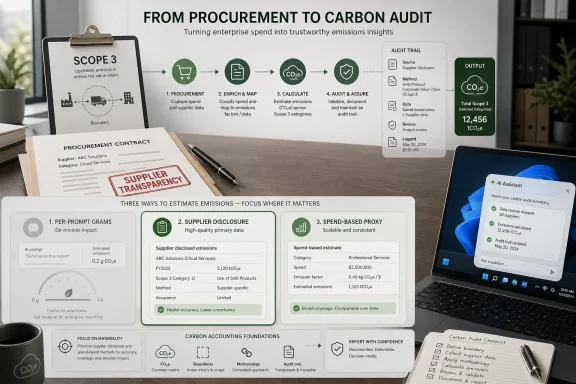
Spend-based accounting is blunt, but common. If a supplier cannot tell you the emissions associated with the service you bought, you estimate using the type of service and the money spent. In the Minutehack example, a £10,000 annual spend on Anthropic or a similar AI/software service is multiplied by a proxy factor of 0.1177 kg CO₂e per pound spent, producing an estimated 1.177 tonnes of CO₂e.
At an illustrative offset price of £15 per tonne, that comes out to £17.66. The same article compares that with estimates of £9.41 for Microsoft Copilot and £7.70 for Google Gemini, using reported corporate emissions intensity figures rather than the broader industry proxy.
The arithmetic is almost comically small in budget terms. A medium-sized business will spend more than that on replacement keyboards, conference-room coffee, or one badly timed taxi ride. But the real issue is not the offset bill. It is the evidentiary quality of the number.
A spend-based proxy tells a sustainability team, “we used a defensible average because better supplier data was unavailable.” A supplier-specific number says, “we have evidence from the company providing the service.” Those are very different positions when a customer, investor, regulator, or procurement department asks how the figure was derived.
Scope 1 emissions are the emissions an organisation directly produces. Scope 2 covers purchased energy. Scope 3 is the sprawling category that includes value-chain emissions, from suppliers to business travel to purchased services. For most digital services, customers are usually dealing with Scope 3.
That creates a chain of dependency. If a business uses Microsoft 365 Copilot, Azure AI, Gemini, ChatGPT Enterprise, Claude, or another AI service, it is not directly running the data center. It is buying access to someone else’s compute stack. Its reporting quality therefore depends heavily on what that provider discloses.
Microsoft and Google are not perfect environmental actors simply because they publish reports. In fact, their own disclosures have shown how hard the AI build-out is making their climate commitments. Microsoft has acknowledged rising total emissions against its 2020 baseline, driven in part by cloud and AI expansion, even as it reports reductions in Scope 1 and 2 emissions. Google has also had to confront the tension between AI demand, data center growth, and its clean-energy ambitions.
But disclosure changes the conversation. Public reporting allows customers to scrutinise the trend, challenge the assumptions, compare progress year to year, and decide whether a supplier’s claims are good enough. With less disclosure, the customer is pushed toward estimation.
That is why Anthropic’s issue is structural rather than moral. The company may be running efficient workloads, relying on cleaner infrastructure partners, or improving rapidly behind the scenes. But until it publishes fuller data, corporate customers cannot easily distinguish between a low-carbon supplier and an opaque one.
Those comparisons are useful for perspective, but dangerous when over-interpreted. AI inference is not one thing. A short classification request, a long legal summary, a code-generation session, a tool-using agent, an image prompt, and a video-generation workload have very different compute profiles.
The Minutehack piece gives indicative 2025–2026 estimates: around 0.03 g CO₂e for a Google Gemini text query, around 0.13–0.19 g CO₂e for an OpenAI GPT-4o query, and around 0.2–0.4 g CO₂e for standard Claude models. The article rightly treats those figures as variable rather than definitive. Model size, output length, data center efficiency, hardware utilisation, and electricity mix all matter.
For everyday office text use, the conclusion is reassuring. Tens of thousands of prompts a month may still amount to only a few kilograms of CO₂e a year. In the hierarchy of corporate emissions, that is usually tiny.
But enterprise AI is not stopping at office text. Microsoft is putting Copilot into Windows, Office, security tooling, developer workflows, and management consoles. Google is pushing Gemini across Workspace, Cloud, Android, and search-adjacent experiences. OpenAI and Anthropic are selling coding agents, research agents, and workflow automation. The industry is moving from occasional prompts to always-available assistants.
At that point, the meaningful unit is no longer the prompt. It is the workflow. A support ticket resolved by an AI agent may involve retrieval, tool calls, multiple model passes, logging, moderation, and summarisation. A developer assistant may generate, test, revise, and explain code repeatedly. A “simple” user-facing answer may sit on top of a stack of hidden inference.
That is why per-query emissions should be treated as context, not absolution. They show that AI can be efficient. They do not show that AI at industrial scale is environmentally trivial.
Copilot is the obvious example, but it is only one piece of a larger shift. Windows PCs are being marketed around neural processing units. Developers are being steered toward AI-assisted coding. Security products increasingly use AI for triage and response. SaaS vendors are adding assistants to dashboards that once contained only menus and reports.
That changes the environmental question. A company that explicitly buys 100 Claude seats can estimate and report that spend. A company whose employees use AI features buried inside five different subscriptions may struggle even to inventory usage. Shadow AI is not just a data-governance problem; it is also a carbon-accounting problem, albeit usually a small one.
Sysadmins already know how this movie starts. A tool appears first as an optional feature, then as a default button, then as a workflow assumption. By the time finance asks how many users are relying on it, the answer is somewhere between “everyone” and “we have no clean telemetry.”
The practical response is not to ban AI from Windows environments. It is to treat AI capabilities as services that need ownership. If Copilot, Claude, Gemini, or ChatGPT is being used in production workflows, someone should know who approved it, what data it touches, how it is paid for, and how it is represented in sustainability reporting.
This is especially true for organisations with formal net-zero targets. The emissions may be small, but unmeasured services have a way of multiplying. The first few licences are an experiment. The next few hundred are a procurement category. The embedded features after that are simply part of doing business.
Microsoft’s reported intensity reflects a vast business that includes cloud services, software subscriptions, gaming, devices, professional services, and data center expansion. Google’s numbers span advertising, cloud, consumer services, hardware, offices, and global infrastructure. Copilot and Gemini sit inside those corporate machines, but they are not identical to them.
Still, Microsoft and Google do offer something Anthropic currently does not offer at the same level: a public reporting apparatus. That apparatus includes emissions categories, energy claims, water metrics, renewable-energy strategies, and year-over-year progress. Customers can debate the methodology, but they have material to debate.
The uncomfortable truth is that the most transparent companies may also be the ones showing the scariest numbers. Microsoft’s AI and cloud growth has complicated its 2030 sustainability path. Google’s data center demand has intensified scrutiny of its net-zero and carbon-free energy commitments. The reports do not make those problems disappear; they make them visible.
For enterprise buyers, visibility is valuable. A supplier with rising emissions and detailed reporting may be easier to govern than a supplier with unknown emissions and excellent marketing. Sustainability is not a vibes-based discipline. It is a record-keeping discipline.
This is where procurement teams should resist both greenwashing and panic. A lower estimated emissions factor should not automatically decide the vendor. Nor should a lack of supplier-specific reporting automatically disqualify a technically superior product. The decision should be made with eyes open: performance, security, cost, data controls, contractual terms, and sustainability evidence all belong in the same room.
That progress is real. It is also only half the story.
The other half is demand. The industry is not using efficiency gains to keep total compute flat. It is using them to make more AI economically viable. More assistants, more agents, more synthetic media, more code generation, more search augmentation, more background automation, and more enterprise integration all increase aggregate demand.
This is the classic rebound problem. When a technology becomes cheaper and more efficient, people often use more of it. If AI becomes ten times more efficient but is deployed a hundred times more widely, the grid still notices.
The environmental debate therefore cannot be settled by pointing to clever chips or cleaner cooling loops. Those are necessary improvements, not guarantees. The key question is whether efficiency gains outpace growth in usage, hardware manufacturing, and data center construction.
Businesses should be wary of vendor narratives that treat AI as automatically sustainable because it can optimise other systems. AI can help reduce waste, improve logistics, model climate risk, analyse energy use, and support scientific research. It can also generate millions of low-value images, automate spam, duplicate work, and encourage organisations to run compute-heavy processes because they are novel rather than necessary.
The same tool can be part of a climate solution or part of a demand problem. The difference is governance.
But offsets should not be the centre of the decision. A tiny offset cost can create a false sense that the problem has been solved. In reality, the important work happens before the offset: choosing a reporting method, setting boundaries, identifying supplier data gaps, and deciding how AI usage should be monitored.
For many organisations, the right answer will be boring. Add AI subscriptions to the purchased-services inventory. Use supplier-specific data where available. Use a recognised spend-based factor where it is not. Document the assumption. Review it annually. Ask vendors for better disclosure.
That process will not produce viral marketing copy. It will produce a defensible audit trail.
The offset conversation also risks flattening different environmental impacts into a single price. AI data centers raise questions about electricity demand, local grid constraints, water use, land use, embodied carbon in construction, and semiconductor supply chains. Carbon offsets do not automatically answer those questions.
This matters particularly in regions where data center growth is colliding with local infrastructure. A data center powered by renewable-energy contracts may still create grid-planning, water, or land-use controversies. Corporate carbon accounting is necessary, but it is not the whole environmental picture.
A sensible AI procurement process should look much like a mature cloud procurement process. The buyer should ask what regions are used, what data is retained, what subcontractors are involved, what audit rights exist, what certifications are available, and what environmental data can be supplied. If the vendor cannot provide product-level data, the buyer should ask for corporate data. If the vendor cannot provide that, the buyer should record the gap.
Anthropic, OpenAI, Microsoft, Google, Amazon, and others will increasingly be judged not only by benchmark scores but by operational transparency. Enterprise customers do not buy magic. They buy risk allocation. A vendor that cannot answer basic sustainability questions is handing that risk back to the customer.
That does not mean every small business needs a climate analyst before buying Claude Team. Proportionality matters. A ten-person consultancy using Claude for writing support does not need the same reporting machinery as a multinational bank deploying AI across customer service, software development, compliance, and internal knowledge systems.
But the habit should be the same at every scale: know what you use, know what you spend, know what you can prove, and know where you are estimating.
Companies should distinguish between AI that replaces waste and AI that creates it. If Claude helps a team summarise documents faster, reduce duplicated research, or improve accessibility, the emissions trade-off may be easy to justify. If a workflow uses a large model to generate decorative sludge nobody reads, the business case is weaker before sustainability even enters the room.
This is a familiar problem in Windows administration. Automation is good when it removes toil. Automation is bad when it creates opaque systems that nobody understands. AI raises the same operational question, with an environmental tail attached.
The most mature organisations will not ask employees to calculate grams of CO₂e before every prompt. That would be absurd. They will set sensible defaults: approved tools, appropriate models, clear data rules, usage monitoring, and periodic review of high-volume workflows.
They will also avoid treating all AI tasks as equal. A short text prompt is not the same as bulk image generation. A local model running on an NPU is not the same as a frontier model performing multi-step reasoning in the cloud. A one-off experiment is not the same as an always-on agent executing thousands of tasks a day.
The lesson is not “use less technology.” It is “use the right amount of technology for the job.”
For Windows-heavy businesses, the AI stack is already fragmenting. Copilot may arrive through Microsoft 365. Developers may prefer GitHub Copilot, Claude Code, or other assistants. Marketing may use ChatGPT or Gemini. Analysts may experiment with browser-based tools. Customer support may trial an AI agent from a SaaS provider whose own model supplier is buried two contracts down.
A sustainability team cannot report what IT cannot see. IT cannot govern what procurement never logged. Procurement cannot compare what vendors do not disclose.
That is why the carbon ledger belongs beside the security review and cost model, not in a separate annual scramble. If AI is important enough to approve, it is important enough to inventory. If a vendor is important enough to standardise on, it is important enough to question.
This does not require turning sysadmins into environmental accountants. It requires adding a few lines to an already familiar checklist. Does the vendor publish emissions data? Does it provide product-level or service-level reporting? Are estimates based on supplier-specific data or spend-based factors? Does the vendor disclose data center energy, water, and carbon-reduction plans? Can usage be tracked well enough to identify material growth?
Those questions will not decide every procurement. But they will stop AI from becoming another unmanaged externality hidden inside “software spend.”
 The Carbon Story Is Really a Procurement Story
The easiest way to misunderstand AI emissions is to shrink the debate down to the individual query. A prompt feels like a digital action, and digital actions have spent decades being marketed as weightless. But AI is not weightless; it is computation, networking, cooling, hardware manufacturing, grid demand, and increasingly a new round of data center construction.That does not mean every business using Claude, ChatGPT, Gemini, or Copilot is suddenly carrying a major new carbon liability. In most offices, AI subscriptions will be a rounding error compared with travel, heating, logistics, manufacturing, cloud infrastructure, or purchased goods. The more serious issue is that AI is becoming embedded in procurement before many companies have worked out how to measure it.
That matters because carbon reporting is not only about physics. It is also about evidence. A company can only make a credible sustainability claim if it can explain where its numbers came from, what boundary it used, and which supplier assumptions sit underneath the calculation.
This is where Anthropic becomes an interesting test case. Claude may be technically impressive, and in some enterprise contexts it may be the best tool for the job. But as a private AI company, Anthropic does not yet give customers the same kind of public, corporate-level emissions reporting that Microsoft and Alphabet provide through annual sustainability reports.
That absence does not prove Claude is dirtier than Copilot or Gemini. It proves something narrower, but still important: customers have less supplier-specific data to work with.
Anthropic’s Problem Is Not Claude’s Prompt, It Is Claude’s Paper Trail
Minutehack’s central claim is that, as of mid-2026, Anthropic has not published a full corporate sustainability report with audited Scope 1, Scope 2, and Scope 3 emissions comparable to the disclosures from Microsoft and Google’s parent company Alphabet. That is the hinge of the argument. Without that corporate reporting, businesses trying to account for Claude usage may have to fall back on spend-based emissions factors.Spend-based accounting is blunt, but common. If a supplier cannot tell you the emissions associated with the service you bought, you estimate using the type of service and the money spent. In the Minutehack example, a £10,000 annual spend on Anthropic or a similar AI/software service is multiplied by a proxy factor of 0.1177 kg CO₂e per pound spent, producing an estimated 1.177 tonnes of CO₂e.
At an illustrative offset price of £15 per tonne, that comes out to £17.66. The same article compares that with estimates of £9.41 for Microsoft Copilot and £7.70 for Google Gemini, using reported corporate emissions intensity figures rather than the broader industry proxy.
The arithmetic is almost comically small in budget terms. A medium-sized business will spend more than that on replacement keyboards, conference-room coffee, or one badly timed taxi ride. But the real issue is not the offset bill. It is the evidentiary quality of the number.
A spend-based proxy tells a sustainability team, “we used a defensible average because better supplier data was unavailable.” A supplier-specific number says, “we have evidence from the company providing the service.” Those are very different positions when a customer, investor, regulator, or procurement department asks how the figure was derived.
Scope 3 Turns AI From an IT Choice Into a Reporting Dependency
For IT buyers, the awkwardness is familiar. The best tool on technical grounds is not always the easiest tool to approve on governance grounds. Security teams ask about data retention, model training, identity controls, and audit logs. Legal teams ask about intellectual property and jurisdiction. Sustainability teams now have their own version of the same question: what can the vendor prove about its environmental footprint?Scope 1 emissions are the emissions an organisation directly produces. Scope 2 covers purchased energy. Scope 3 is the sprawling category that includes value-chain emissions, from suppliers to business travel to purchased services. For most digital services, customers are usually dealing with Scope 3.
That creates a chain of dependency. If a business uses Microsoft 365 Copilot, Azure AI, Gemini, ChatGPT Enterprise, Claude, or another AI service, it is not directly running the data center. It is buying access to someone else’s compute stack. Its reporting quality therefore depends heavily on what that provider discloses.
Microsoft and Google are not perfect environmental actors simply because they publish reports. In fact, their own disclosures have shown how hard the AI build-out is making their climate commitments. Microsoft has acknowledged rising total emissions against its 2020 baseline, driven in part by cloud and AI expansion, even as it reports reductions in Scope 1 and 2 emissions. Google has also had to confront the tension between AI demand, data center growth, and its clean-energy ambitions.
But disclosure changes the conversation. Public reporting allows customers to scrutinise the trend, challenge the assumptions, compare progress year to year, and decide whether a supplier’s claims are good enough. With less disclosure, the customer is pushed toward estimation.
That is why Anthropic’s issue is structural rather than moral. The company may be running efficient workloads, relying on cleaner infrastructure partners, or improving rapidly behind the scenes. But until it publishes fuller data, corporate customers cannot easily distinguish between a low-carbon supplier and an opaque one.
The Per-Query Debate Is Too Small for the Enterprise Reality
The numbers attached to individual AI prompts are seductive because they appear to make the problem concrete. One text query may be described in fractions of a gram of CO₂e. A median Gemini prompt, a GPT-4o query, or a Claude response can be compared in grams, watt-hours, drops of water, or seconds of television viewing.Those comparisons are useful for perspective, but dangerous when over-interpreted. AI inference is not one thing. A short classification request, a long legal summary, a code-generation session, a tool-using agent, an image prompt, and a video-generation workload have very different compute profiles.
The Minutehack piece gives indicative 2025–2026 estimates: around 0.03 g CO₂e for a Google Gemini text query, around 0.13–0.19 g CO₂e for an OpenAI GPT-4o query, and around 0.2–0.4 g CO₂e for standard Claude models. The article rightly treats those figures as variable rather than definitive. Model size, output length, data center efficiency, hardware utilisation, and electricity mix all matter.
For everyday office text use, the conclusion is reassuring. Tens of thousands of prompts a month may still amount to only a few kilograms of CO₂e a year. In the hierarchy of corporate emissions, that is usually tiny.
But enterprise AI is not stopping at office text. Microsoft is putting Copilot into Windows, Office, security tooling, developer workflows, and management consoles. Google is pushing Gemini across Workspace, Cloud, Android, and search-adjacent experiences. OpenAI and Anthropic are selling coding agents, research agents, and workflow automation. The industry is moving from occasional prompts to always-available assistants.
At that point, the meaningful unit is no longer the prompt. It is the workflow. A support ticket resolved by an AI agent may involve retrieval, tool calls, multiple model passes, logging, moderation, and summarisation. A developer assistant may generate, test, revise, and explain code repeatedly. A “simple” user-facing answer may sit on top of a stack of hidden inference.
That is why per-query emissions should be treated as context, not absolution. They show that AI can be efficient. They do not show that AI at industrial scale is environmentally trivial.
Windows Users Are About to Meet AI as Infrastructure, Not an App
For WindowsForum readers, this debate is not abstract. AI is no longer a browser tab you open when you feel like it. It is becoming part of the operating system, the productivity suite, the endpoint security stack, and the admin console.Copilot is the obvious example, but it is only one piece of a larger shift. Windows PCs are being marketed around neural processing units. Developers are being steered toward AI-assisted coding. Security products increasingly use AI for triage and response. SaaS vendors are adding assistants to dashboards that once contained only menus and reports.
That changes the environmental question. A company that explicitly buys 100 Claude seats can estimate and report that spend. A company whose employees use AI features buried inside five different subscriptions may struggle even to inventory usage. Shadow AI is not just a data-governance problem; it is also a carbon-accounting problem, albeit usually a small one.
Sysadmins already know how this movie starts. A tool appears first as an optional feature, then as a default button, then as a workflow assumption. By the time finance asks how many users are relying on it, the answer is somewhere between “everyone” and “we have no clean telemetry.”
The practical response is not to ban AI from Windows environments. It is to treat AI capabilities as services that need ownership. If Copilot, Claude, Gemini, or ChatGPT is being used in production workflows, someone should know who approved it, what data it touches, how it is paid for, and how it is represented in sustainability reporting.
This is especially true for organisations with formal net-zero targets. The emissions may be small, but unmeasured services have a way of multiplying. The first few licences are an experiment. The next few hundred are a procurement category. The embedded features after that are simply part of doing business.
Microsoft and Google Have More Data, Not a Free Pass
It would be easy to read the comparison table and conclude that Microsoft and Google are the “greener” choices, while Anthropic is the risky one. That is too neat. Corporate emissions intensity is not the same as product-level emissions, and a broad organisational ratio may hide as much as it reveals.Microsoft’s reported intensity reflects a vast business that includes cloud services, software subscriptions, gaming, devices, professional services, and data center expansion. Google’s numbers span advertising, cloud, consumer services, hardware, offices, and global infrastructure. Copilot and Gemini sit inside those corporate machines, but they are not identical to them.
Still, Microsoft and Google do offer something Anthropic currently does not offer at the same level: a public reporting apparatus. That apparatus includes emissions categories, energy claims, water metrics, renewable-energy strategies, and year-over-year progress. Customers can debate the methodology, but they have material to debate.
The uncomfortable truth is that the most transparent companies may also be the ones showing the scariest numbers. Microsoft’s AI and cloud growth has complicated its 2030 sustainability path. Google’s data center demand has intensified scrutiny of its net-zero and carbon-free energy commitments. The reports do not make those problems disappear; they make them visible.
For enterprise buyers, visibility is valuable. A supplier with rising emissions and detailed reporting may be easier to govern than a supplier with unknown emissions and excellent marketing. Sustainability is not a vibes-based discipline. It is a record-keeping discipline.
This is where procurement teams should resist both greenwashing and panic. A lower estimated emissions factor should not automatically decide the vendor. Nor should a lack of supplier-specific reporting automatically disqualify a technically superior product. The decision should be made with eyes open: performance, security, cost, data controls, contractual terms, and sustainability evidence all belong in the same room.
The AI Industry Wants Credit for Efficiency While Building for Abundance
AI companies have a strong argument on efficiency. Models are getting better per unit of compute. Hardware is improving. Data centers are being redesigned around liquid cooling, direct-to-chip cooling, higher utilisation, and more sophisticated energy management. Some workloads that once required a frontier model can now be handled by smaller models, distilled models, or on-device inference.That progress is real. It is also only half the story.
The other half is demand. The industry is not using efficiency gains to keep total compute flat. It is using them to make more AI economically viable. More assistants, more agents, more synthetic media, more code generation, more search augmentation, more background automation, and more enterprise integration all increase aggregate demand.
This is the classic rebound problem. When a technology becomes cheaper and more efficient, people often use more of it. If AI becomes ten times more efficient but is deployed a hundred times more widely, the grid still notices.
The environmental debate therefore cannot be settled by pointing to clever chips or cleaner cooling loops. Those are necessary improvements, not guarantees. The key question is whether efficiency gains outpace growth in usage, hardware manufacturing, and data center construction.
Businesses should be wary of vendor narratives that treat AI as automatically sustainable because it can optimise other systems. AI can help reduce waste, improve logistics, model climate risk, analyse energy use, and support scientific research. It can also generate millions of low-value images, automate spam, duplicate work, and encourage organisations to run compute-heavy processes because they are novel rather than necessary.
The same tool can be part of a climate solution or part of a demand problem. The difference is governance.
Offsets Are the Least Interesting Number in the Table
The Minutehack example uses offset costs to make the emissions estimate legible. That is fair enough. Turning 1.177 tonnes of CO₂e into £17.66 at £15 per tonne helps readers understand scale.But offsets should not be the centre of the decision. A tiny offset cost can create a false sense that the problem has been solved. In reality, the important work happens before the offset: choosing a reporting method, setting boundaries, identifying supplier data gaps, and deciding how AI usage should be monitored.
For many organisations, the right answer will be boring. Add AI subscriptions to the purchased-services inventory. Use supplier-specific data where available. Use a recognised spend-based factor where it is not. Document the assumption. Review it annually. Ask vendors for better disclosure.
That process will not produce viral marketing copy. It will produce a defensible audit trail.
The offset conversation also risks flattening different environmental impacts into a single price. AI data centers raise questions about electricity demand, local grid constraints, water use, land use, embodied carbon in construction, and semiconductor supply chains. Carbon offsets do not automatically answer those questions.
This matters particularly in regions where data center growth is colliding with local infrastructure. A data center powered by renewable-energy contracts may still create grid-planning, water, or land-use controversies. Corporate carbon accounting is necessary, but it is not the whole environmental picture.
The Better Question for Claude Is the One Buyers Already Ask of Cloud
The good news is that IT has a template for this. Cloud computing went through a similar evolution. At first, the conversation was mostly about convenience and cost. Then came security, sovereignty, resilience, and eventually sustainability reporting. AI is moving through the same cycle, only faster.A sensible AI procurement process should look much like a mature cloud procurement process. The buyer should ask what regions are used, what data is retained, what subcontractors are involved, what audit rights exist, what certifications are available, and what environmental data can be supplied. If the vendor cannot provide product-level data, the buyer should ask for corporate data. If the vendor cannot provide that, the buyer should record the gap.
Anthropic, OpenAI, Microsoft, Google, Amazon, and others will increasingly be judged not only by benchmark scores but by operational transparency. Enterprise customers do not buy magic. They buy risk allocation. A vendor that cannot answer basic sustainability questions is handing that risk back to the customer.
That does not mean every small business needs a climate analyst before buying Claude Team. Proportionality matters. A ten-person consultancy using Claude for writing support does not need the same reporting machinery as a multinational bank deploying AI across customer service, software development, compliance, and internal knowledge systems.
But the habit should be the same at every scale: know what you use, know what you spend, know what you can prove, and know where you are estimating.
The Real Governance Win Is Knowing When Not to Use AI
There is one environmental control that vendors rarely emphasise: restraint. The cleanest inference is the one you do not run because it adds no value. The best AI policy is not a ban, but neither is it a blank cheque.Companies should distinguish between AI that replaces waste and AI that creates it. If Claude helps a team summarise documents faster, reduce duplicated research, or improve accessibility, the emissions trade-off may be easy to justify. If a workflow uses a large model to generate decorative sludge nobody reads, the business case is weaker before sustainability even enters the room.
This is a familiar problem in Windows administration. Automation is good when it removes toil. Automation is bad when it creates opaque systems that nobody understands. AI raises the same operational question, with an environmental tail attached.
The most mature organisations will not ask employees to calculate grams of CO₂e before every prompt. That would be absurd. They will set sensible defaults: approved tools, appropriate models, clear data rules, usage monitoring, and periodic review of high-volume workflows.
They will also avoid treating all AI tasks as equal. A short text prompt is not the same as bulk image generation. A local model running on an NPU is not the same as a frontier model performing multi-step reasoning in the cloud. A one-off experiment is not the same as an always-on agent executing thousands of tasks a day.
The lesson is not “use less technology.” It is “use the right amount of technology for the job.”
The Claude Carbon Ledger Belongs Beside Security and Cost
The most practical reading of the Anthropic emissions debate is not that Claude is environmentally suspect. It is that Claude is a reminder of how quickly AI purchasing has outrun ordinary governance.For Windows-heavy businesses, the AI stack is already fragmenting. Copilot may arrive through Microsoft 365. Developers may prefer GitHub Copilot, Claude Code, or other assistants. Marketing may use ChatGPT or Gemini. Analysts may experiment with browser-based tools. Customer support may trial an AI agent from a SaaS provider whose own model supplier is buried two contracts down.
A sustainability team cannot report what IT cannot see. IT cannot govern what procurement never logged. Procurement cannot compare what vendors do not disclose.
That is why the carbon ledger belongs beside the security review and cost model, not in a separate annual scramble. If AI is important enough to approve, it is important enough to inventory. If a vendor is important enough to standardise on, it is important enough to question.
This does not require turning sysadmins into environmental accountants. It requires adding a few lines to an already familiar checklist. Does the vendor publish emissions data? Does it provide product-level or service-level reporting? Are estimates based on supplier-specific data or spend-based factors? Does the vendor disclose data center energy, water, and carbon-reduction plans? Can usage be tracked well enough to identify material growth?
Those questions will not decide every procurement. But they will stop AI from becoming another unmanaged externality hidden inside “software spend.”
The Numbers Say “Small,” the Trend Says “Watch Closely”
The immediate business takeaway from the Minutehack analysis is reassuring but not dismissive. For moderate text use, AI emissions are likely to be small. For a £10,000 annual Anthropic spend, the illustrative emissions estimate is just over a tonne of CO₂e, with a token offset cost. The problem is not that Claude will blow up a company’s carbon budget overnight. The problem is that AI is becoming too operationally important to leave out of serious reporting.- Businesses should treat AI tools as reportable purchased services when they fall within Scope 3 boundaries.
- Anthropic’s current public reporting gap means customers may need to use spend-based proxy factors unless better supplier data is provided directly.
- Microsoft and Google offer more public sustainability data, but their AI and cloud expansion still complicates their own climate trajectories.
- Per-query emissions estimates are useful for perspective, but they are too narrow to capture agents, media generation, hidden model calls, and enterprise-scale automation.
- The most credible AI sustainability policy is proportional: measure material use, document assumptions, ask vendors for transparency, and focus reduction work where emissions are actually significant.
- Windows and Microsoft 365 environments should inventory embedded AI features because the line between “AI tool” and “ordinary software feature” is disappearing.
References
- Primary source: Minutehack
Published: 2026-06-10T17:50:07.434887
Anthropic AI And Carbon Emissions: What Businesses Should Consider - Minutehack
Opinion pieces by entrepreneurs, executives and experts on aspects of running businessesminutehack.com - Related coverage: tomshardware.com
Google quietly removes net-zero carbon goal from website amid rapid power-hungry AI data center buildout — industry-first sustainability pledge moved to background amidst AI energy crisis | Tom's Hardware
Google's goal to be net-zero in carbon emissions by 2030 is still apparently company policy, it's just not broadcasting it anymorewww.tomshardware.com - Related coverage: windowscentral.com
Microsoft sees its carbon emissions soar on a 168% glut in AI energy demand, "we recognize that we must also bring more carbon-free electricity onto the grids." | Windows Central
Microsoft's pledge to go carbon neutral by 2030 has hit an AI-shaped snag, as the firm's hunger for cloud growth impacts emissions targets.www.windowscentral.com - Official source: learn.microsoft.com
Azure Emissions Calculation Methodology - Power BI | Microsoft Learn
Learn how Microsoft calculates scope 1, 2, and 3 carbon emissions for Azure cloud services. Understand the Greenhouse Gas Protocol methodology and emission sources.learn.microsoft.com
