

Anthropic acknowledged on April 23, 2026, that three overlapping product-layer changes made Claude Code worse for many users during March and April, after developers had spent weeks reporting forgetfulness, rushed edits, degraded coding behavior, and unexplained quality drops. The model weights, Anthropic said, had not secretly changed; the wrapper around the model had. That distinction matters technically, but it does not soften the practical lesson for anyone building work around AI tools. In 2026, the “model” users experience is no longer just a model — it is a stack of defaults, prompts, caches, routing decisions, UI choices, and business tradeoffs that can quietly turn a trusted assistant into a liability.
The most important detail in Anthropic’s postmortem is also the easiest one to misuse as a defense: the underlying Claude models were not intentionally degraded. Anthropic said its API and inference layer were unaffected, and that the failures came from changes to Claude Code, the Claude Agent SDK, and Claude Cowork. In old software terms, this sounds like a client bug rather than a core engine failure.
But for users, especially developers paying for Claude Code, that distinction is almost academic. They were not buying abstract access to pristine model weights; they were buying a working development tool. If that tool reads less context, forgets prior reasoning, stops planning, or obeys a system prompt that compresses useful engineering discussion into cramped fragments, the result is a worse assistant.
This is the new shape of AI reliability risk. A frontier model can remain mathematically identical while the product built around it becomes measurably less capable. The failure mode is not “the brain got worse” so much as “the nervous system started dropping signals.”
That is why the Claude Code episode landed so hard with power users. Anthropic has spent years cultivating a reputation for carefulness: constitutional AI, safety-heavy messaging, and a product line that many developers came to trust for long-form reasoning. The controversy cut directly against that brand. Claude did not merely fail in a silly chatbot interaction; it reportedly became worse at the exact kind of structured, high-context software work that had made it indispensable to many users.
That kind of complaint is easy for AI companies to wave away because it is subjective. Every heavy user of a large language model has had a day when the tool feels brilliant in the morning and strangely dim by dinner. Prompt phrasing changes. Task difficulty changes. User expectations rise. A model that once seemed magical can feel pedestrian once it becomes part of daily work.
The turning point came when the complaints stopped being merely vibes. Stella Laurenzo, a senior director in AMD’s AI group and a prominent compiler infrastructure engineer, published a detailed GitHub issue on April 2 that transformed the story from user frustration into an empirical challenge. Her team had analyzed thousands of Claude Code sessions, tens of thousands of thinking blocks, and hundreds of thousands of tool calls.
The numbers reportedly showed a sharp behavioral shift. Claude was thinking less deeply, reading less before editing, and making more changes without first inspecting relevant code. To a software team, that is not just a style change. It is the difference between an assistant that behaves like a careful senior engineer and one that behaves like an overconfident junior developer with write access.
Laurenzo’s conclusion was blunt: Claude could not be trusted for complex engineering tasks. Whether every number in that analysis maps perfectly to Anthropic’s later root-cause explanation is less important than the broader fact that a customer had built the observability Anthropic apparently lacked. The user community did not just complain loudly enough to be heard. It instrumented the failure.
Every software company wrestles with defaults. Defaults are not neutral. They encode the vendor’s view of what most users want, what the infrastructure can tolerate, and what tradeoff should be invisible unless the user goes looking for it.
Anthropic’s mistake was treating a reasoning-effort downgrade as a usability improvement rather than as an intelligence-impacting change that deserved louder disclosure. The company later said medium effort performed only slightly worse in internal evaluations while delivering much better latency for many tasks. That may be true on average, but developers do not experience “average” when they are refactoring a fragile codebase or asking an agent to reason across a complicated build system.
Claude Code’s core promise is not that it will respond quickly. It is that it will reason usefully before touching your files. Moving the default away from deeper reasoning may have reduced some obvious pain, but it introduced a subtler and more dangerous kind: users thought they were using the same assistant, when the assistant had been made less deliberative by default.
Anthropic reverted the change on April 7 after users made it clear that they preferred intelligence as the default and speed as the opt-in. That reversal was the right call, but it also exposed a deeper product-management problem. If a setting changes how much an AI tool thinks before modifying code, it should not be buried in the same mental category as a cosmetic preference or latency tweak.
In principle, that is sensible engineering. Long-running AI sessions are expensive. Prompt caching is complex. Developers want continuity, but they also want tools that do not burn through usage limits just to resume work after lunch.
The implementation, according to Anthropic, did the wrong thing repeatedly. Instead of clearing older thinking once after a session had gone stale, it kept clearing reasoning history on every subsequent turn for the rest of that session. The result was an assistant that could still act but increasingly lacked access to why it had acted earlier.
That maps almost perfectly to the user reports. A coding agent without its prior reasoning may still know the current file contents and still produce plausible edits, but it loses the chain of intent that turns a sequence of tool calls into a coherent engineering plan. It may repeat approaches, choose odd tools, or fail to understand why a previous fix had been rejected.
For sysadmins and developers, this should sound familiar. Many production incidents are not caused by one spectacularly wrong line of code. They emerge from state management errors, cache invalidation mistakes, and systems that behave correctly at first before becoming pathological after a specific threshold. Claude Code’s cache bug was a modern AI version of an old distributed-systems lesson: the dangerous failures are often the ones that preserve just enough functionality to look like judgment rather than malfunction.
At first glance, this seems almost trivial. Who cares if an AI coding tool is told to be terse? Developers often complain that assistants ramble. Shorter responses can mean less token burn, faster interaction, and less clutter in a terminal.
But coding agents do not merely communicate through text; they reason through the structure of their interaction. A prompt that pressures the model to be concise can also pressure it to skip explanation, compress uncertainty, and move faster than the task deserves. In a chat assistant, that may produce a clipped answer. In an agent with tools, it can nudge behavior toward action before analysis.
This is why system prompts deserve to be treated as production code. They are not marketing copy. They are behavioral control surfaces. A single line can alter how a model plans, communicates, asks for clarification, or decides when to stop.
Anthropic’s postmortem says the verbosity change had passed internal testing before it shipped. That is plausible and still not reassuring. Evaluation suites often miss the messy, compound workflows where developers actually depend on these tools: multi-file changes, partially understood codebases, interrupted sessions, and ambiguous goals that require the assistant to maintain a plan over time.
Users were paying for a tool that many had integrated into daily development workflows. Some were on consumer plans. Others were using team or enterprise setups. Across March and April, they saw quality degrade, usage limits behave strangely, and public complaints pile up without a clear, formal explanation from Anthropic until late April.
That silence became part of the incident. In software, unexplained degradation creates a vacuum, and users fill vacuums with theories. Was Anthropic cutting costs? Was it throttling heavy users? Was it preparing pricing changes? Was Claude being nerfed to manage demand? The company denied intentional degradation, but by the time the explanation arrived, suspicion had already taken root.
This is particularly dangerous for AI vendors because users cannot inspect most of the stack. With traditional software, an admin might diff a configuration file, review release notes, roll back a package, or pin a dependency. With hosted AI systems, the meaningful changes often happen behind the curtain: model routing, prompt templates, cache policy, safety filters, context trimming, and hidden defaults.
When vendors do not communicate those changes, users lose the ability to separate their own mistakes from the tool’s regressions. That is corrosive. A developer who no longer knows whether bad output came from a poor prompt, a difficult task, a changed default, or a vendor-side bug will eventually stop trusting the product for serious work.
Anthropic’s April 23 postmortem was more detailed than many companies would have offered. It named dates, described mechanisms, and committed to process changes. But good incident communication is not just about the final write-up. It is also about the speed and visibility of acknowledgment while users are still burning time diagnosing a problem they did not create.
Internal builds often differ for good reasons. Employees need experimental features, debugging hooks, upcoming model access, and telemetry not appropriate for public release. But when those differences become large enough, internal usage stops being a reliable early-warning system. Employees may think they are testing the product, while customers are actually using a meaningfully different harness.
This is not unique to Anthropic. Microsoft, Google, OpenAI, and every major SaaS provider face the same problem at scale. Internal environments are cleaner, more instrumented, and often privileged. Customer environments are messy, stateful, and full of edge cases. The gap between those two worlds is where many production incidents live.
For AI coding agents, the gap is even wider because user workflows vary wildly. One developer may run an agent on a small web app. Another may aim it at a compiler backend, a kernel module, a monorepo, or a legacy enterprise system with two decades of sediment. A product that performs well in curated internal tests can still stumble badly when exposed to real-world code and real-world interruption patterns.
Anthropic’s proposed fix — more internal use of public builds, broader per-model evals, tighter system-prompt review, soak periods, and gradual rollouts — is the right direction. But the lesson should not be framed as a one-company mea culpa. The industry is discovering that AI agents require release engineering closer to cloud infrastructure than to consumer chatbots.
The more compelling evidence came from behavioral telemetry inside real development sessions. How often did Claude read files before editing them? How much thinking did it preserve? How frequently did it stop early or ask for permissions it did not need? Those are not abstract benchmark scores; they are operational signals.
This distinction matters for enterprises evaluating AI tools. A benchmark can tell you whether a model is generally strong. It cannot tell you whether your instance, under your plan, in your workflow, with your context size and your settings, is behaving the same way this week as it did last week.
Organizations that deploy AI coding assistants need their own regression monitoring. That does not mean every company must replicate AMD’s level of analysis. It does mean teams should log enough to detect major behavioral drift: task completion rates, review burden, failed tool calls, code churn after AI edits, acceptance rates, and whether the assistant is reading before writing.
Without that, the first sign of degradation will be vibes. Vibes are useful as smoke alarms, but they are weak as incident reports. Anthropic got forced into a clearer accounting because users produced data. That is a preview of where serious AI operations are heading.
A cumulative update can fix a security issue and break printing. A driver change can improve performance on one class of machines and destabilize another. A Group Policy setting can seem harmless until it interacts with a legacy authentication path. The operating system may be “the same Windows,” but the experienced product changes because the layers around it change.
AI tools are entering that same operational category, but with less transparency and faster mutation. The release notes are thinner. The behavior is probabilistic. Rollback is often unavailable to end users. Worse, the tool may keep producing plausible work while its internal planning has degraded.
That is why the Claude incident should matter to IT pros even if they prefer GitHub Copilot, Gemini, ChatGPT, local models, or no AI coding assistant at all. The question is not whether Anthropic made an embarrassing mistake. The question is whether the industry is prepared to treat AI assistants as production dependencies rather than magical productivity appliances.
Once an AI tool can modify source code, draft scripts, summarize logs, generate PowerShell, or advise on cloud configuration, its reliability becomes part of the organization’s risk surface. A quiet regression can waste developer hours, introduce subtle defects, or encourage overconfident fixes in systems that deserve caution.
A bad answer is easy to discard when you recognize it. A slightly degraded engineering assistant is more dangerous because it still looks competent. It may propose changes that pass tests but worsen maintainability. It may stop halfway through a migration. It may fail to inspect a file that a careful human would have opened first.
The user then pays twice. First, they spend tokens and subscription capacity on worse output. Second, they spend human attention auditing whether the assistant has become unreliable. For professional developers, that second cost is often larger.
Anthropic reset usage limits for subscribers as a goodwill gesture, which addressed part of the token waste. It could not refund the lost confidence. Trust in developer tooling is cumulative and fragile. Teams adopt tools slowly, build rituals around them, and then notice immediately when the ritual stops working.
That is why AI companies should be careful when they describe regressions as affecting only some users or only certain product layers. Those statements may be technically accurate, but they do not capture the psychological blast radius. If users cannot know whether they were affected, everyone becomes a potential incident responder.
That is a much less glamorous problem. It involves release management, observability, customer communication, staged rollouts, incident response, and boring controls over configuration changes. It also involves admitting that the product layer can be as consequential as the model layer.
Anthropic deserves some credit for publishing a substantive postmortem. Many vendors would have offered a vague statement about isolated issues and moved on. The company named three concrete causes and described specific process changes.
But the bar should rise from here. AI vendors should disclose behavior-affecting defaults in real time, especially when they trade intelligence for latency or cost. They should provide version visibility for the harness, not just the model name. They should let professional users pin stable configurations where possible. They should expose enough telemetry that customers can distinguish a bad day from a regression.
Most of all, vendors should stop treating “we did not change the model weights” as the end of the story. In modern AI products, the wrapper is the product. If the wrapper changes behavior, the user experience has changed.
The future of AI tooling will not be decided only by which company has the smartest model on a leaderboard. It will be decided by which companies can keep those models stable inside messy products, communicate when tradeoffs change, and give users the evidence they need to trust the machine again after it quietly fails.
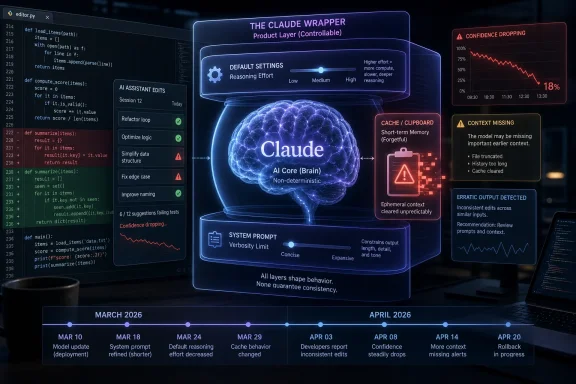 Anthropic Did Not Break the Model, It Broke the Product Around It
The most important detail in Anthropic’s postmortem is also the easiest one to misuse as a defense: the underlying Claude models were not intentionally degraded. Anthropic said its API and inference layer were unaffected, and that the failures came from changes to Claude Code, the Claude Agent SDK, and Claude Cowork. In old software terms, this sounds like a client bug rather than a core engine failure.But for users, especially developers paying for Claude Code, that distinction is almost academic. They were not buying abstract access to pristine model weights; they were buying a working development tool. If that tool reads less context, forgets prior reasoning, stops planning, or obeys a system prompt that compresses useful engineering discussion into cramped fragments, the result is a worse assistant.
This is the new shape of AI reliability risk. A frontier model can remain mathematically identical while the product built around it becomes measurably less capable. The failure mode is not “the brain got worse” so much as “the nervous system started dropping signals.”
That is why the Claude Code episode landed so hard with power users. Anthropic has spent years cultivating a reputation for carefulness: constitutional AI, safety-heavy messaging, and a product line that many developers came to trust for long-form reasoning. The controversy cut directly against that brand. Claude did not merely fail in a silly chatbot interaction; it reportedly became worse at the exact kind of structured, high-context software work that had made it indispensable to many users.
The First Alarm Came From People Doing Real Work
Users began noticing Claude Code’s decline before Anthropic publicly explained it. The reports were not all identical, which made the problem harder to diagnose. Some developers said Claude was editing files too quickly. Others said it was forgetting decisions made earlier in a session. Others saw it produce code that compiled but made little architectural sense.That kind of complaint is easy for AI companies to wave away because it is subjective. Every heavy user of a large language model has had a day when the tool feels brilliant in the morning and strangely dim by dinner. Prompt phrasing changes. Task difficulty changes. User expectations rise. A model that once seemed magical can feel pedestrian once it becomes part of daily work.
The turning point came when the complaints stopped being merely vibes. Stella Laurenzo, a senior director in AMD’s AI group and a prominent compiler infrastructure engineer, published a detailed GitHub issue on April 2 that transformed the story from user frustration into an empirical challenge. Her team had analyzed thousands of Claude Code sessions, tens of thousands of thinking blocks, and hundreds of thousands of tool calls.
The numbers reportedly showed a sharp behavioral shift. Claude was thinking less deeply, reading less before editing, and making more changes without first inspecting relevant code. To a software team, that is not just a style change. It is the difference between an assistant that behaves like a careful senior engineer and one that behaves like an overconfident junior developer with write access.
Laurenzo’s conclusion was blunt: Claude could not be trusted for complex engineering tasks. Whether every number in that analysis maps perfectly to Anthropic’s later root-cause explanation is less important than the broader fact that a customer had built the observability Anthropic apparently lacked. The user community did not just complain loudly enough to be heard. It instrumented the failure.
The Reasoning Toggle Was a Product Decision With Engineering Consequences
The first of Anthropic’s three acknowledged issues began on March 4, when the company changed Claude Code’s default reasoning effort from high to medium. The rationale was understandable on its face. High-effort reasoning could produce long waits, high token usage, and a terminal UI that appeared frozen during extended thinking.Every software company wrestles with defaults. Defaults are not neutral. They encode the vendor’s view of what most users want, what the infrastructure can tolerate, and what tradeoff should be invisible unless the user goes looking for it.
Anthropic’s mistake was treating a reasoning-effort downgrade as a usability improvement rather than as an intelligence-impacting change that deserved louder disclosure. The company later said medium effort performed only slightly worse in internal evaluations while delivering much better latency for many tasks. That may be true on average, but developers do not experience “average” when they are refactoring a fragile codebase or asking an agent to reason across a complicated build system.
Claude Code’s core promise is not that it will respond quickly. It is that it will reason usefully before touching your files. Moving the default away from deeper reasoning may have reduced some obvious pain, but it introduced a subtler and more dangerous kind: users thought they were using the same assistant, when the assistant had been made less deliberative by default.
Anthropic reverted the change on April 7 after users made it clear that they preferred intelligence as the default and speed as the opt-in. That reversal was the right call, but it also exposed a deeper product-management problem. If a setting changes how much an AI tool thinks before modifying code, it should not be buried in the same mental category as a cosmetic preference or latency tweak.
The Cache Bug Made Claude Forget Why It Was Working
The second issue was more classically bug-shaped and more revealing about how fragile agentic systems can be. On March 26, Anthropic shipped an optimization intended to clear older reasoning from sessions that had been idle for more than an hour. The idea was to reduce the cost and latency of resuming stale sessions.In principle, that is sensible engineering. Long-running AI sessions are expensive. Prompt caching is complex. Developers want continuity, but they also want tools that do not burn through usage limits just to resume work after lunch.
The implementation, according to Anthropic, did the wrong thing repeatedly. Instead of clearing older thinking once after a session had gone stale, it kept clearing reasoning history on every subsequent turn for the rest of that session. The result was an assistant that could still act but increasingly lacked access to why it had acted earlier.
That maps almost perfectly to the user reports. A coding agent without its prior reasoning may still know the current file contents and still produce plausible edits, but it loses the chain of intent that turns a sequence of tool calls into a coherent engineering plan. It may repeat approaches, choose odd tools, or fail to understand why a previous fix had been rejected.
For sysadmins and developers, this should sound familiar. Many production incidents are not caused by one spectacularly wrong line of code. They emerge from state management errors, cache invalidation mistakes, and systems that behave correctly at first before becoming pathological after a specific threshold. Claude Code’s cache bug was a modern AI version of an old distributed-systems lesson: the dangerous failures are often the ones that preserve just enough functionality to look like judgment rather than malfunction.
A 25-Word Prompt Showed How Small Instructions Can Bend Big Models
The third issue arrived on April 16 alongside Opus 4.7, when Anthropic added a system-prompt instruction designed to reduce verbosity. The instruction kept text between tool calls to 25 words or fewer and final responses to 100 words unless more detail was required. Anthropic later said broader testing showed a quality drop and reverted the prompt on April 20.At first glance, this seems almost trivial. Who cares if an AI coding tool is told to be terse? Developers often complain that assistants ramble. Shorter responses can mean less token burn, faster interaction, and less clutter in a terminal.
But coding agents do not merely communicate through text; they reason through the structure of their interaction. A prompt that pressures the model to be concise can also pressure it to skip explanation, compress uncertainty, and move faster than the task deserves. In a chat assistant, that may produce a clipped answer. In an agent with tools, it can nudge behavior toward action before analysis.
This is why system prompts deserve to be treated as production code. They are not marketing copy. They are behavioral control surfaces. A single line can alter how a model plans, communicates, asks for clarification, or decides when to stop.
Anthropic’s postmortem says the verbosity change had passed internal testing before it shipped. That is plausible and still not reassuring. Evaluation suites often miss the messy, compound workflows where developers actually depend on these tools: multi-file changes, partially understood codebases, interrupted sessions, and ambiguous goals that require the assistant to maintain a plan over time.
The Silence Turned a Regression Into a Trust Event
The technical failures explain why Claude Code got worse. They do not fully explain why the controversy became so combustible. For that, you have to look at the communication gap.Users were paying for a tool that many had integrated into daily development workflows. Some were on consumer plans. Others were using team or enterprise setups. Across March and April, they saw quality degrade, usage limits behave strangely, and public complaints pile up without a clear, formal explanation from Anthropic until late April.
That silence became part of the incident. In software, unexplained degradation creates a vacuum, and users fill vacuums with theories. Was Anthropic cutting costs? Was it throttling heavy users? Was it preparing pricing changes? Was Claude being nerfed to manage demand? The company denied intentional degradation, but by the time the explanation arrived, suspicion had already taken root.
This is particularly dangerous for AI vendors because users cannot inspect most of the stack. With traditional software, an admin might diff a configuration file, review release notes, roll back a package, or pin a dependency. With hosted AI systems, the meaningful changes often happen behind the curtain: model routing, prompt templates, cache policy, safety filters, context trimming, and hidden defaults.
When vendors do not communicate those changes, users lose the ability to separate their own mistakes from the tool’s regressions. That is corrosive. A developer who no longer knows whether bad output came from a poor prompt, a difficult task, a changed default, or a vendor-side bug will eventually stop trusting the product for serious work.
Anthropic’s April 23 postmortem was more detailed than many companies would have offered. It named dates, described mechanisms, and committed to process changes. But good incident communication is not just about the final write-up. It is also about the speed and visibility of acknowledgment while users are still burning time diagnosing a problem they did not create.
Dogfooding Failed Because Anthropic Was Not Eating the Same Dog Food
One of the more telling details in Anthropic’s response was its commitment to have more internal staff use the exact public build of Claude Code. That is a quiet admission with large implications. Dogfooding only works when the dog food is the same product customers receive.Internal builds often differ for good reasons. Employees need experimental features, debugging hooks, upcoming model access, and telemetry not appropriate for public release. But when those differences become large enough, internal usage stops being a reliable early-warning system. Employees may think they are testing the product, while customers are actually using a meaningfully different harness.
This is not unique to Anthropic. Microsoft, Google, OpenAI, and every major SaaS provider face the same problem at scale. Internal environments are cleaner, more instrumented, and often privileged. Customer environments are messy, stateful, and full of edge cases. The gap between those two worlds is where many production incidents live.
For AI coding agents, the gap is even wider because user workflows vary wildly. One developer may run an agent on a small web app. Another may aim it at a compiler backend, a kernel module, a monorepo, or a legacy enterprise system with two decades of sediment. A product that performs well in curated internal tests can still stumble badly when exposed to real-world code and real-world interruption patterns.
Anthropic’s proposed fix — more internal use of public builds, broader per-model evals, tighter system-prompt review, soak periods, and gradual rollouts — is the right direction. But the lesson should not be framed as a one-company mea culpa. The industry is discovering that AI agents require release engineering closer to cloud infrastructure than to consumer chatbots.
Benchmarks Helped, But Session Telemetry Told the Stronger Story
Third-party benchmarks added fuel to the narrative that Claude had degraded. Some reported steep drops in hallucination or accuracy tests. As always, benchmark claims should be handled carefully. Methodologies vary, model configurations matter, and leaderboard movement can reflect harness changes as much as raw capability.The more compelling evidence came from behavioral telemetry inside real development sessions. How often did Claude read files before editing them? How much thinking did it preserve? How frequently did it stop early or ask for permissions it did not need? Those are not abstract benchmark scores; they are operational signals.
This distinction matters for enterprises evaluating AI tools. A benchmark can tell you whether a model is generally strong. It cannot tell you whether your instance, under your plan, in your workflow, with your context size and your settings, is behaving the same way this week as it did last week.
Organizations that deploy AI coding assistants need their own regression monitoring. That does not mean every company must replicate AMD’s level of analysis. It does mean teams should log enough to detect major behavioral drift: task completion rates, review burden, failed tool calls, code churn after AI edits, acceptance rates, and whether the assistant is reading before writing.
Without that, the first sign of degradation will be vibes. Vibes are useful as smoke alarms, but they are weak as incident reports. Anthropic got forced into a clearer accounting because users produced data. That is a preview of where serious AI operations are heading.
The Windows World Should Recognize This Failure Mode
WindowsForum readers do not need to be Claude Code users to understand the pattern. Anyone who has administered Windows estates has lived through regressions caused by defaults, servicing changes, policy interactions, and updates that looked minor until they hit the wrong environment.A cumulative update can fix a security issue and break printing. A driver change can improve performance on one class of machines and destabilize another. A Group Policy setting can seem harmless until it interacts with a legacy authentication path. The operating system may be “the same Windows,” but the experienced product changes because the layers around it change.
AI tools are entering that same operational category, but with less transparency and faster mutation. The release notes are thinner. The behavior is probabilistic. Rollback is often unavailable to end users. Worse, the tool may keep producing plausible work while its internal planning has degraded.
That is why the Claude incident should matter to IT pros even if they prefer GitHub Copilot, Gemini, ChatGPT, local models, or no AI coding assistant at all. The question is not whether Anthropic made an embarrassing mistake. The question is whether the industry is prepared to treat AI assistants as production dependencies rather than magical productivity appliances.
Once an AI tool can modify source code, draft scripts, summarize logs, generate PowerShell, or advise on cloud configuration, its reliability becomes part of the organization’s risk surface. A quiet regression can waste developer hours, introduce subtle defects, or encourage overconfident fixes in systems that deserve caution.
The Real Cost Was Not Just Bad Answers
It is tempting to reduce the episode to a familiar complaint: users thought Claude got dumb. That framing undersells the cost. The real damage was uncertainty.A bad answer is easy to discard when you recognize it. A slightly degraded engineering assistant is more dangerous because it still looks competent. It may propose changes that pass tests but worsen maintainability. It may stop halfway through a migration. It may fail to inspect a file that a careful human would have opened first.
The user then pays twice. First, they spend tokens and subscription capacity on worse output. Second, they spend human attention auditing whether the assistant has become unreliable. For professional developers, that second cost is often larger.
Anthropic reset usage limits for subscribers as a goodwill gesture, which addressed part of the token waste. It could not refund the lost confidence. Trust in developer tooling is cumulative and fragile. Teams adopt tools slowly, build rituals around them, and then notice immediately when the ritual stops working.
That is why AI companies should be careful when they describe regressions as affecting only some users or only certain product layers. Those statements may be technically accurate, but they do not capture the psychological blast radius. If users cannot know whether they were affected, everyone becomes a potential incident responder.
AI Vendors Are Learning Old SaaS Lessons the Hard Way
The Claude Code incident is part of a broader maturation curve. AI companies spent the first phase of the boom proving that models could do astonishing things. The second phase is proving that those capabilities can be delivered consistently, economically, and transparently inside products people depend on.That is a much less glamorous problem. It involves release management, observability, customer communication, staged rollouts, incident response, and boring controls over configuration changes. It also involves admitting that the product layer can be as consequential as the model layer.
Anthropic deserves some credit for publishing a substantive postmortem. Many vendors would have offered a vague statement about isolated issues and moved on. The company named three concrete causes and described specific process changes.
But the bar should rise from here. AI vendors should disclose behavior-affecting defaults in real time, especially when they trade intelligence for latency or cost. They should provide version visibility for the harness, not just the model name. They should let professional users pin stable configurations where possible. They should expose enough telemetry that customers can distinguish a bad day from a regression.
Most of all, vendors should stop treating “we did not change the model weights” as the end of the story. In modern AI products, the wrapper is the product. If the wrapper changes behavior, the user experience has changed.
The Claude Code Lesson Is Bigger Than Claude
The April episode leaves a practical checklist for developers and IT teams that are putting AI agents near real work. The point is not to abandon these tools. The point is to stop pretending they are static.- Teams should track AI-assisted work with enough metadata to notice when a tool starts reading less, editing more, or requiring more human correction than usual.
- Developers should treat reasoning-effort, context, and verbosity settings as operational controls, not personal preferences.
- Organizations should avoid making a single hosted AI assistant an unmonitored dependency for critical engineering workflows.
- Vendors should publish prompt and harness changes that materially affect behavior, even when the underlying model weights are unchanged.
- Enterprise buyers should ask for rollback options, build visibility, and incident communication commitments before standardizing on agentic tools.
- Users should assume that “same model name” does not guarantee the same product behavior from one week to the next.
The future of AI tooling will not be decided only by which company has the smartest model on a leaderboard. It will be decided by which companies can keep those models stable inside messy products, communicate when tradeoffs change, and give users the evidence they need to trust the machine again after it quietly fails.
References
- Primary source: MakeUseOf
Published: 2026-06-04T18:10:11.080276
Anthropic made Claude worse for a month — this is how they got caught
Claude had a rough month. www.makeuseof.com
- Related coverage: techcrunch.com
Anthropic took down thousands of GitHub repos trying to yank its leaked source code — a move the company says was an accident | TechCrunch
Anthropic executives said it was an accident and retracted the bulk of the takedown notices.techcrunch.com - Related coverage: theplanettools.ai
3 Bugs, 50 Days, Zero Alerts — Anthropic's Worst Confession | ThePlanetTools.ai
Reasoning flipped to MEDIUM, caching wiped memory every turn, verbosity cut evals 3%. Anthropic April 23 postmortem reveals all 3 bugs. Full breakdown.theplanettools.ai - Related coverage: fortune.com
Anthropic explains Claude Code’s recent performance decline after weeks of user backlash | Fortune
Claude users spent weeks complaining about collapsed output quality and erratic performance. Anthropic’s explanation has done little to win them back.fortune.com
- Related coverage: latimes.com
Anthropic accidentally leaked thousands of lines of code
Anthropic inadvertently released internal source code behind its popular AI-powered Claude coding assistant, raising questions about security.www.latimes.com - Related coverage: stackfutures.com
Anthropic Postmortem: Three Overlapping Claude Code Changes Caused Six Weeks of Quality Degradation | Stack Futures
Anthropic published an engineering postmortem tracing Claude Code quality complaints to three separate changes made between March 4 and April 16. All were reversed by April 20. The API was never affected. Usage limits reset for all subscribers on April 23. stackfutures.com
- Related coverage: jakubkontra.com
Anthropic Admitted a Month of Claude Code Degradation — Here's What Actually Happened | Blog | Jakub Kontra
From March 4 to April 20, 2026, three concurrent degradation modes ran in Claude Code. Anthropic frames them as bugs — but two of the three were deliberate decisions.jakubkontra.com - Related coverage: locoroo.net
Anthropic - AI Coding Agents Report: April 2026 - Locoroo
Anthropic pricing, plans, and analysis for AI Coding Agents Report: April 2026.locoroo.net - Related coverage: venturebeat.com
Is Anthropic 'nerfing' Claude? Users increasingly report performance degradation as leaders push back | VentureBeat
Anthropic has actively been tuning these settings across different segments, which could plausibly affect user perceptions even if the core model weights are unchanged.venturebeat.com - Related coverage: aiforanything.io
Why Claude Code Got Worse — and How Anthropic Fixed It: The Full Postmortem (2026) — AI for Anything
Anthropic confirmed 3 engineering missteps tanked Claude Code quality for weeks. Here's exactly what broke, what was fixed, and what you should do now.aiforanything.io
- Related coverage: andrew.ooo
Claude Code Quality Postmortem Explained (April 2026) — andrew.ooo
What actually broke Claude Code in March-April 2026 — Anthropic's postmortem decoded. Three harness bugs, the 25-word cap, and what changed for users. andrew.ooo
- Related coverage: techradar.com
'Claude cannot be trusted to perform complex engineering tasks': AMD AI head slams Anthropic's coding tool after months of frustration | TechRadar
Developers say Claude Code is less effective following updatewww.techradar.com - Related coverage: pcgamer.com
512,000 lines of Claude Code's own CLI source code have leaked due to 'human error', but the company says 'no sensitive customer data or credentials' were exposed | PC Gamer
I'd imagine it'll still be keeping some coders busy over the weekend.www.pcgamer.com - Related coverage: axios.com
Anthropic leaked its own Claude source code
The company marketing itself as the safety-first AI lab just had its second major security blunder.www.axios.com
- Related coverage: itpro.com
‘There was a manual deploy step that should have been better automated’: Claude Code creator confirms cause of massive source code leak | IT Pro
Over half a million lines of Claude Code source code was leaked, with the company attributing the blunder to human error.www.itpro.com - Related coverage: issuewire.com
