

HackerNoon’s July 15 comparison of Claude Code, OpenAI Codex and OpenCode reaches a pragmatic conclusion rather than crowning a universal winner: Claude Code is its pick for understanding unfamiliar codebases, Codex for fast work on tightly specified tasks, and OpenCode for teams that value model choice, local execution and an open toolchain.
The article is based on the author’s own full-stack exercises—a Next.js feature, API bug, legacy refactor and test-writing work—not a reproducible benchmark. Its strongest advice is therefore less about rankings than workflow: coding agents can inspect a repository, edit several files, run tests and iterate, but they still need a human to validate architecture, security and correctness.
Claude Code is presented as the careful terminal-based collaborator: useful when a task begins with tracing data flows, mapping dependencies or planning a multi-file refactor. Anthropic’s documentation confirms that Claude Code supports Windows through WSL or Git Bash, uses project instructions such as
Codex gets the “workhorse” label. HackerNoon argues that it is best when the work is already framed precisely: implement a defined change, review a patch, or dispatch independent chunks of work in parallel. OpenAI has positioned Codex as a cloud-capable coding agent able to work in isolated environments and produce changes suitable for pull-request review. The caveat is straightforward: a fast agent given a vague ticket can deliver the wrong implementation faster.
OpenCode is the outlier. Its official documentation describes an open-source coding agent available in a terminal, desktop app and IDE extension, with support for more than 75 model providers and local models. It can also use language-server diagnostics, although OpenCode’s own documentation warns that LSP integration can consume significant memory and slow agent workflows. Its tool-level LSP functions are still marked experimental.
Treat the article’s performance judgments as anecdotal, verify current pricing and limits with each vendor, and keep every agent-produced change behind the same review and test gates as human code.
The article is based on the author’s own full-stack exercises—a Next.js feature, API bug, legacy refactor and test-writing work—not a reproducible benchmark. Its strongest advice is therefore less about rankings than workflow: coding agents can inspect a repository, edit several files, run tests and iterate, but they still need a human to validate architecture, security and correctness.
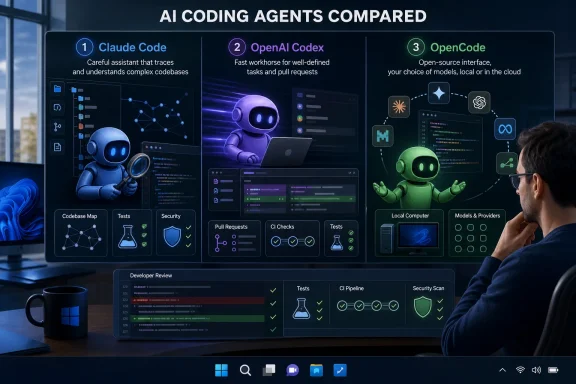 Three different operating models
Claude Code is presented as the careful terminal-based collaborator: useful when a task begins with tracing data flows, mapping dependencies or planning a multi-file refactor. Anthropic’s documentation confirms that Claude Code supports Windows through WSL or Git Bash, uses project instructions such as CLAUDE.md, and can connect to MCP servers. That makes it a credible fit for Windows developers working in established repositories, though it remains tied closely to Anthropic’s service and account model.Codex gets the “workhorse” label. HackerNoon argues that it is best when the work is already framed precisely: implement a defined change, review a patch, or dispatch independent chunks of work in parallel. OpenAI has positioned Codex as a cloud-capable coding agent able to work in isolated environments and produce changes suitable for pull-request review. The caveat is straightforward: a fast agent given a vague ticket can deliver the wrong implementation faster.
OpenCode is the outlier. Its official documentation describes an open-source coding agent available in a terminal, desktop app and IDE extension, with support for more than 75 model providers and local models. It can also use language-server diagnostics, although OpenCode’s own documentation warns that LSP integration can consume significant memory and slow agent workflows. Its tool-level LSP functions are still marked experimental.
Windows and admin considerations
For Windows-centric teams, the comparison is not quite as simple as “install all three and choose later.”- Claude Code officially supports Windows 10 and later through WSL or Git Bash.
- OpenCode offers Chocolatey, Scoop, npm and Docker installation paths; its documentation says Windows support via Bun is still in progress.
- Any cloud-connected agent may expose source code, prompts, build logs or secrets to an external provider unless configured otherwise.
The useful verdict
HackerNoon’s most defensible finding is that the tools optimize for different constraints rather than radically different capabilities. Claude Code may suit exploratory maintenance work; Codex may be the faster choice for clearly scoped implementation and review; OpenCode offers the most control for organizations that need provider flexibility or locally run models.Treat the article’s performance judgments as anecdotal, verify current pricing and limits with each vendor, and keep every agent-produced change behind the same review and test gates as human code.
References
- Primary source: HackerNoon
Published: 2026-07-15T00:00:00+00:00
Loading…
hackernoon.com - Official source: docs.anthropic.com
Advanced setup - Claude Code Docs
System requirements, platform-specific installation, version management, and uninstallation for Claude Code.docs.anthropic.com