

Anthropic’s Cowork arriving on Windows is not just another app release — it is a watershed moment in the race to put agentic AI on the desktop, and it forces IT teams, security officers, and software vendors to confront what “automating work” really means when an assistant can read, write, and reorganize your files on command. The Windows port brings what Anthropic calls “full feature parity” with the macOS research preview — file access, multi‑step task execution, plugins, and Model Context Protocol (MCP) connectors — and it lands on the platform most enterprises use daily, effectively removing the last major barrier to wide corporate experimentation. ttps://venturebeat.com/technology/anthropics-claude-cowork-finally-lands-on-windows-and-it-wants-to-automate)
Background / Overview
Anthropic introduced Cowork in January 2026 as a research‑preview desktop agent built around the Claude family of models. Rather than replying to single prompts, Cowork is designed to plan and execute multistep workflows inside a user‑designated folder: scan documents, extract and reconcile data, generate reports, move or rename files, and interact with external services via plugins and connectors. That design is deliberate — Anthropic frames Cowork as “Claude Code without the code,” a watomation to non‑developers while exposing the agent’s plan and steps for human review.The Windows release in February 2026 completes platform parity and opens Cowork to the larger desktop market. Anthropic announced the Windows launch publicly, noting global and folder‑specific instructions — persistent behavioral and style preferences the agent follows on every session — as a notable usability upgrade. Early community posts and company channels show the rolloearch preview and initially available to paid Claude subscribers.
Why the Windows port matters
- Windows still represents the primary endpoint for corporate knowledge work in many organizations. A macOS‑only agent can excite early adopters, but enterprise pilots and regulated production dequire Windows compatibility and endpoint‑management integration. The Windows release therefore materially accelerates enterprise experiments.
- Practically, Windows parity means IT can evaluate Cowork in the same managed estate images, with group policy and endpoint management tooling (Intune, SCCM), and with the same data‑handling controls they already operate. That removes a deployment gating factor that often stalls pilots.
- For Anthropic, bringing Cowork to Windows increases the addressable market overnight. For competitors and incumbents, it raises the threat horizon: a single agentic desktop app that can read files, call services, and produce finished artifacts sits squarely in the middle of what many SaaS vendors sell.
What Cowork actually does — feature map and behavior
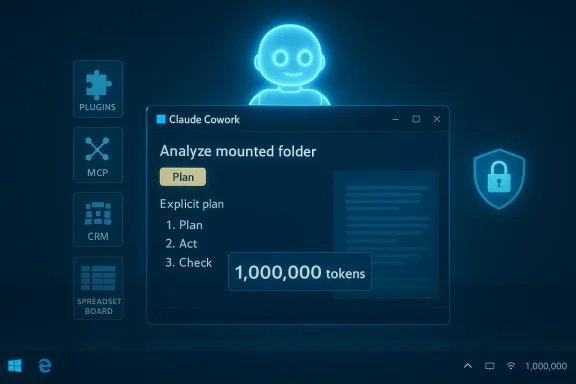
Cowork’s UX and capabilities are organized around a small set of high‑leverage primitives:- Folder sandboxing — users explicitly grant the agent access to a specific folder (the primary safety boundary). The agent cannot see files outside that mount unless permissions are expanded.
- Sandboxed execution runtime — tasks run inside an isolated VM‑like environment on the desktop; the agent’s actions are recorded, surfaced as a plan, and persisted back to the mounted folder when complete. This virtualization is central to minimizing lateral exposure. Wired’s coverage repeated Anthropic engineers’ explanation that a VM under the hood is used so “if you don't give it access to a folder, Claude literally cann
- Agentic planning UI — the agent breaks user instructions into an explicit, reviewable plan; users can approve, alter, or abort steps so the workflow follows a plan→act→check pattern.
- Plugins and MCP connectors — a plugin framework (Anthropic open‑sourced an initial set of 11 plugins) plus Model Context Protocol connectors lets Cowork reach into CRMs, spreadsheets, legal stacks, and project boards under scoped permissions. These connectors make the destion hub, not just a file tool.
- Persistent instructions — global and folder‑scoped instructions are applied automatically when a folder is opened so Claude follows consistent tone, role, and formatting across sessions.
The model under the hood: Claude Opus 4.6 and why context size matters
Cowork’s ambition depends critically on model capabilities. Anthropic’s Claude Opus 4.6 — the model powering Cowork on desktop — introduces two features that change the calculus of agentic workflows:- Ultra‑long context window (beta 1,000,000 tokens) — Opus 4.6 gives agents the ability to reason across very large document sets in a single session, reducing the repeated upload/forget cycles that hamstrung earlier agents. That means an agent can hold an entire project dossier, a large codebase, or months of notes in working memory while performing cross‑document synthesis. Multiple model trackers and explainers confirm the 1M‑token beta context and place Opus 4.6’s launch in early February 2026.
- Expanded max output (~128,000 tokens) — doubling the output ceiling enables the model to generate long artifacts (draft policy documents, full code modules, extended reports) in one go, which reduces brittle continuation logic that developers had to stitch together previously.
The Microsoft–Anthropic realignment: compute, sales, and internal adoption
Anthropic’s platform momentum cannot be divorced from its recent strategic partnership with Microsoft and NVIDIA. In November 2025 Microsoft, NVIDIA, and Anthropic announced a major alliance in which Anthropic committed to purchase roughly $30 billion of Azure compute capacity and NVIDIA agreed to supply large‑scale chip capacity; the partnership also included equity commitments from NVIDIA and Microsoft. That $30‑billion compute commitment is documented in Microsoft’s corporate blog and widely reported across outlets.That infrastructure deal was the opening move; it has since evolved into deeper product ties. Microsoft made Opus‑family Claude models available in Microsoft Foundry and has positioned Claude models inside certain Copilot surfaces. Separately, reporting indicates Microsoft has been buying Anthropic model usage — The Information estimated Microsoft’s spending on Anthropic models was running at a pace approaching roughly $500 million annually as of mid‑2025, reflecting Anthropic model usage across GitHub Copilot features and other Copilot surfaces. This is a material commercial relationship: Azure compute commitments, product integrations, and large annual consumption all tilt the market from single‑provider reliance toward a multi‑vendor frontier model environment.
Microsoft’s internal behavior is worth noting: teams inside Microsoft have reportedly been encouraged to use Anthropic‑powered tools (Claude Code and related tooling) in addition to Microsoft’s own Copilot offerings, and feedback loops comparing multiple agent vendors are being cultivated by internal AI groups. That posture — selling GitHub Copilot while dogfooding Anthropic models in some teams — signals a pragmatic product strategy: enterprise customers value choice, and Microsoft appears willing to bring multiple frontier models into its ecosystem where they add value.
The immediate and structural risks
Anthropic has been explicit about the tradeoffs. Cowork’s convenience — reading, editing, deleting files; running browser automations; calling external services — creates a practical list of hazards that security and legal teams must manage:uctive actions** — misconfigured instructions or misguided approvals could lead the agent to delete or corrupt many files in the mounted folder, or to run scripts inside the VM that have unintended side effects. Anthropic’s UX includes explicit confirmations for risky steps, but user error is a major exposure vector.- Prompt‑injection attacks — documents or web pages can contain hidden instructions that try to override the agent’s planning or data flow. When an agent browses or ingests external content via MCP connectors, attackers can weaponize that surface to exfiltrate or to drive destructive actions. Anthropic warns explicitly about this and recommends constrained connectors.
- Data leakage and compliance exposure — Cowork necessarily routes content to cloud models for reasoning (even if andbox), so organizations must verify how data flows in their enterprise contract terms, especially for regulated data (PHI, financials, classified material). Microsoft’s integration guidance notes some Anthropic services operate outside Microsoft‑managed controls, which has compliance implications for tenants.
- Supply‑chain and vendor governance — relying on third‑party model providers introduces subprocessor risk; enterprises need contractual rights for audits, data residency assurances, and incident response commitments. Even with Anthropic offering enterprise/HIPAA options, customers retain responsibility for due diligence.
- Operational risk from mass adoption — agents, when scaled without controls, can produce widespread errors (misrouted documents, unintended public postings, credential exposure). Reddit and early community reports noted Windows Cowork initially restricted file access to the user’s personal folder — a conservative choice that reduces the chance of “nuking” system directories but frustrates power users who expected full developer‑folder access. That tension between safety and capability will define early production pilots.
Practical mitigations and an IT playbook
Anthropic and early enterprise pilots suggest a conservative, staged approach for organizations that want to pilot Cowork safely. Key operat1. Inventory and classify folders and file types; choose low‑risk, high‑value pilot targets (marketing collateral, sanitized receipts).- Use least‑privilege folder mounts for Cowork; avoid mounting cloud sync roots (OneDrive/Dropbox) or system directories.
- Require human approvals for destructive actions (bulk deletes, permission changes).
- Maintain versioned backups and file snapshots for any folder used with the agent so recovery is possible.
- Whitelist MCP connectors and plugins at the tenant level; expose external connectors only after code, privacy, and risk review.
- Export agent logs to centralized SIEM for anomaly detection and for audit trails in legal discovery scenarios.
- Update data processing agreements and reqons for data flows, residency, and breach notification guarantees.
Business implications: ROI, pricing, and the vendor response
Cowork is being positioned as a premium productivity play. Anthropic has gated access behind paid Claude tiers during the research preview; historically that meant Max ($100/month) subscribers saw early access before a tiered rollout to Pro and Team customers. Cowork’s presence is currently limited to paid plans, which frames it as a paid automation product rather than a mass free offering. That subscription calculus reduces friction for enterprise adoption — many organizations already budget for per‑seat SaaS fees.From the vendor side, the new compute and commercial arrangements between Anthropic, Microsoft, and NVIDIA matter. Anthropic’s $30‑billion Azure compute commitment and Microsoft’s growing consumption of Anthropic models (reported at roughly $500 million per year in some accounts) reshape the economics of model access and distribution: Anthropic can offer scaled, integrated enterprise channels (Microsoft Foundry, Copilot surfaces) in ways that change how customers buy AI features. Those deals also explain why Microsoft is comfortable inviting Anthropic models into its ecosystem even while it sells GitHub Copilot.
For incumbent SaaS vendors, Cowork presents two simultaneous threats:
- Seat compression — if an agent can perform the work that previously required subscribing to specialized software, vendors could see renewal pressures.
- Feature bypass — agents that orchestrate across multiple tools reduce the need to integrate deeply with each vendor’s UI; instead, the agent becomes the glue. The market reaction to Cowork’s plugin release — an estimated $285 billion in market value repricing across software and related stocks — highlights investor anxiety that agentic automation could compress long‑term revenue modelies of enterprise software.
Strengths and the credible opportunity
Cowork is not a vaporware threat; it offers several real strengths that justify attention:- Time savings on routine, file‑heavy tasks — pilots and demos show potential to compress hours of manual work (expense assembly, file reconciliation, draft generation) into minutes of human supervision. For administrative staff and knowledge workers, that is a meaningful productivity delta.
- Accessibility for non‑technical users — translating Claude Code’s agentic primitives into an approachable desktop UI opens automation to teams that lack engineering resources.
- Long‑project handling enabled by Opus 4.6 — the million‑token context and larger output limits make Cowork plausible for sustained project workflows rather than just short tasks.
- Extensibility via plugins and MCP connectors — an open plugin ecosystem lowers the bar for role‑specific automations and enables ISVs and VARs to build certified skills for customers.
The open questions and longer‑term risks
Even with the above strengths, Cowork raises enduring questions:- Can vendors deliver enterprise‑grade governance at the scale customers require — tenant‑wide connector controls, immutable audit trails, and eDiscovery support — quickly enough to satisfy legal and compliance teams?
- Will model providers and cloud partners converge on clear contractual norms for data residency, subprocessors, and breach responsibilities? Microsoft’s own guidance shows there are nontrivial differences when customers choose Anthropic models vs. other model options.
- How many workflows are truly safe to automate without human oversight? Early usage suggests high time‑savers exist, but misconfigurations and prompt attacks can produce catastrophic failures.
- Will agents compress seat economics for SaaS incumbents in practice, or will those vendors successfully bundle governance and domain expertise that agents alone cannot replicate? The market reaction indicates fear, but adoption dynamics and feature advancement will determine winners and losers over time.
Verdict: pilot now, govern relentlessly
Cowork’s Windows arrival is a practical inflection point. The technology — an agentic desktop app powered by a model with a million‑token context and large single‑response capacity — is real and immediately useful for specific file‑centric workflows. Early enterprise interest and major cloud partnerships mean adoption will not be limited to tinkering teams for long.That said, the smart play for IT organizations is clear andork as a privileged automation platform. Don’t deploy it broadly until governance, backups, auditing, and connector whitelisting are in place.
- Start small, measure outcomes, and codify failure modes. Use locked pilots and low‑risk folders, require human approvals for destructive actions, and instrument visibility into every agent operation.
- Get contractual protections in place before wider rollouts: explicit subprocessors, data residency commitments, audit rights, and incident response SLAs.
What to watch next
- How quickly Anthropic and partners (Microsoft, NVIDIA) ship enterprise‑grade admin tooling for tenant‑level controls and plugin certification.
- Whether major SaaS incumbents respond with integrated agent capabilities or focused governance offerings that blunt the seat‑compression threat.
- Real‑world pilot data on error rates, prompt‑injection incidents, and recovery times — the hard metrics that will decide whether Cowork stays an experimental convenience or becomes a production workhorse.
Anthropic has removed the last major platform barrier between Claude Cowork and the enterprise desktop: Windows parity makes the agent accessible to the bulk of corporate users, and Opus 4.6 gives it the memory and output bandwidth to handle project‑scale work. Those two facts together explain why markets and vendors are reacting in earnest. For IT leaders the choice is no longer whether to engage with agentic tools — it’s how to do so in a way that captures productivity gains while containing operational, legal, and security risk. The tools are ready enough to pilot; the governance that follows will determine whether Cowork is a productivity revolution or a cautionary tale.
Source: VentureBeat https://venturebeat.com/technology/...ly-lands-on-windows-and-it-wants-to-automate/
