

Anthropic’s latest move puts Claude directly inside the spreadsheet cells that drive Wall Street: the company has launched a research-preview add-in, Claude for Excel, tied to live financial feeds and pre-built analyst workflows — a deliberate push to make Claude the default AI assistant for institutional finance and a direct challenge to Microsoft’s own Copilot strategy.
Microsoft Excel remains the operational backbone of financial analysis, valuation, and reporting. For decades analysts, traders, risk teams, and dealmakers have built bespoke workbooks that encode business logic, valuation techniques, and regulatory checks. Embedding an AI that can read, edit, and explain spreadsheet changes natively inside Excel is therefore a strategic shortcut to adoption: the user base and the workflows are already there. Anthropic’s announcement is the latest sign that the AI battle for productivity in finance is being fought — literally — in spreadsheet cells. Anthropic packaged this capability as part of a larger expansion of Claude for Financial Services: a native Excel sidebar add-in, new real-time market-data and document connectors, and six pre-configured “Agent Skills” tailored to common analyst tasks (discounted cash flow models, comparable-company analysis, earnings analysis, due-diligence extractors, initiating coverage reports, and document-to-Excel pipelines). The company says the features are initially available as a limited research preview to Max, Enterprise, and Team customers via a waitlist.
At the same time, production deployments will be measured, monitored, and governed: the model’s imperfect accuracy, legal precedents around AI-driven disparate impacts, and the technical complexity of legacy spreadsheets mean that human oversight, firm governance, and staged rollouts remain non-negotiable. If Anthropic can sustain reliability while preserving auditability and contractual clarity around data and connectors, Claude may become a credible alternative to incumbent AI assistants — but only as part of a controlled, accountable toolchain that keeps final decision authority firmly in human hands. The spreadsheet is once again the battleground for productivity gains in finance. The winners will be the vendors and institutions that combine superior accuracy, guarded governance, and practical integrations with the messy, mission-critical world of Excel.
Source: Bahia Verdade Anthropic rolls out Claude AI for finance, integrates with Excel to rival Microsoft Copilot - Bahia Verdade
 Background
Microsoft Excel remains the operational backbone of financial analysis, valuation, and reporting. For decades analysts, traders, risk teams, and dealmakers have built bespoke workbooks that encode business logic, valuation techniques, and regulatory checks. Embedding an AI that can read, edit, and explain spreadsheet changes natively inside Excel is therefore a strategic shortcut to adoption: the user base and the workflows are already there. Anthropic’s announcement is the latest sign that the AI battle for productivity in finance is being fought — literally — in spreadsheet cells. Anthropic packaged this capability as part of a larger expansion of Claude for Financial Services: a native Excel sidebar add-in, new real-time market-data and document connectors, and six pre-configured “Agent Skills” tailored to common analyst tasks (discounted cash flow models, comparable-company analysis, earnings analysis, due-diligence extractors, initiating coverage reports, and document-to-Excel pipelines). The company says the features are initially available as a limited research preview to Max, Enterprise, and Team customers via a waitlist. Why Excel matters — and why this is competitive
Excel is the industry’s lingua franca
Despite years of innovation in analytics and data platforms, Excel remains ubiquitous in finance. It is the authoritative repository for many investment models, pitchbooks, and regulatory reconciliations. Embedding Claude inside Excel lowers the barrier to adoption: financial professionals don’t have to export data to another tool or change their preferred workflows to get AI assistance. That reduces friction and speeds uptake — precisely what enterprise buyers pay for.Built for auditability and traceability
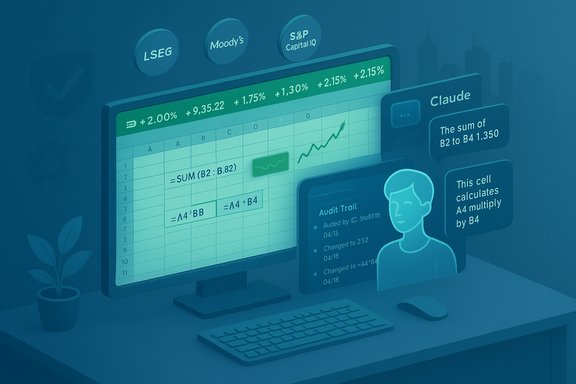
One of the most salient features Anthropic highlights is cell-level transparency: Claude for Excel can track, explain, and link to the exact cells it reads or changes. That’s a direct answer to the “black box” anxiety that haunts AI adoption in regulated domains. In practice this means Claude will log the formulas it altered, the cells it referenced, and present an explanation you can navigate to — a design aimed at enabling human-in-the-loop oversight rather than fully autonomous decisioning. Early materials make clear that Anthropic warns users to verify outputs, and that the add-in will not initially support every advanced Excel feature (for example, macros/VBA and some pivot/table features are listed as limitations).What Anthropic added: connectors, skills, and models
New financial data connectors — building a domain moat
Anthropic’s update expands Claude’s direct access to high-value financial information sources. New connectors announced in the rollout include Aiera (earnings-call transcripts and event summarization), Chronograph (private-equity operational and fund data), Egnyte (secure document room search), LSEG (live market data across equities, fixed income, FX, and macro series), Moody’s (credit ratings and research), and MT Newswires (real-time market news). These join previously announced integrations with S&P Capital IQ, FactSet, Morningstar, PitchBook, Daloopa, Snowflake, and Databricks. The practical effect: Claude can pull institutional-grade, proprietary inputs directly into analysis workflows. Why this matters: the quality of AI outputs is only as good as their inputs. Generic LLMs trained primarily on public web text cannot match models that have pipelines to Bloomberg-level market data, transcript libraries, credit ratings, and private-company intelligence. By tying Claude to these ecosystems, Anthropic is building a defensible stack for financial use cases where accuracy and timeliness are mission-critical.Agent Skills — productizing analyst workflows
Anthropic introduced six pre-built Agent Skills that map to repetitive, labor-intensive analyst tasks:- Discounted cash flow (DCF) models with WACC, scenario toggles, and sensitivities.
- Comparable-company analysis with multiples and operating metrics that refresh with new data.
- Earnings-analysis pipelines that ingest call transcripts and financials to flag guidance changes and management commentary.
- Due-diligence extractors that convert data-room documents into populated Excel sheets (financials, contracts, customer lists).
- Pitch and teaser generation for M&A processes.
- Initiating coverage frameworks: industry overviews, company deep dives, and valuation templates.
Model progress: Sonnet 4.5 and finance benchmarks
Anthropic points to benchmark progress as evidence of Claude’s growing finance competence. On the Finance Agent benchmark maintained by Vals AI, Claude Sonnet 4.5 (Thinking) tops the leaderboard at 55.3% accuracy — a state-of-the-art result for agent-style financial analyst tasks, though well short of perfection. Anthropic also highlights performance on specialized competitions like levels of the Financial Modeling World Cup when run in controlled deployments. These metrics underscore what the company and clients already admit: Claude is powerful, but not infallible, so human oversight remains essential.Early enterprise traction and the productivity math
Several marquee financial institutions are already live on Claude for Financial Services or report production deployments of Claude-based tools. Anthropic and client materials name organizations such as Norges Bank Investment Management (NBIM), AIA Labs at Bridgewater, Commonwealth Bank of Australia, and American International Group (AIG) among early adopters. Client case narratives claim material productivity gains: NBIM reports roughly 20% time savings, which Anthropic quantifies as about 213,000 hours, while AIG’s leadership describes a greater-than-5x compression in review timelines and a lift in data accuracy from roughly 75% to over 90% in early rollouts. These are client-reported outcomes and should be read as performance claims contingent on deployment scope and measurement methodology. Why these numbers matter: in large institutions, even modest percentage improvements in analyst throughput compound into significant headcount or time savings when multiplied across thousands of models, reports, and reviews. That explains the enterprise appetite for domain-ready AI products and the willingness of banks and insurers to make strategic investments in platform integrations.The regulatory and legal landscape: opportunity and peril
Changing federal posture and a patchwork of enforcement
The U.S. regulatory landscape for AI in financial services has been in flux. The CFPB’s 2023 circular emphasizing specific and accurate reasons for adverse actions taken with AI signaled a cautious approach to algorithmic credit and underwriting. Subsequent policy changes at the federal level — including executive orders and OMB memoranda — have shifted with administrations, producing both momentum for regulation and periods where work on enforcement or additional guidance was paused or rescoped. Analysts and policy experts note that while some federal AI guardrails pressed forward in 2023–24, the regulatory agenda has seen reversals and re-prioritization in 2025, creating uncertainty for institutions deciding how aggressively to deploy AI.State-level enforcement is real and immediate
Even as federal directives shift, state attorneys general continue to litigate and settle matters involving AI-driven lending and underwriting. The Massachusetts Attorney General announced a $2.5 million settlement with Earnest Operations LLC over alleged disparate impacts and other compliance failures tied to automated underwriting — a concrete example that state enforcement can and will penalize companies for insufficient fair-lending controls. Financial institutions can’t rely solely on federal posture; state-level risks are immediate and actionable.What institutions are doing about governance
Boards and risk committees are responding: a large proportion of financial-services boards now report some form of responsible-use policy, AI audit regime, or vendor governance playbook. Reports from professional services firms indicate that many institutions are implementing recognized AI risk frameworks, ethics guidelines, and regular AI-use audits. At the same time, CFOs and technology leaders express acute concern around hallucinations, cascading errors, and the systemic risks of agentic automation in payment and treasury functions. For now, the dominant model in production-grade deployments remains human-in-the-loop with explicit guardrails.Competition and strategic positioning
Anthropic’s Excel integration places it in direct competition — and awkward proximity — with Microsoft. Microsoft has begun diversifying Copilot to include Anthropic models in some 365 experiences, while Anthropic’s Excel add-in effectively places Claude in the same user environment as Copilot. Simultaneously, OpenAI, Google, Bloomberg (via BloombergGPT-style domain models), and specialized fintech entrants are all targeting slices of the finance workflow market. The market is likely to fragment along two axes:- General-purpose assistants embedded in productivity suites (Copilot, Claude in Excel).
- Domain-specific stacks that couple specialized models with proprietary data connectors (Anthropic’s financial connectors, Bloomberg-style models).
Technical and operational risks to watch
- Hallucinations and formula errors: Claude can produce incorrect or invented values. In a spreadsheet context, a single misplaced formula or wrong assumption can cascade into erroneous valuations or regulatory submissions. Product materials explicitly warn users to verify outputs.
- Tooling limits and edge cases: Early releases list limitations (no macros/VBA support, missing advanced pivot/table handling). Complex legacy workbooks remain hard to automate reliably.
- Data lineage and governance: Connecting AI to privileged market data (LSEG, Moody’s, FactSet) raises contractual, compliance, and IP questions. Who logs requests? How are audit trails preserved? How is access governed across internal and external users? These are operational questions institutions must answer during onboarding.
- Regulatory liability: Even with guardrails, the risk of disparate impact in lending or underwriting persists. Settlements like Earnest’s show enforcement will focus on outcomes, not just process. Institutions must validate models, test for bias, and document remediation steps.
- Vendor dependency and lock-in: Building core workflows around a third-party model plus proprietary connectors increases switching costs. Institutions will weigh the value of time-savings against strategic vendor concentration.
Practical implementation checklist for CIOs and CFOs
- Define the business case: quantify current analyst hours for the target workflow and estimate conservative gains (10–20%).
- Run a controlled pilot with a clearly scoped workbook set; require cell-level audit trails and change logs.
- Map data flows: identify which connectors will be used, required SLAs, and contractual terms with data providers.
- Institute model validation protocols: test for accuracy, edge-case failures, and fairness across protected classes where applicable.
- Build human-in-the-loop gating for all client-facing outputs and regulatory submissions.
- Establish incident response and rollback procedures for cascading spreadsheet errors or hallucinations.
The investor and market context
Anthropic’s commercial traction and aggressive enterprise push have coincided with rapid capital markets activity. The company raised $3.5 billion in March 2025 at a post-money valuation of about $61.5 billion, and later completed a much larger Series F that pushed its valuation materially higher (reports show a $13 billion raise that lifted the value into the hundreds of billions in later 2025 rounds). The capital flow underscores investor conviction in enterprise AI use cases, but it also raises the stakes: the larger Anthropic becomes, the more its commercial deals and product stability will be scrutinized by clients and regulators.Assessment: strengths, limits, and likely outcomes
Strengths
- Product-market fit: By embedding Claude directly in Excel and pre-packaging financial workflows, Anthropic meets users where they already work — a big adoption advantage.
- Data partnerships: Tight integrations with LSEG, Moody’s, FactSet, PitchBook, and others materially improve the quality of outputs and create a moat that generic models can’t easily replicate.
- Enterprise-first posture: Anthropic emphasizes safety, governance, and limited research previews (1,000-seat waitlists), aligning product rollout with the cautious buying culture of finance.
Limits and risks
- Not yet autonomous or perfectly reliable: Benchmarks (55.3% on Vals AI Finance Agent for Sonnet 4.5) show progress but confirm the need for human oversight. The technology is complementary, not a replacement.
- Regulatory and legal exposure: State-level enforcement and evolving federal policy create residual risk, especially in lending and underwriting domains. The Earnest settlement is a cautionary example.
- Operational friction with legacy Excel features: Many mission-critical spreadsheets rely on macros, complex VBA, and bespoke add-ins that Claude’s early release does not fully support. That limits near-term scope.
Likely outcomes
- Large incumbents will scale pilots into production for non-decisioning workflows first (research, pitchbook prep, model audits).
- Organizations with mature model governance (big banks, sovereign funds, global insurers) will become the fastest adopters and the most vocal proponents — driving a virtuous cycle of enterprise credibility.
- Smaller firms and certain regulated activities (consumer credit decisions, appraisal adjudication) will remain conservative until regulatory clarity and independent validation grow.
Conclusion
Anthropic’s Claude for Excel and the broader set of financial connectors and Agent Skills represent a pragmatic, enterprise-focused push to make AI directly useful to financial professionals. The product’s emphasis on cell-level transparency, domain-grade data connectors, and pre-built analyst workflows answers many of the adoption obstacles that have slowed AI uptake in regulated industries.At the same time, production deployments will be measured, monitored, and governed: the model’s imperfect accuracy, legal precedents around AI-driven disparate impacts, and the technical complexity of legacy spreadsheets mean that human oversight, firm governance, and staged rollouts remain non-negotiable. If Anthropic can sustain reliability while preserving auditability and contractual clarity around data and connectors, Claude may become a credible alternative to incumbent AI assistants — but only as part of a controlled, accountable toolchain that keeps final decision authority firmly in human hands. The spreadsheet is once again the battleground for productivity gains in finance. The winners will be the vendors and institutions that combine superior accuracy, guarded governance, and practical integrations with the messy, mission-critical world of Excel.
Source: Bahia Verdade Anthropic rolls out Claude AI for finance, integrates with Excel to rival Microsoft Copilot - Bahia Verdade
