

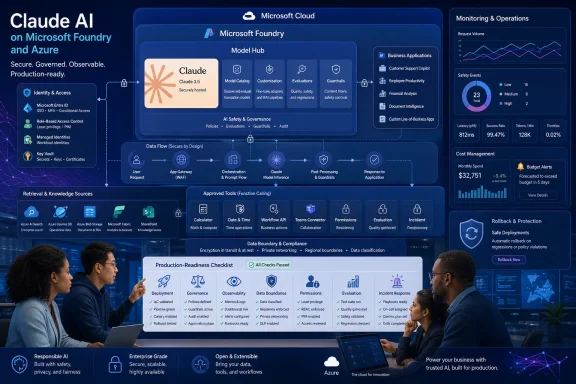
What Changed / What to Do Now
| What changed | What Azure teams should do now |
|---|---|
| Claude is available through Microsoft Foundry. | Select one bounded workload and document how Claude would fit into its architecture. |
| Azure handles billing, authentication, and commitment retirement. | Assign commercial, technical, security, and spending owners instead of assuming the existing Azure relationship resolves every responsibility. |
| The webinar focuses on deployment, business-workflow integration, governance, and observability. | Attend with unresolved production questions and require written evidence before approving a rollout. |
| The intended audience is developers and architects moving beyond experimentation. | Bring an actual data-flow diagram, tool-permission plan, evaluation suite, logging decision, and rollback procedure. |
Five questions to bring to the webinar
- Deployment: What is the verified request path for our selected model, region, tenant, and application architecture?
- Data boundaries: Which services and organizations process prompts, retrieved context, outputs, tool payloads, logs, and support data?
- Controls: Which identities can deploy, invoke, modify, monitor, or retire the workload, and where are those permissions enforced?
- Workflow safety: How should our application restrict retrieval and consequential tool actions to the requesting user’s authorization?
- Observability: Which records will let us reconstruct behavior, attribute spending, detect degradation, and investigate an incident without retaining unnecessary sensitive content?
WindowsForum Production-Readiness Gate
The following is vendor-neutral agent-production guidance, not a list of confirmed Microsoft Foundry features or mandatory Microsoft controls. A workload should not pass into production until each row has an accountable owner and an approved artifact.
| Gate | Required pass artifact | Pass condition | Fail condition |
|---|---|---|---|
| Ownership | Named business owner, technical owner, security contact, spend owner, incident lead, and rollback owner | Each owner has accepted responsibility and has a documented escalation path | Ownership is assigned to a generic team, shared mailbox, or unnamed administrator |
| Data boundary | Approved end-to-end data-flow diagram | The diagram identifies users, applications, model access, retrieval sources, tools, downstream systems, logs, and external processing boundaries | The architecture is represented only as “application connects to AI in Azure” |
| Tool access | Tool-permission matrix | Every operation is classified as read-only, write-enabled, approval-required, or prohibited, with an enforcing identity named | The agent inherits broad application permissions or relies on prompt instructions to avoid unsafe actions |
| Evaluation | Versioned evaluation suite with acceptance thresholds | Tests cover representative tasks, malformed input, unauthorized requests, prompt injection, tool failures, required refusals, and escalation paths | Approval is based primarily on successful demonstrations or informal user impressions |
| Logging and retention | Approved logging-retention decision | The team has defined what metadata and content are recorded, who can access them, how sensitive data is protected, and when records are deleted | Everything is logged indefinitely, or too little is retained to investigate consequential actions |
| Spending | Named spend owner, budget, allocation method, and alert threshold | Consumption can be attributed to a workload and alerts reach someone authorized to act | Costs appear only on a consolidated bill with no workload owner or response threshold |
| Recovery | Tested rollback and fallback plan with a named rollback owner | The service can disable tools, revert configuration, restore a known-good release, or route work to a safe alternate process | The only recovery plan is to wait for the model or platform to recover |
A team that cannot produce these artifacts is still evaluating, regardless of whether the endpoint is reachable or the demonstration is compelling.
This Is Not Another Model-Launch Webinar
The arrival of Claude in Microsoft Foundry is a model-availability story, but the webinar’s production focus makes it more relevant to enterprise architecture teams than a conventional launch presentation.
Azure customers can evaluate Claude through an established Microsoft cloud relationship rather than treating the project as an entirely detached procurement program. That can shorten the path from technical interest to an approved evaluation, especially for organizations already managing cloud consumption and commitments through Azure.
The verified webinar scope is narrower and more useful than an expansive list of assumed agenda items. The session covers:
- Deployment through Microsoft Foundry
- Integration with business workflows
- Governance
- Observability
The supplied information does not provide a detailed agenda beyond those subjects. Questions about model choice, performance targets, budgeting methods, security mechanisms, data geography, implementation steps, or cost controls should therefore be treated as matters to verify—not as promised webinar demonstrations.
The intended audience is developers and architects moving from experimentation toward production. Attendees will get more value by bringing a bounded workload and identifying the operational decisions that remain unresolved.
Azure Is Selling the Friction Removal
The commercial proposition is straightforward: Azure handles billing, authentication, and commitment retirement for Claude in Microsoft Foundry. Procurement, cloud-platform, and finance teams can therefore approach the service through a familiar organizational channel.
Procurement affects whether an AI project advances beyond evaluation. A technically successful pilot can stall if it requires a separate purchasing relationship, an unfamiliar billing process, or an operational structure that the organization has not approved.
Microsoft Foundry availability is intended to reduce that friction. It places Claude within an Azure-centered commercial context and may allow eligible consumption to align with existing cloud commitments.
Commercial convenience does not, by itself, define all contractual, privacy, security, support, or data-processing responsibilities. Teams should verify the applicable documentation and terms for their selected tenant, region, model, and deployment configuration. That is the article’s central limitation note; the sections below identify the evidence administrators should obtain rather than speculating about undocumented mechanisms.
Operational sequence
No webinar date or general-availability timeline is asserted here. The verified sequence is functional:
- Availability: Claude models are accessible through Microsoft Foundry.
- Commercial preparation: Azure provides billing, authentication, and commitment-retirement handling.
- Architecture review: The customer defines deployment boundaries, data flows, identities, workflow integrations, and ownership.
- Production approval: The customer evaluates governance, observability, permissions, failure handling, spending, and rollback evidence.
- Ongoing operation: Owners monitor technical behavior, business quality, security signals, usage, and cost after release.
The webinar addresses the transition from availability to architecture and operational planning. It should not be used as a substitute for workload-specific approval.
The Procurement Shortcut Is Part of the Product
Enterprise buyers evaluate more than model capability. They also need to know whether procurement has approved the purchasing route, whether finance can account for consumption, and whether the service fits existing cloud-management practices.
Azure’s handling of billing, authentication, and commitment retirement is therefore part of the practical value of Claude’s Foundry availability. These functions can remove organizational barriers that sometimes last longer than the technical evaluation.
Commitment retirement may be particularly relevant for organizations that have already made Azure spending commitments. A purchasing route that aligns AI consumption with those commitments can be easier to justify than a disconnected budget and vendor process.
Easier access, however, increases the importance of explicit internal policy. Azure administrators and AI platform teams should define:
- Who may sponsor a Claude workload
- Who may create or modify deployments
- Which environments may connect to business data
- Who owns the resulting consumption
- Which reviews are required before tools receive write permissions
- What evidence must exist before production approval
- Who can suspend or retire the workload
An experiment created inside an approved Azure estate is not automatically approved for every dataset, integration, or business process available in that estate. Claude’s availability through Microsoft Foundry simplifies access; it does not eliminate workload-level authorization.
Deployment Is Only One Architecture Step
Deployment establishes that an application can reach Claude through the selected service configuration. Production approval requires evidence about what surrounds that connection.
Teams should begin with the workload boundary. The architecture record should identify:
- Who can initiate a request
- Which application mediates model access
- What information may enter prompts or retrieved context
- Which systems can receive generated output
- Whether Claude is advisory or can initiate actions
- Where authorization is checked
- What happens when the service is unavailable, slow, uncertain, or blocked
Identity design should distinguish end users, application services, deployment administrators, evaluators, monitoring operators, and downstream tools. This is a vendor-neutral security principle rather than a claim about a particular Foundry interface: each identity should receive only the access needed for its assigned role.
Credential handling needs an owner, protected storage, rotation procedures, a revocation path, and misuse monitoring. Applications should not embed secrets in source code, user-distributed configuration files, or unmanaged automation.
Configuration changes also require control. Prompts, retrieval rules, tool descriptions, model parameters, application logic, and policy checks can all alter system behavior. Those artifacts should be versioned, tested, reviewed, and promoted through controlled environments.
Claude should not be coupled to business logic in a way that makes a safe rollback impossible. A production design should define how administrators can disable a tool, revert a prompt or application release, select a known-good configuration, or route the workflow to a manual process.
Teams should confirm the lifecycle and service commitments of every component used in the architecture. The availability of Claude in Microsoft Foundry does not automatically establish the production status of every agent feature, integration, SDK, or supporting service a customer might combine with it.
The Data Boundary Must Be Documented
Architecture teams need an approved map of how information moves through the complete workload. The Microsoft commercial relationship should not be used as shorthand for the technical request path.
| Decision area | Question requiring confirmation | Evidence the team should retain | Practical admin consequence |
|---|---|---|---|
| Request processing | Which services process prompts, retrieved context, outputs, and tool results? | Current official documentation and an approved architecture diagram | Avoid describing the workload only as “Claude in Azure” when additional components participate |
| Data geography | Where may request content, operational records, backups, and support data be processed or stored? | Region-specific documentation and legal or privacy approval | Residency statements must match the selected configuration |
| Provider roles | Which organizations provide, operate, support, or process each component? | Applicable terms and an approved responsibility map | Billing ownership cannot substitute for a technical and legal role analysis |
| Retention | Which content or metadata may be retained, for how long, and for what purposes? | Provider documentation plus the customer’s logging-retention decision | Provider and customer retention must both appear in the data-flow review |
| Authentication | Which authentication options apply to the selected deployment? | Current deployment documentation and identity design | Credential implementation must follow verified capabilities |
| Service commitments | Which model and surrounding components are supported for the intended use? | Lifecycle and service-level records | Review components individually instead of relying on a broad product-family label |
This table is a planning aid. It does not assert that Microsoft Foundry provides a particular residency setting, authentication option, retention control, or service commitment.
The data-flow diagram should include more than prompts and responses. It should account for:
- User input
- System instructions
- Retrieved documents
- Search results
- Generated output
- Tool-call arguments
- Tool responses
- Application telemetry
- Diagnostic records
- Evaluation datasets
- Human review records
- Support or incident evidence
Legal, privacy, and security review should follow this actual flow. A simple architecture box labeled “AI” or “Foundry” is not adequate when multiple identities, data stores, tools, and operational systems participate in a transaction.
Real Workflows Turn Model Risk into Systems Risk
The webinar’s workflow-integration topic is where Claude can move from answering questions to participating in business processes. It is also where model errors can become persistent system actions.
A standalone assistant may produce text that a user accepts, edits, or rejects. An agent connected to enterprise tools may retrieve internal documents, prepare records, open tickets, draft communications, update systems, or request actions that continue after the original conversation ends.
The risk path therefore includes the user, application identity, retrieval layer, prompt construction, model output, validation logic, tool permissions, downstream APIs, approval controls, and audit records.
A model can generate a plausible plan while the surrounding application remains unsafe because it grants excessive access. Conversely, a relatively small model error can create a substantial incident when automation treats generated language as authorization.
The following recommendations are vendor-neutral agent-production guidance, not confirmed Microsoft Foundry requirements:
- Separate read permissions from write permissions.
- Give each tool the minimum access needed for its function.
- Require deterministic validation before consequential operations.
- Use additional authorization or human approval for high-impact actions.
- Enforce the requesting user’s permissions before retrieval.
- Restrict context to the minimum necessary for the task.
- Treat retrieved documents, email, tickets, websites, and knowledge-base entries as untrusted data.
- Prevent retrieved instructions from overriding application policy or expanding tool access.
- Record enough metadata to determine which identity requested an action and which control allowed it.
Claude can recommend an action, but the application should decide whether the action is permitted. Prompt wording is not a substitute for access control.
Governance Must Be Enforceable
Governance for Claude workloads should define who may sponsor, deploy, invoke, modify, monitor, suspend, and retire each service.
Every production deployment needs named ownership. At minimum, the readiness record should identify a business owner, technical owner, security contact, spend owner, incident lead, and rollback owner. Each must know what event requires action and how escalation works outside normal business hours when the workflow warrants it.
Separation of duties should reflect the workload’s consequence. Commercial approval, cloud administration, deployment configuration, prompt changes, tool registration, production release, and incident review should not automatically belong to one person.
Change management must cover all behavior-changing artifacts, not only application code. A new prompt, retrieval source, tool description, permission, model configuration, or policy rule can materially change the service. Those changes need version history, evaluation evidence, approval, and rollback instructions.
Evaluation must also move beyond a few successful conversations. A production suite should test:
- Representative business cases
- Missing or contradictory information
- Malformed input
- Unauthorized requests
- Excessive data-retrieval attempts
- Prompt-injection content
- Tool timeouts and malformed tool results
- Duplicate-action risks
- Situations requiring refusal
- Situations requiring human escalation
- Expected behavior during dependency failure
The suite should include measurable acceptance thresholds and a named person authorized to approve exceptions. A collection of interesting prompts without pass criteria is a demonstration set, not a production gate.
Governance should remain proportional to consequence. An internal drafting assistant generally requires fewer controls than an agent that changes customer records, submits transactions, alters infrastructure, processes regulated information, or communicates externally.
Observability Must Measure Behavior, Not Just Uptime
Endpoint availability, response time, throttling, and error rates remain important, but they cannot show whether an agent is producing useful, authorized, and cost-effective outcomes.
Agent observability may need to capture:
- Request volume and latency
- Failures, retries, and throttling
- Consumption by workload and environment
- Retrieval success and source selection
- Tool selection and execution results
- Authorization and policy decisions
- Human approvals and overrides
- User feedback
- Evaluation results
- Rollback or fallback events
These are vendor-neutral categories for production monitoring. Teams must verify which signals Microsoft Foundry and the surrounding Azure architecture expose, then identify where application-level telemetry is still required.
Logging creates its own data-boundary decision. Retaining every prompt, retrieved document, generated response, and tool payload may help debugging while creating an unnecessary archive of sensitive material. Retaining too little may make it impossible to reconstruct a consequential action.
A practical design separates operational metadata from content. Request identifiers, deployment identifiers, timing, consumption, tool names, authorization outcomes, policy decisions, and response status may have different access and retention rules from raw prompts, documents, generated text, and tool payloads.
Content logging should have a defined purpose, restricted access, masking where appropriate, an approved retention period, and a deletion process. Temporary diagnostic logging should expire rather than silently becoming the permanent policy.
Cost belongs in the same operational view. Azure’s billing and commitment-retirement handling provides a commercial framework, but each customer still needs a spend owner, an attribution method, a budget, an alert threshold, and a response procedure.
A consolidated Azure bill can simplify procurement while obscuring which application, environment, department, or customer created the consumption. The production gate should fail if nobody can connect a spending alert to a workload owner empowered to reduce usage, suspend a deployment, or investigate abnormal activity.
Behavioral monitoring is equally important. A Claude workload can remain technically available while retrieving unnecessary context, calling tools more often, escalating fewer uncertain cases, or producing outputs that no longer meet business expectations. Evaluation results and workflow-level signals must therefore complement infrastructure monitoring.
Production Readiness Starts Before the Webinar
Teams should arrive at the webinar with one concrete workload rather than a general ambition to “build an enterprise agent.”
A useful candidate is bounded but real: document intake, research synthesis, internal support, coding assistance, incident triage, or another process with observable success and failure conditions.
The workload should have a consequence model. Some mistakes inconvenience a user; others create financial, legal, privacy, security, customer, or operational impact. Permissions, approvals, evaluations, and monitoring should reflect the cost of a wrong action.
Advisory and transactional steps should be separated. Claude might summarize an incident, compare evidence, or recommend remediation while a human operator or deterministic system retains authority to make the production change.
Fallback behavior should be explicit. If Claude is unavailable, slow, uncertain, blocked, or unable to complete a tool call, the workflow should degrade predictably. It should not wait indefinitely, retry without limits, repeat a consequential action, or invent an alternate route.
Pre-webinar admin checklist
Use this checklist to assemble the production-readiness artifacts shown at the beginning of the article:
- Select one business workflow with measurable success criteria.
- Name the business, technical, security, spending, incident, and rollback owners.
- Draw the complete data path from user input through model access, retrieval, tools, logging, and downstream systems.
- Mark every external service and organizational processing boundary.
- Inventory all human, application, administrator, and tool identities.
- Create a permission matrix for every retrieval source and tool operation.
- Identify which actions are advisory, read-only, write-enabled, approval-required, or prohibited.
- Define where authorization is enforced before retrieval and before each consequential action.
- Confirm current documentation for the intended tenant, region, model, authentication configuration, and supporting components.
- Obtain approved answers about processing, geography, retention, provider roles, support, and applicable terms.
- Establish credential ownership, storage, rotation, revocation, and misuse monitoring.
- Build a versioned evaluation suite with documented acceptance thresholds.
- Decide which operational metadata and content will be logged.
- Approve access, masking, retention, deletion, and incident-preservation requirements.
- Set a workload budget and alert threshold, then assign the person who must respond.
- Define retry limits, timeouts, duplicate-action protections, and rate safeguards.
- Document fallback, rollback, incident-response, business-continuity, and retirement procedures.
- Bring unresolved deployment, data-boundary, control, and observability questions to the webinar.
Questions WindowsForum Recommends Asking
The following questions are editorial guidance from WindowsForum. They are not reported webinar agenda items or promises about what Anthropic’s presenters will demonstrate.
Deployment questions
- What components participate in a production request, and which organization operates each component?
- Which prerequisites vary by tenant, region, subscription, model, or commercial arrangement?
- Which authentication options apply to the selected architecture?
- How are deployment and application identities separated?
- Which failures, throttling conditions, or capacity constraints should applications handle?
- What is the supported rollback path after a configuration or application change?
Workflow-integration questions
- How should an application preserve the requesting user’s authorization during retrieval?
- Where should tool permissions be enforced?
- How can read-only and write-enabled tools be separated?
- Which evidence can show who requested, approved, and executed a consequential action?
- How should applications handle untrusted instructions found in retrieved content?
- What safeguards prevent retries from creating duplicate actions?
Governance questions
- Which administrative roles can deploy, modify, monitor, suspend, or retire a workload?
- Which configuration changes generate an auditable record?
- How should organizations version prompts, tools, retrieval sources, and policy rules?
- Which lifecycle information should administrators monitor for Claude and surrounding components?
- What evidence should a production-review board request before approval?
Observability questions
- Which operational metrics and logs are available from the service?
- Which workflow signals must the customer record in its own application?
- How can consumption be attributed to workloads, environments, or departments?
- What content is necessary for debugging, and what can be omitted or masked?
- How can operators reconstruct tool selection, authorization, policy decisions, and human approval?
- Which alerts can trigger a safe suspension, fallback, or rollback?
The Webinar Should Inform a Workload Decision
Claude’s availability in Microsoft Foundry gives Azure customers a more familiar route to Anthropic’s models, including Azure handling for billing, authentication, and commitment retirement. The webinar is relevant to production-minded Azure developers and architects because it focuses on deployment, business-workflow integration, governance, and observability.
Teams should not attend with only a general interest in agents. They should bring a specific workload, an approved or draft data-flow diagram, a tool-permission matrix, an evaluation plan, a logging-retention decision, named owners, a spending threshold, and a rollback path.
The reader takeaway is concise: Claude is available in Microsoft Foundry; the webinar is for production-minded Azure teams; and attendees should arrive with a specific workload plus a defined list of deployment, data-boundary, control, and observability questions.