

Anthropic’s latest discussion of long-horizon AI work is not a new Claude release. It is an engineering note on the “agent harnesses” around the model—the code, tools, state management, and safety controls that let Claude carry out multi-step work without losing track of the job. The StartupHub item published July 17 summarizes material Anthropic published earlier this year.
In an April 2 post, Anthropic technical staff member Lance Martin argued that agent performance increasingly depends on the surrounding application design, not just the underlying model. A harness controls how an AI receives task context, invokes tools, stores progress, and handles failures between sessions.
That matters for work that cannot be finished in one prompt or one context window: building an application, triaging a large codebase, running tests, collecting research, or processing a multi-stage IT workflow. An agent that forgets prior decisions, stops early, or repeats completed work is not useful simply because it can write convincing code.
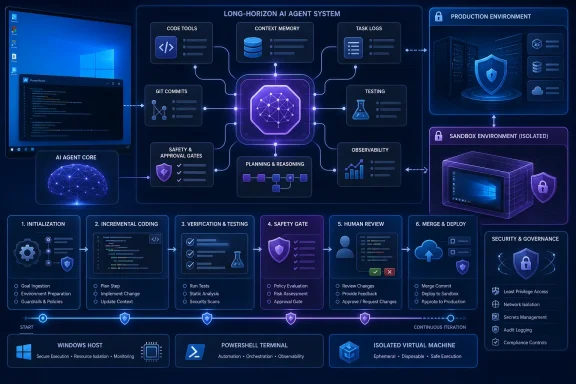
Anthropic’s earlier long-running-agent guidance described two practical roles: an initialization pass that prepares the workspace, records requirements, and creates a baseline; and subsequent coding passes that make incremental changes while leaving a clear progress record for the next session. Git history, structured notes, scripts, tests, and a clean working tree are all part of the handoff mechanism.
The remedy is less glamorous than a bigger model: split work into verifiable increments, give each run a concrete objective, require tests or other checks, and persist state outside the model’s transient conversation context. Martin also noted that some harness work becomes obsolete as models improve. Anthropic found that context-reset mechanisms built around an earlier Claude model became unnecessary with a newer one, and could themselves constrain performance.
For Windows developers and admins experimenting with Claude through the API, Claude Code, or another agent wrapper, the key point is that unattended execution needs ordinary engineering controls. Treat the agent as an automation component with imperfect memory and judgment, not as an autonomous operator.
A sensible deployment pattern includes:
 The model is only part of the system
In an April 2 post, Anthropic technical staff member Lance Martin argued that agent performance increasingly depends on the surrounding application design, not just the underlying model. A harness controls how an AI receives task context, invokes tools, stores progress, and handles failures between sessions.That matters for work that cannot be finished in one prompt or one context window: building an application, triaging a large codebase, running tests, collecting research, or processing a multi-stage IT workflow. An agent that forgets prior decisions, stops early, or repeats completed work is not useful simply because it can write convincing code.
Anthropic’s earlier long-running-agent guidance described two practical roles: an initialization pass that prepares the workspace, records requirements, and creates a baseline; and subsequent coding passes that make incremental changes while leaving a clear progress record for the next session. Git history, structured notes, scripts, tests, and a clean working tree are all part of the handoff mechanism.
Context management remains the weak point
Anthropic says its testing found common failure modes when an agent was left to loop through a large task with only a high-level prompt. It could attempt too much at once, run out of context mid-implementation, and leave an incomplete feature for the next session. Or it could inspect a partly finished project and incorrectly decide the task was complete.The remedy is less glamorous than a bigger model: split work into verifiable increments, give each run a concrete objective, require tests or other checks, and persist state outside the model’s transient conversation context. Martin also noted that some harness work becomes obsolete as models improve. Anthropic found that context-reset mechanisms built around an earlier Claude model became unnecessary with a newer one, and could themselves constrain performance.
For Windows developers and admins experimenting with Claude through the API, Claude Code, or another agent wrapper, the key point is that unattended execution needs ordinary engineering controls. Treat the agent as an automation component with imperfect memory and judgment, not as an autonomous operator.
Practical implications for Windows environments
Long-running agents can be useful for bounded tasks such as repository maintenance, documentation updates, test generation, migration planning, and log or configuration analysis. They should not receive broad access to production systems merely because the task spans several steps.A sensible deployment pattern includes:
- A disposable VM, Windows Sandbox, container, or tightly scoped remote workspace.
- Least-privilege credentials and explicit approval gates for destructive actions.
- Git commits, task logs, and test results after every meaningful stage.
- Limits on runtime, tool access, network destinations, and spending.
- Human review before changes reach production, especially for PowerShell, identity, backup, or endpoint-management work.
References
- Primary source: startuphub.ai
Published: 2026-07-17T23:02:10.688000+00:00
Anthropic's Claude Tackles Long-Horizon AI Tasks | StartupHub.ai
Anthropic's Lance Martin discusses building agent harnesses for Claude to reliably perform complex, long-horizon AI tasks.www.startuphub.ai - Official source: anthropic.com
Effective harnesses for long-running agents \ Anthropic
Anthropic is an AI safety and research company that's working to build reliable, interpretable, and steerable AI systems.www.anthropic.com - Related coverage: aie-wf.sentry.dev
AI Engineer World's Fair 2026
Build your personalized AI Engineer World's Fair scheduleaie-wf.sentry.dev - Official source: www-cdn.anthropic.com