

Anthropic’s Claude Mythos Preview, introduced in April 2026 through Project Glasswing, is a restricted AI cybersecurity model that reportedly helped vetted partners find thousands of serious software vulnerabilities, including old flaws in major operating systems, browsers, and open-source projects. The obvious story is model safety: who gets access to a tool that can find bugs at industrial scale. The more durable story is governance, because most organizations are not built to absorb risk discovery at machine speed. Mythos is less a freak event than a preview of the operating tempo businesses will soon have to manage.
For decades, the security industry has treated discovery as the hard part. Find the bug, write the proof of concept, get it into the right hands, patch it, disclose it, and hope attackers do not arrive first. The process was messy, political, and often slow, but it was still bounded by human scarcity.
Mythos challenges that assumption. Anthropic’s Project Glasswing was framed as a defensive deployment: restricted access, selected partners, coordinated vulnerability hunting, and an attempt to give defenders a head start before comparable capabilities become broadly available. That is the responsible version of the story, and it matters.
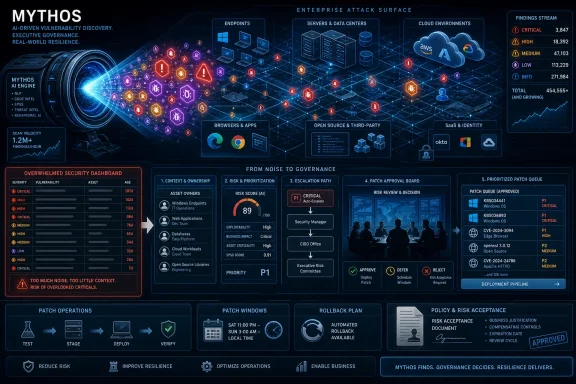
But even the responsible version exposes the next bottleneck. If an AI system can surface serious weaknesses faster than humans can validate, prioritize, patch, test, approve, deploy, and explain them, then the shortage is no longer detection. The shortage is organizational judgment.
That shift should make boards and CIOs uncomfortable. Security teams can identify risk, but they do not own every business process, software dependency, supplier contract, regulatory exposure, customer commitment, or production deadline affected by that risk. Once discovery accelerates, the question becomes painfully simple: who decides what happens next?
What AI changes is the velocity and volume of credible findings. A human red team may produce a curated report after weeks of work. A capable AI-assisted workflow can potentially produce a much larger stream of suspected weaknesses, each demanding triage. That does not automatically make organizations safer; it can also flood the mechanism that turns knowledge into action.
The uncomfortable truth is that many companies still run vulnerability management as if risk arrives in orderly batches. There is a scan, a ticket, a severity score, a service-level agreement, and then a familiar negotiation with the application owner. That model bends under ordinary pressure. It can snap when discovery becomes continuous.
This is where Mythos becomes more than an Anthropic story. The model is a symbol of a broader inversion: defenders are gaining better eyes, but not necessarily faster hands. Seeing more does not help much if the business lacks a disciplined way to decide what deserves immediate action and what can be tolerated.
In reality, an unresolved critical vulnerability in a revenue platform, identity system, medical device, payment workflow, or supplier integration is not merely a technical item. It is a business decision, even when nobody has formally made it. If the risk remains open because the product team is busy, because the vendor has not shipped a fix, because downtime is politically impossible, or because nobody knows who owns the system, the organization has still chosen to carry it.
That is why governance matters. Governance is not the binder of policies that gets updated before an audit. It is the muscle that determines how risk is translated into authority, money, accountability, and action.
Mythos reveals the weakness of treating cybersecurity as a specialist function instead of a shared operating model. A vulnerability may be found by a security analyst, validated by an engineer, delayed by a business unit, escalated by legal, influenced by procurement, and ultimately accepted by an executive. If those handoffs are improvised, the organization is not governing risk. It is negotiating with it in real time.
Attackers do not observe that distinction. Regulators increasingly do not, either. Customers certainly do not when an outage, breach, or supply-chain compromise exposes data or disrupts service.
AI-assisted discovery makes that gap harder to ignore. If a weakness has existed in code for years but is only now surfaced by a model, the risk did not begin at discovery. Discovery merely changed the organization’s ability to deny, defer, or misclassify it.
That is an important shift for smaller and midsize organizations. Large technology firms may have security research teams, coordinated disclosure staff, mature bug bounty programs, and enough engineering capacity to absorb a wave of findings. Smaller businesses often inherit the same exposure through software, cloud services, SaaS platforms, managed providers, and open-source dependencies, but without the remediation machinery.
The danger is not that every company must now behave like Microsoft, Google, or Apple. The danger is that every company depends on ecosystems whose weaknesses can be discovered with increasing speed, while their internal decision-making remains built for a slower era.
But the hardest decisions remain political in the grown-up sense of the word. They involve trade-offs between uptime and exposure, feature delivery and remediation, customer commitments and engineering capacity, regulatory risk and operational reality. The more vulnerabilities AI finds, the more often those trade-offs have to be made.
A model can help say that one flaw is likely exploitable and another is theoretical. It can help identify affected components or draft a patch. It cannot alone decide whether a hospital system should accept downtime, whether a bank should delay a product launch, whether a manufacturer should isolate a plant network, or whether a SaaS vendor should notify customers before a fix is complete.
Those choices require accountable human authority. They also require preparation before the crisis. If leadership first learns who owns a system during a vulnerability escalation, governance has already failed.
Still, vendor restraint is not the same as customer readiness. Anthropic can control access to its model. It cannot control the pace at which comparable techniques diffuse across labs, open-source projects, commercial tools, criminal markets, or nation-state programs.
That is why the governance lesson travels beyond Mythos. Whether or not a given organization ever touches Anthropic’s model is almost beside the point. The capability class is arriving: AI systems that can reason over large codebases, test hypotheses, automate parts of exploit development, and compress the time between suspicion and proof.
Security vendors will package that acceleration as empowerment, and sometimes it will be. But a business that buys faster discovery without improving ownership, escalation, and remediation has not bought resilience. It has bought a louder alarm.
But the practical impact will not stop at the top of the stack. Smaller organizations consume the products, libraries, APIs, plug-ins, SaaS tools, and managed services affected by upstream vulnerability discovery. They may not write the vulnerable code, but they still run the vulnerable business process.
That creates an asymmetry. The companies with the greatest ability to discover and patch weaknesses are not always the companies most exposed to operational disruption from those weaknesses. A vendor may ship an update, but customers still have to test it, deploy it, validate integrations, train support teams, and manage downtime.
For smaller IT teams, the issue is capacity. They are already managing identity, endpoint protection, backups, email security, cloud configuration, compliance demands, helpdesk tickets, and vendor sprawl. If AI-driven discovery increases the rate of urgent advisories and emergency updates, the practical question is not whether the team cares. It is whether the organization has given that team the authority and resources to act.
AI-driven discovery pushes governance closer to operations. It has to show up when a developer chooses a dependency, when procurement approves a vendor, when a business unit adopts an AI tool, when an employee uploads data into a chatbot, and when a security finding lands in a ticket queue. Governance that appears only after the fact becomes archaeology.
This does not mean every decision needs an executive meeting. It means the operating model must be explicit. There should be known owners for critical systems, known escalation paths for severe findings, known rules for risk acceptance, and known thresholds for involving legal, compliance, communications, and senior leadership.
The goal is not bureaucracy. The goal is speed with accountability. A company that can make a defensible risk decision in hours will outperform one that has a beautiful policy and no idea who can approve downtime.
Organizations that treat AI risk as a training problem alone are underestimating the shift. Training matters, but it is not sufficient if workers are under pressure to move quickly, if approved tools are clumsy, if policies are vague, or if leaders quietly reward risky shortcuts. People do not use unsanctioned systems only because they are ignorant. They use them because the sanctioned path is slower than the work.
That dynamic mirrors vulnerability management. A security team can tell the business not to accept unknown risk. A policy can tell employees not to paste sensitive data into public AI tools. Neither instruction will hold if the organization’s incentives, systems, and workflows point the other way.
Governance has to become practical. It should make the right behavior easier, not merely punish the wrong behavior after discovery.
Severity does not equal business exposure. A technically severe vulnerability in an isolated lab environment may be less urgent than a moderate flaw in a public-facing identity workflow. A weakness in a supplier’s software may matter more than a flaw in an internal tool if it touches regulated data or critical operations. A vulnerability with no known exploit today may become urgent tomorrow if AI systems make exploitation easier.
This is why asset context is now strategic. Businesses need to know which systems are internet-facing, which hold sensitive data, which support critical processes, which depend on fragile suppliers, and which cannot be patched without service interruption. Without that map, faster discovery simply produces a larger pile of alerts.
The next generation of vulnerability management will be less about ranking bugs in isolation and more about ranking decisions. What can be fixed immediately? What requires compensating controls? What needs vendor pressure? What must be formally accepted by leadership? What triggers customer communication? Those are governance questions wearing security clothing.
That creates pressure on maintainers, especially in open source. Many foundational projects are maintained by small teams or volunteers who already face unrealistic expectations. If powerful AI systems can produce large numbers of plausible findings against widely used projects, maintainers may be forced to spend more time validating reports than writing fixes.
There is a danger here of mistaking volume for value. A flood of low-quality AI-generated vulnerability reports could become a denial-of-service attack on maintainers. But a stream of high-quality findings can still overwhelm if the patching and disclosure process lacks support.
This is where industry coordination matters. If the AI era produces more vulnerability discovery, it must also produce better funding for maintainers, clearer disclosure norms, improved patch distribution, and more realistic expectations for downstream users. Otherwise the ecosystem will discover risks faster than it can metabolize them.
Windows environments are often heterogeneous in ways outsiders underestimate. A single organization may run current Windows 11 endpoints, aging Windows Server workloads, third-party line-of-business applications, Microsoft 365, Entra ID, Intune, legacy Group Policy, VPN clients, EDR tooling, and industrial systems that cannot be touched without vendor approval. The risk picture is not one product; it is an estate.
AI-driven vulnerability discovery will make that estate feel more exposed. More flaws will be found in upstream components, more advisories will land with urgency, and more compensating controls will be needed when patching cannot happen immediately. The teams that fare best will be the ones that already know their crown-jewel systems, their emergency change process, and their rollback path.
This is not glamorous work. It is asset inventory, ownership mapping, privileged access review, segmentation, tested backups, application dependency tracking, and honest risk acceptance. Mythos makes that work more important precisely because it makes ignorance less durable.
In a faster discovery environment, that pattern becomes less defensible. If an organization knows about a serious weakness and chooses not to remediate it immediately, that choice should be explicit. It should have an owner, a rationale, a review date, and compensating controls where possible.
This is not about blame. It is about clarity. Security teams should not be left carrying business risk they cannot resolve, and business leaders should not be allowed to unknowingly inherit decisions made by delay.
The phrase accepted risk should mean something concrete. It should not be a euphemism for a ticket aging out of sight.
AI is becoming part of how risks are discovered, amplified, and acted upon across the enterprise. It affects security operations, software development, procurement, compliance, legal exposure, and incident response. A governance program that focuses only on preventing employees from leaking data into AI tools will miss the larger operational change.
The better framing is decision governance. How does the organization decide what AI tools may be used? How does it decide which AI-generated findings are credible? How does it assign ownership? How does it prevent hallucinated or low-confidence findings from wasting scarce time? How does it ensure real findings are not buried because they are inconvenient?
These questions belong in the same room as cybersecurity governance, enterprise risk management, software engineering leadership, and executive operations. AI is not creating a new silo. It is increasing the pressure on old seams.
Attackers benefit when discovery accelerates and remediation lags. Defenders benefit only if they can turn findings into reduced exposure. The same technological acceleration can produce either outcome.
That means the winners will not simply be the organizations with the most advanced AI tools. They will be the organizations with the best operating discipline around those tools. They will know which systems matter, who can make decisions, what level of downtime is tolerable, which vendors are critical, and how to communicate when risk becomes material.
This is the least flashy lesson from Mythos, and probably the most important one. AI can change what security teams see. It cannot automatically change what businesses are willing and able to do.
 Mythos Turns Vulnerability Discovery Into an Executive Problem
For decades, the security industry has treated discovery as the hard part. Find the bug, write the proof of concept, get it into the right hands, patch it, disclose it, and hope attackers do not arrive first. The process was messy, political, and often slow, but it was still bounded by human scarcity.Mythos challenges that assumption. Anthropic’s Project Glasswing was framed as a defensive deployment: restricted access, selected partners, coordinated vulnerability hunting, and an attempt to give defenders a head start before comparable capabilities become broadly available. That is the responsible version of the story, and it matters.
But even the responsible version exposes the next bottleneck. If an AI system can surface serious weaknesses faster than humans can validate, prioritize, patch, test, approve, deploy, and explain them, then the shortage is no longer detection. The shortage is organizational judgment.
That shift should make boards and CIOs uncomfortable. Security teams can identify risk, but they do not own every business process, software dependency, supplier contract, regulatory exposure, customer commitment, or production deadline affected by that risk. Once discovery accelerates, the question becomes painfully simple: who decides what happens next?
The Patch Queue Was Already Breaking Before AI Arrived
The industry did not need Mythos to prove that remediation is hard. Enterprises already struggle with sprawling software estates, unmaintained systems, inherited infrastructure, cloudy ownership, shadow IT, and third-party dependencies that nobody fully maps until something breaks. Vulnerability management dashboards have been glowing red for years.What AI changes is the velocity and volume of credible findings. A human red team may produce a curated report after weeks of work. A capable AI-assisted workflow can potentially produce a much larger stream of suspected weaknesses, each demanding triage. That does not automatically make organizations safer; it can also flood the mechanism that turns knowledge into action.
The uncomfortable truth is that many companies still run vulnerability management as if risk arrives in orderly batches. There is a scan, a ticket, a severity score, a service-level agreement, and then a familiar negotiation with the application owner. That model bends under ordinary pressure. It can snap when discovery becomes continuous.
This is where Mythos becomes more than an Anthropic story. The model is a symbol of a broader inversion: defenders are gaining better eyes, but not necessarily faster hands. Seeing more does not help much if the business lacks a disciplined way to decide what deserves immediate action and what can be tolerated.
The Governance Gap Hides Behind Technical Language
Security teams often describe unresolved vulnerabilities as a technical backlog. That framing is comforting, because backlogs sound manageable. They imply a queue, a set of owners, and a path to completion.In reality, an unresolved critical vulnerability in a revenue platform, identity system, medical device, payment workflow, or supplier integration is not merely a technical item. It is a business decision, even when nobody has formally made it. If the risk remains open because the product team is busy, because the vendor has not shipped a fix, because downtime is politically impossible, or because nobody knows who owns the system, the organization has still chosen to carry it.
That is why governance matters. Governance is not the binder of policies that gets updated before an audit. It is the muscle that determines how risk is translated into authority, money, accountability, and action.
Mythos reveals the weakness of treating cybersecurity as a specialist function instead of a shared operating model. A vulnerability may be found by a security analyst, validated by an engineer, delayed by a business unit, escalated by legal, influenced by procurement, and ultimately accepted by an executive. If those handoffs are improvised, the organization is not governing risk. It is negotiating with it in real time.
Unknown Risk Is Still Risk the Business Is Carrying
One useful phrase in the TechRadar Pro argument is that unknown risk is still accepted risk. It sounds harsh because it collapses a distinction businesses often rely on. Leaders tend to separate what they know from what they are responsible for, as if ignorance provides temporary insulation.Attackers do not observe that distinction. Regulators increasingly do not, either. Customers certainly do not when an outage, breach, or supply-chain compromise exposes data or disrupts service.
AI-assisted discovery makes that gap harder to ignore. If a weakness has existed in code for years but is only now surfaced by a model, the risk did not begin at discovery. Discovery merely changed the organization’s ability to deny, defer, or misclassify it.
That is an important shift for smaller and midsize organizations. Large technology firms may have security research teams, coordinated disclosure staff, mature bug bounty programs, and enough engineering capacity to absorb a wave of findings. Smaller businesses often inherit the same exposure through software, cloud services, SaaS platforms, managed providers, and open-source dependencies, but without the remediation machinery.
The danger is not that every company must now behave like Microsoft, Google, or Apple. The danger is that every company depends on ecosystems whose weaknesses can be discovered with increasing speed, while their internal decision-making remains built for a slower era.
AI Makes Prioritization More Political, Not Less
There is a common fantasy that better tooling will make risk decisions more objective. Feed the machine enough context, and it will tell the company what to patch first. In narrow ways, that is true: better asset data, exploitability signals, business criticality, and threat intelligence can improve prioritization.But the hardest decisions remain political in the grown-up sense of the word. They involve trade-offs between uptime and exposure, feature delivery and remediation, customer commitments and engineering capacity, regulatory risk and operational reality. The more vulnerabilities AI finds, the more often those trade-offs have to be made.
A model can help say that one flaw is likely exploitable and another is theoretical. It can help identify affected components or draft a patch. It cannot alone decide whether a hospital system should accept downtime, whether a bank should delay a product launch, whether a manufacturer should isolate a plant network, or whether a SaaS vendor should notify customers before a fix is complete.
Those choices require accountable human authority. They also require preparation before the crisis. If leadership first learns who owns a system during a vulnerability escalation, governance has already failed.
Vendor-Led Safety Does Not Equal Customer-Led Readiness
Anthropic deserves credit for not simply releasing Mythos into the wild. Project Glasswing’s restricted-access model reflects a serious attempt to balance defensive value against offensive risk. In cybersecurity, that distinction matters less than vendors sometimes imply, because the same capability that finds a flaw for a defender can help an attacker find one too.Still, vendor restraint is not the same as customer readiness. Anthropic can control access to its model. It cannot control the pace at which comparable techniques diffuse across labs, open-source projects, commercial tools, criminal markets, or nation-state programs.
That is why the governance lesson travels beyond Mythos. Whether or not a given organization ever touches Anthropic’s model is almost beside the point. The capability class is arriving: AI systems that can reason over large codebases, test hypotheses, automate parts of exploit development, and compress the time between suspicion and proof.
Security vendors will package that acceleration as empowerment, and sometimes it will be. But a business that buys faster discovery without improving ownership, escalation, and remediation has not bought resilience. It has bought a louder alarm.
The Small Business Problem Is Not Smaller
It is tempting to treat Mythos as a concern for major software vendors and hyperscale platforms. After all, the early Project Glasswing partners are the kinds of organizations that maintain operating systems, browsers, cloud services, and critical infrastructure. Their code underpins much of the digital economy.But the practical impact will not stop at the top of the stack. Smaller organizations consume the products, libraries, APIs, plug-ins, SaaS tools, and managed services affected by upstream vulnerability discovery. They may not write the vulnerable code, but they still run the vulnerable business process.
That creates an asymmetry. The companies with the greatest ability to discover and patch weaknesses are not always the companies most exposed to operational disruption from those weaknesses. A vendor may ship an update, but customers still have to test it, deploy it, validate integrations, train support teams, and manage downtime.
For smaller IT teams, the issue is capacity. They are already managing identity, endpoint protection, backups, email security, cloud configuration, compliance demands, helpdesk tickets, and vendor sprawl. If AI-driven discovery increases the rate of urgent advisories and emergency updates, the practical question is not whether the team cares. It is whether the organization has given that team the authority and resources to act.
Compliance Will Lag Unless Governance Moves Into the Workflow
Traditional compliance programs are poorly suited to this tempo. They tend to ask whether a policy exists, whether a control is documented, and whether evidence can be produced for a review period. That is useful, but it is not enough when the risk environment changes faster than the committee calendar.AI-driven discovery pushes governance closer to operations. It has to show up when a developer chooses a dependency, when procurement approves a vendor, when a business unit adopts an AI tool, when an employee uploads data into a chatbot, and when a security finding lands in a ticket queue. Governance that appears only after the fact becomes archaeology.
This does not mean every decision needs an executive meeting. It means the operating model must be explicit. There should be known owners for critical systems, known escalation paths for severe findings, known rules for risk acceptance, and known thresholds for involving legal, compliance, communications, and senior leadership.
The goal is not bureaucracy. The goal is speed with accountability. A company that can make a defensible risk decision in hours will outperform one that has a beautiful policy and no idea who can approve downtime.
Sensitive Data Is the Other Half of the Mythos Lesson
The TechRadar Pro piece also points to a related anxiety: employees entering sensitive data into AI systems. That concern can sound separate from vulnerability discovery, but it is part of the same governance failure. AI changes the speed at which employees can move information, generate outputs, inspect systems, and make decisions.Organizations that treat AI risk as a training problem alone are underestimating the shift. Training matters, but it is not sufficient if workers are under pressure to move quickly, if approved tools are clumsy, if policies are vague, or if leaders quietly reward risky shortcuts. People do not use unsanctioned systems only because they are ignorant. They use them because the sanctioned path is slower than the work.
That dynamic mirrors vulnerability management. A security team can tell the business not to accept unknown risk. A policy can tell employees not to paste sensitive data into public AI tools. Neither instruction will hold if the organization’s incentives, systems, and workflows point the other way.
Governance has to become practical. It should make the right behavior easier, not merely punish the wrong behavior after discovery.
The Old Severity Score Is Not Enough
Most organizations still lean heavily on severity scoring. A critical vulnerability should be patched quickly; a low-severity issue can wait. That hierarchy is useful, but it is a crude instrument for the world Mythos represents.Severity does not equal business exposure. A technically severe vulnerability in an isolated lab environment may be less urgent than a moderate flaw in a public-facing identity workflow. A weakness in a supplier’s software may matter more than a flaw in an internal tool if it touches regulated data or critical operations. A vulnerability with no known exploit today may become urgent tomorrow if AI systems make exploitation easier.
This is why asset context is now strategic. Businesses need to know which systems are internet-facing, which hold sensitive data, which support critical processes, which depend on fragile suppliers, and which cannot be patched without service interruption. Without that map, faster discovery simply produces a larger pile of alerts.
The next generation of vulnerability management will be less about ranking bugs in isolation and more about ranking decisions. What can be fixed immediately? What requires compensating controls? What needs vendor pressure? What must be formally accepted by leadership? What triggers customer communication? Those are governance questions wearing security clothing.
The Disclosure Pipeline Becomes a Public Trust System
Project Glasswing also highlights a deeper ecosystem problem: finding vulnerabilities is only one stage in a chain that includes verification, coordination, patch development, disclosure, downstream adoption, and post-release monitoring. AI may accelerate the first stage faster than the rest can adapt.That creates pressure on maintainers, especially in open source. Many foundational projects are maintained by small teams or volunteers who already face unrealistic expectations. If powerful AI systems can produce large numbers of plausible findings against widely used projects, maintainers may be forced to spend more time validating reports than writing fixes.
There is a danger here of mistaking volume for value. A flood of low-quality AI-generated vulnerability reports could become a denial-of-service attack on maintainers. But a stream of high-quality findings can still overwhelm if the patching and disclosure process lacks support.
This is where industry coordination matters. If the AI era produces more vulnerability discovery, it must also produce better funding for maintainers, clearer disclosure norms, improved patch distribution, and more realistic expectations for downstream users. Otherwise the ecosystem will discover risks faster than it can metabolize them.
Windows Shops Should Read This as an Operations Story
For Windows administrators and Microsoft-centric enterprises, Mythos is not just an AI lab story. It intersects with the realities of patch management, identity hardening, endpoint security, legacy application support, and vendor dependency that define daily operations.Windows environments are often heterogeneous in ways outsiders underestimate. A single organization may run current Windows 11 endpoints, aging Windows Server workloads, third-party line-of-business applications, Microsoft 365, Entra ID, Intune, legacy Group Policy, VPN clients, EDR tooling, and industrial systems that cannot be touched without vendor approval. The risk picture is not one product; it is an estate.
AI-driven vulnerability discovery will make that estate feel more exposed. More flaws will be found in upstream components, more advisories will land with urgency, and more compensating controls will be needed when patching cannot happen immediately. The teams that fare best will be the ones that already know their crown-jewel systems, their emergency change process, and their rollback path.
This is not glamorous work. It is asset inventory, ownership mapping, privileged access review, segmentation, tested backups, application dependency tracking, and honest risk acceptance. Mythos makes that work more important precisely because it makes ignorance less durable.
Risk Acceptance Needs a Name and a Signature
One of the most damaging habits in enterprise security is informal risk acceptance. A vulnerability remains open because the app owner does not respond. A patch is delayed because the release window is inconvenient. A supplier issue is monitored indefinitely because nobody wants to renegotiate the contract. Months later, everyone acts surprised that the risk was still there.In a faster discovery environment, that pattern becomes less defensible. If an organization knows about a serious weakness and chooses not to remediate it immediately, that choice should be explicit. It should have an owner, a rationale, a review date, and compensating controls where possible.
This is not about blame. It is about clarity. Security teams should not be left carrying business risk they cannot resolve, and business leaders should not be allowed to unknowingly inherit decisions made by delay.
The phrase accepted risk should mean something concrete. It should not be a euphemism for a ticket aging out of sight.
AI Governance Cannot Stay in the AI Office
Many companies are building AI governance programs around model use, data handling, acceptable prompts, vendor approvals, and employee productivity tools. That work is necessary. But Mythos shows why AI governance cannot be limited to how employees use chatbots.AI is becoming part of how risks are discovered, amplified, and acted upon across the enterprise. It affects security operations, software development, procurement, compliance, legal exposure, and incident response. A governance program that focuses only on preventing employees from leaking data into AI tools will miss the larger operational change.
The better framing is decision governance. How does the organization decide what AI tools may be used? How does it decide which AI-generated findings are credible? How does it assign ownership? How does it prevent hallucinated or low-confidence findings from wasting scarce time? How does it ensure real findings are not buried because they are inconvenient?
These questions belong in the same room as cybersecurity governance, enterprise risk management, software engineering leadership, and executive operations. AI is not creating a new silo. It is increasing the pressure on old seams.
The Race Is Not Between Attackers and Defenders Alone
Cybersecurity is often described as a race between attackers and defenders. Mythos complicates that metaphor. The race is also between discovery and governance, between knowledge and action, between visibility and accountability.Attackers benefit when discovery accelerates and remediation lags. Defenders benefit only if they can turn findings into reduced exposure. The same technological acceleration can produce either outcome.
That means the winners will not simply be the organizations with the most advanced AI tools. They will be the organizations with the best operating discipline around those tools. They will know which systems matter, who can make decisions, what level of downtime is tolerable, which vendors are critical, and how to communicate when risk becomes material.
This is the least flashy lesson from Mythos, and probably the most important one. AI can change what security teams see. It cannot automatically change what businesses are willing and able to do.
The Companies That Survive the Mythos Era Will Govern Faster Than They Discover
The practical lesson from Mythos is not that every organization needs access to frontier vulnerability-hunting models. It is that every organization needs to prepare for a world in which somebody else may have that capability, and in which the resulting discoveries arrive faster than traditional processes can handle.- Businesses should treat AI-driven vulnerability discovery as an enterprise risk workflow, not merely as a security operations enhancement.
- Security teams should map critical systems, owners, escalation paths, and risk-acceptance authority before high-severity findings arrive.
- Smaller organizations should focus on patch readiness, vendor visibility, backups, identity controls, and segmentation rather than trying to imitate hyperscale security research programs.
- Executives should require explicit ownership for unresolved serious risks, because delay is still a decision even when nobody signs a form.
- AI governance programs should cover how AI-generated security findings are validated, prioritized, escalated, and translated into business action.
- The real advantage will come from shortening the path between discovery and accountable remediation, not from producing the longest list of vulnerabilities.
References
- Primary source: TechRadar
Published: 2026-07-02T11:52:09.623675
Mythos shows why AI governance must catch up to the speed of risk discovery | TechRadar
AI exposes governance gaps as risk discovery outpaces organizational responsewww.techradar.com - Related coverage: thecybersignal.com
Anthropic Says Glasswing's Mythos Found 10,000+ Vulnerabilities
Anthropic says Project Glasswing's Claude Mythos Preview has surfaced over 10,000 high- or critical-severity vulnerabilities in its first month of operation. www.thecybersignal.com
- Related coverage: cyberscoop.com
Anthropic: Mythos finds more than 10,000 software flaws in first month | CyberScoop
Anthropic’s Mythos model uncovers over 10,000 critical software flaws in its first month, shifting the cyber challenge from finding bugs to patching them.cyberscoop.com - Related coverage: isec.news
Anthropic launches Project Glasswing to use Claude Mythos for vulnerability hunting – iSec News
Anthropic launched Project Glasswing to use its Claude Mythos preview model for vulnerability hunting, saying the system found thousands of flaws and can also be powerful enough to aid exploitation.www.isec.news - Related coverage: tomshardware.com
Anthropic's latest AI model identifies 'thousands of zero-day vulnerabilities' in 'every major operating system and every major web browser' — Claude Mythos Preview sparks race to fix critical bugs, some unpatched for decades | Tom's Hardware
Anthropic holds back its most advanced model yet to allow companies and institutions to prepare.www.tomshardware.com - Related coverage: llm-hacking.com
Project Glasswing: 10,000+ critical bugs found by Claude Mythos in a month — LLM-Hacking
Anthropic's May 26, 2026 update on Project Glasswing reports that ~50 partners have used Claude Mythos Preview to find more than 10,000 high/critical-severity vulnerabilities, including 271 latent bugs patched in Firefox 150 — and lays out a controlled-access model for a frontier offensive...www.llm-hacking.com
- Related coverage: cyberhappenings.com
Anthropic launches Project Glasswing with Claude Mythos for vulnerability discovery • CyberHappenings
Anthropic’s Project Glasswing is now showing measurable results: since launching last month, the Claude Mythos Preview-based initiative has uncovered more than 10,000 high- or critical-severity vulnerabilities in widely used software. Anthropic said 6,202 of those candidates affect more than 1,000 ocyberhappenings.com - Related coverage: elpais.com
Anthropic oculta su nuevo modelo de IA, Mythos, por ser demasiado peligroso | Tecnología | EL PAÍS
La compañía ha optado por ceder estrictamente su acceso a unas docenas de empresas escogidas para que lo usen para proteger su ‘software’elpais.com - Related coverage: labs.cloudsecurityalliance.org
CSA research note ai vuln discovery velocity disclosure crisis 20260524 csa styled
PDF documentlabs.cloudsecurityalliance.org
- Related coverage: assets.kpmg.com
Claude Mythos: What Frontier AI Vulnerability Discovery Means for Canadian Enterprises
PDF documentassets.kpmg.com
- Related coverage: omni.se
Mythos uppges ha hittat fler än 10 000 sårbarheter
Anthropic uppger att bolagets nya AI-modell Claude Mythos har identifierat över 10 000 allvarliga sårbarheter i mjukvara. Det enligt en rapport från Project Glasswing, ett initiativ som Anthropic lanserade för en månad sedan.omni.se - Related coverage: theweek.com
Mythos: Anthropic’s new AI model experts fear is unsafe | The Week
Anthropic is not releasing the model to the public over safety concerns and potential hacking possibilitiestheweek.com - Related coverage: ai.se
