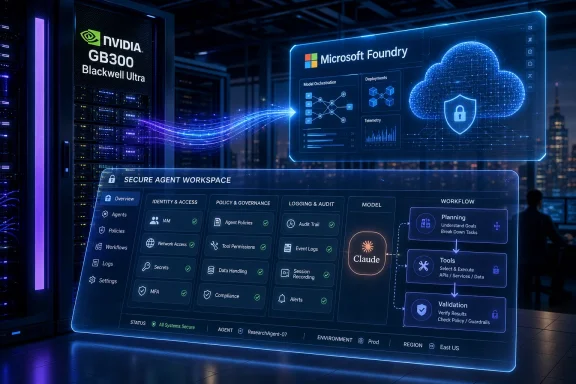
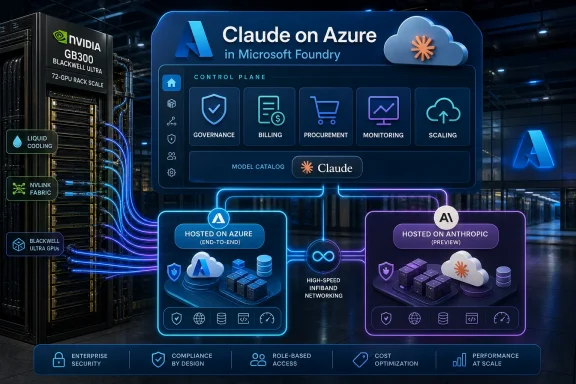
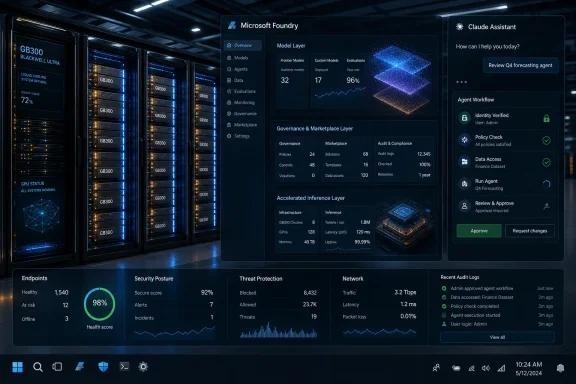
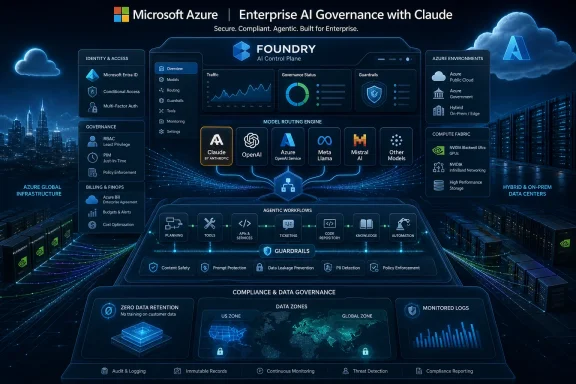
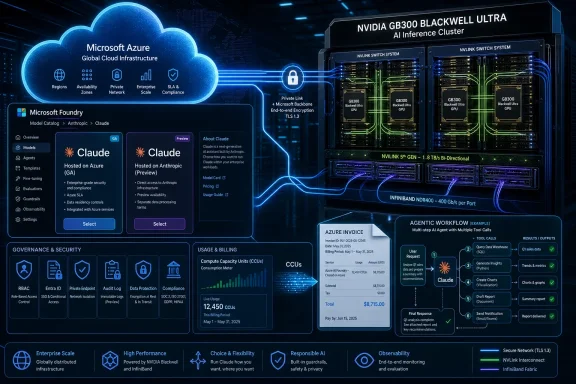
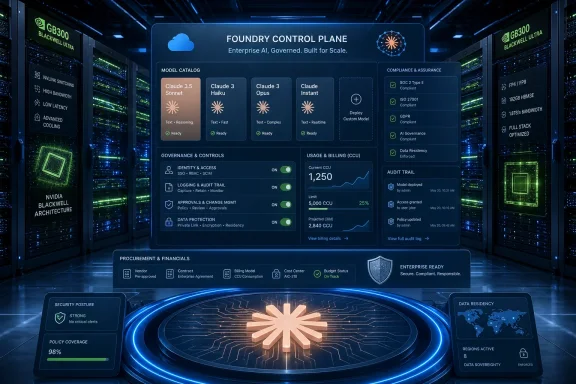
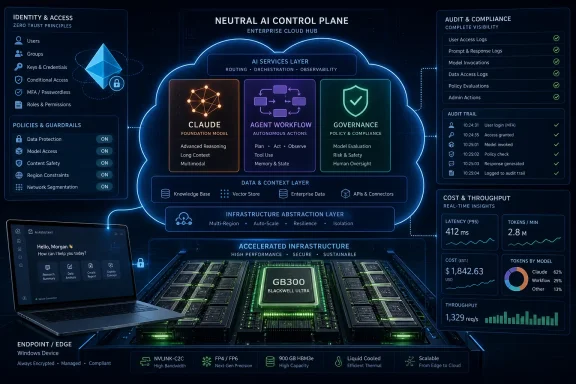
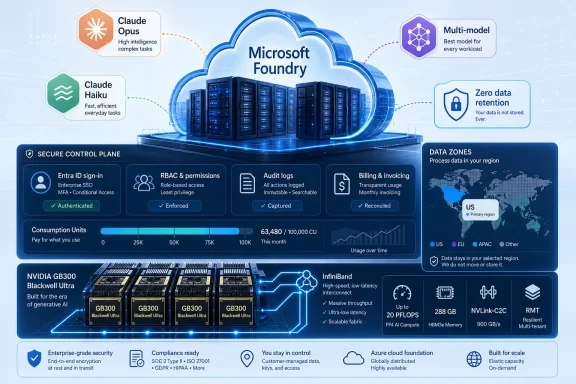
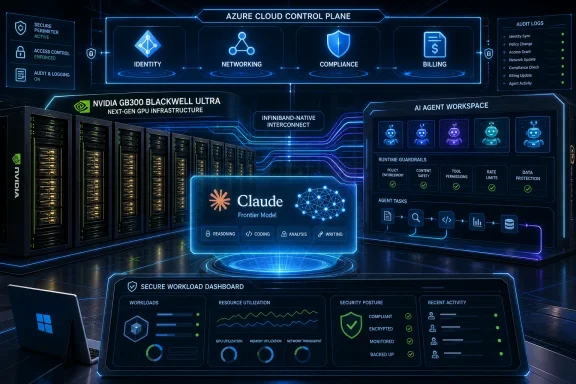
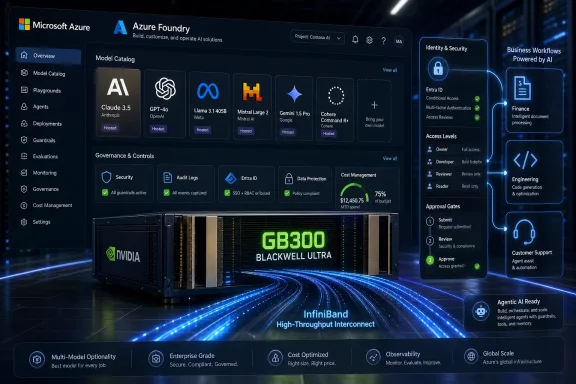
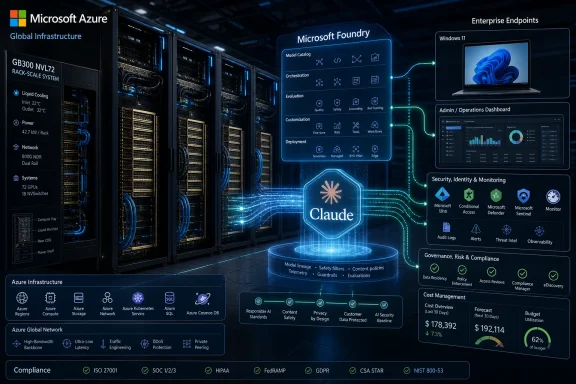
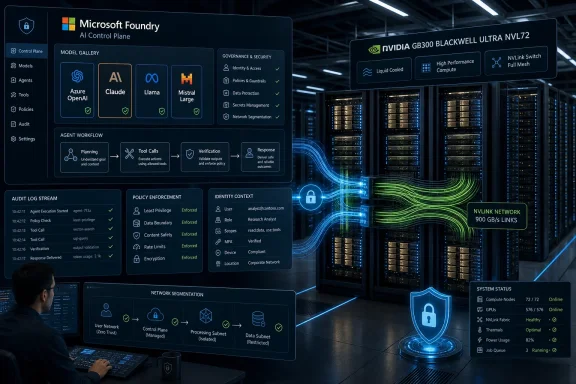
Anthropic’s Claude models became generally available in Microsoft Foundry on June 29, 2026, running on NVIDIA GB300 Blackwell Ultra GPUs in Azure for enterprise customers that want to build domain-specific and autonomous AI agents. The announcement is less about another model appearing in another cloud catalog than about Microsoft’s attempt to make Azure the neutral operating floor for frontier AI. For Windows shops, Azure administrators, and developers already tied into Microsoft identity, governance, billing, and tooling, Claude’s arrival on GB300 is a signal that the next AI platform war will be fought inside enterprise control planes.
Microsoft’s cloud AI strategy has spent the last few years walking a tightrope. On one side sits OpenAI, still deeply woven into Microsoft’s consumer and enterprise AI story. On the other side sits the reality of enterprise procurement: large customers do not want a single-model monoculture, particularly when they are building systems that may handle regulated data, internal code, legal workflows, financial analysis, or operational decision-making.
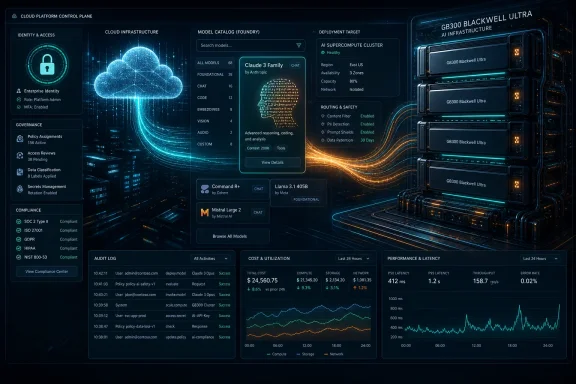
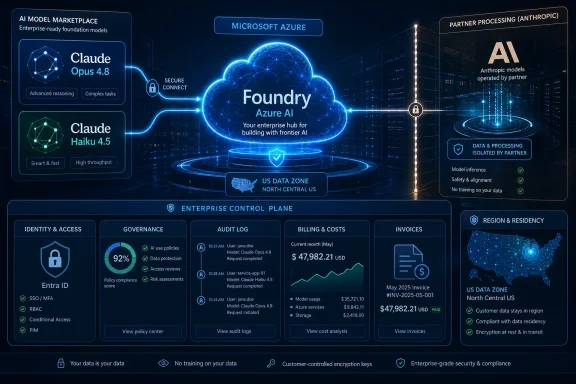
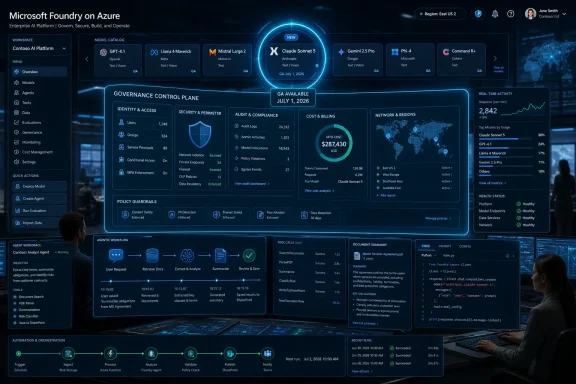
The Claude-on-Azure move fits neatly into that second pressure. Microsoft Foundry has become the place where Microsoft wants customers to discover, evaluate, deploy, govern, and meter models without leaving the Azure estate. By making Claude generally available there, Microsoft is not merely selling access to Anthropic’s models. It is selling the idea that model selection should be an administrative choice inside Azure, not a migration event.
That distinction matters. A CIO already managing Entra ID, Purview, Defender, Azure networking, private endpoints, budgets, and compliance policies does not want every AI experiment to become a new vendor island. Microsoft’s pitch is that Claude can now sit closer to the same governance fabric as everything else the enterprise already runs.
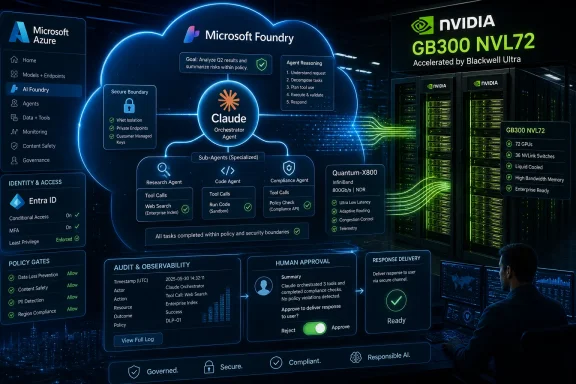
The hardware detail is equally important, but for a different reason. NVIDIA’s GB300 Blackwell Ultra systems are designed for the punishing inference patterns that modern reasoning and agentic workloads create. These are not just larger chatbots. They are systems that may call tools repeatedly, inspect documents, write code, retry failed steps, and maintain context over extended tasks.
That is why NVIDIA keeps talking about agentic infrastructure rather than just faster GPUs. Blackwell Ultra, NVLink, NVSwitch, and Quantum-X800 InfiniBand are not marketing confetti in this context. They are the plumbing needed when models become components in larger loops rather than endpoints for one-off prompts.
Enterprises will notice this first in cost forecasting. The old spreadsheet model of “tokens in, tokens out” was already too simple, but agentic systems make it actively misleading. A support agent resolving one customer case may perform a dozen internal searches, summarize policy documents, draft a response, check it against compliance rules, and escalate uncertain cases. A coding agent might inspect a repository, run tests, patch files, evaluate failures, and try again.
The more useful the agent, the more infrastructure it tends to consume. That creates a paradox for IT buyers: the systems that save the most human time may also be the hardest to budget. Microsoft and NVIDIA are trying to solve that paradox by making the underlying stack more efficient, but no amount of accelerator horsepower makes governance optional.
For Microsoft, this diversifies a story that had become too easy to summarize as “Azure equals OpenAI.” That shorthand was never fully accurate, but it was powerful. Azure OpenAI Service made Microsoft the default enterprise path for GPT-class models, and Copilot turned those models into products. But enterprises increasingly want leverage, redundancy, and policy flexibility.
Claude gives Microsoft another frontier-class option to put in front of those customers. It also lets Microsoft argue that its cloud is the venue where the major AI players can coexist under a common enterprise wrapper. That is a more durable position than betting every workload on one lab, however successful that lab may be.
There is an implicit warning here for the rest of the market. If Azure becomes the place where customers compare OpenAI, Anthropic, Meta, Mistral, Cohere, NVIDIA models, and others under one governance and billing model, the individual model vendors risk becoming interchangeable in procurement conversations. They will still compete on capability, safety, latency, and price. But the customer relationship increasingly belongs to the platform.
GB300 NVL72 is a rack-scale system, not a part number in the old PC-upgrade sense. Each rack combines dozens of Blackwell Ultra GPUs with Grace CPUs and high-bandwidth interconnects, aiming to reduce the bottlenecks that appear when enormous models need to move data quickly across memory and compute. In plain English, NVIDIA is trying to make the datacenter behave less like a collection of servers and more like a single AI machine.
That matters for Azure customers even if they never see the hardware. The entire cloud abstraction depends on someone else making brutal physical tradeoffs about power, cooling, networking, supply chain, and utilization. When Microsoft says Claude is running on GB300 in Azure, it is also saying that a chunk of this expensive, scarce infrastructure has been allocated to Anthropic workloads inside Microsoft’s cloud.
The obvious upside is performance and scale. The less obvious implication is dependency. Enterprise AI roadmaps are now tied to the capital spending rhythms of Microsoft, NVIDIA, Anthropic, OpenAI, Amazon, Google, and a handful of datacenter operators. A model may be available in a catalog, but the practical experience depends on region, capacity, quota, latency, pricing tier, and workload pattern.
Developers building internal applications in Visual Studio, GitHub, Power Platform, or Azure-native stacks are the obvious audience. If Claude is exposed through Microsoft Foundry, teams can potentially test it against internal workloads without building a separate Anthropic procurement and integration path. That is exactly the kind of convenience that changes adoption curves.
Administrators should pay attention because the governance surface will widen. Once business units can choose powerful models from a catalog, IT’s job shifts from approving a single AI vendor to managing a portfolio of model access, data boundaries, audit logs, prompt flows, connectors, and cost controls. The risk is not just that employees will paste sensitive data into a chatbot. The risk is that sanctioned agents will be granted more authority than anyone fully understands.
Security teams should be even more cautious. Agentic systems are uniquely good at crossing boundaries because that is what they are designed to do. They read, decide, call tools, write outputs, and keep going. That can be productive when everything is configured correctly. It can be catastrophic when permissions are overbroad, retrieval sources are poisoned, logs are incomplete, or human review is treated as a speed bump.
This is a familiar pattern in computing. Faster hardware makes each operation cheaper, which encourages people to run more operations. Cloud storage got cheaper and data volumes exploded. Virtual machines got easier to provision and sprawl became an operational discipline. AI agents will likely follow the same path.
The question is not whether Claude on GB300 can make some workloads cheaper. It probably can. The question is whether enterprises will use that efficiency to control budgets or to authorize more ambitious automation. History suggests both will happen, often in the same organization and sometimes in the same quarter.
That is why the practical work will happen in policy rather than press releases. IT departments will need per-team quotas, workload tagging, model routing rules, evaluation harnesses, human-in-the-loop thresholds, and red-team exercises. The era of “let the department try the chatbot” is giving way to a more formal discipline: AI operations as a sibling to cloud operations, security operations, and endpoint management.
That ambition is exactly why Azure availability matters. Frontier models become more valuable when they are easy to attach to corporate systems. An isolated model can draft text. A governed model connected to approved tools can modernize code, triage support cases, analyze contracts, summarize incidents, or orchestrate business processes.
But the safety pitch will be tested harder in agentic deployments than in chat. A model that produces a questionable answer is one kind of risk. A model that takes a questionable action is another. The difference between suggestion and execution is the difference between a productivity tool and an operational actor.
Anthropic and Microsoft know this, which is why the language around governed deployment, controlled workspaces, and verified skills is not incidental. It is a response to the buyer’s deepest fear: that AI adoption will outrun the institution’s ability to supervise it. The industry has spent two years proving that frontier models are useful. The next fight is proving that they can be made accountable.
That is good for enterprise buyers in one sense. A model available across clouds gives customers more deployment paths and reduces the fear of being trapped in a single vendor’s AI stack. It also reflects the way large enterprises actually operate: many are already multi-cloud, even when their governance teams wish they were not.
But multi-cloud model availability can also create hidden inconsistency. The same model family may differ by region, version, latency, available tools, data handling options, logging, fine-tuning support, or integration surface depending on where it is consumed. The procurement slide may say “Claude,” while the implementation details say something far messier.
Microsoft’s task is to make the Azure version feel like the enterprise-native version. That means deep integration with Foundry, identity, networking, monitoring, and compliance. If Microsoft can make Claude feel less like an outside model and more like an Azure resource, it has a stronger argument against both AWS Bedrock and Google’s AI platforms.
That ease cuts both ways. Developers will be tempted to build agents before they build evaluation systems. They will wire models to internal APIs before they fully understand failure modes. They will discover that demos are easy and production is hard, especially when the model is expected to perform reliably across edge cases, bad inputs, stale documentation, and permission boundaries.
The right engineering pattern is not to treat Claude as a magical employee. It is to treat the model as an unreliable but powerful component inside a larger system. That means tests, constraints, fallbacks, observability, and explicit authority limits. The model can reason, but the application still needs architecture.
Windows and Azure developers should also expect toolchains to change. The boundary between coding assistant, DevOps agent, documentation assistant, and security reviewer will blur. Claude’s availability in Azure makes it easier for organizations to standardize those workflows around Microsoft infrastructure, even when the model itself comes from Anthropic.
That is why the real adoption curve for Claude on GB300 in Azure will depend on compliance features as much as model quality. Data residency, auditability, retention controls, access management, encryption, private networking, model versioning, and contractual assurances will shape deployment decisions. The model may be the glamorous part, but the paperwork is the market.
Microsoft has an advantage here because it already sells trust machinery to enterprises. Azure customers are used to thinking in terms of tenants, subscriptions, policies, managed identities, conditional access, and compliance dashboards. If Claude fits into that machinery cleanly, it will pass through doors that a standalone AI product might not.
Still, enterprises should resist the comfort of familiar branding. A governed deployment is not automatically a safe deployment. Compliance can confirm that controls exist; it cannot guarantee that an agent’s delegated task is wise, that a workflow is well-designed, or that business owners understand the operational consequences.
Each company is both partner and leverage point. Microsoft can offer distribution but also shape customer access. NVIDIA can offer performance but also influences the economics of every frontier lab. Anthropic can offer model capability but depends on infrastructure it does not own at sufficient scale.
That web of dependence is becoming the normal state of AI. The myth of the standalone model company is fading. Frontier AI is now an industrial supply chain: chips, power, cooling, network fabric, model training, inference optimization, cloud deployment, governance tools, developer frameworks, and enterprise procurement all fused into one market.
For customers, that means vendor evaluation has to become more sophisticated. It is not enough to ask whether a model performs well on a benchmark. Buyers need to ask whether the model is available in the right region, whether capacity can be guaranteed, whether costs remain predictable under agentic workloads, whether logs are usable for audit, and whether the deployment model aligns with internal risk policy.
Good early candidates are tasks with abundant context, clear success criteria, and limited blast radius. Internal knowledge retrieval, code review assistance, test generation, incident summarization, ticket classification, and policy-aware drafting are more realistic starting points than fully autonomous process execution. The goal is to learn how the model behaves under enterprise constraints before granting it broader authority.
Evaluation will matter more than enthusiasm. Teams should compare Claude against other models available in Foundry, including OpenAI and open or semi-open alternatives, using their own data and tasks. Vendor benchmarks may indicate potential, but local workload performance is what determines value.
Cost measurement should begin on day one. Agentic systems can look cheap in pilot mode and expensive at scale. Instrumentation, tagging, and reporting are not administrative afterthoughts; they are how teams avoid discovering six months later that their “automation savings” became a new cloud budget problem.
A company with well-documented internal systems can give an agent useful tools. A company with chaotic permissions gives an agent a minefield. A company with strong logging can investigate mistakes. A company with weak telemetry gets anecdotes and blame.
This is why Windows administrators and Azure engineers should not treat the announcement as someone else’s cloud news. The deployment layer is coming for the operating layer. AI agents will need access to files, tickets, repositories, mail, calendars, databases, line-of-business applications, and identity systems. Those are the systems IT already protects.
The operational question is therefore simple: when a business unit asks for a Claude agent that can “handle” a workflow, who decides what handle means? If the answer is unclear, the organization is not ready for autonomy. It may be ready for assistance, summarization, and supervised drafting, but not for open-ended action.
The most concrete reading is that Microsoft has expanded Azure’s model portfolio with a major frontier system, NVIDIA has supplied the infrastructure story for agentic workloads, and Anthropic has gained a deeper path into Microsoft-centric enterprises. That is significant on its own. It does not mean every business process is suddenly ready for autonomous AI.
The near-term winners will be teams that treat the model as a component, not a strategy. The long-term winners will be platforms that make model choice feel safe, measurable, and reversible. Microsoft wants Azure Foundry to be that platform.
 Microsoft Is Turning Model Choice Into an Azure Feature
Microsoft’s cloud AI strategy has spent the last few years walking a tightrope. On one side sits OpenAI, still deeply woven into Microsoft’s consumer and enterprise AI story. On the other side sits the reality of enterprise procurement: large customers do not want a single-model monoculture, particularly when they are building systems that may handle regulated data, internal code, legal workflows, financial analysis, or operational decision-making.The Claude-on-Azure move fits neatly into that second pressure. Microsoft Foundry has become the place where Microsoft wants customers to discover, evaluate, deploy, govern, and meter models without leaving the Azure estate. By making Claude generally available there, Microsoft is not merely selling access to Anthropic’s models. It is selling the idea that model selection should be an administrative choice inside Azure, not a migration event.
That distinction matters. A CIO already managing Entra ID, Purview, Defender, Azure networking, private endpoints, budgets, and compliance policies does not want every AI experiment to become a new vendor island. Microsoft’s pitch is that Claude can now sit closer to the same governance fabric as everything else the enterprise already runs.
The hardware detail is equally important, but for a different reason. NVIDIA’s GB300 Blackwell Ultra systems are designed for the punishing inference patterns that modern reasoning and agentic workloads create. These are not just larger chatbots. They are systems that may call tools repeatedly, inspect documents, write code, retry failed steps, and maintain context over extended tasks.
The Real Product Is Not Claude, It Is the Agent Stack Around Claude
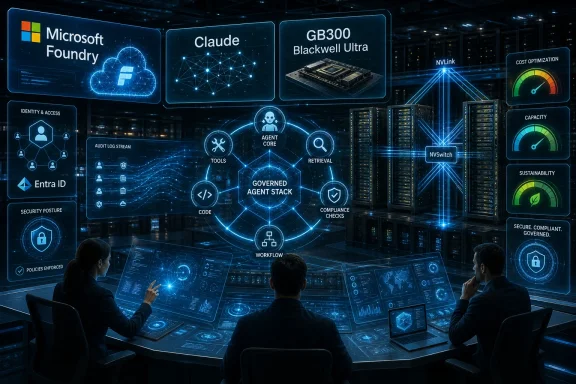
Anthropic’s brand is Claude, but the enterprise product Microsoft and NVIDIA are helping sell is agentic AI: software that does not simply answer a prompt, but takes a goal and works through a sequence of actions. That is where the economics get uncomfortable. A single chat response is one thing; a multi-step agent can burn through many model calls, tool invocations, retrieval operations, and validation passes before producing something useful.That is why NVIDIA keeps talking about agentic infrastructure rather than just faster GPUs. Blackwell Ultra, NVLink, NVSwitch, and Quantum-X800 InfiniBand are not marketing confetti in this context. They are the plumbing needed when models become components in larger loops rather than endpoints for one-off prompts.
Enterprises will notice this first in cost forecasting. The old spreadsheet model of “tokens in, tokens out” was already too simple, but agentic systems make it actively misleading. A support agent resolving one customer case may perform a dozen internal searches, summarize policy documents, draft a response, check it against compliance rules, and escalate uncertain cases. A coding agent might inspect a repository, run tests, patch files, evaluate failures, and try again.
The more useful the agent, the more infrastructure it tends to consume. That creates a paradox for IT buyers: the systems that save the most human time may also be the hardest to budget. Microsoft and NVIDIA are trying to solve that paradox by making the underlying stack more efficient, but no amount of accelerator horsepower makes governance optional.
Azure Gains a Second Frontier Anchor
The November 2025 strategic partnership among Microsoft, NVIDIA, and Anthropic set the stage for this moment. Under that arrangement, Anthropic committed to buying a massive amount of Azure compute capacity, while Microsoft and NVIDIA committed billions in investment. The June 2026 general availability announcement is the operational follow-through: Claude is no longer just a future tenant of Azure infrastructure, but an available model family inside Microsoft’s enterprise AI storefront.For Microsoft, this diversifies a story that had become too easy to summarize as “Azure equals OpenAI.” That shorthand was never fully accurate, but it was powerful. Azure OpenAI Service made Microsoft the default enterprise path for GPT-class models, and Copilot turned those models into products. But enterprises increasingly want leverage, redundancy, and policy flexibility.
Claude gives Microsoft another frontier-class option to put in front of those customers. It also lets Microsoft argue that its cloud is the venue where the major AI players can coexist under a common enterprise wrapper. That is a more durable position than betting every workload on one lab, however successful that lab may be.
There is an implicit warning here for the rest of the market. If Azure becomes the place where customers compare OpenAI, Anthropic, Meta, Mistral, Cohere, NVIDIA models, and others under one governance and billing model, the individual model vendors risk becoming interchangeable in procurement conversations. They will still compete on capability, safety, latency, and price. But the customer relationship increasingly belongs to the platform.
NVIDIA’s GPU Roadmap Is Becoming Enterprise Policy
For years, IT departments treated GPUs as a specialized concern: important for research groups, simulation teams, media workflows, and some machine learning shops, but not a daily strategic issue for most Windows administrators. That era is over. GPU availability, interconnect architecture, datacenter power density, and inference efficiency now shape which AI features enterprises can realistically deploy.GB300 NVL72 is a rack-scale system, not a part number in the old PC-upgrade sense. Each rack combines dozens of Blackwell Ultra GPUs with Grace CPUs and high-bandwidth interconnects, aiming to reduce the bottlenecks that appear when enormous models need to move data quickly across memory and compute. In plain English, NVIDIA is trying to make the datacenter behave less like a collection of servers and more like a single AI machine.
That matters for Azure customers even if they never see the hardware. The entire cloud abstraction depends on someone else making brutal physical tradeoffs about power, cooling, networking, supply chain, and utilization. When Microsoft says Claude is running on GB300 in Azure, it is also saying that a chunk of this expensive, scarce infrastructure has been allocated to Anthropic workloads inside Microsoft’s cloud.
The obvious upside is performance and scale. The less obvious implication is dependency. Enterprise AI roadmaps are now tied to the capital spending rhythms of Microsoft, NVIDIA, Anthropic, OpenAI, Amazon, Google, and a handful of datacenter operators. A model may be available in a catalog, but the practical experience depends on region, capacity, quota, latency, pricing tier, and workload pattern.
Windows Shops Should Read This as a Foundry Story
For WindowsForum readers, the headline may look remote from the desktop. Claude on GB300 sounds like something happening in hyperscale datacenters, not on the machines sysadmins patch every month. But Microsoft’s AI strategy increasingly collapses the distance between cloud model deployment and the Windows-managed workplace.Developers building internal applications in Visual Studio, GitHub, Power Platform, or Azure-native stacks are the obvious audience. If Claude is exposed through Microsoft Foundry, teams can potentially test it against internal workloads without building a separate Anthropic procurement and integration path. That is exactly the kind of convenience that changes adoption curves.
Administrators should pay attention because the governance surface will widen. Once business units can choose powerful models from a catalog, IT’s job shifts from approving a single AI vendor to managing a portfolio of model access, data boundaries, audit logs, prompt flows, connectors, and cost controls. The risk is not just that employees will paste sensitive data into a chatbot. The risk is that sanctioned agents will be granted more authority than anyone fully understands.
Security teams should be even more cautious. Agentic systems are uniquely good at crossing boundaries because that is what they are designed to do. They read, decide, call tools, write outputs, and keep going. That can be productive when everything is configured correctly. It can be catastrophic when permissions are overbroad, retrieval sources are poisoned, logs are incomplete, or human review is treated as a speed bump.
The Cost-Efficiency Claim Needs a Sysadmin’s Skepticism
The announcement emphasizes improved performance and lower inference costs. That is plausible, especially if GB300 systems deliver better throughput per watt and per rack for the kind of multi-step workloads that agents generate. But “lower cost” in AI infrastructure usually means lower unit cost, not necessarily lower total spend.This is a familiar pattern in computing. Faster hardware makes each operation cheaper, which encourages people to run more operations. Cloud storage got cheaper and data volumes exploded. Virtual machines got easier to provision and sprawl became an operational discipline. AI agents will likely follow the same path.
The question is not whether Claude on GB300 can make some workloads cheaper. It probably can. The question is whether enterprises will use that efficiency to control budgets or to authorize more ambitious automation. History suggests both will happen, often in the same organization and sometimes in the same quarter.
That is why the practical work will happen in policy rather than press releases. IT departments will need per-team quotas, workload tagging, model routing rules, evaluation harnesses, human-in-the-loop thresholds, and red-team exercises. The era of “let the department try the chatbot” is giving way to a more formal discipline: AI operations as a sibling to cloud operations, security operations, and endpoint management.
Anthropic’s Enterprise Pitch Is Safety With Ambition
Anthropic has long positioned Claude around safety, reliability, and enterprise suitability. That positioning has helped distinguish it from rivals in markets where customers want powerful models but fear unpredictable behavior. The company’s recent model cadence, including Claude 4.x systems and newer high-end offerings, has pushed the brand beyond cautious assistant and toward long-horizon work.That ambition is exactly why Azure availability matters. Frontier models become more valuable when they are easy to attach to corporate systems. An isolated model can draft text. A governed model connected to approved tools can modernize code, triage support cases, analyze contracts, summarize incidents, or orchestrate business processes.
But the safety pitch will be tested harder in agentic deployments than in chat. A model that produces a questionable answer is one kind of risk. A model that takes a questionable action is another. The difference between suggestion and execution is the difference between a productivity tool and an operational actor.
Anthropic and Microsoft know this, which is why the language around governed deployment, controlled workspaces, and verified skills is not incidental. It is a response to the buyer’s deepest fear: that AI adoption will outrun the institution’s ability to supervise it. The industry has spent two years proving that frontier models are useful. The next fight is proving that they can be made accountable.
The Multi-Cloud Reality Gets More Complicated
Claude’s Azure availability does not erase Anthropic’s relationships with Amazon and Google. If anything, it underscores how unusual Anthropic’s position has become. The company has managed to place Claude across the major cloud ecosystems while also taking strategic money and capacity commitments from multiple hyperscalers and NVIDIA.That is good for enterprise buyers in one sense. A model available across clouds gives customers more deployment paths and reduces the fear of being trapped in a single vendor’s AI stack. It also reflects the way large enterprises actually operate: many are already multi-cloud, even when their governance teams wish they were not.
But multi-cloud model availability can also create hidden inconsistency. The same model family may differ by region, version, latency, available tools, data handling options, logging, fine-tuning support, or integration surface depending on where it is consumed. The procurement slide may say “Claude,” while the implementation details say something far messier.
Microsoft’s task is to make the Azure version feel like the enterprise-native version. That means deep integration with Foundry, identity, networking, monitoring, and compliance. If Microsoft can make Claude feel less like an outside model and more like an Azure resource, it has a stronger argument against both AWS Bedrock and Google’s AI platforms.
Developers Get More Power, and More Ways to Misuse It
For developers, Claude on Azure is likely to be attractive for the same reason Azure OpenAI was attractive: it reduces friction. Teams can prototype against a frontier model without negotiating every layer from scratch. If billing, authentication, and deployment fit into existing Azure patterns, experimentation becomes easier.That ease cuts both ways. Developers will be tempted to build agents before they build evaluation systems. They will wire models to internal APIs before they fully understand failure modes. They will discover that demos are easy and production is hard, especially when the model is expected to perform reliably across edge cases, bad inputs, stale documentation, and permission boundaries.
The right engineering pattern is not to treat Claude as a magical employee. It is to treat the model as an unreliable but powerful component inside a larger system. That means tests, constraints, fallbacks, observability, and explicit authority limits. The model can reason, but the application still needs architecture.
Windows and Azure developers should also expect toolchains to change. The boundary between coding assistant, DevOps agent, documentation assistant, and security reviewer will blur. Claude’s availability in Azure makes it easier for organizations to standardize those workflows around Microsoft infrastructure, even when the model itself comes from Anthropic.
Compliance Will Decide How Fast This Actually Moves
The fastest AI adoption stories tend to come from demos, startups, and internal productivity experiments. The slower and more consequential stories come from regulated industries. Banks, insurers, healthcare companies, airlines, government contractors, and large manufacturers cannot simply hand operational authority to an agent because a vendor says it is efficient.That is why the real adoption curve for Claude on GB300 in Azure will depend on compliance features as much as model quality. Data residency, auditability, retention controls, access management, encryption, private networking, model versioning, and contractual assurances will shape deployment decisions. The model may be the glamorous part, but the paperwork is the market.
Microsoft has an advantage here because it already sells trust machinery to enterprises. Azure customers are used to thinking in terms of tenants, subscriptions, policies, managed identities, conditional access, and compliance dashboards. If Claude fits into that machinery cleanly, it will pass through doors that a standalone AI product might not.
Still, enterprises should resist the comfort of familiar branding. A governed deployment is not automatically a safe deployment. Compliance can confirm that controls exist; it cannot guarantee that an agent’s delegated task is wise, that a workflow is well-designed, or that business owners understand the operational consequences.
The Announcement Also Reveals the Shape of AI Competition
This is not a simple three-way partnership. It is a map of the modern AI economy. Anthropic needs massive compute and enterprise distribution. NVIDIA needs the leading model labs to keep proving demand for its most advanced systems. Microsoft needs AI workloads to justify datacenter expansion and to keep Azure central to enterprise software strategy.Each company is both partner and leverage point. Microsoft can offer distribution but also shape customer access. NVIDIA can offer performance but also influences the economics of every frontier lab. Anthropic can offer model capability but depends on infrastructure it does not own at sufficient scale.
That web of dependence is becoming the normal state of AI. The myth of the standalone model company is fading. Frontier AI is now an industrial supply chain: chips, power, cooling, network fabric, model training, inference optimization, cloud deployment, governance tools, developer frameworks, and enterprise procurement all fused into one market.
For customers, that means vendor evaluation has to become more sophisticated. It is not enough to ask whether a model performs well on a benchmark. Buyers need to ask whether the model is available in the right region, whether capacity can be guaranteed, whether costs remain predictable under agentic workloads, whether logs are usable for audit, and whether the deployment model aligns with internal risk policy.
The Practical Read for Azure Teams Is Narrower Than the Hype
The marketing frame is broad: autonomous agents, domain-specific workflows, enterprise transformation. The practical first steps should be narrower. The smartest Azure teams will not begin by replacing departments with agents. They will begin by finding constrained workflows where Claude’s strengths can be measured against known baselines.Good early candidates are tasks with abundant context, clear success criteria, and limited blast radius. Internal knowledge retrieval, code review assistance, test generation, incident summarization, ticket classification, and policy-aware drafting are more realistic starting points than fully autonomous process execution. The goal is to learn how the model behaves under enterprise constraints before granting it broader authority.
Evaluation will matter more than enthusiasm. Teams should compare Claude against other models available in Foundry, including OpenAI and open or semi-open alternatives, using their own data and tasks. Vendor benchmarks may indicate potential, but local workload performance is what determines value.
Cost measurement should begin on day one. Agentic systems can look cheap in pilot mode and expensive at scale. Instrumentation, tagging, and reporting are not administrative afterthoughts; they are how teams avoid discovering six months later that their “automation savings” became a new cloud budget problem.
The Claude-on-GB300 Era Rewards the Boring Teams
The organizations most likely to benefit are not the ones with the flashiest AI demos. They are the ones with boring strengths: clean identity architecture, disciplined data classification, mature API management, observability, cost controls, and security review processes that developers actually use. Agentic AI magnifies both capability and dysfunction.A company with well-documented internal systems can give an agent useful tools. A company with chaotic permissions gives an agent a minefield. A company with strong logging can investigate mistakes. A company with weak telemetry gets anecdotes and blame.
This is why Windows administrators and Azure engineers should not treat the announcement as someone else’s cloud news. The deployment layer is coming for the operating layer. AI agents will need access to files, tickets, repositories, mail, calendars, databases, line-of-business applications, and identity systems. Those are the systems IT already protects.
The operational question is therefore simple: when a business unit asks for a Claude agent that can “handle” a workflow, who decides what handle means? If the answer is unclear, the organization is not ready for autonomy. It may be ready for assistance, summarization, and supervised drafting, but not for open-ended action.
The Fine Print Will Matter More Than the First Demo
This announcement puts powerful pieces in motion, but enterprise outcomes will depend on implementation details that rarely fit into launch copy. Azure regions, quotas, model versions, service-level commitments, data handling terms, logging depth, and integration maturity will decide whether Claude on GB300 becomes a production staple or another pilot platform.The most concrete reading is that Microsoft has expanded Azure’s model portfolio with a major frontier system, NVIDIA has supplied the infrastructure story for agentic workloads, and Anthropic has gained a deeper path into Microsoft-centric enterprises. That is significant on its own. It does not mean every business process is suddenly ready for autonomous AI.
The near-term winners will be teams that treat the model as a component, not a strategy. The long-term winners will be platforms that make model choice feel safe, measurable, and reversible. Microsoft wants Azure Foundry to be that platform.
Azure’s Claude Moment Leaves IT With a Short New Checklist
Claude’s general availability on GB300-backed Azure infrastructure is a meaningful expansion of enterprise AI choice, but it should push administrators toward sharper questions rather than broader hype. The technology is powerful; the deployment discipline will decide whether it is useful.- Enterprises should test Claude in Microsoft Foundry against real internal workloads before assuming it is better or cheaper than existing model choices.
- Azure teams should define cost controls and workload tagging before allowing agentic pilots to scale across departments.
- Security teams should treat autonomous agents as delegated actors with permissions, not as chat interfaces with better branding.
- Developers should build evaluation, logging, and fallback paths around Claude instead of relying on model quality alone.
- Regulated organizations should validate data residency, retention, audit, and access-control behavior before moving from prototypes to production.
- Windows and Microsoft 365 administrators should expect AI governance to become part of normal identity, endpoint, and application management work.
References
- Primary source: blockchain.news
Published: 2026-06-29T18:16:28.336935
Anthropic’s Claude Models Now On NVIDIA GB300 GPUs in Azure
Anthropic’s Claude AI models, now on NVIDIA GB300 GPUs via Microsoft Azure, promise enhanced enterprise AI capabilities with domain-specific agents.blockchain.news - Independent coverage: Crypto Briefing
Published: Mon, 29 Jun 2026 17:31:08 GMT
Anthropic's Claude models now run on Nvidia GB300 Blackwell Ultra systems via Microsoft Azure
Anthropic's Claude AI models now run on Nvidia GB300 Blackwell Ultra via Azure, backed by $15B in investments and a $30B compute commitment reshaping AIcryptobriefing.com - Official source: blogs.microsoft.com
Microsoft, NVIDIA and Anthropic announce strategic partnerships - The Official Microsoft Blog
Anthropic to scale Claude on Azure Anthropic to adopt NVIDIA architecture NVIDIA and Microsoft to invest in Anthropic Today Microsoft, NVIDIA and Anthropic announced new strategic partnerships. Anthropic is scaling its rapidly-growing Claude AI model on Microsoft Azure, powered by NVIDIA, which...blogs.microsoft.com - Related coverage: techrepublic.com
Microsoft, Nvidia, and Anthropic Forge New AI Alliance
Microsoft, Nvidia, and Anthropic seal a multibillion-dollar AI pact, scaling Claude on Azure with Nvidia chips to bring frontier models to more enterprises.www.techrepublic.com
- Related coverage: tech-insider.org
Anthropic $65B Series H: $965B Valuation [2026]
Anthropic closed a $65B Series H at a $965B valuation May 28, 2026. Inside the lead investors, $47B ARR, and Oct 2026 IPO timing.tech-insider.org - Related coverage: teahose.com
Anthropic Valuation (2026): $965B, the Road to It, and the IPO | Teahose
Anthropic's valuation in 2026: $965B after a $65B Series H (May 2026), up from $61.5B in March 2025. Full funding history, the $47B revenue run-rate behind…www.teahose.com
- Related coverage: theairankings.com
Anthropic in 2026: Claude, Fable 5, $965B Valuation & Strategy | The AI Rankings
Anthropic's 2026 profile: the safety lab behind Claude, its $965B Series H valuation, $47B revenue run rate, the new Mythos-class models (Fable 5 / Mythos 5), the export-control suspension, Constitutional AI, leadership, and where it leads and lags. theairankings.com
- Related coverage: techradar.com
Anthropic locks in massive Azure deal to fuel Claude expansion across global clouds and reshape enterprise AI access worldwide | TechRadar
Claude models integrate into the Microsoft Foundry platform for enterprise deploymentwww.techradar.com - Related coverage: blogs.nvidia.com
Microsoft Azure Unveils World’s First NVIDIA GB300 NVL72 Supercomputing Cluster for OpenAI | NVIDIA Blog
New state-of-the-art platform enables next-generation AI model development and deployment while furthering American leadership in AI.blogs.nvidia.com - Related coverage: axios.com
Anthropic lands $15 billion investment from Microsoft, Nvidia
The move is the latest in a series of deals that have all the big players partnering with one another.www.axios.com
- Related coverage: shacknews.com
Anthropic boasts $965 billion valuation following $65 billion Series H funding round | Shacknews
Altimeter Capital, Dragoneer, Greenoaks, and Sequoia Capital were contributors in this funding round, reportedly making Anthropic the world's most valuable AI start-up.www.shacknews.com - Official source: azure.microsoft.com
- Related coverage: dataconomy.com
Anthropic launches Claude Fable 5 ahead of $965 billion IPO
Anthropic has launched Claude Fable 5, its first publicly available model in the Mythos class, which features a safeguard systemdataconomy.com - Related coverage: windowscentral.com
NVIDIA joins Microsoft’s push on Claude — piling billions into Anthropic’s future | Windows Central
Claude’s arrival on Azure signals a major shift in the competitive AI cloud landscape.www.windowscentral.com - Related coverage: tomshardware.com
- Related coverage: newsroom.ibm.com
IBM and Anthropic Partner to Advance Enterprise Software Development with Proven Security and Governance
PDF documentnewsroom.ibm.com
- Related coverage: e24.no
Microsoft og Nvidia investerer i AI-selskap – E24
Anthropic henter opptil 15 milliarder dollar fra Microsoft og Nvidia og binder seg til gigantisk skyavtale. e24.no
- Related coverage: techxplore.com
- Related coverage: press.spglobal.com
S&P Global and Anthropic Announce Integration of S&P Global's Trusted Financial Data into Claude - Jul 15, 2025
PDF documentpress.spglobal.com
- Related coverage: nvidianews.nvidia.com
Latest News | NVIDIA Newsroom
nvidianews.nvidia.com
- Official source: anthropic.com
Anthropic at AWS Summit Washington, D.C. 2026 \ Anthropic
Join Anthropic at AWS Summit Washington, D.C. to learn how customers are making employees smarter, automating complex operations, and building the next generation of AI products with Claude on AWS. www.anthropic.com
- Related coverage: developer.nvidia.com
Tag: GB300 | NVIDIA Technical Blog
developer.nvidia.com
- Official source: red.anthropic.com
Anthropic's coordinated vulnerability disclosure dashboard
red.anthropic.com
- Related coverage: docs.nvidia.com