

Claude Opus 4.6 arriving in Microsoft Foundry marks a pivotal moment for enterprise AI—bringing Anthropic’s latest reasoning-focused model into a production-ready, governance-first platform that aims to let organizations move from experiments to long‑running, agentic workflows with confidence. The combination promises more capable coding assistants, higher‑context financial and legal analysis, and agents that can operate across multiple enterprise systems with less human supervision. But the upgrade also brings new technical trade‑offs, cost considerations, and operational risks that IT teams must understand before handing critical workflows to autonomous systems.
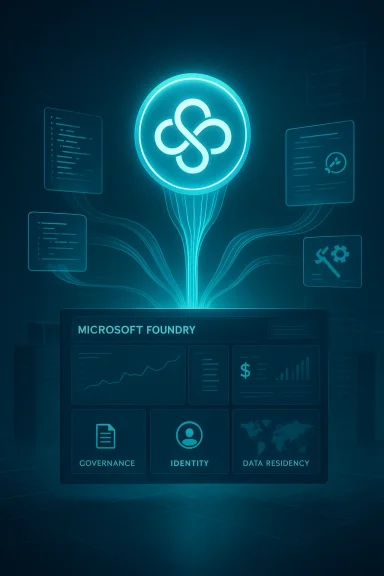
Anthropic’s Claude family has steadily positioned itself as a competitor to mainstream LLMs by emphasizing alignment, instruction following, and structured tool use. Claude Opus 4.6 is presented as the latest refinement in that lineage—optimized for long‑horizon reasoning, multi‑tool agents, and production code generation. Microsoft Foundry is Microsoft’s enterprise AI platform that unifies model hosting, agent orchestration, knowledge access (Foundry IQ), security controls, and deployment pipelines on Azure. The Foundry integration surfaces Opus 4.6 inside the same portal and operational fabric used by customers already building enterprise agents and Copilot integrations.
Put simply: Anthropic contributes frontier model capabilities; Microsoft contributes an enterprise control plane, identity and governance integrations, and connectors to Microsoft 365, Fabric, and other data systems. The result is billed as a pathway to delegate complex end‑to‑end tasks—everything from requirements and implementation to maintenance—while keeping human reviewers and governance in the loop.
However, the technical promise comes with operational reality checks. Larger contexts and higher effort settings raise costs and require mature engineering practices to manage latency, reliability, and security. Compaction and server‑side summarization accelerate long conversations, but they also add an extra transformation step that must be auditable. And while vendor statements and early customer testimonials are encouraging, enterprises should validate claims with domain‑specific benchmarking, red‑teaming, and a phased rollout plan that preserves human oversight.
In short: Opus 4.6 plus Foundry gives enterprises a capable engine for more ambitious automation and reasoning. The difference between a safe, productive deployment and a risky experiment will depend on governance, testing, and sensible incremental adoption. For IT leaders, the practical path forward is clear: pilot aggressively on low‑blast‑radius workflows, instrument comprehensively, and scale only when operational metrics demonstrate reliability, cost predictability, and compliance readiness.
Conclusion
The partnership between Anthropic’s Opus 4.6 and Microsoft Foundry advances the practical frontier of enterprise AI by making longer, more sophisticated, and more agentic tasks feasible in production. Organizations that invest in proper governance, monitoring, and validation can realize significant gains in engineering throughput, knowledge work quality, and automation. But the technology is not a drop‑in replacement for human expertise—successful adoption will require disciplined rollout plans, robust security defenses, and clear accountability for model‑driven decisions. When those elements are in place, Opus 4.6 in Foundry offers a powerful new toolset for building trusted, autonomous workstreams at enterprise scale.
Source: Microsoft Azure Claude Opus 4.6: Anthropic's powerful model for coding, agents, and enterprise workflows is now available in Microsoft Foundry | Microsoft Azure Blog
 Background
Anthropic’s Claude family has steadily positioned itself as a competitor to mainstream LLMs by emphasizing alignment, instruction following, and structured tool use. Claude Opus 4.6 is presented as the latest refinement in that lineage—optimized for long‑horizon reasoning, multi‑tool agents, and production code generation. Microsoft Foundry is Microsoft’s enterprise AI platform that unifies model hosting, agent orchestration, knowledge access (Foundry IQ), security controls, and deployment pipelines on Azure. The Foundry integration surfaces Opus 4.6 inside the same portal and operational fabric used by customers already building enterprise agents and Copilot integrations.Put simply: Anthropic contributes frontier model capabilities; Microsoft contributes an enterprise control plane, identity and governance integrations, and connectors to Microsoft 365, Fabric, and other data systems. The result is billed as a pathway to delegate complex end‑to‑end tasks—everything from requirements and implementation to maintenance—while keeping human reviewers and governance in the loop.
What Claude Opus 4.6 brings to enterprises
Key technical highlights (what has changed)
- Hybrid reasoning model tuned for agentic workflows — Opus 4.6 focuses on multi‑step planning, tool orchestration, and instruction fidelity for professional domains such as coding, finance, legal, and security.
- Large context and output windows — the model supports a practical default context in the hundreds of thousands of tokens and a beta 1,000,000‑token context window for extremely long‑horizon tasks. It also supports up to 128K output tokens, enabling much longer single responses than typical previous limits.
- Adaptive thinking and finer effort controls — a new adaptive thinking mode lets the model dynamically decide when to allocate more internal “thinking” resources, and a new max effort level gives developers a higher capability tier for hard problems.
- Context compaction (beta) — server‑side summarization that reduces earlier conversation context into concise traces so agents can maintain continuity in long‑running conversations or multi‑stage workflows.
- Tooling and streaming improvements — fine‑grained tool streaming for smoother interleaving of tool outputs and model reasoning as agents interact with external systems.
- Data residency and deployment controls — per‑request inference geography controls and enterprise governance hooks designed for compliance and regulatory scenarios.
What Foundry contributes
- Foundry IQ: a single knowledge layer that connects SharePoint, Fabric OneLake, Microsoft 365 sources, the web, and other indexed or remote sources so agents can ground responses while honoring access controls.
- Agent orchestration and runtime governance: fine‑grained RBAC, audit logging, managed VNETs, and integration with Microsoft Purview and Entra ID to provide enterprise observability and compliance.
- Operationalization: templates, one‑click channel deployment (Teams, M365 Copilot integrations), and connectors to hundreds of business systems that help transition agents from prototype to production.
- Local & hybrid deployment options: support for edge/local SDKs and containerized deployments for scenarios where data cannot leave specific jurisdictions or networks.
Where Claude Opus 4.6 shines
1) Autonomous coding and long‑running engineering workflows
Opus 4.6 is explicitly pitched at complex software engineering tasks: deep refactors, cross‑repository changes, automated code review, test generation, and multi‑step implementations. With larger context windows it can see more of a codebase in a single session, reducing the need for piecemeal prompts or external retrieval layers. In practice this can compress common engineering cycles:- Requirements gathering and code design
- Implementation scaffolds and initial code generation
- Test generation and static analysis
- Iterative refactoring and production readiness checks
2) High‑context analytics for finance and legal
For disciplines that require high fidelity and traceability—financial modeling, regulatory compliance, legal drafting—Opus 4.6’s extended context and better instruction following reduce the amount of human re‑work required. The model’s ability to connect insights across regulatory filings, market reports, and internal datasets makes it a potent assistant for analysts and lawyers, particularly when paired with Foundry IQ to ensure the model’s inputs are the organization’s authoritative sources.3) Agentic computer use and multi‑tool automation
Opus 4.6 brings improved visual and multi‑step interface understanding so agents can interact across applications: filling forms, moving data between systems, and driving cross‑application workflows. In enterprise settings this can automate repetitive service desk tasks, data reconciliation, and multi‑system transaction workflows—again with the caveat that proper guards and monitoring are required.4) Security and threat hunting
Anthropic positions the model as helpful in sniffing out subtle attack vectors and complex patterns in log data. Deeper reasoning can speed triage and pattern recognition for security teams. But automated security workflows must be validated extensively: false positives and flawed remediation automation can create operational hazards.Critical analysis: strengths, weaknesses, and real‑world tradeoffs
Strengths
- Improved long‑horizon capability: The larger context and output windows are genuinely useful for enterprise workflows that span documents, code, and tools.
- Better instruction following: Anthropic’s continuous focus on alignment tends to produce more reliable and professional outputs, minimizing superficial errors in structured domains.
- Integrated governance through Foundry: The combination with Microsoft Foundry removes a large amount of infrastructure stitching—identity, audit, compliance and deployment controls are critical enablers for enterprise adoption.
- Agent orchestration: Native agent primitives, sub‑agent spawning, and parallelization allow more complex, team‑like behavior from AI systems.
Weaknesses and risks
- Cost and resource tradeoffs: Larger context windows and longer outputs come with higher compute and token costs. Beta features (1M token window) will likely carry premium pricing beyond practical thresholds; teams must budget carefully.
- Latency and reliability: Larger model runs and extended reasoning increase latency and may require streaming or special client patterns to avoid timeouts. Operational engineering is required to make this predictable in production.
- Over‑automation hazards: Agents that act across systems—especially ones that can write to or modify production systems—risk unintended side effects if safeguards are incomplete.
- Traceability and accountability: Long compactions and server‑side summarization introduce another transformation step. Teams must verify that compaction preserves factual provenance and does not silently drop critical context.
- Regulatory and privacy constraints: Some high‑stakes domains (healthcare, regulated finance, government) impose strict data residency, audit, and explainability requirements. Per‑request inference geo controls help, but comprehensive compliance will still require process changes.
- Performance variability on edge cases: No model is perfect. Opus 4.6 will still need domain‑specific validation, adversarial testing, and guardrails for hallucinations, especially where factual precision matters.
Claims that require cautious reading
- Assertions that the model outperforms competitor X across all professional benchmarks should be treated carefully. Benchmark comparisons vary by dataset, prompt style, and evaluation criteria. Organizations should run domain‑specific evaluations using their own data and metrics before trusting model outputs at scale.
- Customer testimonials in launch posts highlight promising pilots, but they do not substitute for rigorous, independent operational metrics that reflect long‑term durability, cost, and governance maturity.
Practical guidance for IT teams: pilot to production checklist
If you’re responsible for deploying Opus 4.6 in Foundry, treat this as a full engineering and governance project. Below is an actionable roadmap.- Define measurable objectives
- Align pilots to clear KPIs (time saved per task, reduction in rework, defect escape rates).
- Inventory sensitive data flows
- Map what data the agent will touch. Classify sensitivity and apply appropriate data residency and encryption controls.
- Start with a narrow, high‑value use case
- Choose a single workflow (e.g., code review for non‑production branches, legal contract summarization) to limit blast radius.
- Prepare datasets for validation
- Collect representative test cases, edge cases, and adversarial examples from production systems.
- Configure conservative effort and access settings
- Begin with medium effort and no system‑write privileges; increase capabilities as confidence grows.
- Implement human‑in‑the‑loop (HITL) gating
- Require human approval for any write or outbound actions to critical systems during early rollout.
- Instrument monitoring and observability
- Enable detailed audit logs, decision traces, and per‑request provenance capture. Track costs per session and token usage.
- Run red‑team exercises
- Test for prompt injections, data exfiltration risks, and malicious tool behavior.
- Formalize escalation paths
- Ensure operations and legal teams can quickly pause or rollback agent activity.
- Iterate and scale
- Move from manual approvals to automated governance rules once sufficient reliability metrics are met.
Architecture and operational patterns
- Hybrid retrieval + model: Use Foundry IQ as the canonical knowledge layer for grounding; maintain versioned knowledge bases and retention rules to preserve auditability.
- Streaming and chunked outputs: For long outputs leverage streaming APIs and client streaming to avoid HTTP timeouts and to enable partial productivity gains.
- Compaction validation: Keep original context snapshots for a configurable retention period so compaction outputs can be audited and compared to original text if needed.
- Cost controls: Enforce per‑team or per‑agent token quotas and throttle max‑effort levels to protect budgets during experimentation.
- Least privilege agents: Start agents with read‑only connectors; progressively grant write permissions with checks and logging.
Security and compliance considerations
- Prompt injection & tool abuse: Agents that invoke tools or execute code must sanitize and validate inputs. Use execution sandboxes and circuit breakers.
- Data exfiltration: Prevent models from sending proprietary data to external endpoints by restricting egress and monitoring request payloads.
- Explainability: Encourage use of step‑by‑step traces and to‑do lists (chain‑of‑thought variants that are auditable) rather than single black‑box outputs.
- Regulatory records: For finance, legal, or regulated industries, persist both inputs and outputs to support audits, and maintain a mapping from model outputs back to source documents.
- Third‑party risk: Vendors’ marketing statements are not guarantees—conduct independent security assessments before embedding models deep into production.
Cost, performance, and SLA realities
- Token economics: Expect a steep marginal cost curve for extremely large contexts and high effort levels. Budget around peak concurrent throughput for sustained agent workloads.
- Latency tradeoffs: High‑effort, long‑context tasks will be slower; architect asynchronous job patterns for heavy workloads (batch refactors, large document analysis).
- Operational SLAs: Foundry reduces a lot of operational burden but does not eliminate the need for SRE practices: capacity planning, failover, and incident runbooks remain essential.
Where Opus 4.6 could change practices—and where it won’t
- It will accelerate workflows that are currently split across many manual steps: multi‑document synthesis, cross‑system reconciliation, and multi‑stage code changes.
- It will not remove the need for domain experts. Human judgment, especially in high‑risk decision domains, remains irreplaceable. The right balance is delegation plus human oversight.
- It will make agent orchestration and lifecycle management standard engineering concerns, not niche research problems. Teams must treat agents like software services—versioning, testing, observability, and governance.
Recommendations for procurement and vendor management
- Insist on transparent pricing models for high‑context usage and understand how beta features (e.g., 1M token windows) will be billed.
- Require contractual rights to audit inference location, logging, and data residency to meet compliance obligations.
- Negotiate clear support SLAs for production incidents that involve agent behavior across integrated systems.
- Seek proof‑points: request measurable case studies that quantify error rates, average latency, and mitigation strategies for hallucinations or tool misuse.
Final verdict
Claude Opus 4.6 in Microsoft Foundry is a meaningful step toward making truly capable, long‑horizon agents usable inside enterprise IT environments. The synergy—Anthropic’s reasoning-focused model plus Foundry’s governance, identity, and knowledge services—reduces the plumbing and policy work that often slows AI deployments. For organizations focused on coding productivity, legal and financial analysis, and multi‑system automation, this combination will unlock new efficiencies and enable agentic workflows that were previously impractical.However, the technical promise comes with operational reality checks. Larger contexts and higher effort settings raise costs and require mature engineering practices to manage latency, reliability, and security. Compaction and server‑side summarization accelerate long conversations, but they also add an extra transformation step that must be auditable. And while vendor statements and early customer testimonials are encouraging, enterprises should validate claims with domain‑specific benchmarking, red‑teaming, and a phased rollout plan that preserves human oversight.
In short: Opus 4.6 plus Foundry gives enterprises a capable engine for more ambitious automation and reasoning. The difference between a safe, productive deployment and a risky experiment will depend on governance, testing, and sensible incremental adoption. For IT leaders, the practical path forward is clear: pilot aggressively on low‑blast‑radius workflows, instrument comprehensively, and scale only when operational metrics demonstrate reliability, cost predictability, and compliance readiness.
Conclusion
The partnership between Anthropic’s Opus 4.6 and Microsoft Foundry advances the practical frontier of enterprise AI by making longer, more sophisticated, and more agentic tasks feasible in production. Organizations that invest in proper governance, monitoring, and validation can realize significant gains in engineering throughput, knowledge work quality, and automation. But the technology is not a drop‑in replacement for human expertise—successful adoption will require disciplined rollout plans, robust security defenses, and clear accountability for model‑driven decisions. When those elements are in place, Opus 4.6 in Foundry offers a powerful new toolset for building trusted, autonomous workstreams at enterprise scale.
Source: Microsoft Azure Claude Opus 4.6: Anthropic's powerful model for coding, agents, and enterprise workflows is now available in Microsoft Foundry | Microsoft Azure Blog
