

ClickUp’s Super Agents landed as one of the most consequential product releases in the current wave of agentic AI: autonomous, workspace‑native teammates that ClickUp says come with 500+ built‑in skills, ‘infinite’ memory, and the same collaboration gestures as human users — @mentions, task assignment, and direct messages — a combination that reframes what “workflow automation” can mean inside a project platform.
ClickUp’s Super Agents were announced publicly in late December 2025 alongside a corporate release and product pages that describe them as persistent, self‑learning AI teammates that live inside a ClickUp Workspace and operate with scoped permissions, workspace context, and scheduled triggers. The vendor frames them as “human‑level” collaborators that can run repeatable work end‑to‑end and interact with team members just like another human user. This debut is part of a broader, fast‑moving shift: generative AI is evolving from single‑turn assistants into multi‑step, action‑oriented agents that plan, call tools, act on behalf of users, coordinate with other agents, and persist state across time. Major platforms (Microsoft’s Copilot family and Azure Foundry, Anthropic’s agent tooling, Google’s Workspace agent features) set the enterprise baseline for identity‑backed, governed agent deployments; ClickUp places its bet on workspace‑native agents that operate directly inside the project data model.
ClickUp surfaces governance controls: admins set which agents can access which data sources and can manage agent scopes and memory. But operationalizing governance at scale requires identity, least‑privilege tokens, audit trails, and policy enforcement — the same themes enterprise customers have seen with Microsoft’s Agent 365 and similar orchestrators that treat agents as directory objects with Entra/AD identities and tenant‑level approval workflows.
Key enterprise governance must‑haves:
That said, the novelty comes with real operational obligations. Memory, permissions, auditability and cost management are not features to bolt on later; they must be the foundation of any production rollout. Metrics and governance will determine whether Super Agents become a reliable second pair of hands — or an expensive, unpredictable experiment.
For organizations considering adoption: pilot quickly, govern rigorously, and measure concretely. The agent revolution is here, but success goes to teams who couple bold experiments with disciplined AgentOps.
Acknowledgements: product documentation, vendor briefings and independent research were consulted while preparing this analysis; official ClickUp product pages, the ClickUp blog, and ClickUp’s December 23, 2025 corporate release provide the core product claims, and broader market and technical context were validated against vendor reports and peer research.
Source: Blockchain News ClickUp Super Agents: AI Agents with 500+ Skills and Infinite Memory Revolutionize Workflow Automation | AI News Detail
 Background / Overview
ClickUp’s Super Agents were announced publicly in late December 2025 alongside a corporate release and product pages that describe them as persistent, self‑learning AI teammates that live inside a ClickUp Workspace and operate with scoped permissions, workspace context, and scheduled triggers. The vendor frames them as “human‑level” collaborators that can run repeatable work end‑to‑end and interact with team members just like another human user. This debut is part of a broader, fast‑moving shift: generative AI is evolving from single‑turn assistants into multi‑step, action‑oriented agents that plan, call tools, act on behalf of users, coordinate with other agents, and persist state across time. Major platforms (Microsoft’s Copilot family and Azure Foundry, Anthropic’s agent tooling, Google’s Workspace agent features) set the enterprise baseline for identity‑backed, governed agent deployments; ClickUp places its bet on workspace‑native agents that operate directly inside the project data model.What exactly are ClickUp Super Agents?
The product in plain terms
- They are AI entities provisioned inside ClickUp that:
- Hold continuous, retrievable memory of interactions and workspace state.
- Expose a catalog of skills (ClickUp lists “500+” skills at launch) like triage, scheduling, email/copy generation, reporting, code generation, and design tasks.
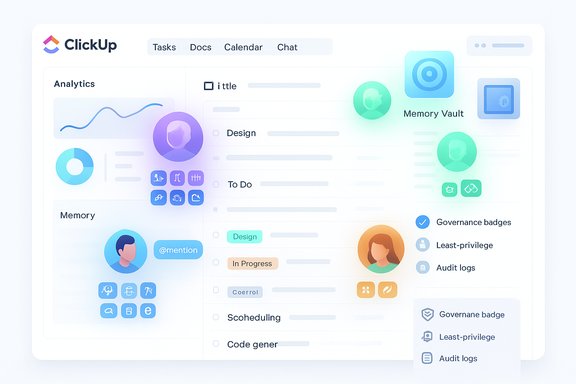
- Act like users: you can @mention them, assign tasks to them, and message them directly (DMs), enabling natural handoffs to teams.
- Run on schedules or triggers and can execute multi‑step workflows across ClickUp artifacts (tasks, docs, chat, calendar).
What “500+ skills” and “infinite memory” mean (practically)
- “500+ skills” is a marketing shorthand for a large, categorized skill set of discrete capabilities: triage, scheduling, backlog grooming, reporting, code generation, template creation, and so on. In practice this means ClickUp ships many prebuilt templates and action modules that agents can invoke without per‑customer engineering.
- “Infinite memory” is ClickUp’s description of a memory system that stores different memory types (ephemeral working memory, persistent long‑term memory, and retrievable knowledge) and surfaces relevant facts when the agent needs them. Technically this is implemented with retrieval‑augmented architectures and vector stores that index workspace content for fast lookup; ClickUp’s help pages explicitly reference memory capabilities.
Why this matters: market context and comparative benchmarks
AI agents have moved from research demos to product reality in 2024–2025. Microsoft’s expansion of Copilot into knowledge work delivered measurable productivity lifts in vendor‑run studies (Microsoft reported early Copilot users completed tasks faster in pilot testing, with internal figures cited as up to ~29% faster in general tasks), and large vendors have operationalized agent runtimes and governance planes. ClickUp’s Super Agents place a team‑centered agent into a dedicated project OS with the goal of reducing the cognitive load of coordination and follow‑up. Market sizing and demand signals:- The project and work‑management category is large and growing: Grand View Research reports the global project management software market generated approximately \$7.38 billion in revenue in 2023 and projects strong growth through 2030. That makes ClickUp’s platform a meaningful channel for agent monetization.
- Independent analyst coverage and industry briefs forecast rapid expansion of the agentic AI market (various market trackers estimate multibillion‑dollar opportunity ranges; estimates differ widely by methodology). Some commercial forecasts project the agent/assistant market to reach tens of billions within this decade, though growth rates and target years vary across publishers. These macro figures underscore why productivity platforms are racing to embed agents.
Technical architecture (what to expect under the hood)
Model + Memory + Connectors = Agent behavior
ClickUp’s public technical descriptions and product help point to three core layers:- Reasoning / LLM layer — a large language model or multi‑model reasoning core that decomposes goals, drafts text, and helps plan multi‑step workflows.
- Memory and retrieval layer — searchable indexes and vector stores that let an agent recall past interactions, decisions, and workspace artifacts (the “infinite” memory claim maps here).
- Connector / tool layer — adapters to ClickUp objects, other SaaS tools, email and calendar, and developer APIs that let agents perform actions (create tasks, update docs, message people).
Implementation patterns and engineering realities
- Retrieval‑Augmented Generation (RAG) is the practical approach for memory: embeddings + vector DB + relevance ranking, not a literal “unbounded internal LLM memory.” These systems require maintenance (indexing pipelines, TTLs, compaction), and enterprise users must balance retention, cost, and GDPR‑style deletion requests.
- Tool calling and orchestration replace brittle prompt glue with deterministic APIs: true agentic workflows should call functions, edit docs programmatically, and log every action for auditability.
- Observability and mid‑execution controls are necessary. Research continues to show that agents can over‑execute, take too many steps, or drift from goals—so debug and monitoring tools (trace logs, step replays, intervention breakpoints) are critical in production. Empirical research into agent reliability shows progress but also concrete failure modes in long‑horizon tasks.
Business impact: value, pricing, and go‑to‑market
ClickUp is positioning Super Agents as both a productivity multiplier and a revenue stream. Practical commercial levers include:- Tiered subscriptions and an add‑on credit model for agent use (agent compute and memory retention incur cost). Early user reports and community feedback show Super Agents consume credits under ClickUp’s AI billing model.
- Enterprise integrations and professional services for high‑value automations (onboarding, migration, security reviews).
- Marketplace and templates: prebuilt agent templates for PMO, marketing automation, release engineering, and support triage reduce time‑to‑value and encourage expansion from SMBs to enterprise accounts.
Governance, security and compliance — the non‑negotiables
When agents can read, remember, and act on behalf of teams, three questions must be answered: Who gave permission? What was accessed? What decision did the agent make and why?ClickUp surfaces governance controls: admins set which agents can access which data sources and can manage agent scopes and memory. But operationalizing governance at scale requires identity, least‑privilege tokens, audit trails, and policy enforcement — the same themes enterprise customers have seen with Microsoft’s Agent 365 and similar orchestrators that treat agents as directory objects with Entra/AD identities and tenant‑level approval workflows.
Key enterprise governance must‑haves:
- Scoped connectors and least‑privilege credentials for agents.
- Audit logs that record intent, input, tool calls, outputs, and confidence.
- Memory management and deletion workflows that honor data‑subject requests.
- Human‑in‑the‑loop gates for high‑risk actions (purchasing, legal signoff, payroll changes).
Where the marketing and reality diverge — honest caveats
- “500+ skills” is an impressive catalog but must be judged by real‑world effectiveness (Does a scheduling skill handle unusual timezones? Does a triage skill correctly prioritize ambiguous blockers?. Templates and skills reduce build cost, but complex orgs will still require tuning and governance.
- “Infinite memory” is a product narrative: production systems must deal with retention, compaction, and cost. “Perfect memory” is not a technical reality without strong data‑governance and clear retention policies. ClickUp provides memory controls but administrators must configure limits and deletion policies to meet privacy obligations.
- Agent reliability is improving but not infallible. Research benchmarks show agents can succeed on many tasks but still struggle with long‑horizon, tightly constrained workflows; reproducible academic work highlights both progress and a long tail of failure modes in complex web tasks and multi‑step operations. Expect human oversight to remain essential.
Competitive landscape: where ClickUp stands
- ClickUp vs. traditional PM tools: ClickUp’s advantage is the convergence of tasks, docs, chat, and now agents within one data model. Embedded agents can avoid context loss that happens when teams stitch together separate tools.
- ClickUp vs. hyperscalers: Microsoft, Google, Anthropic and others provide agent runtimes, connectors, and clouds. ClickUp competes by owning the workspace surface and selling deep workflow integrations rather than raw model APIs. The Microsoft approach emphasizes enterprise governance (Agent IDs, Agent Store) that large regulated customers favor; ClickUp’s product takes a more workspace‑centric approach and must prove enterprise readiness in regulated verticals.
Implementation checklist for IT leaders and product teams
- Inventory high‑value workflows: identify repetitive, high‑touch processes that require cross‑tool orchestration (e.g., weekly reporting, release notes, customer triage).
- Scope agent permissions: adopt least‑privilege connectors and clear data‑access patterns for each agent.
- Define memory policy: set retention windows, deletion controls, and review cadences for agent memory stores.
- Pilot with governance: run a controlled pilot, log everything, validate outputs against human review criteria, and measure time‑to‑value.
- Prepare AgentOps: appoint an owner for agent lifecycle (create, version, retire), monitor costs, and maintain observability dashboards.
Future outlook: short‑term and mid‑term expectations
- Rapid adoption in knowledge‑work: early enterprise pilots and vendor studies suggest significant efficiency gains in admin‑heavy processes; expect widespread adoption in marketing, sales ops, support, and software engineering where repeatable sub‑tasks are common.
- Multimodal and deeper desktop automation: agents will increasingly ingest and produce text, images, and voice, plus integrate with desktop automation flows to edit documents, manipulate spreadsheets, and synthesize outputs across files. Research into web and computer‑use agents shows notable improvement but highlights reliability gaps that will require tooling and testing.
- Agent marketplaces and ecosystems: expect ClickUp and other vendors to expand agent templates, third‑party agent stores, and partner ecosystems — that distribution model accelerates adoption but also introduces new vetting and security needs.
Strengths and risks — a balanced assessment
Notable strengths
- Workspace‑native orchestration: agents that live in the same data model reduce context switching and enable more deterministic actions.
- Broad skill catalog and templates: a large skill library reduces build time and increases the chance of immediate ROI for common PM workflows.
- Governance hooks: ClickUp exposes admin controls for agent access and memory, a must for enterprise readiness.
Material risks and gaps
- Over‑promising on “infinite memory”: the term glosses over retention, compaction, and privacy tradeoffs; organizations must test retention and deletion behavior under real workloads.
- Operational complexity and cost: agent compute and storage can be expensive; a credit or metered model may surprise teams without strong cost controls. Early community posts already note credit consumption during testing.
- Accuracy and legal risk: agents that generate communications or take actions can create compliance and legal exposure if outputs are incorrect; robust human approval gates and audit logs are essential.
- Vendor lock and interoperability: relying on one vendor’s agent model and proprietary skill set risks lock‑in; organizations should demand exportable templates, connector standards, and clear exit paths.
Practical recommendations for WindowsForum readers and IT teams
- Treat the first deployments as augmentations, not replacements. Use Super Agents to offload clearly defined, bounded tasks (summaries, triage, report drafts) while keeping human‑in‑the‑loop for final approvals.
- Build an AgentOps practice: version control for agents, cost monitoring, scheduled audits of memory contents, and incident playbooks for off‑path agent behavior.
- Negotiate enterprise terms: insist on traceability (who asked the agent to act and why), data residency options if required, and SLOs for availability and latency.
- Conduct an adversarial test: intentionally craft scenarios where agents might be exploited (prompt injection, escalations) and validate the controls. Industry case studies emphasize the confused‑deputy and permission escalation risks in agentic environments.
Final verdict
ClickUp Super Agents represent a meaningful evolution in productivity tooling: bringing agentic AI directly inside the project workspace closes many of the context‑loss gaps that previously limited productivity gains from external assistants. The combination of a broad skill set, workspace memory, and native collaboration gestures is powerful — and for many teams that can translate into measurable time savings and cleaner handoffs.That said, the novelty comes with real operational obligations. Memory, permissions, auditability and cost management are not features to bolt on later; they must be the foundation of any production rollout. Metrics and governance will determine whether Super Agents become a reliable second pair of hands — or an expensive, unpredictable experiment.
For organizations considering adoption: pilot quickly, govern rigorously, and measure concretely. The agent revolution is here, but success goes to teams who couple bold experiments with disciplined AgentOps.
Acknowledgements: product documentation, vendor briefings and independent research were consulted while preparing this analysis; official ClickUp product pages, the ClickUp blog, and ClickUp’s December 23, 2025 corporate release provide the core product claims, and broader market and technical context were validated against vendor reports and peer research.
Source: Blockchain News ClickUp Super Agents: AI Agents with 500+ Skills and Infinite Memory Revolutionize Workflow Automation | AI News Detail
