

Levi Strauss & Co. has announced a high‑profile collaboration with Microsoft to build an Azure‑native, Teams‑embedded “super‑agent” — a single conversational orchestrator that routes employee requests to a network of specialist subagents — as part of a broader effort to rewire operations, accelerate its direct‑to‑consumer pivot, and roll out new AI‑driven store and consumer features.
Levi’s announcement, published jointly by the company and Microsoft on November 17, 2025, frames the project as a major step in a multiyear digital transformation. The headline element is the “super‑agent”: a hierarchical, multi‑agent orchestration layer that surfaces inside Microsoft Teams as the entry point for corporate and store employees. The super‑agent will dispatch queries to purpose‑built subagents for HR, IT, store operations, inventory, returns and other domains — aggregate answers, and when appropriate, execute authorized actions or escalate to human operators. Levi’s also announced consumer‑facing and frontline tools that complement the internal orchestrator: Outfitting, an AI‑driven styling feature in the Levi’s app, and STITCH, a store assistant app being deployed to a 60‑store pilot ahead of a broader 2026 rollout. These elements show the program is both an employee productivity play and a customer‑facing experience strategy.
For the retail sector, the program signals a shift from isolated chatbots toward orchestrated agent fleets embedded into collaboration surfaces — a pattern likely to be copied by other chains with distributed staff and high volumes of routine queries. The differentiator will be governance, not novelty: firms that treat agentic AI as an operational discipline will extract durable value; those that treat it as a canned product will face costly incidents.
Levi’s move signals that retail is moving beyond isolated chatbots toward enterprise‑grade agent orchestration. If Levi executes with discipline, the company — and Microsoft — may set a new reference architecture for retail AI. If not, the initiative will reinforce common warnings: ambition must be matched with operational rigor.
Conclusion
Levi Strauss & Co. and Microsoft have publicly committed to building a next‑generation, Azure‑native super‑agent that could materially change how frontline store teams and corporate employees access information and perform tasks. The architecture is technically sound in principle, leverages mature product primitives, and already includes pragmatic pilots. But converting the technical architecture into safe, auditable, and revenue‑generating operations requires disciplined AgentOps, sharp identity and access controls, continuous red‑teaming, and transparent KPIs. Watch the 2026 rollout and Levi’s disclosure of pilot results and governance artifacts as the true test of whether this collaboration becomes a durable industry blueprint or an ambitious experiment.
Source: WV News Levi Strauss & Co. partners with Microsoft to develop next-gen superagent
 Background
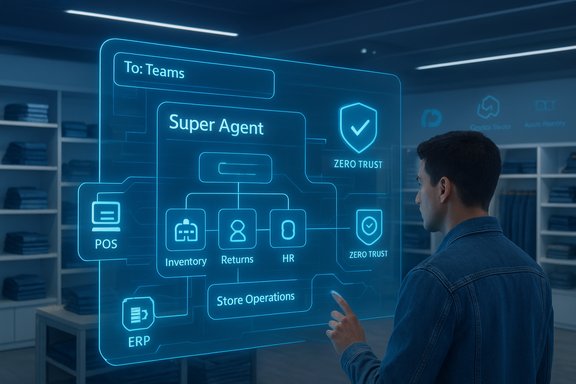
Levi’s announcement, published jointly by the company and Microsoft on November 17, 2025, frames the project as a major step in a multiyear digital transformation. The headline element is the “super‑agent”: a hierarchical, multi‑agent orchestration layer that surfaces inside Microsoft Teams as the entry point for corporate and store employees. The super‑agent will dispatch queries to purpose‑built subagents for HR, IT, store operations, inventory, returns and other domains — aggregate answers, and when appropriate, execute authorized actions or escalate to human operators. Levi’s also announced consumer‑facing and frontline tools that complement the internal orchestrator: Outfitting, an AI‑driven styling feature in the Levi’s app, and STITCH, a store assistant app being deployed to a 60‑store pilot ahead of a broader 2026 rollout. These elements show the program is both an employee productivity play and a customer‑facing experience strategy. What Levi and Microsoft are building
The super‑agent concept (high level)
At its core, the super‑agent is a single conversational front door embedded in Microsoft Teams that:- Accepts natural‑language queries from employees across roles and locations.
- Routes each query to one or more domain‑specific subagents tuned for tasks like inventory lookup, returns processing, scheduling, or HR.
- Aggregates structured results and presents a consolidated response in Teams, or initiates an action where permissions allow.
- Escalates high‑risk or ambiguous items to human operators with full audit trails.
The technology stack Levi cites
Levi’s announcement and Microsoft’s press material name a consistent set of Microsoft products forming the backbone of the effort:- Microsoft 365 Copilot & Copilot Studio for low‑code composition and delivery of copilots and agent workflows.
- Azure AI Foundry and Semantic Kernel as the runtime and orchestration layer for multi‑agent behavior, tooling, and telemetry.
- Microsoft Teams as the primary user interface for the super‑agent.
- Microsoft Entra Agent ID, conditional access and zero‑trust primitives for agent identity and permissioning.
- Surface Copilot+ PCs running Windows 11, Microsoft Intune for device management, and GitHub Copilot for developer productivity during build and migration phases.
Why Levi is doing this: business rationale
Levi frames the initiative as an enabler for three strategic outcomes:- Scale personalized service — by giving store associates fast access to product knowledge, sizing guidance and curated outfit suggestions, Levi expects better in‑store conversions and a more consistent omnichannel experience.
- Reduce operational overhead — the super‑agent aims to consolidate knowledge across POS, ERP, HRIS and internal KBs so employees spend less time context switching and more time engaging customers.
- Accelerate DTC growth — Levi positions AI as a foundational capability to support its goal of stronger direct‑to‑consumer performance and long‑term revenue targets. The company has publicly tied the effort to its ambition of becoming a larger DTC leader, while labeling revenue targets as aspirational corporate guidance.
Timeline, scope and verification
Levi and Microsoft state the super‑agent is in active development and testing with a corporate rollout targeted for early 2026, followed by broader global expansion later in the year. The STITCH store assistant is being piloted in about 60 U.S. locations ahead of the holiday season and will scale in 2026. The fiscal metrics cited in Levi’s release (net revenues of $6.4B for fiscal 2024) align with the company’s public filings and are used as context for the program. A clear distinction is necessary: the vendor messages and press releases describe product choices, pilot scope and high‑level timelines; they do not reveal granular implementation details such as the exact subagent list, the third‑party systems each subagent calls, SLAs, or the specific datasets used for training. Those are internal engineering and procurement decisions Levi will need to publish or disclose under regulatory or investor frameworks for full independent verification. Treat forward‑looking financial claims as corporate targets rather than empirically proven outcomes.Technical analysis: architecture, capabilities, and realistic limits
Multi‑agent orchestration fits the problem space
Retail workflows are inherently multi‑system: POS, order management, inventory, HRIS, learning platforms, and knowledge bases. A hierarchical multi‑agent design — a single user portal delegating to specialist subagents — is a logical pattern because it:- Reduces front‑end complexity for staff (one conversational surface).
- Enables reuse of domain logic maintained by subject matter teams.
- Separates concerns: subagents can be developed, tested, and governed independently.
Action‑capable agents vs read‑only assistants
A critical design choice is whether subagents are read‑only (answer or recommend) or action‑capable (initiate transaction, modify inventory, issue refunds). Early pilots typically restrict agents to read‑only modes and require human confirmation for material actions; Levi’s public materials do not fully disclose where they will draw that line. The safety design — human‑in‑the‑loop, circuit breakers, and immutable audit logs — will determine whether the platform can scale without costly incidents.Identity, least privilege and agent lifecycle
Agent identities must be first‑class entities in enterprise access models. Microsoft’s Entra Agent ID and conditional access patterns provide primitives for assigning short‑lived, least‑privilege credentials and for rotating keys automatically. Properly implemented, this reduces the attack surface; misconfiguration (overbroad scopes, long‑lived tokens) would magnify risk. Levi’s stated zero‑trust posture is appropriate, but execution is the differentiator.Observability, explainability and auditing
Agentic systems multiply telemetry: user prompts, chain‑of‑thought traces, tool calls, responses, and any downstream side effects. To meet compliance and operational needs, Levi will have to:- Log complete request/response traces with agent identities and timestamps.
- Retain explainability artifacts for decisions that affect HR, finance or customer accounts.
- Integrate agent telemetry with SIEM and incident response playbooks.
Risks and failure modes
No enterprise agent program is risk‑free. Major categories Levi must address:- Hallucinations: LLM subagents can produce plausible but incorrect outputs. When agents are allowed to take actions, hallucinations become business events. Rigid thresholds, human approval gates and red‑team testing are essential.
- Identity and permission errors: Overbroad agent privileges or long‑lived credentials risk data exposure and unauthorized actions. Entra Agent ID and conditional access can help but must be strictly configured and audited.
- Observability gaps: Without full traceability of agent decisions and tool calls, incident response and regulatory audits will be ineffective.
- Vendor lock‑in: Heavy dependence on a single cloud and agent stack accelerates time‑to‑pilot but increases strategic risk. Design choices that favor exportable agent definitions, open A2A protocols and data portability mitigate long‑term lock‑in.
- Privacy and cross‑border data flows: Levi operates in ~120 countries; agents that combine customer or employee data must enforce data residency, consent and retention policies per jurisdiction. Public statements of “responsible AI” are necessary, but Levi must publish operational artifacts to demonstrate compliance.
Retail implications: what this could change in stores
If Levi’s execution is strong, frontline outcomes could include:- Faster answers to product and returns questions, reducing average handle time.
- More consistent, personalized merchandising assistance via Outfitting in the Levi’s app.
- Lower back‑office ticket volumes through automated HR or IT triage.
- Better conversion and NPS via personalized styling and faster in‑store service.
Governance and operational recommendations (practical checklist)
For enterprises building or adopting similar agentic platforms, recommended actions include:- Inventory and classify every data source agents may access (POS, ERP, HRIS, CRM), then apply a read‑only by default posture during initial pilots.
- Define agent action levels and require explicit human confirmation for any action that modifies financials, prices, inventory or contractual records.
- Implement Entra Agent ID for short‑lived agent identities and enforce least privilege, automated token rotation and conditional access policies.
- Configure full agent tracing and integrate agent telemetry into the SIEM for anomaly detection and audit trails.
- Run continuous red‑teaming, adversarial testing and model‑level content‑safety checks before enabling action‑capable agents.
- Publish internal escalation and user guidance so frontline staff understand when to trust agents and when to escalate to humans.
Strategic implications for Microsoft and the wider retail market
Levi’s alignment with Microsoft’s agentic stack is consequential beyond a single deployment. A successful program becomes a marquee reference for Microsoft, accelerating enterprise adoption of Copilot Studio and Azure AI Foundry. Conversely, heavy platform alignment increases the gravitational pull of Microsoft’s stack across retail ISVs and systems integrators, deepening lock‑in risks for adopters who prioritize speed over portability.For the retail sector, the program signals a shift from isolated chatbots toward orchestrated agent fleets embedded into collaboration surfaces — a pattern likely to be copied by other chains with distributed staff and high volumes of routine queries. The differentiator will be governance, not novelty: firms that treat agentic AI as an operational discipline will extract durable value; those that treat it as a canned product will face costly incidents.
What Levi should publish next (signals to watch)
Over the coming months, investors, partners and competitors should look for:- Pilot KPIs: reductions in mean time to resolution, agent accuracy rates, changes in ticket volumes and conversion impacts attributed to Outfitting or STITCH.
- Governance artifacts: evidence of AgentOps, scheduled red‑teaming results, audit logs, and published policies for agent action scopes and data handling.
- Interoperability details: which backend systems are integrated and whether Levi exposes APIs or agent definitions that can be ported or standardized.
- Consumer safeguards: disclosures where consumer‑facing advice is AI‑generated and privacy notices where personal data are used for personalization.
Strengths and notable positives
- Integrated vendor stack reduces friction. Choosing Microsoft’s Copilot family and Azure AI Foundry lowers the number of bespoke connectors and integration contracts Levi would otherwise need to assemble. That speeds pilots and reduces integration risk when compared with a polyglot toolchain.
- Teams as a delivery surface increases adoption chances. Embedding the super‑agent where employees already collaborate reduces friction and situates agents inside routine workflows.
- Staged pilots demonstrate pragmatic risk management. Deploying STITCH to 60 stores provides a measurable environment to tune accuracy, governance and UX before scaling.
Weaknesses, unanswered questions and cautionary flags
- Action scope ambiguity. Public materials do not define exactly which subagents will be action‑capable. This ambiguity matters because action‑capable agents multiply risk and require stronger controls.
- Portability and lock‑in concerns. Heavy alignment to a single vendor stack raises strategic questions about future flexibility and negotiating leverage.
- Measurement and attribution gaps. The proof of value will be in measurable outcomes; Levi has not (yet) published pilot KPIs or audit artifacts that prove the expected productivity and revenue impacts. Treat financial forecasts tied to AI as aspirational until measured evidence is provided.
Final assessment
Levi Strauss & Co.’s partnership with Microsoft is a credible and strategically logical step for a large retailer pursuing a DTC‑first model and seeking to modernize store and corporate workflows with agentic AI. The technical choices — Copilot Studio, Azure AI Foundry, Teams embedding, device standardization — are plausible and consistent with Microsoft’s product roadmap, and staged pilots (STITCH in 60 stores) demonstrate a reasonable risk posture. However, the program’s ultimate value will hinge on rigorous governance, clear limits on action‑capable agents, robust observability, identity hygiene and demonstrable pilot metrics. Absent published pilot KPIs and governance artifacts, the announcement is a strong statement of intent and capability — but not yet definitive proof of production‑grade outcomes. Enterprises watching Levi’s experience should expect lessons on AgentOps, identity management for agents, observability integration and how to convert productivity gains into measurable consumer and financial results.Levi’s move signals that retail is moving beyond isolated chatbots toward enterprise‑grade agent orchestration. If Levi executes with discipline, the company — and Microsoft — may set a new reference architecture for retail AI. If not, the initiative will reinforce common warnings: ambition must be matched with operational rigor.
Conclusion
Levi Strauss & Co. and Microsoft have publicly committed to building a next‑generation, Azure‑native super‑agent that could materially change how frontline store teams and corporate employees access information and perform tasks. The architecture is technically sound in principle, leverages mature product primitives, and already includes pragmatic pilots. But converting the technical architecture into safe, auditable, and revenue‑generating operations requires disciplined AgentOps, sharp identity and access controls, continuous red‑teaming, and transparent KPIs. Watch the 2026 rollout and Levi’s disclosure of pilot results and governance artifacts as the true test of whether this collaboration becomes a durable industry blueprint or an ambitious experiment.
Source: WV News Levi Strauss & Co. partners with Microsoft to develop next-gen superagent
