

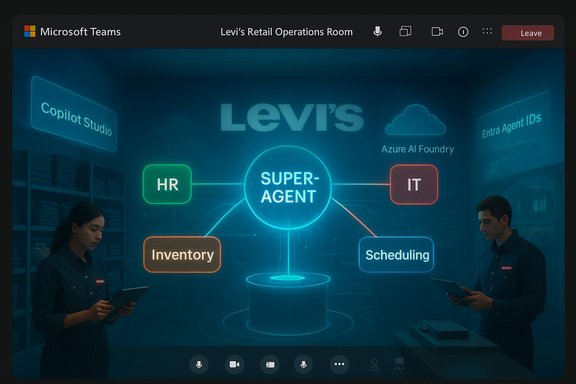
Levi Strauss & Co. has chosen Microsoft to build an Azure‑native, Teams‑embedded “super‑agent” — a hierarchical, multi‑agent orchestration system that will route employee queries to specialized subagents and is slated for corporate rollout in early 2026 as part of Levi’s broader direct‑to‑consumer and digital transformation push.
Background / Overview
Levi’s announcement, published November 17, 2025, frames the collaboration with Microsoft as a major step in a multiyear modernization program that ties an agentic AI platform to the company’s direct‑to‑consumer (DTC) strategy. The core element is a single conversational front door — the super‑agent — that lives inside Microsoft Teams and orchestrates a network of domain‑specialist subagents for functions such as HR, IT, store operations and inventory. The vendor and corporate communications state the super‑agent is under development and being tested now, with a phased rollout beginning in early 2026 and broader global expansion to follow. Alongside the internal orchestrator, Levi’s is releasing two AI‑driven retail features: Outfitting, a consumer‑facing personalized styling feature in the Levi’s mobile app, and STITCH, a store‑facing assistant for frontline employees that is entering a 60‑store pilot ahead of holiday season deployments and wider rollout in 2026. Those consumer and frontline tools are positioned as complementary pieces of the super‑agent strategy, creating both an employee productivity play and customer experience enhancements. This move places Levi’s in the vanguard of large retailers moving from isolated automation to agentic AI — multi‑agent systems where a coordinating orchestrator routes and aggregates work across specialist agents. The pattern Microsoft has productized — Copilot Studio for low‑code agent composition and Azure AI Foundry as an “agent factory” — is explicitly cited in Levi’s materials and Microsoft’s press coverage.What Levi and Microsoft say they are building
Architecture at a glance
- A Teams‑embedded conversational portal (the super‑agent) that accepts natural‑language queries from employees.
- An orchestration layer that routes prompts to multiple subagents specialized for HR, IT, inventory, returns, scheduling, and other domains.
- Subagents built and managed via Copilot Studio and deployed on Azure AI Foundry (with Semantic Kernel and retrieval tooling for grounding).
- Identity, permissioning, and governance enforced via Microsoft Entra and zero‑trust controls.
- Integration with enterprise data sources (POS, ERP, HRIS, internal KBs) and device management via Microsoft Intune and Surface Copilot+ PCs.
Key products named in public materials
- Microsoft 365 Copilot and Copilot Studio — compositional tooling and low‑code experience to author copilots and agent flows.
- Azure AI Foundry and Semantic Kernel — runtime and orchestration primitives for multi‑agent behavior and observability.
- Microsoft Teams — the primary user surface for the super‑agent.
- Microsoft Entra Agent ID, conditional access and auditability features — for agent identity and lifecycle control.
- Surface Copilot+ devices, GitHub Copilot, and Intune — for endpoint standardization and developer productivity.
Why Levi is doing it: the business logic
Levi’s leadership ties the project directly to three strategic outcomes:- Scale personalized service: By surfacing product knowledge and curated outfit recommendations to store associates, Levi hopes to raise conversion rates and create a more consistent omnichannel experience.
- Reduce operational overhead: Consolidating knowledge and routine workflows should reduce context switching for employees who currently juggle POS, ERP and several siloed knowledge bases.
- Accelerate DTC growth: The firm ties AI investments to its goal of amplifying direct‑to‑consumer revenue, positioning agentic AI as a core enabler in its path to larger, more profitable retail operations.
Technical verification: facts the press releases make and where they check out
To separate marketing from engineering reality, key load‑bearing claims were cross‑checked against corporate and vendor materials:- The super‑agent and Teams embedding: Both Levi’s investor release and Microsoft’s press materials explicitly describe an Azure‑native orchestrator surfaced in Teams as the employee entry point. That claim is documented in both companies’ communications dated November 17, 2025.
- Product stack: Levi’s materials name Microsoft 365 Copilot, Copilot Studio, Azure AI Foundry, Semantic Kernel, Entra, Intune, Surface Copilot+ and GitHub Copilot. Microsoft documentation and recent product announcements confirm these services and features exist and are being positioned to enable multi‑agent scenarios. That alignment makes the technical architecture plausible on paper.
- Timeline and pilot scope: Levi’s release states STITCH is being piloted in 60 U.S. stores and the corporate super‑agent will begin phased rollout in early 2026. These timeline claims appear in the public press release and Microsoft coverage; they are statements of intent and pilot sizing, not independently verifiable production SLAs.
- Financial context: The fiscal 2024 net revenue figure of $6.4 billion is confirmed by Levi’s investor relations filings and quarterly reports. Use that figure as an anchor for market sizing and operational scale.
Strengths and competitive advantages
Levi’s program has several notable strengths that make the bet reasonable from an IT and operations standpoint:- Integrated vendor stack reduces friction. Building on Microsoft’s Copilot family and Azure minimizes bespoke connector work and leverages vendor‑native observability, identity and governance primitives — shortening pilot‑to‑production cycles.
- Teams as a delivery surface improves adoption odds. Embedding the super‑agent in Teams places it where many employees already work daily, increasing the chance of organic usage and lowering training friction.
- Pilot pragmatism. A staged STITCH pilot (60 stores) gives Levi an environment to tune accuracy, test human‑in‑the‑loop flows, and instrument guardrails before a wider rollout. Early, small‑scale pilots are the sensible path for agentic systems.
- Operational alignment to DTC goals. Tighter store experiences, faster employee support, and personalized consumer tools like Outfitting are directly aimed at increasing conversion, retention and lifetime value on Levi’s owned channels.
Risks, unresolved questions and red flags
Agentic AI at retail scale amplifies both promise and peril. The most consequential risks to watch are:- Hallucination and correctness. Large language model‑based agents can hallucinate — producing fluent but incorrect outputs. In retail contexts this can translate to wrong inventory counts, mistaken return guidance, or incorrect pricing — outcomes that damage customer trust and create operational messes. Levi will need robust retrieval‑augmented techniques, provenance logging, and evidence return to minimize risk.
- Action‑capable agents vs. read‑only controls. The difference between an agent that recommends and one that executes (e.g., issuing refunds or changing inventory) is material. Early deployments usually lock agents to read‑only modes and require explicit human confirmation for material actions; Levi’s public materials do not fully specify where it will draw this line. The safety design will determine scalability.
- Agent sprawl and governance complexity. Copilot Studio and Azure AI Foundry make it easy to create many agents. Without lifecycle policies, organizations risk hundreds of unmanaged agents, each widening the attack surface and complicating audits. Enforce AgentOps disciplines and discovery registries from day one.
- Data privacy and cross‑border constraints. Agents accessing customer purchase histories or employee records must obey GDPR, CCPA/CPRA and other regional rules. Data residency, retention and consent rules must be embedded at the agent level. Public PR language about “responsible AI” is a start but not a substitute for technical enforcement and policy evidence.
- Security of non‑human identities. Assigning identities to agents — a capability Microsoft enables with Entra Agent IDs — creates a novel asset class. If an agent identity is compromised, an adversary can abuse privileged flows. Short‑lived credentials, just‑in‑time access and realtime monitoring are mandatory.
- Vendor lock‑in and portability. A deep investment in Microsoft copilot/agent primitives accelerates time‑to‑value but increases dependence on one cloud and orchestration fabric. Evaluate portability strategies, open protocols and multi‑cloud fallbacks where mission‑critical continuity is required.
- Infrastructure and energy costs. Large‑scale agent deployments drive sustained inference load. Cloud TCO, capacity planning and sustainability (power and cooling) must be included in cost models; cloud parties are publicly raising the issue of datacenter capacity and energy constraints as agent workloads scale.
Practical recommendations (AgentOps checklist for Levi’s peers)
- Audit and map data sources before agent rollout — owners, retention, sensitivity and lineage.
- Start with low‑risk, read‑only agents (knowledge Q&A, product lookup, scheduling) and publish clear escalation paths for action‑capable agents.
- Bake evidence return into every agent response — cite the document, timestamp and source system that grounded the answer.
- Enforce agent identity lifecycle management with Entra Agent IDs, short‑lived tokens, conditional access and access reviews.
- Instrument observability and create SLOs: accuracy, rework frequency, false positive/negative rates and time‑to‑human‑escalation.
- Implement continuous red‑teaming and adversarial testing on a scheduled cadence to uncover unsafe behavior.
- Define rollback and circuit‑breaker policies for any agent that can modify business state; require explicit human confirmation for high‑risk actions.
- Plan for talent and change: dedicate agent product owners, upskill store associates, and measure employee sentiment alongside operational KPIs.
How Levi’s fits into the retail agentic AI race
Levi’s announcement joins a wave of high‑profile retail bets on super‑agents. Walmart recently unveiled its own quartet of “super agents” tailored for customers, associates, suppliers and developers — a move widely reported and emblematic of the sector’s push to consolidate agent experiences. Target, Amazon and other major retailers are also exploring agentic tools for marketplace management and seller analytics; Ulta Beauty has emphasized building the data and operational foundation before scaling agents. That industry momentum validates Levi’s strategic choice — but also raises benchmarks and competitive pressure. Retailers succeed with agentic AI when they pair strong data hygiene, staged pilots, and rigorous governance. The implementation gap—not the technology stack—remains the real battleground. Levi’s is betting that a Microsoft‑aligned stack will lower integration friction; the proof will be measurable pilot KPIs and safe, auditable operations at scale.Business and investor considerations
For Levi’s investors and boardroom watchers, the important metrics to demand in the 6–18 months following rollout are concrete and measurable:- Percentage reduction in average handle time for frontline queries.
- Decrease in escalations to manager level and rework caused by incorrect agent outputs.
- Conversion lift attributable to Outfitting and STITCH in pilot stores (A/B test results).
- Developer velocity metrics tied to Copilot and Copilot Studio (time‑to‑market for subagents).
- Security incidents, agent compromise events and audit trail completeness.
- Cloud spend attributable to inference and agent orchestration (with chargeback model).
The hard governance questions Levi must answer — and quickly
- Who owns each agent’s behavior and output? (Define accountable agent owners with SLOs.
- Which subagents are authorized to take action, and under what human‑approval thresholds?
- How will Levi prove provenance and auditability for decisions that affect customers, payroll, refunds or inventory?
- What are the contractual terms with Microsoft around portability, data use and service levels — especially if Levi later seeks multi‑cloud resilience?
- How will Levi measure adverse mentions, customer complaints and unplanned manual rework attributable to agent errors?
Conclusion
Levi Strauss & Co.’s decision to partner with Microsoft on a Teams‑embedded, Azure‑native super‑agent is a decisive bet that agentic AI will be a foundation technology for next‑generation retail operations. The technical ingredients named in the announcement — Microsoft 365 Copilot, Copilot Studio, Azure AI Foundry, Entra Agent IDs and Teams — are real products that enable the architecture Levi describes, and the pilot timelines (STITCH at 60 stores, corporate rollout in early 2026) are concrete commitments to test and scale. Yet the gap between pilot and safe, auditable, large‑scale production remains substantial. The crucial determinants of success will be Levi’s ability to enforce AgentOps disciplines: strict identity and lifecycle controls, evidence‑return and provenance, human‑in‑the‑loop designs for critical actions, continuous red‑teaming, and transparent KPIs that tie automation to measurable business outcomes. Absent those controls, an alluring promise of efficiency risks turning into governance and customer‑experience liabilities.For retail CIOs and technology leaders watching this rollout, the pragmatic lesson is clear: choose vendors that supply integrated primitives for identity, observability and governance, but insist on rigorous operational proofs — reproducible pilot KPIs, contractual portability, and ironclad audit trails — before committing core workflows to any super‑agent fabric. Levi’s partnership with Microsoft is an important case study in how established brands are attempting to industrialize agentic AI; the wider industry will be watching closely to see whether the promise translates into durable advantage or becomes another enterprise experiment that failed to operationalize at scale.
Source: CIO Dive Levi’s picks Microsoft to deploy ‘super-agent’
