

Levi Strauss & Co. and Microsoft have announced a strategic collaboration to build an Azure‑native, Teams‑embedded “superagent” — a hierarchical, multi‑agent orchestration platform that Levi says will route employee queries to specialized subagents and accelerate the company’s direct‑to‑consumer (DTC) transformation.
Levi Strauss & Co. is positioning the project as a core element of a multiyear modernization program intended to make the business more fan‑obsessed and DTC‑first. The company’s public materials describe a single conversational front door — the superagent — that lives inside Microsoft Teams and orchestrates a network of domain‑specialist subagents for HR, IT, store operations, inventory, returns and other functions. Microsoft and Levi say the system is in development and testing, with a phased corporate rollout targeted for early 2026 and broader global expansion later that year. At a technical level the partnership explicitly names a consistent Microsoft stack:
Conclusion
Levi Strauss & Co. has publicly committed to an ambitious, Azure‑native agentic architecture embedded in Microsoft Teams that promises streamlined operations, faster employee workflows, and richer customer experiences. The announcement is verifiable across vendor press channels and independent trade coverage; the architecture maps to known Microsoft products and patterns. The project’s success will hinge on Levi’s ability to manage data grounding, security, governance and the human factors of adoption. If Levi can pair the technical integration with rigorous measurement and transparent governance, the superagent could materially reshape how frontline and corporate staff work across retail operations. If not, it will become one more well‑funded pilot that failed to turn potential into production value.
Source: StreetInsider Levi Strauss & Co. partners with Microsoft to develop next-gen superagent
 Background / Overview
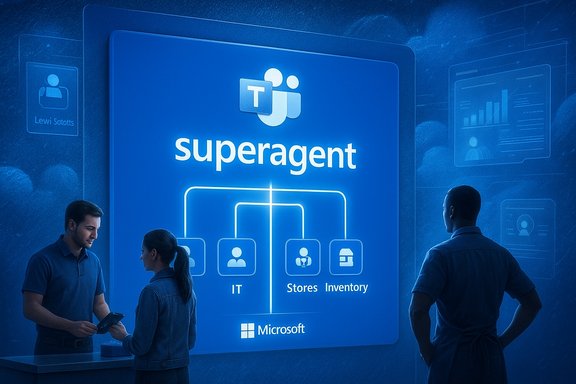
Levi Strauss & Co. is positioning the project as a core element of a multiyear modernization program intended to make the business more fan‑obsessed and DTC‑first. The company’s public materials describe a single conversational front door — the superagent — that lives inside Microsoft Teams and orchestrates a network of domain‑specialist subagents for HR, IT, store operations, inventory, returns and other functions. Microsoft and Levi say the system is in development and testing, with a phased corporate rollout targeted for early 2026 and broader global expansion later that year. At a technical level the partnership explicitly names a consistent Microsoft stack:- Microsoft 365 Copilot and Copilot Studio for authoring and low‑code agent composition.
- Azure AI Foundry (the “agent factory”) and Semantic Kernel for model hosting, orchestration and observability.
- Microsoft Teams as the delivery surface for the superagent conversational portal.
- Microsoft Entra for agent identity and zero‑trust controls.
- Microsoft Intune and Surface Copilot+ PCs running Windows 11 for endpoint standardization.
- GitHub Copilot and Azure Migrate to accelerate development and cloud consolidation.
Why Levi is investing: business logic and measurable aims
Levi’s leadership ties the superagent to three strategic outcomes:- Scale personalized service — deliver quicker, consistent product and styling guidance to store staff to improve conversion and omnichannel parity.
- Reduce operational overhead — consolidate knowledge lookups and routine workflows (POS, ERP, HRIS) into a single conversational surface to cut context switches and average handle time.
- Accelerate DTC growth — make AI and cloud foundations part of a broader push to increase direct‑to‑consumer share and lifetime customer value.
What the technology looks like in practice
The superagent architecture (high level)
At its core the architecture maps to a common multi‑agent pattern:- A user asks a question in Teams (the superagent front door).
- The superagent performs intent detection and decides whether to handle the query itself or delegate to one or more subagents.
- Subagents consult backend systems (HRIS, ERP, WMS, POS, internal KBs) and return structured results or initiate allowed actions.
- The superagent composes a consolidated response and either presents it in Teams or escalates to a human with full audit trails when policy requires it.
Key platform primitives Levi will rely on
- Agent identity and governance: Microsoft Entra’s Agent ID and conditional access features are intended to treat agents as first‑class entities with lifecycle, credentials and permissions, enabling least‑privilege tool invocation and audit trails.
- Observability: Azure AI Foundry and the agent service provide telemetry, traces and evaluation hooks so engineering teams can monitor agent decisions, tool calls and model behavior.
- Grounding and retrieval: Semantic Kernel and vector retrieval connect agents to curated, controlled knowledge stores (SharePoint, Fabric, enterprise search).
- Device and developer tooling: Surface Copilot+ PCs and Intune simplify endpoint standardization; GitHub Copilot and Copilot Studio accelerate iterative agent creation.
Verification: what we can independently confirm
To meet journalistic verification standards, the most important claims in Levi’s announcement were checked against multiple independent sources:- The joint announcement and basic architecture framing were published by Microsoft’s newsroom and PR distribution services on November 17, 2025.
- Multiple trade outlets documented the Teams‑embedded orchestrator, the role of Copilot Studio and Azure AI Foundry, and the planned early‑2026 corporate rollout with broader expansion in 2026.
- Levi’s public financials (reported 2024 net revenues of $6.4 billion) used as program context match Levi’s investor relations filings and earnings releases. That figure appears in Levi’s investor announcements and related coverage.
Strengths: why this makes sense for Levi (and Microsoft)
- Consolidation reduces friction: Retail staff currently move between multiple systems; a single conversational portal inside Teams reduces context switching and can materially cut time spent on routine lookups.
- Reusing subject matter logic: Subagents allow domain teams (HR, store ops, inventory) to own their logic and governance, shortening the development-to-production path and limiting blast radius for failures.
- Microsoft native stack reduces integration complexity: Using Microsoft‑native tooling (Copilot Studio, Entra, Foundry, Teams, Intune) simplifies authentication, connectors and lifecycle automation for organizations already invested in Microsoft 365 and Azure.
- Developer velocity: Tools like GitHub Copilot plus low‑code authoring in Copilot Studio accelerate iterative improvements and observability-driven refinement of agents.
- Endpoint standardization: Rolling out Surface Copilot+ PCs and Intune simplifies the security posture and enables consistent on‑device Copilot experiences for corporate and store teams.
Risks and unresolved technical / governance challenges
The superagent concept is powerful, but several practical and security risks must be managed carefully:1. Data grounding, hallucination risk and operational correctness
Large language models can generate fluent but incorrect responses. In retail workflows that execute actions (returns processing, refunds, schedule changes), action‑capable agents must be conservatively designed with strict authorization, deterministic checks and human‑in‑the‑loop escalation for high‑risk operations. Microsoft highlights observability and content safety, but the real test is reliable grounding to authoritative sources and measured SLA‑backed performance.2. Agent identity, third‑party consents and OAuth risks
New attack vectors have already emerged in the Copilot ecosystem; security researchers have highlighted risks where malicious agents or deceptive consent flows can be used to exfiltrate OAuth tokens and gain access to tenant data. Enterprises must harden consent policies, restrict third‑party app consent, enforce conditional access, and continuously monitor for suspicious agent activity. Microsoft has responded to such reports with patches and recommendations, but tenant operators carry most of the operational burden.3. Supply chain and platform portability
A heavy dependency on Microsoft’s integrated stack simplifies deployment at first, but it also concentrates operational risk and vendor lock‑in. Organizations must ask for contractual clarity on portability, model governance, data egress and the long‑term cost model for agent hosting at scale. Treat vendor product roadmaps as enabling technology, not an irreversible architectural commitment.4. Multi‑agent orchestration limits in current tooling
Community reports and practitioner experiences indicate Copilot Studio and early agent frameworks have rough edges: inconsistent runtime behavior between studio and Teams, tooling gaps for true distributed MCP servers, weak version control and limited transparency for content filtering. These are solvable engineering problems, but they matter materially during enterprise rollouts at Levi’s scale. Expect iterative improvements and careful pilot instrumentation.5. Change management and employee adoption
Technology alone doesn’t change workflows. Levi must pair the rollout with measured training, a feedback loop for frontline associates, and KPIs that tie agent outputs to real commercial metrics (conversion, speed, satisfaction). Diginomica‑style research cautions that AI wins are organizational discipline more than pure tech wins.Operational checklist: what Levi (and peers) need to get right
To convert promise into production outcomes, retail IT and product teams should run a disciplined checklist. The following items are practical and sequential:- Inventory and prioritize use cases: start with read‑only, high‑value queries (product attributes, return policies, size charts), then graduate to guarded action‑capable flows.
- Harden identity & consent: enforce conditional access, limit app consent, and register all agents as distinct Entra Agent IDs for lifecycle control.
- Ground responses: connect agents to authoritative, versioned knowledge stores and apply retrieval augmentation rather than relying on base LLM tacit knowledge.
- Observe and measure: instrument every agent call with telemetry, error budgets, user feedback flags and human escalation metrics.
- Rollout with human oversight: pilot within a single region/store cluster, measure KPIs, iterate and expand only after operational readiness.
- Publish safety rules and thresholds: define what constitutes a high‑risk action and require manual approval for those flows.
Compliance, privacy and regulatory considerations
Large retailers operate across jurisdictions; data residency, employee privacy and sector‑specific rules matter. Levi’s Azure‑first approach gives it regional cloud options and enterprise controls, but keeping PII, payroll data and sensitive HR workflows properly segmented is essential. Entra Agent ID and zero‑trust controls provide primitives for least‑privilege, but governance must include regular audits, role‑based access reviews and clear retention policies for agent logs and query traces. Public vendor statements do not disclose the finer implementation details (exact data connectors, retention periods, SLAs), so auditors and investors should treat those as operational artifacts that must be reviewed during procurement and rollout.Product and developer experience: Copilot Studio and Microsoft tooling realities
Microsoft’s Copilot Studio and Azure AI Foundry provide the low‑code and runtime surfaces to compose and operate agents, and Microsoft has released features for agent identity, tool invocation and on‑device Copilot acceleration. But practitioner reports show several areas requiring attention:- Versioning and runtime transparency are still maturing; teams need clearer controls for runtime versions and rollbacks.
- Multi‑agent tool invocation (MCP) can require architectural workarounds today; in some cases tool calls must be proxied through a parent agent.
- Documentation and enterprise‑grade deployment guides are still catching up to product releases; expect reliance on dedicated vendor support during initial rollouts.
What success looks like — metrics Levi should report
To justify the scale of this program, Levi should publish measurable outcomes as the rollout advances. Useful, verifiable KPIs include:- Percent reduction in average handle time for store queries.
- Ticket deflection rate and first‑contact resolution for HR/IT support.
- Conversion lift attributable to agent‑enabled recommendations at POS.
- Error/escalation rates for action‑capable flows and corresponding manual intervention rates.
- Security incidents linked to agent interactions (token theft, anomalous agent behavior) and mitigation latency.
Competitive and market context
Levi’s move reflects a broader pattern: large enterprises are re‑architecting workflows around agentic AI rather than isolated automation. Microsoft’s strategy — productizing agent primitives through Copilot Studio and Azure AI Foundry, and packaging identity and governance via Entra — positions it to be a major systems integrator for agentic deployments. At the same time, security incidents and tooling maturity will determine whether enterprise confidence scales with the technology. Independent reporting and industry analysis show both strong enthusiasm for agentic architectures and a growing emphasis on governance and safe‑deployment patterns.Bottom line and final assessment
Levi Strauss & Co.’s decision to partner with Microsoft and build a Teams‑embedded, Azure‑native superagent is a sensible strategic bet: it leverages an existing enterprise ecosystem, addresses clear operational pain points in retail, and can be instrumented to produce measurable ROI if executed with discipline. The technical building blocks named in public materials (Copilot Studio, Azure AI Foundry, Entra, Teams, Intune, Surface Copilot+ PCs) are available and maturing, and Levi’s pilot schedule and timeline have been corroborated by multiple independent sources. However, the path from pilot to reliable global operation is nontrivial. Realizing sustainable value requires rigorous grounding to authoritative data, conservative authorization for action‑capable agents, active monitoring for emerging security threats (including OAuth‑related token phishing), and a strong change‑management program for the frontline workforce. Many of the most important claims about revenue uplift and strategic acceleration remain forward‑looking; those will only be validated through published KPIs once the system has been in production. For readers tracking enterprise AI in retail, Levi’s initiative is an important case study: it shows how legacy brands can combine heritage and cloud scale, but it also highlights that the decisive factors will be governance, measured pilots and operational discipline — not marketing language.Conclusion
Levi Strauss & Co. has publicly committed to an ambitious, Azure‑native agentic architecture embedded in Microsoft Teams that promises streamlined operations, faster employee workflows, and richer customer experiences. The announcement is verifiable across vendor press channels and independent trade coverage; the architecture maps to known Microsoft products and patterns. The project’s success will hinge on Levi’s ability to manage data grounding, security, governance and the human factors of adoption. If Levi can pair the technical integration with rigorous measurement and transparent governance, the superagent could materially reshape how frontline and corporate staff work across retail operations. If not, it will become one more well‑funded pilot that failed to turn potential into production value.
Source: StreetInsider Levi Strauss & Co. partners with Microsoft to develop next-gen superagent
