The fourth quarter of 2025 produced a clear inflection point for cloud computing: after years of steady growth, the industry reaccelerated as enterprises moved from experimentation to large-scale production of generative AI workloads. All three hyperscalers — Amazon Web Services (AWS), Microsoft Azure, and Google Cloud — reported robust quarterly numbers, but the quarter’s pace and profit dynamics were not the same for each vendor. The short version: AI demand pushed overall cloud infrastructure revenue to roughly $119 billion for the quarter, AWS stayed dominant in absolute dollars while Google Cloud posted the fastest percentage growth, and Microsoft continued to convert enterprise commitments into durable, sticky cloud revenue. .com]
AI workloads are not like ordinary cloud jobs. They require high-density accelerators (GPUs and TPUs), custom networking, and huge storage and preprocessing pipelines. That structural shift turned cloud platforms into the primary economic engines for modern AI: customers buy compute and model-serving capacity at hyperscaler scale rather than hosting everything on-premises.
Independent market tracking confirms the scale of that change. Global cloud infrastructure services revenue surged roughly 30% year‑over‑year in Q4 2025, driven primarily by generative AI adoption and a wave of enterprise commitments to host production models and agents. This wasn’t a minor blip — it was the ninth consecutive quarter of accelerating growth, and it redistributed how cloud providers win: speed of deployment, model cost efficiency, and integrated AI stacks now matter as much as raw catalog breadth.
Call this a fork in the road: the next 12–24 months will test whether Google’s efficiency gains are durable, whether AWS can accelerate capacity fast enough to maintain share, and whether Microsoft can continue converting enterprise traction into long‑duration, high‑value commitments. For customers and investors alike, the prudent stance is to treat the quarter as evidence of a new competitive phase — one where unit economics of AI serving, supply‑chain control of accelerators, and integrated AI stacks matter as much as scale. The winners will be those who can coordinate infrastructure, models, and productization while keeping serving costs manageable and execution risks contained.
Source: AOL.com Amazon, Microsoft, and Alphabet All Reported Robust Cloud Growth. 1 Was a Clear Winner
 Background: why Q4 2025 matters for cloud and AI
AI workloads are not like ordinary cloud jobs. They require high-density accelerators (GPUs and TPUs), custom networking, and huge storage and preprocessing pipelines. That structural shift turned cloud platforms into the primary economic engines for modern AI: customers buy compute and model-serving capacity at hyperscaler scale rather than hosting everything on-premises.Independent market tracking confirms the scale of that change. Global cloud infrastructure services revenue surged roughly 30% year‑over‑year in Q4 2025, driven primarily by generative AI adoption and a wave of enterprise commitments to host production models and agents. This wasn’t a minor blip — it was the ninth consecutive quarter of accelerating growth, and it redistributed how cloud providers win: speed of deployment, model cost efficiency, and integrated AI stacks now matter as much as raw catalog breadth.
Overview of the quarter: three different stories
Each hyperscaler entered Q4 from a different starting point and leaned on distinct strengths:- AWS delivered massive absolute revenue and told investors it is supply‑constrained, justifying an aggressive capex plan.
- Microsoft Azure showed very strong growth, anchored by breadth of enterprise products and multi‑year commitments, and flagged a growing remaining performance obligation (RPO) that increases revenue visibility.
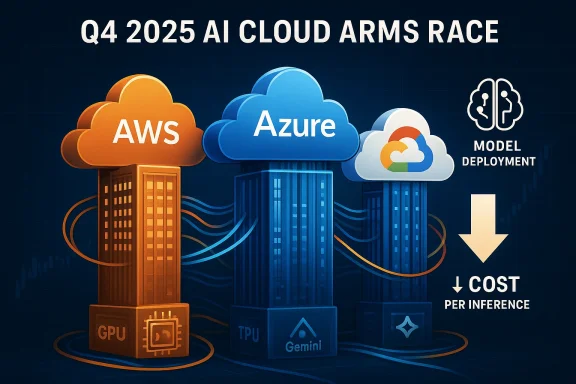
- Google Cloud posted the highest percentage growth and, crucially, reported large efficiency gains from Gemini model optimizations that materially lowered the cost to serve inference workloads. Those efficiency gains — if sustained — change the margin calculus for cloud-hosted AI.
Amazon Web Services — scale, capex, and the limits of supply
Q4 snapshot
AWS reported $35.6 billion in cloud revenue for the fourth quarter of 2025, a 24% year‑over‑year increase and the company’s fastest growth in 13 quarters. AWS’s operating income remained strong and the company signaled it is monetizing capacity as fast as it can install it, telling investors demand is currently outstripping supply. In direct response, Amazon announced an ambitious $200 billion capex plan for 2026, with the majority earmarked for AWS and AI infrastructure.Strengths
- Unmatched scale. AWS’s revenue base remains the largest in the industry; 24% growth on a massive run rate translates into very large absolute dollars and robust profitability that funds reinvestment.
- Breadth of services. AWS continues to lead in product breadth — compute, storage, analytics, security, and a thriving partner ecosystem — which reduces churn and supports enterprise migrations.
- Operational maturity. Years of engineering investment have given AWS advantages in availability, global footprint, and operational practices that matter to risk‑averse enterprises.
Tradeoffs and risks
- Supply constraints are real. AWS explicitly noted that compute capacity — especially accelerator availability, power, and data center buildout timelines — is limiting growth. That creates a near‑term tradeoff between winning new AI customers and preserving capacity for existing high‑value contracts.
- Capex optics. The $200 billion capex plan is strategically aggressive but raises investor scrutiny: heavy short‑term spending can compress free cash flow before the revenue accrues.
- Competitive pressure on price/performance. If competitors can serve models at lower unit cost (through TPUs, model optimizations, or better utilization), AWS could face margin pressure in inference-heavy segments.
Microsoft Azure — enterprise breadth, RPO visibility, and hybrid muscle
Q4 snapshot
Microsoft’s results for fiscal 2026 second quarter (ended Dec. 31, 2025) showed Azure and other cloud services grew 39% year‑over‑year (38% in constant currency). Intelligent Cloud revenue was reported at $32.9 billion. Management emphasized a growing remaining performance obligation (RPO) and reiterated that customer demand continues to exceed supply — particularly for GPU capacity — prompting plans for higher capex in fiscal 2026.Strengths
- Enterprise stickiness. Microsoft benefits from portfolio integration: Azure, Microsoft 365, Dynamics, GitHub, and Windows server products create many cross‑sell and upsell vectors, increasing customer lifetime value.
- RPO and bookings visibility. Larger, multi‑year commitments (including bundled AI infrastructure and SaaS contracts) provide predictable revenue and lower volatility than spot infrastructure sales.
- Hybrid and on‑prem capabilities. For enterprises reluctant to commit fully to the cloud, Microsoft’s hybrid story remains compelling: customers can incrementally adopt Azure for AI while maintaining on‑prem governance.
Tradeoffs and risks
- Allocation complexity. Microsoft must manage constrained accelerator supply across Azure, cloud services, and strategic partnerships (e.g., OpenAI). Decisions about prioritization could affect relationships and revenue recognition timing.
- Capital intensity. Microsoft signaled higher capex, which is appropriate given demand, but execution risk exists: building data centers and securing GPU supply are capital and time intensive.
Google Cloud — the fastest grower and the efficiency story
Q4 snapshot
Alphabet reported Google Cloud revenue of $17.7 billion, a 48% year‑over‑year increase — the fastest growth rate among the Big Three for the quarter. The company attributed the acceleration to strong demand for the Gemini model family and enterprise AI solutions. Alphabet also disclosed striking operational metrics: more than 8 million paid seats of Gemini Enterprise sold (company‑reported), the Gemini app surpassed 750 million monthly active users, and Alphabet claimed it reduced Gemini serving unit costs by 78% over 2025 through model and infrastructure optimizations. Alphabet guided 2026 capex in the range of $175–$185 billion, primarily for servers and data centers to support AI and cloud growth. These claims come directly from company disclosures and were a central theme of Alphabet’s earnings commentary.Strengths
- AI-first product advantage. Google’s vertical integration across chips (TPUs), models (Gemini), and platform (GCP) creates a compelling stack for AI-native workloads. When a provider owns more of the stack, it can optimize across layers to cut serving costs.
- Rapid cost reduction. The reported 78% drop in serving unit cost — if sustained and accurately measured — is a differentiator. Lower inference costs mean Google can serve models more profitably or undercut competitors on price/performance.
- Commercial traction. High headline adoption metrics (paid seats, app MAUs) indicate broad demand across consumer and enterprise surfaces, which drives both infrastructure and higher‑level service revenue.
Caveats and verification
- Company‑reported metrics require context. Figures like "8 million paid seats" and "750 million MAU" are significant but come from Alphabet’s disclosures. These numbers are powerful signals of demand, but third‑party verification and granularity (e.g., average revenue per seat, churn rates) are not publicly broken out in the same detail; treat them as company‑reported leading indicators rather than independently audited metrics.
- Base-rate effects. Google Cloud’s high percentage growth is measured from a smaller base than AWS or Azure; percentage gains on a smaller revenue base are easier to achieve. That said, Google’s strong operating income improvement (cloud operating income more than doubled year‑over‑year in the quarter) signals healtot just top‑line promotion.
Putting the numbers in context: market share, run rates, and capex arms races
- Market trackers put Q4 2025 cloud infrastructure revenue at approximately $119.1 billion, up about 30% year‑over‑year — a magnitude that confirms AI is the proximate cause of the acceleration. The Big Three captured the lion’s share of that growth, but market share shifts are subtle and depend more on multi‑year enterprise commitments than on a single quarter.
- AWS still leads in absolute scale. On an annualized run‑rate, AWS remains by far the largest cloud provider, which gives it a capital and distribution advantage. Microsoft’s enterprise bundling produces high‑value commitments and revenue visibility. Google Cloud is the fastest percentage grower and, critically, is demonstrating improving margins. These are complementary advantages, not mutually exclusive outcomes.
- The capex numbers are striking. AWS’s plan for roughly $200 billion in 2026 capex, Microsoft’s increasing fiscal capex guidance, and Alphabet’s $175–$185 billion range reflect an industry‑wide “arms race” to secure accelerator supply, build data centers, and invest in power and cooling. These are not ordinary infrastructure bills; they represent multi‑year commitments to host and monetize AI workloads at scale.
Comparative analysis: who really “won” Q4 2025?
The shorthand narrative that Google Cloud was the “clear winner” is defensible on percentage growth, margin improvement, and efficiency gains; but the reality is nuanced.- Google Cloud’s case for “winner”:
- Fastest revenue growth (48%) among the Big Three.
- Substantial reported reductions in serving costs for Gemini, implying sustainable margin uplift.
- Large enterprise bookings and a growing cloud backlog that signal durable demand.
- Why that’s not the whole story:
- Base effects matter. High percentage growth from a smaller revenue base does not immediately threaten AWS’s dominance in absolute dollars. AWS’s 24% growth on a far larger base still adds enormous revenue and margin.
- Profitability and cash flow matter. AWS and Microsoft convert revenue into operating leverage with different profiles; investors must evaluate cash flow impacts of massive capex cycles.
- Execution risk. Google’s cost improvements are compelling, but sustaining 78% reductions in inference cost requires continual model and systems optimization; competitors can copy parts of this approach by vertically integrating optimizations or negotiating better hardware economics.
Implications for customers and partners
For enterprise buyers, Q4 2025 crystallized several truths:- AI compute is scarce; plan capacity now. Hyperscalers flagged supply constraints for accelerators. Customers should include capacity reservation clauses, multi-region strategies, and contingency plans when signing enterprise AI contracts.
- Optimize for cost and compliance, not just raw model performance. With large differences in serving unit costs reported, buyers should benchmark not only model accuracy but also cost-per-inference, utilization metrics, and integration overhead into enterprise stacks.
- Consider multi-cloud not for redundancy alone but for bargaining power. Commitments still matter (and are rewarded with discounts), but multi-cloud strategies can preserve negotiating leverage and reduce vendor lock-in risk.
- SaaS vendors and ISVs have a choice to make. Many independent software vendors will select primary model providers; Google’s Gemini traction among software partners indicates growing ecosystem effects that could lock in platform preferences.
Investor takeaway: growth vs. margin vs. capex
Investors must balance three competing vectors:- Growth (top‑line acceleration): Google Cloud’s 48% growth is impressive and suggests market share gains if the trend persists.
- Margin expansion (unit economics): Alphabet’s claimed 78% reduction in serving unit cost translates to tangible margin leverage on AI-serving businesses — a potential rerating catalyst if sustained.
- Capex intensity (cash conversion): AWS’s and Alphabet’s multi‑year multi‑billion capex plans will pressure free cash flow in the near term even as they secure capacity. Investors need clarity on payback timelines and utilization curves.
Risks, unknowns, and what to watch next
- Verification of company metrics. Many of the most exciting numbers are company‑reported (Gemini seats, app MAUs, percentage cost reductions). These are important but should be monitored and triangulated against partner reports and independent telemetry where possible. Treat them as directional until corroborated.
- Hardware supply chain and geopolitical risk. AI acceleration depends on GPUs and other specialized silicon, which face supply and export controls. Any disruptions — from manufacturing bottlenecks to export restrictions — could skew the competitive balance quickly.
- Energy and data center constraints. Building enormous AI farms requires significant power and cooling. Local permitting, grid capacity, and renewable energy availability will influence where and how quickly providers can scale.
- Customer concentration and pricing power. Large enterprise deals can improve visibility but concentrate risk. If a handful of customers account for a meaningful share of cloud AI spend, renegotiation or competitive switching by those customers could create outsized swings.
- Regulatory and compliance pressures. As enterprises deploy models for sensitive tasks, regulatory scrutiny on data usage, explainability, and safety could add operational costs and slow deployment.
Practical guidance for IT leaders
- Audit projected AI workloads for 2026 and map them to accelerator needs (training vs. inference). Quantify token and throughput requirements so you can buy the right capacity.
- Negotiate multi-tier commitments: balance committed capacity (for cost predictability) with burst options for peak training runs.
- Benchmark inference costs across providers using representative workloads, not synthetic tests. Include networking, storage egress, and monitoring costs.
- Prepare a migration and fallback plan: test hybrid and multi‑cloud deployments to avoid single‑vendor lock‑in for critical production models.
- Monitor vendor roadmaps for custom silicon and optimization tooling — choose partners whose technical direction aligns with your operational constraints.
Conclusion
Q4 2025 was the quarter that turned AI into a measurable commercial force for cloud providers. The market grew sharply — roughly $119 billion in cloud infrastructure revenue for the quarter — and each hyperscaler translated that demand into a distinct strategic narrative: AWS doubled down on scale and capex, Microsoft capitalized on enterprise breadth and commitments, and Google Cloud combined explosive percentage growth with a credible story about drastically improved model serving economics.Call this a fork in the road: the next 12–24 months will test whether Google’s efficiency gains are durable, whether AWS can accelerate capacity fast enough to maintain share, and whether Microsoft can continue converting enterprise traction into long‑duration, high‑value commitments. For customers and investors alike, the prudent stance is to treat the quarter as evidence of a new competitive phase — one where unit economics of AI serving, supply‑chain control of accelerators, and integrated AI stacks matter as much as scale. The winners will be those who can coordinate infrastructure, models, and productization while keeping serving costs manageable and execution risks contained.
Source: AOL.com Amazon, Microsoft, and Alphabet All Reported Robust Cloud Growth. 1 Was a Clear Winner