

Microsoft’s cloud backbone hiccupped again this month, and the tremors were felt across offices, shops, airlines and living rooms around the world: a widespread Microsoft Azure outage triggered by an “inadvertent configuration change” to the Azure Front Door service left Microsoft 365, Xbox sign‑ins, Copilot, and numerous third‑party sites struggling to authenticate or route traffic, spiking outage‑tracker reports into the six‑figure range. The incident arrived within days of a separate, large Amazon Web Services (AWS) failure in the US‑East region that disrupted dozens of popular apps and services, renewing urgent debate about systemic risk in a cloud market dominated by a handful of hyperscalers. What these two incidents together reveal is not merely operational fragility inside huge platforms; it exposes structural concentration, contractual lock‑in, and fragile dependency chains that make local faults cascade into global service outages. This feature takes stock of what happened, why it matters, and what realistic technical, commercial and regulatory steps can reduce the chance of a repeat — and the severity if it does.
On a single day late in October, engineers at a major cloud provider rolled a configuration change into a global routing and edge service that made it difficult for millions of end users and customer applications to reach services dependent on that routing fabric. The provider confirmed the trigger as an inadvertent configuration change and mitigated the fault by halting further changes, rolling back to a prior known good configuration, and rerouting traffic while recovery progressed.
Less than two weeks earlier, a separate control‑plane and DNS‑related incident in the US‑East (Northern Virginia) region at another hyperscaler caused DNS resolution failures for a widely used managed API. That event quickly cascaded because that managed API is on the critical path for small but essential operations — session tokens, feature flags, service discovery — used by thousands of higher‑level services. The result: a cascade of failures across many customer apps and, temporarily, millions of users.
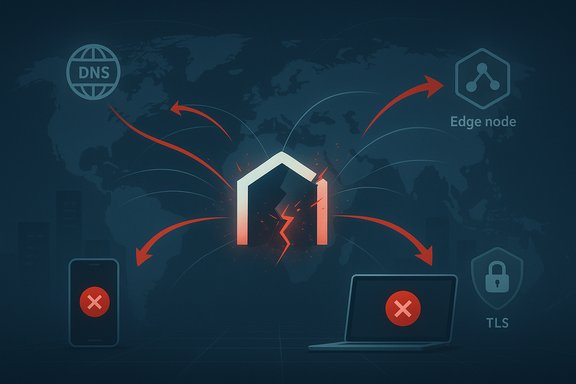
Both episodes share a structural feature: failures in control or routing layers — DNS, global edge routers, or internal monitoring subsystems — can have outsized, immediate effects. Modern cloud stacks are layered and highly automated; when core automation or configuration systems misbehave, the automated responses themselves can amplify impact.
Policymakers face trade‑offs: imposing heavy operational constraints risks raising costs and slowing innovation, whereas doing nothing leaves market structures that concentrate systemic risk unaddressed. Sensible policy should therefore aim for targeted, measurable interventions that reduce lock‑in and improve resilience without undermining the commercial model that funds hyperscale infrastructure investment.
The architecture of the internet is an evolving socio‑technical ecosystem. The path forward is not to reject scale but to insist on better design, clearer accountability and a safety net of standards, contracts and engineering practices that make the next outage less likely and less damaging. The message these incidents deliver is unambiguous: concentration amplifies faults, and resiliency is now as much a governance and procurement problem as it is an engineering one.
Source: Daily Mail The alarming reality of the internet blackout
 Background: what happened, in plain terms
On a single day late in October, engineers at a major cloud provider rolled a configuration change into a global routing and edge service that made it difficult for millions of end users and customer applications to reach services dependent on that routing fabric. The provider confirmed the trigger as an inadvertent configuration change and mitigated the fault by halting further changes, rolling back to a prior known good configuration, and rerouting traffic while recovery progressed.Less than two weeks earlier, a separate control‑plane and DNS‑related incident in the US‑East (Northern Virginia) region at another hyperscaler caused DNS resolution failures for a widely used managed API. That event quickly cascaded because that managed API is on the critical path for small but essential operations — session tokens, feature flags, service discovery — used by thousands of higher‑level services. The result: a cascade of failures across many customer apps and, temporarily, millions of users.
Both episodes share a structural feature: failures in control or routing layers — DNS, global edge routers, or internal monitoring subsystems — can have outsized, immediate effects. Modern cloud stacks are layered and highly automated; when core automation or configuration systems misbehave, the automated responses themselves can amplify impact.
Overview: why these outages matter beyond "a website went down"
The cloud market is highly concentrated
Industry tracking shows that a handful of providers — led by Amazon Web Services, Microsoft Azure, and Google Cloud — command the lion’s share of global public cloud infrastructure revenues. Collectively they capture roughly two‑thirds of the market in many recent analyses. That concentration is the commercial reason the outages matter: when one of these major providers has a problem, the service disruptions are not limited to a small number of niche customers — they propagate to large enterprise platforms, consumer apps and critical public services simply because those providers host so much of the active internet.Critical services and consumer devices ride on the same rails
Cloud services are not just hosting websites. They house identity systems, payment gateways, airline check‑in flows, emergency dispatch backends, and the thin software layers that control smart devices. A DNS or routing issue that prevents authentication to a cloud identity provider, or that makes a managed database endpoint unreachable, can halt a broad and seemingly unrelated set of systems.Automation increases speed — and blast radius
Automation, staged rollouts and self‑healing mechanisms are essential for operating hyperscale infrastructure. But they create coupling: automatic rollbacks, health‑check logic, and dynamic routing changes can produce simultaneous, global effects that are hard to stop quickly when something goes wrong. Short of cutting automation entirely — an impractical and undesirable step — the challenge is to design automation so it limits blast radius and offers reliable human intervention points.The technical anatomy: Azure Front Door, DNS and cascading failures
What Azure Front Door is — and why a configuration matters
Azure Front Door is a global, Layer‑7 routing and content delivery fabric that fronts applications, completes TLS termination, performs Web Application Firewall (WAF) checks, and routes incoming requests to customer origin services or distributed edge nodes. When Front Door’s configuration contains a misrouted rule, malformed route, or bad health‑probe setting, it can misdirect traffic or deem healthy origin infrastructure as unhealthy. Because Front Door sits at the global ingress for many applications, a configuration error there affects not only Microsoft‑branded services but also any customer that uses Front Door as the first hop.DNS and DynamoDB: why a managed database API can break lots of things
In the other incident, DNS resolution problems for a managed database API made it impossible for services to locate the database endpoints they depend on. Many cloud services rely on small, high‑frequency metadata lookups (session tokens, feature flags, auth checks) stored in managed NoSQL services. When those lookups fail, the higher‑level application often times out, retry aggressively and, in some cases, locks up entire request paths. Because those managed services are used internally by other cloud components, a problem at that layer can amplify into broad outages across compute, messaging and storage subsystems.The amplification loop: retries, queues and control‑plane coupling
When clients see failures they retry. If clients retry without exponential back‑off or jitter, retries can cause sudden load spikes that overwhelm recovery attempts. Similarly, control‑plane operations that are themselves dependent on the same failing services can stall, making automated recovery slower. In effect, initial faults can convert into larger failures through well‑known systemic coupling.What we know — and what is still uncertain
- Major providers publicly acknowledged root causes consistent with control‑plane / routing / configuration faults; recovery actions included rolling back to a prior configuration and routing traffic around affected nodes.
- Outage‑tracking platforms recorded spikes in user‑reported incidents that reached six figures at peak windows for one event; these user reports reflect perceived impact, not unique user counts or transaction volumes.
- The two incidents were distinct in technical trigger (configuration change versus DNS/control‑plane failure) but are equivalent in telling us that control and routing layers remain critical single points of failure.
- Any claim that a simultaneous multi‑hyperscaler outage would cause a literal, global “internet blackout” should be treated as plausible but speculative. Such a scenario is theoretically possible because of downstream dependencies, but it would require multiple independent failures or a correlated systemic shock. The internet has substantial geographic and provider diversity; a complete, simultaneous global blackout would be extreme and is not the most likely outcome. Still, localized or regional catastrophic disruptions affecting critical services are a realistic threat.
- Specific dollar or insured‑loss figures reported immediately after outages can vary widely by source and require formal actuarial analysis; early loss estimates are provisional.
The human and business impacts: the interruptions that matter
- For consumers: interrupted access to email, office documents, gaming networks, and consumer payment systems is disruptive, costly, and sometimes dangerous for people who rely on digital services for urgent needs.
- For enterprises: productivity loss from blocked collaboration tools, failed authentication, stalled CI/CD pipelines and interrupted payment processing can create immediate revenue and reputational damage.
- For public services: airline check‑ins and transit logistics rely on cloud APIs; outages that affect boarding passes or payment terminals create cascading operational headaches and safety risks.
- For small vendors: firms that depend on a single cloud front end or managed service can face outsized harm relative to their size, with recovery costs and brand damage that are disproportionate.
Why moving off the hyperscalers is not a simple fix
Large cloud providers grew dominant because they offer unmatched scale, geographic reach, integrated tooling, and aggressive pricing that make building at scale feasible for startups and enterprises alike. For many organizations, moving entirely off a major cloud to a regional provider or on‑premises stack is prohibitively expensive, operationally complex, and technically risky. Factors that lock customers in include:- Data egress fees and time‑consuming data transfer processes.
- Proprietary APIs and managed services that are not trivially portable.
- Complex application rewrites required to change service endpoints or authentication flows.
- Economies of scale: hyperscalers can amortize infrastructure and pass through lower effective costs for many workloads.
Practical resilience measures for organisations (technical and contractual)
Enterprises and platform operators can take concrete steps to reduce exposure and recovery time when a major cloud provider stumbles.- Multi‑region and multi‑cloud architecture
- Deploy critical control planes across multiple geographic regions and, where possible, across different cloud vendors.
- Avoid architecting all global control traffic through a single region or zone.
- Design for graceful degradation
- Use circuit breakers, service meshes, and fallback caches so that critical paths can operate in read‑only or degraded modes during dependent service outages.
- Prioritise essential transactions; allow less important requests to queue or fail fast.
- Resilient client behaviour
- Implement exponential back‑off with jitter in retry logic to avoid creating retry storms.
- Use idempotent operations and safe retry semantics for transactional requests.
- Data portability and backup plans
- Evaluate data egress exposure and plan periodic exports to a neutral, portable storage format to reduce the cost and effort of moving critical data under duress.
- Maintain a small, hardened on‑prem or alternative cloud fallback for essential services.
- DNS and routing redundancy
- Use multiple DNS providers and health‑checked CNAME failovers that can cut over without manual tungsten‑plate procedures.
- Validate that CDNs and edge routes include fail‑open options for emergency access to origin services.
- Contractual protections and runbooks
- Negotiate SLAs with meaningful remedies and transparent post‑incident reporting obligations.
- Maintain tabletop exercises and runbooks that include steps for rapid identification, mitigation, and customer communications.
- Monitoring and third‑party observability
- Combine vendor status pages with independent synthetic monitoring and network telemetry to detect real‑world user impact quickly and reliably.
- Instrument client‑side telemetry to map which functionality fails under provider outages (auth, data, routing) so mitigation can be prioritized.
Systemic fixes: what hyperscalers, regulators and industry groups should do next
For hyperscalers (what they must improve)
- Harden staged rollout procedures for control‑plane changes and add more conservative guardrails that stop wide propagation of certain classes of change.
- Reduce single‑point‑of‑failure tendencies inside global control planes by allowing local diverging rules during incidents.
- Publish timely Post‑Incident Reviews (PIRs) that include technical root cause, blast radius, steps taken and a concrete timeline for mitigation of underlying process gaps.
- Offer clearer, lower‑friction data portability paths and transparent, predictable egress pricing for customers who need to implement failover plans.
For enterprises and operators
- Treat cloud providers as infrastructure vendors with contractual obligations and audit rights; demand better transparency and emergency support.
- Incorporate public accountability clauses in procurement that require fast, actionable incident reports and assistance during incidents that create critical business impact.
For regulators and policymakers
- Consider targeted measures to improve portability, interoperability and competition in cloud services rather than blunt, across‑the‑board interventions.
- Use regulatory tools to require transparency on market share, egress pricing practices, and interoperability roadmaps — especially where a provider’s dominance creates systemic risk.
- Explore “critical infrastructure” frameworks for cloud services that host essential public functions, mandating resilience standards and recovery playbooks.
The regulatory angle: competition, lock‑in and the CMA example
Regulators in several jurisdictions have scrutinised cloud market concentration and practices that make switching providers difficult. Concerns commonly include data egress fees, software licensing terms that disadvantage competitor clouds, and high technical barriers to migration. Some competition authorities have considered designating dominant cloud providers with special oversight powers — a controversial but increasingly discussed policy lever intended to enforce conduct remedies such as increased interoperability, reduced egress fees, and enforced data portability.Policymakers face trade‑offs: imposing heavy operational constraints risks raising costs and slowing innovation, whereas doing nothing leaves market structures that concentrate systemic risk unaddressed. Sensible policy should therefore aim for targeted, measurable interventions that reduce lock‑in and improve resilience without undermining the commercial model that funds hyperscale infrastructure investment.
Risks and unlikely but plausible worst-case scenarios
- Reasonable risk: Extended outages that take critical business systems offline for hours to days, creating financial, human and safety impacts.
- Less likely but plausible: Correlated outages affecting multiple providers in a short window because of third‑party dependencies (e.g., shared DNS resolvers, common third‑party libraries or software supply‑chain issues).
- Highly unlikely: A total global internet blackout. The internet’s physical and logical topologies include vast redundancy and provider diversity. Still, localized or cross‑border systemic failures that disable essential services regionally are plausible and materially dangerous.
What consumers and IT decision‑makers should do this week
- Prepare for short but disruptive outages: maintain alternate contact methods (SMS, phone) and offline copies of essential documents for key team members.
- Review your organisation's cloud dependence map: identify single points of failure tied to a single provider or region and prioritise mitigations for the most critical paths.
- Update incident communications playbooks so customers and users receive clear, timely status updates when outages occur.
- In procurement, demand portability clauses and plan a realistic, incremental redundancy implementation (multi‑region/edge, multicloud for critical control paths).
Conclusion: living with concentration without being powerless
The recent twin outages are a wake‑up call rather than a reason to tear down the cloud. Hyperscalers provide indispensable scale and innovation; they also centralise risk. The technical problems that caused these outages are solvable, and both providers and customers have concrete steps they can take now to reduce likelihood and impact. For organisations, the immediate action is pragmatic: inventory dependencies, add redundancy for critical paths, and design systems that degrade gracefully. For providers, the obligation is to reduce blast radius for configuration and control‑plane changes and to make portability practical. For regulators, the task is to balance competition remedies that reduce lock‑in with preserving the economic incentives that fund global infrastructure.The architecture of the internet is an evolving socio‑technical ecosystem. The path forward is not to reject scale but to insist on better design, clearer accountability and a safety net of standards, contracts and engineering practices that make the next outage less likely and less damaging. The message these incidents deliver is unambiguous: concentration amplifies faults, and resiliency is now as much a governance and procurement problem as it is an engineering one.
Source: Daily Mail The alarming reality of the internet blackout
