

Large-scale data science no longer lives in notebooks and isolated GPU racks — it lives on cloud platforms that blend raw compute, managed data services, and governance into an operational fabric that teams can scale, secure, and iterate on. This feature examines the cloud platforms that currently give enterprise data science teams the best chance to build, train, and operationalize models at scale, explains what each platform does well, flags realistic limits and risks, and lays out a practical decision framework to choose and pilot the right platform for your organization. overview
Cloud vendors have shifted from offering virtual machines and object storage to delivering tightly integrated data-and-AI stacks: managed feature stores, model serving, vector indexing, and in-place GPU acceleration for data workloads. This change is driven by three forces: (1) the explosion of embeddings and LLM-scale training workloads, (2) the need to reduce data movement for terabyte-to-petabyte datasets, and (3) stronger governance and MLOps tooling that enterprises require to trust production models.
The market can be usefully divided ins:
Strengths:
Strengths:
Strengths:
Why this matters:
Strengths:
Strengths:
The right answer for your organization will usually be hybrid: use the hyperscaler that matches your cloud strategy for large distributed training and global scale, and consider data-native acceleration (Snowflake, Databricks) for heavy data-prep, feature engineering, and mid-size model training where data gravity dominates. Always pilot with measurable KPIs and validate vendor performance claims on your real data before committing to a single platform.
By aligning platform choice with your data gravity, accelerator needs, governance posture, and cost model — and by running focused pilots that measure real-world performance — engineering and data science teams can reduce risk while accelerating time-to-value for large-scale AI projects.
Source: Analytics Insight Best Cloud Platforms for Large-Scale Data Science Projects
Cloud vendors have shifted from offering virtual machines and object storage to delivering tightly integrated data-and-AI stacks: managed feature stores, model serving, vector indexing, and in-place GPU acceleration for data workloads. This change is driven by three forces: (1) the explosion of embeddings and LLM-scale training workloads, (2) the need to reduce data movement for terabyte-to-petabyte datasets, and (3) stronger governance and MLOps tooling that enterprises require to trust production models.
The market can be usefully divided ins:
- Hyperscalers (AWS, Microsoft Azure, Google Cloud) that provide global scale, broad services, and custom silicon options for training and inference.
- Data-cloud and ML-specialist platforms (Snowflake, Databricks, VAST and others) that aim to collapse the storage-compute gap and embed GPU acceleration or ML runtimes inside the data plane.
 Hyperscalers: breadth, scale, and ecosystem
AWS — the breadth play (SageMaker, Bedrock, custom silicon)
AWS remains the default choice for many large-scale teams because of sheer breadth — managed training and inference services, orchestration tools, and a massive global footprint. Amazon SageMaker provides managed training, model tuning, and deployment pipelines; Bedrock focuses on foundation-model access and customization. AWS continues to invest in hardware and model customization features to lower model development time.Strengths:
- Deep ecosystem of managed services (compute, storage, monitoring, security).
- Wide choice of accelerators, including instances optimized for inference/training and accelerating silicon options.
- Mature MLOps integrations (MLflow, SageMaker Pipelines, Amazon EKS support).
- Vendor lock-in through managed services and proprietary APIs unless you adopt strict open standards in your architecture.
- Cost complexity at scale: large GPU fleets and data egress can quickly dominate budgets.
- Region-level GPU availability must be validated for production timelines; capacity constraintsng for large training jobs.
- Use AWS when you need broad service coverage, global regions, and tightly integrated operational controls.
- Plan a capacity validation exercise early in procurement to ensure the GPU types and counts you need are available in your target regions.
Google Cloud — data-first analytics (BigQuery + Vertex AI + TPU)
Google Cloud’s architectural advantage is its data-first tooling: BigQuery for petabyte-scale analytics and Vertex AI for unified model development and serving. Google also offers powerful TPU accelerators for both training and inference; Vertex AI supports TPU VM training and TPU-hosted inference to accelerate large model workloads. These make Google especially attractive for analytics-led teams that want to data.Strengths:
- BigQuery’s managed, serverless analytics gives fast access to large datasets without provisioning compute.
- TPU support for high-throughput model training and inference, with multi-host options coming through Vertex AI.
- Strong price-performance on very large-scale linear algebra workloads and custom silicon investments for hyperscale ML.
- TPUs and advanced accelerator offerings are region- and availability-zone dependent; enterprises must confirm capacity and compatibility with frameworks (e.g., JAX, PyTorch via PJRT).
- Teams used to GPU-centric tooling may need to adjust for TPU runtime differences and tooling ecosystem subtleties.
- Choose Google Cloud for analytics-first projects that benefit from keeping compute adjacent to BigQuery and where TPU performance materially reduces iteration time.
Microsoft Azure — hybrid-first enterprise integration
Azure’s strength is deep integration with enterprise identity and productivity platforms (Microsoft 365, Entra/Azure AD) and strong hybrid-cloud offerings, making it a pragmatic choice for regulated industries and Windows-centdes managed ML services and close integration with enterprise governance controls, which is often decisive in industries with strong compliance requirements.Strengths:
- Seamless integration with enterprise identity, governance, and Microsoft stack.
- Hybrid-cloud support for on-premises and edge scenarios, easing regulated deployments.
- Growing AI stack and partnerships to support model training and inference at scale.
- If your stack is not Microsoft-centric, integration bd migration could be frictional.
- Hybrid adds complexity: maintain a disciplined strategy for networking, replication, and compliance.
- Favor Azure where enterprise governance, hybrid deployments, or Microsoft ecosystem lock-in are requirements.
Data-cloud & ML-specialist platforms: collapsing the storage-compute gap
Snowflake — in-place GPU acceleration with CUDA‑X libraries
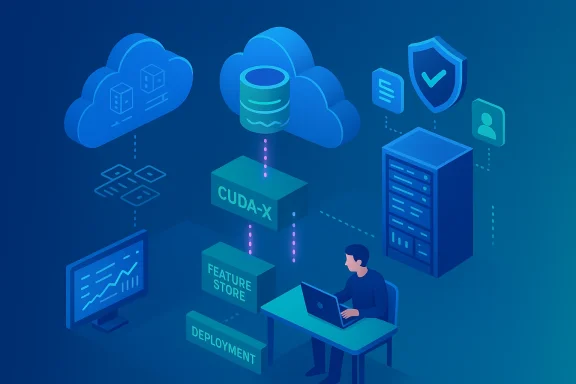
Snowflake has moved beyond SQL analytics into the AI Data Cloud by integrating NVIDIA CUDA‑X Data Science libraries directly into Snowflake ML. This lets teams run GPU‑accelerated cuDF/cuML workloads (pandas, scikit-learn, UMAP, HDBSCAN) inside Snowflake’s container runtime without wholesale code rewrites. Snowflake and NVIDIA benchmarks claim very large speedups for algorithms, which can materially reduce iteration cycles for data scientists working on terabyte-scale datasets.Why this matters:
- Eliminates heavy ETL/data movement for many supervised and unsupervised workflows.
- Shortens time-to-insight by running GPU-accelerated Pythonic data science libraries inside the data cloud.
- Benchmarks vary by dataset and workload; vendor-published gains often represent best-case scenarios. Always pilot on production-like datasets.
- GPU costs and runtime limits inside the platform should be analyzed against external GPU fleet alternatives for long-running training jobs—Snowflake’s integration is particularly compelling for data-prep and mid-size training tasks rather than massive distributed model pretraining.
- Pilot Snowflake ML for workloads dominated by heavy data movement (feature engineering, clustering, embedding extraction) to measure real-world speedups and cost-effectiveness.
Databricks — lakehouse-first MLOps and operational features
Databricks continues to lead in unified lakehouse architectures and MLOps tooling. Recent releases emphasize tighter integrations with MLflow, Unity Catalog, and model serving, plus agentic assistants designed for data science workflows. Databricks’ approach is engineered for teams who want a single platform from data engineering to model serving.Strengths:
- Mature Delta Lake storage, robust MLOps integrations, and strong support for reproducible pipelines.
- Built-in support for online feature stores and serving, lowering friction between training and production.
- Rapid support for experimentation and agent-assisted notebook generation to accelerate productivity.
- Cost and operational complexity need close management when scaling clusters and high-throughput inference.
- Data governance and cross-team semantics must be enforced via Unity Catalog and linked governance tooling.
- Use Databricks where reproducible ML pipelines, feature stores, and a single unified lakehouse simplify cross-team workflows.
Emerging storage and index platforms (VAST, unified namespaces)
Storage-first vendors aim to reduce the friction of managing huge embedding catalogs and agent memory by exposing unified namespaces and high-throughput IO optimized fe architectures are especially relevant when your workload centers on low-latency vector search across billions of embeddings.Strengths:
- Minimize movement of large embedding catalogs.
- Often provide specialized indexing and IO for retrieval-augmented systems.
- These platforms are complementary, not always replacements for hyperscalers—consider them where the data movement costs and latency of embedding lookups are dominant.
Key technical considerations for picking a platform
1. Data gravity and movement
If your terabytes or petabytes of raw data already reside in a particular platform (e.g., BigQuery, Snowflake, S3), gravity favors running computation where the data lives. Moving petabytes for model training is costly and slow; platforms that provide in-place acceleration (Snowflake CUDA‑X, BigQuery ML pipelines, Databricks compute close to Delta Storage) reduce time-to-insight.2. Accelerator availability and model compatibility
Check the specific accelerator types offered (A100, H100, GB300, TPU v5/v6e) and validate framework compatibility (PyTorch, TensorFlow, JAX). TPUs offer excellent price-performance for certain workloads but require different runtimes; GPUs remain the default for broad framework compatibility. Always validate region-level capacity for your accelerator of choice.3. MLOps, lineage, and governance
Enterprise readiness requires native model lineage, monitoring, and governance. Databricks, major hyperscalers, and many data-cloud vendors now include toolsg, model lineage, and feature-store integration — but none are plug-and-play. Governance is often the true gating factor for production adoption.4. Cost predictability and unit economics
Estimate training and inference costs, data storage and egress, and the engineering overhead for operations. Managed services reduce ops overher-hour costs; bringing GPUs inside the data cloud can cut ETL costs but you must model per-job runtime economics carefully.Risks and vendor lock-in — a practical risk matrix
- Vendor lock-in: Managed APIs, proprietary runtimes, and specialized accelerators cnsive. Prefer open formats (ONNX, Delta Lake, Parquet) and containerized training jobs when possible.
- Capacity risk: Acd regional constraints delay production schedules. Validate availability early.
- Governance and auditability gaps: Platforms are improving but auditors still require clbility, and access controls. Bake governance into pilots.
- Cost overruns: Uncontrolled experiment cycles on large accelerators are expensive. Is and cost monitoring from day one.
- Vendor benchmark numbers (e.g., "up to 200x faster") should be treated as directional. These figures are often derived from specific datasets and settings; you must reproduce them on your workloads to confirm. Snowflake and NVIDIA provide benchmark claims for CUDA‑X, but actual gains will vary by data shape and preprocessing.
How to run a pilot that proves value (practical six-step playbook)
- Identify a business-critical, medium-complexity use case (churn prediction, monthly financial close automation, or an embedding-powered search application). Keep scope finite and measurable. -functional squad: data engineer, ML engineer, a business owner, security/compliance lead, and an SRE. Clear roles avoid slowdowns.
- Choose two candiperscaler that matches your cloud strategy, and a data-cloud or lakehouse contender that claims in-place acceleration (e.g., Snowflake or Databricks). This lets you compare “compute-in-place” vs “external GPU” approaches.
- Define success metrics: time-to-first-iteration, model accuracy lift vs baseline, cost per training run, and end-to-end latency for inference. Capture both engineering and business KPIs.
- Run matched experiments with production-like data: replicate sample sizeity your production job will encounter. Measure wall-clock, dollars-per-iteration, and operational overhead. Reproduce vendor benchmark claims on your dataset before committing.
- Evaluate results and operationalize: pick the platform that meets your success metrics and create a migration and governance plan (CI/CD, model registry, monitoring, SSO/identity integration).
Platform recommendations by project profile
- Analytics-first, massive SQL datasets: Google Cloud (BigQuery + Vertex AI) for a fit and strong TPU options.
- Enterprise regulated/hybrid: Microsoft Azure for governance, identity, and hybrid deployments.
- Data-native ML with heavy feature engineering: Snowflake ML for intion; Databricks for lakehouse-first MLOps and reproducible pipelines. Pilot both to compare cost and speed on your workload.
- Realtime embedding-heavy retrieval systems: consider specialized storage/index vendors (VAST, vector DBs) combined with a hyperscaler for serving to minimize lookup latency.
Closing analysis — balancing innovation and operational reality
The modern large-scale data science stack is no long “a cloud.” It’s about choosing an architecture: do you prioritize minimal data movement, maximum accelerator performance, or enterprise governance and hybrid flexibility? Hyperscalers deliver the broadest toolkit and global capacity. Data-cloud vendors and lakehouse platforms are closing the gap by embedding GPU acceleration and ML runtimes close to the data, which often reduces iteration time and simplifies pipelines. However, vendor benchmarks should be validated against production-like datasets, and governance must be prioritized from day one to avoid costly rework.The right answer for your organization will usually be hybrid: use the hyperscaler that matches your cloud strategy for large distributed training and global scale, and consider data-native acceleration (Snowflake, Databricks) for heavy data-prep, feature engineering, and mid-size model training where data gravity dominates. Always pilot with measurable KPIs and validate vendor performance claims on your real data before committing to a single platform.
By aligning platform choice with your data gravity, accelerator needs, governance posture, and cost model — and by running focused pilots that measure real-world performance — engineering and data science teams can reduce risk while accelerating time-to-value for large-scale AI projects.
Source: Analytics Insight Best Cloud Platforms for Large-Scale Data Science Projects
