

Microsoft’s argument is simple and consequential: 2026 will be the year organizations stop treating agents as one‑off experiments and start operating them like production services—and Copilot Studio is the toolset Microsoft expects enterprises to use to get there.
Enterprise AI crossed a practical threshold in 2025. What had been narrow, manually triggered assistants began evolving into persistent, goal‑oriented programs that can plan, act, and hand off to humans. Microsoft’s product narrative — from Copilot Studio and Copilot in Office to the control surfaces of Agent 365 and Microsoft Foundry — stitches authoring, models, identity and governance into a single operational story intended for large organizations.
That transition matters because it changes the unit of value: from saving minutes on a single task to removing whole bottlenecks across workflows. The Microsoft framing presented at Ignite and in product posts emphasizes three linked needs for enterprise readiness: contextual grounding of models (Fabric/Foundry), identity and governance (Entra Agent ID, Agent 365), and reliable authoring plus lifecycle controls (Copilot Studio). These are the scaffolding for the six pillars Microsoft highlights as the checklist for being “agent‑ready” in 2026.
The practical payoffs are clear:
Benefits include:
Concrete advantages:
This flexibility is powerful but introduces operational choices:
Operational benefits:
What leaders get:
Copilot Studio and Microsoft’s broader agent stack provide the primitives to move from experimentation to production. The real work for IT leaders is not technical novelty; it’s the organizational engineering: AgentOps, CoEs, FinOps guardrails, auditable grounding, and human‑centric fallbacks. Do that, and agents stop being curiosities and become durable operational partners that change how work gets done.
If your next step is tactical: pick a high‑value B2E flow, build a read‑only agent from a vetted template in Copilot Studio, register it in Agent 365, instrument KPIs and telemetry, and iterate. That measured approach is how organizations convert agent curiosity into sustained capability, confidence, and commitment in 2026.
Source: Microsoft The 6 pillars that will define agent readiness in 2026 | Microsoft Copilot Blog
 Background
Enterprise AI crossed a practical threshold in 2025. What had been narrow, manually triggered assistants began evolving into persistent, goal‑oriented programs that can plan, act, and hand off to humans. Microsoft’s product narrative — from Copilot Studio and Copilot in Office to the control surfaces of Agent 365 and Microsoft Foundry — stitches authoring, models, identity and governance into a single operational story intended for large organizations.That transition matters because it changes the unit of value: from saving minutes on a single task to removing whole bottlenecks across workflows. The Microsoft framing presented at Ignite and in product posts emphasizes three linked needs for enterprise readiness: contextual grounding of models (Fabric/Foundry), identity and governance (Entra Agent ID, Agent 365), and reliable authoring plus lifecycle controls (Copilot Studio). These are the scaffolding for the six pillars Microsoft highlights as the checklist for being “agent‑ready” in 2026.
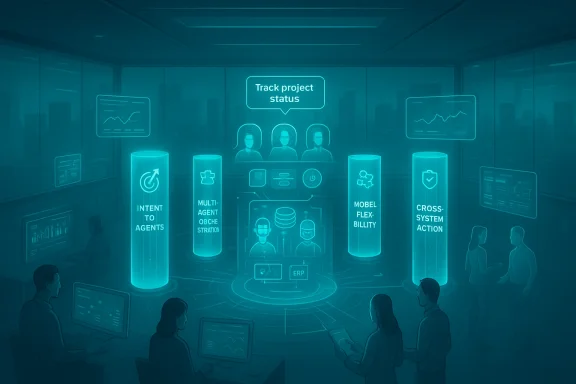
The six pillars explained
Below I unpack each pillar, explain the business payoff, and call out the technical trade‑offs and governance considerations that matter when you move an agent into production.1. Ability for anyone to turn intent into agents
Microsoft’s vision: remove the translation layer between business intent and technical execution. Instead of requiring DSLs or code, Copilot Studio and the Agent Builder let people describe outcomes in natural language and publish agents that interpret intent and context. That lowers the bar for Line‑of‑Business owners—sales, HR, ops—to create agents that solve their problems without waiting in a long engineering queue.The practical payoffs are clear:
- Faster time to prototype and publish agents.
- Fewer “translation” gaps between business requirement and behavior.
- Broader participation across non‑technical roles.
2. Agents that can own workflows end to end
The move from “assist” to “own” is the core business promise: agents that can run a repeatable process start to remove coordination overhead. Copilot Studio’s agent flows and Workflows Agent support multi‑step automations that trigger on events, walk users through required inputs, validate policy constraints, and route or escalate as needed. The example Microsoft uses—expense or wellness reimbursements automated end‑to‑end—is emblematic of the low‑hanging fruit.Benefits include:
- Reduced cycle times and fewer manual handoffs.
- Consistent application of business rules and validations.
- Fewer hidden bottlenecks that stall work.
3. Power to coordinate agents for real outcomes
Single agents are useful; multi‑agent systems scale the value. Microsoft and partners describe an orchestration model where specialized agents—monitoring agents, validation agents, domain experts—collaborate and delegate to deliver outcomes that would be brittle for a single agent to manage. Composing small, focused agents reflects how teams already work and makes systems easier to evolve.Concrete advantages:
- Specialization improves correctness and maintainability.
- Coordination layers can route queries to the right expertise automatically.
- It simplifies the human experience—ask once, get an orchestrated answer.
4. Flexibility to control your agent models
Not all agents need the same model. Some require deep reasoning; others need low‑cost predictable outputs. Copilot Studio’s multi‑model approach (support for Anthropic, chat/reasoning models, Microsoft Foundry and bring‑your‑own‑model paths) is built to match workload needs without fragmenting governance. The practical effect: you can apply different models where they fit—reasoning models for policy interpretation, cost‑efficient models for high‑volume tasks—under a consistent management and policy structure.This flexibility is powerful but introduces operational choices:
- Model routing has to be explicit and auditable.
- Costs vary dramatically by model selection and inference volume—expect FinOps implications.
- Regulatory and residency constraints may force on‑prem or private model options for certain data domains.
5. Agents that can act across your systems
One of the most consequential capabilities Microsoft showcased is agent “computer use”—agents that can interact with GUIs, call APIs, update records and file tickets. That bridges the long‑standing gap between “advice” and “action.” Agents can now enact the recommended next steps across SaaS tools and internal systems instead of leaving work paused for a human to click through multiple tools.Operational benefits:
- Faster response times and fewer manual handoffs.
- Reduced human error in repetitive updates.
- Continuous operation outside standard business hours.
6. Capability to scale agents without sacrificing control
Scaling from dozens to thousands of agents is where governance and lifecycle tooling become critical. Copilot Studio paired with Agent 365 aims to provide the inventory, identity, telemetry, and evaluation surfaces to make agents discoverable, auditable, and cost‑visible across an enterprise. That combination is central to avoiding the “pilot trap” and turning agents into durable operational levers.What leaders get:
- A unified view of agents, usage, and costs.
- Admin controls to apply consistent policies and human‑in‑the‑loop thresholds.
- Evaluation tooling to measure agent quality and retirement signals.
Why these pillars matter: business outcomes and examples
Each pillar maps to measurable business outcomes when stitched together.- Faster onboarding and HR flows: agents that validate forms, check policy, and escalate exceptions reduce time‑to‑complete and free HR to focus on exceptions. (Pillars 2, 5, 6).
- Reduced operational toil: multi‑agent orchestration can detect supply issues, update systems of record and file remediation tickets without human handoffs (Pillars 3 and 5).
- Higher adoption across roles: natural‑language creation plus agent catalogs expands who builds and reuses agents (Pillar 1).
Critical analysis: strengths, caveats, and enterprise risk
Microsoft’s approach brings real strengths, but also structural risks every enterprise must weigh.Strengths
- An integrated stack: Copilot Studio, Agent 365, Foundry and Fabric present a coherent architectural vision for authoring, grounding, identity and governance—reducing integration work for customers already invested in Microsoft.
- Democratized authoring: Natural‑language and low‑code agent builders accelerate experimentation and adoption across lines of business.
- Enterprise governance primitives: Identity‑bound agents, telemetry surfaces and lifecycle tooling create a plausible path to scale without losing control.
- Model choice and extensibility: Support for multiple models and BYOM options helps match workloads to the right inference characteristics.
Key risks and caveats
- Governance and compliance exposure: Agents that can write back or access regulated data require DLP, Purview classification, short‑lived credentials, and audit trails. Microsoft emphasizes these controls, but they add operational overhead and complexity.
- Agent sprawl and runaway cost: Democratized creation plus per‑inference costs can cause uncontrolled spend. Finance and IT must set environment caps, credit budgets and chargeback models early.
- Grounding and hallucinations: Relying on models without properly versioned, governed corpora increases the risk of incorrect or unsafe outputs. RAG architectures and Foundry/Fabric IQ are meant to mitigate this, but they depend on data hygiene and labeling work.
- Operational brittleness: GUI automation and multi‑agent routing introduce fragile dependencies—vendor UI changes or misrouted queries can cause failures. Resilience and fallbacks are essential.
- Vendor claims vs. tenant reality: Some public‑facing numbers and roadmap points (model availability, routing policies, and projected agent counts) are vendor claims or forecasts that require tenant‑level validation and staging for regional availability. Treat big headline forecasts as planning signals, not guarantees.
How to operationalize the six pillars: practical playbook
If you lead an IT, security, or automation program, these steps convert the pillars into a pragmatic roadmap.- Run quick, focused pilots (2–6 weeks)
- Choose high‑value, low‑risk processes (B2E), such as employee self‑service or IT ticket triage.
- Start agents in recommend or read‑only mode; avoid write‑back for initial pilots.
- Create a Copilot Center of Excellence (CoE)
- Staff cross‑functional representatives (IT, security, legal, finance, and business SMEs).
- Define agent naming, ownership, lifecycle, and retirement policies.
- Instrument metrics and FinOps controls
- Track MAU, agent‑level inference cost, latency, escalation frequency and error rates.
- Set environment‑level caps and metering to prevent runaway spend.
- Enforce identity and least privilege
- Register agents as identities, use short‑lived tokens, and apply conditional access and Purview labels to all RAG sources.
- Build AgentOps and CI/CD for agents
- Version agent definitions, run acceptance tests in staging, schedule periodic red‑teaming, and run drift detection.
- Integrate telemetry into SIEM and make agent actions auditable.
- Standardize reuse and templates
- Publish vetted agent templates in a catalog; encourage reuse and discourage ad‑hoc tenant publishing.
- Use cataloged templates to maintain consistency in security posture and observability.
- Validate model routing and data residency
- Document which model families serve which workloads and map costs to budgets.
- Validate any claims about model availability or routing in your tenant; preview features may be region‑gated.
Measurement: what to track to prove value (and safety)
Make measurement a first‑class activity. Metrics should be both business‑oriented and safety‑oriented:- Business KPIs
- Time saved per task, process cycle time reduction, MAU for agents, ticket volume reduction.
- Quality and safety KPIs
- Hallucination/error rate, escalation frequency, approval override rate, number of incidents tied to agent actions.
- Operational KPIs
- Inference cost per agent, cost per successful outcome, uptime and latency, agent version drift.
Two vendor claims to treat with healthy skepticism
- “1.3 billion agents by 2028.” Several Microsoft materials cite IDC projections as planning signals; treat this as a forecast, not a hard deliverable. Use it to plan scale, but validate costs and governance needs with realistic internal modeling.
- “Turnkey model routing and perfect grounding.” Microsoft’s MCP, Foundry and Fabric IQ are built to make routing and grounding manageable, but tenant customizations, data quality, and legacy system idiosyncrasies mean you must verify behavior in your environment. Bench tests and staged rollouts are essential.
Quick checklist for IT leaders before you publish an agent
- Register the agent in your inventory and assign an owner.
- Confirm the agent’s model routing, data sources, and data residency constraints.
- Start in read‑only or recommend mode; require human approval for write actions until KPIs are validated.
- Apply least‑privilege tokens and short‑lived credentials for agent identities.
- Instrument telemetry into your SIEM and add agent logs to Purview retention policies.
Conclusion: transform curiosity into disciplined capability
The six pillars Microsoft lays out for agent readiness are not a product checklist so much as an operational manifesto: democratize creation, enable agents to act, orchestrate expertise, choose models deliberately, let agents touch systems safely, and scale with lifecycle controls. When combined, those pillars make agents useful at enterprise scale—but only if an organization pairs rapid pilots with disciplined governance and operational rigor.Copilot Studio and Microsoft’s broader agent stack provide the primitives to move from experimentation to production. The real work for IT leaders is not technical novelty; it’s the organizational engineering: AgentOps, CoEs, FinOps guardrails, auditable grounding, and human‑centric fallbacks. Do that, and agents stop being curiosities and become durable operational partners that change how work gets done.
If your next step is tactical: pick a high‑value B2E flow, build a read‑only agent from a vetted template in Copilot Studio, register it in Agent 365, instrument KPIs and telemetry, and iterate. That measured approach is how organizations convert agent curiosity into sustained capability, confidence, and commitment in 2026.
Source: Microsoft The 6 pillars that will define agent readiness in 2026 | Microsoft Copilot Blog
