

Businesses running production applications across Amazon Web Services and Microsoft Azure maintain security and availability through continuous monitoring, strict identity controls, secrets management, Kubernetes lifecycle maintenance, and incident response practices that prevent routine configuration drift from becoming outages or security exposure. That is the unglamorous reality behind modern cloud reliability. The cloud sells elasticity and abstraction, but the work that keeps it safe is stubbornly operational: watch the signals, rotate the credentials, patch the clusters, restrict the permissions, and explain the failure when something breaks. Harika Sanugommula’s work across AWS, Azure, and Kubernetes environments is a useful lens into that larger shift, because the job is no longer merely deploying infrastructure — it is continuously defending it from entropy.
The public cloud changed who owns the hardware, but it did not remove the need for operational discipline. AWS and Azure take responsibility for enormous layers of physical infrastructure, regional networking, managed control planes, and service durability. Customers, meanwhile, inherit a different burden: configuring identities, securing application paths, monitoring behavior, updating runtime platforms, and proving that their own workloads can survive failure.
That division is where many cloud misunderstandings begin. A company can move from a private data center into managed cloud services and still carry forward the habits that caused outages on-premises. The names change from racks and storage arrays to IAM roles, node pools, managed identities, and observability pipelines, but the risk remains familiar: systems fail when nobody owns the boring details.
Sanugommula’s experience, as described in the submitted profile, sits squarely in that gap. Her work spans monitoring infrastructure, managing access controls, using AWS Secrets Manager, supporting Azure Kubernetes Service clusters, investigating network failures, and coordinating incident response. None of those tasks make for the sort of keynote demo that sells cloud transformation. They are the tasks that determine whether the keynote demo survives contact with production.
The deeper point is that multi-cloud reliability is not a procurement strategy. Running workloads across AWS and Azure can reduce dependency on a single vendor in some scenarios, but it also expands the operational surface area. Each platform has its own identity model, logging conventions, networking abstractions, quota systems, maintenance windows, and support boundaries. Availability becomes less about choosing the “best” cloud and more about maintaining enough institutional muscle to operate both.
The profile highlights Sanugommula’s use of AWS CloudWatch to enable real-time alerts for unusual activity and infrastructure problems. That is not a minor implementation detail. Alerting is the mechanism by which infrastructure turns from a passive asset into an active participant in operations, forcing anomalies into the attention of people who can act before users notice.
Good monitoring is not just a flood of metrics. It requires deciding which signals actually matter, tuning alerts so engineers do not ignore them, and correlating low-level events with customer-facing symptoms. CPU saturation, pod restarts, failed secret retrieval, throttled API calls, and expired credentials can all appear as separate signals while sharing a single operational story.
In Kubernetes environments, this gets harder because the unit of failure is more fluid. Containers start and stop by design. Nodes can be replaced. Services can reschedule. A transient pod failure might be harmless, or it might be the first visible crack in a bad rollout, a broken identity binding, or an exhausted subnet. The value of monitoring lies not in collecting more data, but in making the right failure obvious quickly enough to act.
Sanugommula’s implementation of AWS Secrets Manager, as described in the source material, illustrates the basic discipline cloud teams are expected to adopt: sensitive credentials should be stored in a managed secrets service, retrieved at runtime, rotated safely, and removed from application code. That is not advanced security theater. It is table stakes for production systems that handle customer data, business logic, or privileged infrastructure access.
The operational payoff is just as important as the security benefit. When credentials are embedded in code, rotation becomes a deployment event, and deployment events create risk. When secrets are centrally managed, rotation can become a controlled process with auditing, access boundaries, and fewer application changes. The organization gains the ability to respond when credentials age out, vendors change, or incident response demands rapid revocation.
But secrets management is not magic. A secrets vault with poor access policies becomes a more polished version of the same problem. Workloads need narrowly scoped access. Engineers need only the permissions their roles require. Rotation needs to be tested. Applications need to handle refreshed credentials gracefully. The tool matters, but the process around the tool determines whether it actually reduces risk.
The profile’s emphasis on identity and access management is therefore more than a security checkbox. In cloud environments, identity is the control plane. It determines who can deploy, who can read data, who can alter networking, who can retrieve secrets, who can scale systems, and who can destroy them. Misconfigured identity is not an edge case; it is one of the central ways cloud environments fail.
AWS and Azure make this both better and worse. They provide mature identity systems, managed roles, policy engines, audit trails, and integrations with enterprise directories. They also expose thousands of permissions across services, many of which interact in ways that are difficult to reason about without experience. A team can be using modern cloud-native services and still grant dangerously broad access because the permission model is too complex for casual administration.
This is where disciplined engineers make a measurable difference. Least privilege is not a one-time design decision; it is a maintenance habit. It requires reviewing access, removing unused permissions, separating human and workload identities, and treating identity changes as production changes. In a multi-cloud environment, it also requires translating security intent across different provider models without pretending they are identical.
The source material describes outages tied to unsupported Kubernetes versions and expired identity credentials in AKS environments. That detail should make every platform team sit up. A cluster that keeps running after its support window narrows is not necessarily healthy; it may simply be drifting toward a state where security patches, bug fixes, and component compatibility become harder to rely on.
AKS, like other managed Kubernetes services, reduces the burden of operating the control plane, but it does not eliminate the customer’s responsibility to plan upgrades, test workloads, manage node pools, and understand version support. The managed service gives teams a safer path, not an excuse to ignore the calendar. Kubernetes versions move, container runtimes evolve, APIs deprecate, and add-ons change behavior.
Identity lifecycle is just as important. Managed identities, certificates, service principals, workload identities, and federated credentials are supposed to reduce secret sprawl, but they still have expiration dates, binding rules, permissions, and dependencies. When those identities fail, the symptom may look like an application outage rather than a security configuration issue. A pod that cannot pull an image, mount a secret, call an API, or authenticate to a backing service is still a failed service from the customer’s perspective.
The profile describes Sanugommula recreating customer environments, capturing network traces, and working with networking teams to analyze packet-level behavior. That is a useful corrective to the idea that cloud troubleshooting is mostly dashboard work. Sometimes the only way to understand a failure is to follow the packets and prove where they stop.
In Kubernetes, networking failures can be especially deceptive. A service may exist, DNS may resolve, pods may be healthy, and yet traffic can still fail because of network policy, conntrack pressure, SNAT exhaustion, misconfigured ingress, broken certificate chains, or cloud-side routing behavior. The farther a team gets from the underlying network, the more important it becomes to know when to drop below the abstraction.
This is one reason experienced DevOps and platform engineers remain valuable even in heavily managed environments. Managed services reduce the amount of infrastructure a customer must directly operate, but they do not remove the need to interpret failure across layers. When availability is at stake, someone still has to connect application symptoms to container behavior, cloud metrics, identity logs, and network traces.
The submitted profile notes that Sanugommula coordinates with multiple technical teams, keeps customers informed during incidents, and prepares root cause analyses after systems are restored. That sequence reflects a mature operational pattern. Restore service first, preserve enough evidence to understand what happened, then turn the incident into a durable improvement rather than an isolated war story.
Root cause analysis can be badly misunderstood. The point is not to find one person to blame or one setting to shame. In complex systems, incidents usually involve a chain: a missed upgrade, a noisy alert, a permission gap, a delayed rotation, a hidden dependency, a test environment that did not match production, or a runbook that assumed a credential still worked. The useful question is not “Who broke it?” but “Why did our system allow this to become customer-visible?”
Customer communication is part of that system. During an outage, silence creates its own damage. A technically incomplete but honest update is often better than waiting for perfect certainty. For enterprise customers, knowing that engineers are engaged, impact is being assessed, and mitigations are underway can determine whether an incident is perceived as controlled or chaotic.
Monitoring is a good example. AWS CloudWatch and Azure Monitor both collect operational data, but their data models, integrations, alerting behaviors, and cost structures differ. A team that wants consistent observability across both platforms has to design for that consistency rather than assume it appears by default.
Identity is even more consequential. AWS IAM and Microsoft Entra-centered Azure identity models reflect different histories and architectural assumptions. The high-level goals may be the same — authenticate users and workloads, authorize access, audit behavior, limit privilege — but the implementation details differ sharply. Multi-cloud security depends on understanding those differences instead of smoothing them over in a policy document.
Kubernetes can provide a common operational surface, but even Kubernetes is not identical across clouds. AKS, EKS, Azure Red Hat OpenShift, and self-managed clusters each come with different defaults, integrations, support models, networking options, and upgrade paths. A container image may be portable; the production environment around it rarely is.
The work described in the profile — alerting, secrets management, access control, AKS support, container registry and container instance work, OpenShift exposure, migration support, packet analysis, and root cause documentation — is the kind of practical engineering that turns cloud adoption from an architectural diagram into a functioning production environment. It is not glamorous, but it is strategic because failure is expensive.
There is also a talent implication. The industry has spent years telling organizations to hire cloud architects, DevOps engineers, site reliability engineers, platform engineers, and security engineers, sometimes as if those were interchangeable labels. They are not. The strongest practitioners tend to be those who can move between systems thinking and implementation detail: understand the customer impact, read the logs, reason about identity, inspect the network, and still communicate clearly under pressure.
Sanugommula’s research writing on AKS CRUD-related issues, as summarized in the source material, points to another underappreciated responsibility: documenting the failure modes. Cloud knowledge that lives only in incident calls and individual memory is fragile. Teams become more reliable when they turn repeated troubleshooting into shared playbooks, known patterns, escalation guides, and preventive checks.
But automation can also accelerate mistakes. A bad permission template can overexpose every environment. A flawed rollout script can break every cluster faster than a human operator could. An automated scaling rule can hide a capacity problem until cost or quota becomes the next incident. The question is not whether to automate, but whether the automation is observable, reversible, tested, and governed.
This is where cloud operations begins to resemble aviation more than software tinkering. Checklists matter. Change windows matter. Version compatibility matters. Credential expiry matters. Telemetry matters. Post-incident reviews matter. The goal is not to eliminate human involvement, but to reserve human judgment for the places where it adds value.
The best platform teams use automation to enforce the boring rules: no hardcoded secrets, no public storage by accident, no unsupported cluster versions, no permanent elevated access without review, no production change without traceability. That kind of automation does not make engineers less important. It makes their judgment more scalable.
An expired credential is both a security artifact and an availability risk. A stale Kubernetes version is both a patching concern and a supportability concern. A permissive IAM role is both a breach path and a misconfiguration risk. Poor monitoring is both an operational weakness and a detection failure. A broken secrets rotation process can become either an outage or an exposure depending on how it fails.
That convergence is one of the most important lessons from the kind of work described here. Secure systems are more available because they are better controlled. Available systems are more secure because they are better understood. The same practices — observability, least privilege, lifecycle management, disciplined change control, and post-incident learning — serve both goals.
For WindowsForum’s audience of administrators and IT pros, this should feel familiar rather than exotic. The cloud has new nouns, but the old truths remain. Inventory matters. Patch levels matter. Credentials matter. Logs matter. Backups matter. Communication matters. What has changed is the speed and scale at which neglect becomes visible.
The job is no longer confined to one provider’s console or one narrow operational domain. An engineer may need to understand AWS alerting in the morning, Azure managed identity behavior after lunch, Kubernetes node scaling before dinner, and packet traces during an overnight incident. That breadth is not accidental; it is the shape of production.
There is a risk in turning individual engineers into symbols for industry trends, because reliability is ultimately a team property. No single practitioner can compensate forever for weak governance, poor architecture, underfunded operations, or executive impatience. But individual expertise still matters, especially in the messy middle where an incident has not yet resolved into a clean root cause.
That messy middle is where many organizations discover whether their cloud maturity is real. Dashboards are easy to admire when everything is green. The meaningful test comes when a cluster version is unsupported, an identity expires, traffic drops inside a container network, or a secret rotation breaks an application path. Mature operations are visible in the speed of diagnosis, the clarity of communication, and the quality of the fix that follows.
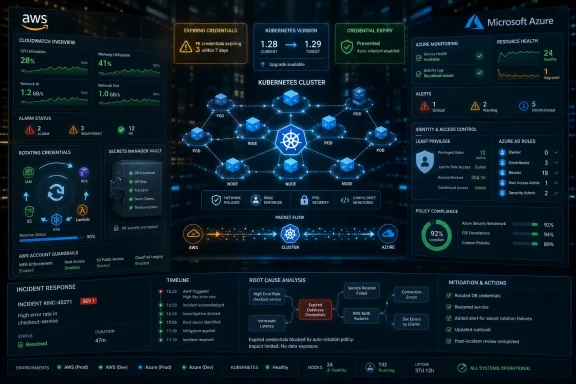 The Cloud Did Not Eliminate Operations; It Multiplied Them
The public cloud changed who owns the hardware, but it did not remove the need for operational discipline. AWS and Azure take responsibility for enormous layers of physical infrastructure, regional networking, managed control planes, and service durability. Customers, meanwhile, inherit a different burden: configuring identities, securing application paths, monitoring behavior, updating runtime platforms, and proving that their own workloads can survive failure.That division is where many cloud misunderstandings begin. A company can move from a private data center into managed cloud services and still carry forward the habits that caused outages on-premises. The names change from racks and storage arrays to IAM roles, node pools, managed identities, and observability pipelines, but the risk remains familiar: systems fail when nobody owns the boring details.
Sanugommula’s experience, as described in the submitted profile, sits squarely in that gap. Her work spans monitoring infrastructure, managing access controls, using AWS Secrets Manager, supporting Azure Kubernetes Service clusters, investigating network failures, and coordinating incident response. None of those tasks make for the sort of keynote demo that sells cloud transformation. They are the tasks that determine whether the keynote demo survives contact with production.
The deeper point is that multi-cloud reliability is not a procurement strategy. Running workloads across AWS and Azure can reduce dependency on a single vendor in some scenarios, but it also expands the operational surface area. Each platform has its own identity model, logging conventions, networking abstractions, quota systems, maintenance windows, and support boundaries. Availability becomes less about choosing the “best” cloud and more about maintaining enough institutional muscle to operate both.
Monitoring Is the First Admission That Failure Is Normal
Monitoring is often treated as a technical add-on, something teams wire up after the application is deployed. In mature cloud environments, it is closer to an operating philosophy. If a team cannot see what is happening across compute, containers, networks, identities, and storage, it is not running a cloud platform so much as supervising a rumor.The profile highlights Sanugommula’s use of AWS CloudWatch to enable real-time alerts for unusual activity and infrastructure problems. That is not a minor implementation detail. Alerting is the mechanism by which infrastructure turns from a passive asset into an active participant in operations, forcing anomalies into the attention of people who can act before users notice.
Good monitoring is not just a flood of metrics. It requires deciding which signals actually matter, tuning alerts so engineers do not ignore them, and correlating low-level events with customer-facing symptoms. CPU saturation, pod restarts, failed secret retrieval, throttled API calls, and expired credentials can all appear as separate signals while sharing a single operational story.
In Kubernetes environments, this gets harder because the unit of failure is more fluid. Containers start and stop by design. Nodes can be replaced. Services can reschedule. A transient pod failure might be harmless, or it might be the first visible crack in a bad rollout, a broken identity binding, or an exhausted subnet. The value of monitoring lies not in collecting more data, but in making the right failure obvious quickly enough to act.
Secrets Are Where Convenience Becomes Liability
Few cloud security failures are as avoidable, or as persistent, as mishandled credentials. Hardcoded passwords, embedded API keys, stale tokens, over-permissive service accounts, and forgotten certificates remain common because they are convenient in the moment. The bill comes later, when a repository leaks, a container image is copied, a developer leaves, or an attacker finds a credential that should never have existed in plain sight.Sanugommula’s implementation of AWS Secrets Manager, as described in the source material, illustrates the basic discipline cloud teams are expected to adopt: sensitive credentials should be stored in a managed secrets service, retrieved at runtime, rotated safely, and removed from application code. That is not advanced security theater. It is table stakes for production systems that handle customer data, business logic, or privileged infrastructure access.
The operational payoff is just as important as the security benefit. When credentials are embedded in code, rotation becomes a deployment event, and deployment events create risk. When secrets are centrally managed, rotation can become a controlled process with auditing, access boundaries, and fewer application changes. The organization gains the ability to respond when credentials age out, vendors change, or incident response demands rapid revocation.
But secrets management is not magic. A secrets vault with poor access policies becomes a more polished version of the same problem. Workloads need narrowly scoped access. Engineers need only the permissions their roles require. Rotation needs to be tested. Applications need to handle refreshed credentials gracefully. The tool matters, but the process around the tool determines whether it actually reduces risk.
Least Privilege Is Still the Cloud’s Hardest Simple Rule
The principle of least privilege is easy to describe and hard to maintain. Users and workloads should receive only the access they need, for only as long as they need it. In practice, permissions accumulate like sediment. Emergency access becomes permanent access. Temporary roles survive long after the project ends. Broad administrator rights get copied from one environment to another because nobody wants to be the person who breaks production by tightening them.The profile’s emphasis on identity and access management is therefore more than a security checkbox. In cloud environments, identity is the control plane. It determines who can deploy, who can read data, who can alter networking, who can retrieve secrets, who can scale systems, and who can destroy them. Misconfigured identity is not an edge case; it is one of the central ways cloud environments fail.
AWS and Azure make this both better and worse. They provide mature identity systems, managed roles, policy engines, audit trails, and integrations with enterprise directories. They also expose thousands of permissions across services, many of which interact in ways that are difficult to reason about without experience. A team can be using modern cloud-native services and still grant dangerously broad access because the permission model is too complex for casual administration.
This is where disciplined engineers make a measurable difference. Least privilege is not a one-time design decision; it is a maintenance habit. It requires reviewing access, removing unused permissions, separating human and workload identities, and treating identity changes as production changes. In a multi-cloud environment, it also requires translating security intent across different provider models without pretending they are identical.
Kubernetes Turns Routine Maintenance Into a Reliability Requirement
Kubernetes is often sold as a portability layer, and to a degree it is. It gives teams a common model for deploying containerized applications across clouds and data centers. But the platform’s portability can obscure the fact that Kubernetes itself has a lifecycle, and that lifecycle has to be managed with the same seriousness as the applications running on top of it.The source material describes outages tied to unsupported Kubernetes versions and expired identity credentials in AKS environments. That detail should make every platform team sit up. A cluster that keeps running after its support window narrows is not necessarily healthy; it may simply be drifting toward a state where security patches, bug fixes, and component compatibility become harder to rely on.
AKS, like other managed Kubernetes services, reduces the burden of operating the control plane, but it does not eliminate the customer’s responsibility to plan upgrades, test workloads, manage node pools, and understand version support. The managed service gives teams a safer path, not an excuse to ignore the calendar. Kubernetes versions move, container runtimes evolve, APIs deprecate, and add-ons change behavior.
Identity lifecycle is just as important. Managed identities, certificates, service principals, workload identities, and federated credentials are supposed to reduce secret sprawl, but they still have expiration dates, binding rules, permissions, and dependencies. When those identities fail, the symptom may look like an application outage rather than a security configuration issue. A pod that cannot pull an image, mount a secret, call an API, or authenticate to a backing service is still a failed service from the customer’s perspective.
The Network Is Where Abstractions Go to Be Tested
Cloud networking has become more abstract, but not simpler. Virtual networks, private endpoints, load balancers, ingress controllers, network policies, container network interfaces, DNS zones, and service meshes all exist to make distributed systems reachable and controllable. They also create a dense failure surface where a small misconfiguration can mimic an application defect.The profile describes Sanugommula recreating customer environments, capturing network traces, and working with networking teams to analyze packet-level behavior. That is a useful corrective to the idea that cloud troubleshooting is mostly dashboard work. Sometimes the only way to understand a failure is to follow the packets and prove where they stop.
In Kubernetes, networking failures can be especially deceptive. A service may exist, DNS may resolve, pods may be healthy, and yet traffic can still fail because of network policy, conntrack pressure, SNAT exhaustion, misconfigured ingress, broken certificate chains, or cloud-side routing behavior. The farther a team gets from the underlying network, the more important it becomes to know when to drop below the abstraction.
This is one reason experienced DevOps and platform engineers remain valuable even in heavily managed environments. Managed services reduce the amount of infrastructure a customer must directly operate, but they do not remove the need to interpret failure across layers. When availability is at stake, someone still has to connect application symptoms to container behavior, cloud metrics, identity logs, and network traces.
Incident Response Is a Communications Discipline as Much as a Technical One
High-severity incidents are rarely solved by one person typing the perfect command. They are coordinated events involving platform teams, application owners, security staff, support engineers, customer representatives, and sometimes cloud provider escalation paths. The technical fix matters, but so does the ability to keep everyone aligned while uncertainty is still high.The submitted profile notes that Sanugommula coordinates with multiple technical teams, keeps customers informed during incidents, and prepares root cause analyses after systems are restored. That sequence reflects a mature operational pattern. Restore service first, preserve enough evidence to understand what happened, then turn the incident into a durable improvement rather than an isolated war story.
Root cause analysis can be badly misunderstood. The point is not to find one person to blame or one setting to shame. In complex systems, incidents usually involve a chain: a missed upgrade, a noisy alert, a permission gap, a delayed rotation, a hidden dependency, a test environment that did not match production, or a runbook that assumed a credential still worked. The useful question is not “Who broke it?” but “Why did our system allow this to become customer-visible?”
Customer communication is part of that system. During an outage, silence creates its own damage. A technically incomplete but honest update is often better than waiting for perfect certainty. For enterprise customers, knowing that engineers are engaged, impact is being assessed, and mitigations are underway can determine whether an incident is perceived as controlled or chaotic.
Multi-Cloud Raises the Bar for Boring Excellence
AWS and Azure are often discussed as rivals, but many enterprise environments use both. Sometimes that is the result of mergers, regional requirements, developer preference, vendor relationships, or specific service strengths. Sometimes it is a deliberate resilience strategy. Either way, operating across both clouds means teams must avoid the comforting fiction that a control in one platform automatically maps cleanly to a control in the other.Monitoring is a good example. AWS CloudWatch and Azure Monitor both collect operational data, but their data models, integrations, alerting behaviors, and cost structures differ. A team that wants consistent observability across both platforms has to design for that consistency rather than assume it appears by default.
Identity is even more consequential. AWS IAM and Microsoft Entra-centered Azure identity models reflect different histories and architectural assumptions. The high-level goals may be the same — authenticate users and workloads, authorize access, audit behavior, limit privilege — but the implementation details differ sharply. Multi-cloud security depends on understanding those differences instead of smoothing them over in a policy document.
Kubernetes can provide a common operational surface, but even Kubernetes is not identical across clouds. AKS, EKS, Azure Red Hat OpenShift, and self-managed clusters each come with different defaults, integrations, support models, networking options, and upgrade paths. A container image may be portable; the production environment around it rarely is.
The Quiet Work Is Becoming the Strategic Work
Cloud operations used to be described as back-office plumbing. That framing no longer holds. For businesses whose revenue, customer trust, compliance posture, and internal workflows depend on digital systems, infrastructure reliability is a board-level concern even when the board does not know the names of the services involved.The work described in the profile — alerting, secrets management, access control, AKS support, container registry and container instance work, OpenShift exposure, migration support, packet analysis, and root cause documentation — is the kind of practical engineering that turns cloud adoption from an architectural diagram into a functioning production environment. It is not glamorous, but it is strategic because failure is expensive.
There is also a talent implication. The industry has spent years telling organizations to hire cloud architects, DevOps engineers, site reliability engineers, platform engineers, and security engineers, sometimes as if those were interchangeable labels. They are not. The strongest practitioners tend to be those who can move between systems thinking and implementation detail: understand the customer impact, read the logs, reason about identity, inspect the network, and still communicate clearly under pressure.
Sanugommula’s research writing on AKS CRUD-related issues, as summarized in the source material, points to another underappreciated responsibility: documenting the failure modes. Cloud knowledge that lives only in incident calls and individual memory is fragile. Teams become more reliable when they turn repeated troubleshooting into shared playbooks, known patterns, escalation guides, and preventive checks.
Automation Helps, but It Cannot Replace Judgment
The obvious response to cloud complexity is automation, and the instinct is correct. Manual configuration does not scale well across accounts, subscriptions, clusters, regions, and teams. Infrastructure as code, policy as code, automated patching, deployment pipelines, secret rotation workflows, and alert-driven remediation can all reduce human error.But automation can also accelerate mistakes. A bad permission template can overexpose every environment. A flawed rollout script can break every cluster faster than a human operator could. An automated scaling rule can hide a capacity problem until cost or quota becomes the next incident. The question is not whether to automate, but whether the automation is observable, reversible, tested, and governed.
This is where cloud operations begins to resemble aviation more than software tinkering. Checklists matter. Change windows matter. Version compatibility matters. Credential expiry matters. Telemetry matters. Post-incident reviews matter. The goal is not to eliminate human involvement, but to reserve human judgment for the places where it adds value.
The best platform teams use automation to enforce the boring rules: no hardcoded secrets, no public storage by accident, no unsupported cluster versions, no permanent elevated access without review, no production change without traceability. That kind of automation does not make engineers less important. It makes their judgment more scalable.
Security and Availability Are Now the Same Conversation
Security and availability used to be treated as separate disciplines. Security teams worried about attackers, access, vulnerabilities, and compliance. Operations teams worried about uptime, latency, capacity, and incident response. Cloud platforms have collapsed much of that distinction.An expired credential is both a security artifact and an availability risk. A stale Kubernetes version is both a patching concern and a supportability concern. A permissive IAM role is both a breach path and a misconfiguration risk. Poor monitoring is both an operational weakness and a detection failure. A broken secrets rotation process can become either an outage or an exposure depending on how it fails.
That convergence is one of the most important lessons from the kind of work described here. Secure systems are more available because they are better controlled. Available systems are more secure because they are better understood. The same practices — observability, least privilege, lifecycle management, disciplined change control, and post-incident learning — serve both goals.
For WindowsForum’s audience of administrators and IT pros, this should feel familiar rather than exotic. The cloud has new nouns, but the old truths remain. Inventory matters. Patch levels matter. Credentials matter. Logs matter. Backups matter. Communication matters. What has changed is the speed and scale at which neglect becomes visible.
The Sanugommula Case Study Shows the Shape of Modern Operations
The submitted article frames Harika Sanugommula as a DevOps engineer working across large cloud environments and Kubernetes systems, with responsibilities that include monitoring, access controls, production troubleshooting, AKS lifecycle work, and customer-facing incident coordination. Read narrowly, it is a professional profile. Read more broadly, it is a snapshot of where cloud operations has landed in 2026.The job is no longer confined to one provider’s console or one narrow operational domain. An engineer may need to understand AWS alerting in the morning, Azure managed identity behavior after lunch, Kubernetes node scaling before dinner, and packet traces during an overnight incident. That breadth is not accidental; it is the shape of production.
There is a risk in turning individual engineers into symbols for industry trends, because reliability is ultimately a team property. No single practitioner can compensate forever for weak governance, poor architecture, underfunded operations, or executive impatience. But individual expertise still matters, especially in the messy middle where an incident has not yet resolved into a clean root cause.
That messy middle is where many organizations discover whether their cloud maturity is real. Dashboards are easy to admire when everything is green. The meaningful test comes when a cluster version is unsupported, an identity expires, traffic drops inside a container network, or a secret rotation breaks an application path. Mature operations are visible in the speed of diagnosis, the clarity of communication, and the quality of the fix that follows.
The Real Cloud Skill Is Keeping the System Boring
The most concrete lesson from this profile is that reliable cloud operations are built from repeatable habits rather than heroic rescues. The goal is not to make AWS, Azure, or Kubernetes exciting. The goal is to make production boring enough that customers do not have to think about the infrastructure at all.- Organizations should treat monitoring as a production dependency, not as a post-deployment enhancement.
- Secrets should live in managed secrets platforms with controlled access and tested rotation paths, not in source code, container images, or scattered configuration files.
- Least-privilege access should be reviewed continuously because cloud permissions expand quietly when teams are under pressure.
- Kubernetes clusters need active lifecycle management, including version upgrades, node maintenance, identity rotation, and compatibility testing.
- Incident response should produce durable learning through root cause analysis, customer communication, and preventive engineering work.
- Multi-cloud operations require deliberate translation between AWS and Azure models rather than assuming that similar services behave the same way.
References
- Primary source: Analytics Insight
Published: 2026-06-24T07:30:19.262377
What It Takes to Maintain Security and Availability Across AWS and Azure
Discover how AWS and Azure experts use AWS CloudWatch, Azure Kubernetes Service, and Azure Red Hat OpenShift to strengthen cloud security, reliability, and availability.www.analyticsinsight.net - Related coverage: aws.amazon.com
Using AWS Secrets Manager Agent with Amazon EKS | AWS Security Blog
AWS Secrets Manager is a service that you can use to manage, retrieve, and rotate database credentials, application credentials, API keys, and other secrets throughout their lifecycles. You can also use Secrets Manager to replace hard-coded credentials in application source code with runtime...aws.amazon.com - Official source: learn.microsoft.com
Kubernetes Workload Identity and Access - Azure Architecture Center | Microsoft Learn
Understand how Kubernetes pods handle identity and access, and compare options in Amazon EKS and Azure Kubernetes Service (AKS).learn.microsoft.com
