

Cloudflare will start blocking “mixed-use” AI crawlers from ad-supported pages by default on September 15, 2026, pushing search engines, AI agents, and model-training systems to identify their purposes separately before they touch publisher content. The immediate fight is about bots and ads, but the larger argument is about whether the open web can survive when discovery, extraction, and monetization are no longer the same transaction. Cloudflare is not merely adding another dashboard toggle; it is trying to turn the crawler economy into a permission economy. For publishers, sysadmins, and anyone who runs a site behind a CDN, this is the moment when AI traffic stops being background noise and becomes infrastructure policy.
For most of the web’s history, crawling was treated as a rough bargain. A search engine indexed a page, the publisher received traffic, and the crawler got a limited license of sorts through custom, convention, and robots.txt. It was never a clean legal settlement, but it worked well enough because the economic loop was visible: Google took a copy, Google sent readers back, and publishers optimized their lives around that exchange.
Generative AI broke the emotional logic of that bargain before it broke the technical one. A model trainer can read a page without sending a reader. An AI answer engine can summarize a page without producing a click. An agent can visit thousands of pages on behalf of one user and leave behind no obvious human audience at all.
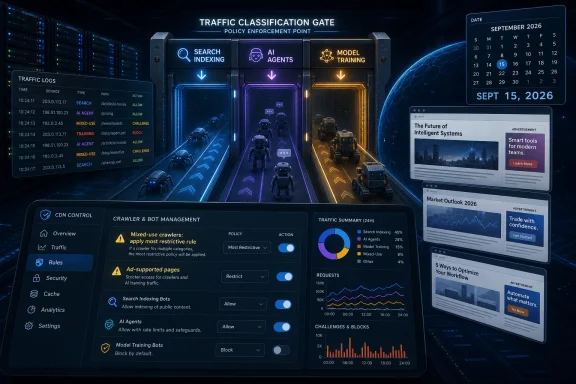
Cloudflare’s September 15 deadline is aimed directly at that ambiguity. The company wants crawlers to declare whether they are crawling for traditional search, AI agent activity, or model training. If a bot combines those purposes, Cloudflare says the most restrictive applicable rule should apply, especially on pages that show ads.
That last detail matters. Ad-supported pages are where the old web bargain is easiest to see and easiest to break. If a crawler consumes the page but the page never gets an impression from a human reader, the publisher has paid the bandwidth and production cost while the AI system captures the downstream value.
A publisher might reasonably want to appear in ordinary search results. The same publisher might also reasonably refuse to have its archive used to train a future model. Another might allow real-time AI search summaries but reject bulk ingestion for training. Those are distinct business decisions, yet mixed-use crawling collapses them into one yes-or-no gate.
This is why Cloudflare’s policy is more aggressive than a conventional anti-scraping tool. It is not only blocking unwanted bots; it is defining acceptable crawler behavior. Search, agent use, and training become separate categories that site owners can treat differently.
The technical demand is simple in theory: run separate crawlers, label them clearly, and let websites choose. The political demand is sharper: stop using search dependency as leverage to obtain AI permissions that publishers would not grant if the choices were cleanly separated.
Google’s defense is that publishers already have some control. Google-Extended, for example, lets site owners opt out of certain uses involving future Gemini model training and some Gemini or Vertex AI functions without being removed from ordinary Google Search. That is a real control, and it is more than many AI companies offered in the first wave of the scraping fight.
But Cloudflare’s critique lands because Google’s AI Overviews and AI Mode are part of Google Search itself. If a publisher wants to block the main Googlebot, it risks damaging visibility in conventional search. The practical choice is therefore not as clean as the product documentation makes it sound.
This is the central tension of the AI search era: the same crawler identity can support a blue-link index, a generated answer, a shopping assistant, and a model ecosystem. Platform companies see integration. Publishers see coercion by architecture.
That reverses a basic assumption behind website operations. Traditionally, bot traffic was a cost of doing business, tolerated because the most important bots helped humans find pages. Now automated systems may be the primary consumers of pages, and the human reader may arrive only indirectly, if at all.
For site operators, that changes the security model. A bot is no longer merely a nuisance to rate-limit or a crawler to accommodate for SEO. It may be a commercial counterparty, a potential abuser, an agent acting for a user, a model-training pipeline, or an unclassified system pretending to be something else.
For IT teams, the distinction matters because enforcement happens at the boring layers: user-agent strings, verified bot lists, WAF rules, robots.txt, CDN settings, cache behavior, and log analysis. The AI policy debate may sound like publishing politics, but the implementation burden will land on infrastructure teams.
The company’s newer “Pay Per Use” direction goes further. Instead of charging whenever a crawler downloads a page, Cloudflare wants to explore compensation when content produces value inside an AI product. If a publisher’s article appears in an AI search result or supplies premium information to an agent, payment would be tied to that use rather than to the raw HTTP request.
That is closer to how publishers think about harm and value. A crawler request that never surfaces in an answer may be less consequential than a paragraph that becomes the backbone of a generated response. But it is also harder to audit. Counting crawls is an infrastructure problem; counting value is an attribution problem.
The early tests with Ceramic.ai and You.com suggest Cloudflare is trying to build a market before the courts or regulators impose one. That could appeal to publishers tired of waiting for licensing negotiations with the largest AI labs. It could also worry smaller AI developers who see a future where access to the public web is mediated by a handful of CDN, search, and platform companies.
That distinction is especially important for niche publications, forums, and specialist communities. A site like WindowsForum.com is valuable precisely because it contains lived technical experience: upgrade failures, driver fixes, sysadmin workarounds, obscure event-log patterns, and practical troubleshooting language that rarely appears in polished vendor documentation. That content is extremely useful to AI systems because it reflects the messy reality of Windows in the field.
But community-generated knowledge has a fragile incentive structure. If answers are extracted and repackaged without visits, attribution, or reciprocal value, the forum loses the audience loop that keeps new posts coming. The AI answer may be good for the user in the moment while slowly starving the source of future expertise.
Cloudflare’s model gives those communities a vocabulary for saying yes to discovery and no to uncompensated extraction. Whether the market respects that vocabulary is another matter.
That sounds straightforward until you imagine the average organization’s web estate. Marketing owns the main site. Product owns docs. Support owns a knowledge base. Engineering owns developer pages. A long-retired agency owns a forgotten microsite still sitting behind Cloudflare on a free plan. Nobody has a single authoritative map of crawler policy.
This is how “default” becomes destiny. A security-minded admin may welcome stricter blocking, while an SEO team may panic when AI visibility drops. A developer relations team may want documentation reachable by AI coding assistants, while legal may want training blocked. A publisher may want search allowed, agents negotiated, and training denied.
The right answer will vary by page type. A public press release, a paid research report, a troubleshooting forum, and a product documentation page do not have the same commercial logic. Cloudflare’s move gives administrators more levers, but it also makes crawler governance a real operational discipline.
AI crawling exposed the weakness of that model. Some bots obey robots.txt, some interpret it narrowly, some change user agents, some use third-party fetchers, and some retrieve pages through user-triggered tools that blur the boundary between browsing and scraping. Meanwhile, publishers are trying to express more nuanced preferences than “allow” or “disallow.”
Cloudflare’s Content Signals approach tries to add that missing nuance by describing intended uses such as search, AI training, and reference or input use. The September policy puts teeth behind those distinctions by tying them to default blocking behavior on ad-supported pages.
The challenge is that standards only become standards when powerful actors accept them. If major AI companies and search platforms separate their crawlers cleanly, Cloudflare’s framework could become part of the web’s new operating manual. If they resist, the result may be a messy escalation of blocking, spoofing, exceptions, and platform-specific deals.
A human shopping for a laptop might read five reviews and three spec sheets. An agent optimizing that purchase could visit hundreds or thousands of pages, compare prices, check stock, parse return policies, validate coupon codes, and repeat the process as conditions change. Multiply that behavior across travel, insurance, finance, procurement, compliance, and software selection, and the web becomes a substrate for machine labor.
Cloudflare says a large share of legitimate bot traffic involves repeatedly downloading pages that have not changed. That is wasteful for publishers and inefficient for AI companies. If the CDN can help crawlers determine whether a page changed before fetching it again, everyone saves bandwidth and compute.
This is the less glamorous but more durable part of the story. The agentic web will not work if every agent behaves like an overeager intern hammering refresh. It needs cache awareness, change detection, identity, rate discipline, and commercial rules. In other words, it needs protocols and incentives, not just smarter models.
If more publishers restrict agent and training access, AI answers may become more uneven. Some sources will be visible to one assistant but not another. Some content will be available for search snippets but not for generated answers. Some premium material may appear only when a provider has a commercial arrangement.
That fragmentation matters for enterprise IT. A helpdesk agent using an AI tool to diagnose a Windows 11 deployment problem may get different results depending on which sources the tool can access. A developer using an AI coding assistant may find that vendor docs are available but community troubleshooting threads are not. A security analyst may need to know whether an automated research tool is browsing as a user, crawling as an agent, or retrieving from a licensed corpus.
Microsoft and other platform vendors will have to decide how transparent they want to be about those boundaries. The more AI becomes part of the operating system experience, the less acceptable it will be for source availability to remain a black box.
The danger is that this middle path could become another layer of concentration. Cloudflare has enormous visibility into web traffic. Google has enormous leverage over discovery. Microsoft, OpenAI, Anthropic, Meta, Perplexity, and others have enormous demand for content. If crawler compensation becomes a negotiated market, small publishers may still have little bargaining power unless intermediaries aggregate them effectively.
There is also a measurement problem. Pay Per Use sounds fair, but “use” is slippery. Did a model rely on a page if it influenced a generated answer but was not cited? Did a forum thread provide value if it shaped a troubleshooting recommendation months after ingestion? Should payment depend on display, retrieval, training contribution, or user action?
These are not edge cases. They are the product. AI systems blur the line between reading, remembering, summarizing, and acting. Any payment system that pretends those categories are simple will invite disputes.
That means Cloudflare is not just reflecting publisher preference; it is shaping it. By blocking Training and Agent crawlers from ad-supported pages by default, and by applying the most restrictive rule to mixed-use crawlers, Cloudflare is making a normative claim: AI companies should not get broad access unless they classify themselves clearly.
Critics will argue that this gives Cloudflare too much control over the public web. They have a point. A CDN should not casually become the licensing desk for internet knowledge. But the counterargument is equally strong: if crawler platforms refuse to provide meaningful separation, the network layer is where site owners will enforce the separation themselves.
This is the pattern of internet governance in miniature. When application-layer norms fail, infrastructure providers become regulators by accident, then by product strategy.
For WindowsForum readers, the practical lesson is that crawler policy now belongs in the same conversation as SEO, security, privacy, and performance. It is no longer a niche publishing issue. If your organization runs public documentation, a support forum, a blog, a knowledge base, or any customer-facing technical content, AI access should be reviewed deliberately.
 Cloudflare Turns the Crawler Into a Contract
For most of the web’s history, crawling was treated as a rough bargain. A search engine indexed a page, the publisher received traffic, and the crawler got a limited license of sorts through custom, convention, and robots.txt. It was never a clean legal settlement, but it worked well enough because the economic loop was visible: Google took a copy, Google sent readers back, and publishers optimized their lives around that exchange.Generative AI broke the emotional logic of that bargain before it broke the technical one. A model trainer can read a page without sending a reader. An AI answer engine can summarize a page without producing a click. An agent can visit thousands of pages on behalf of one user and leave behind no obvious human audience at all.
Cloudflare’s September 15 deadline is aimed directly at that ambiguity. The company wants crawlers to declare whether they are crawling for traditional search, AI agent activity, or model training. If a bot combines those purposes, Cloudflare says the most restrictive applicable rule should apply, especially on pages that show ads.
That last detail matters. Ad-supported pages are where the old web bargain is easiest to see and easiest to break. If a crawler consumes the page but the page never gets an impression from a human reader, the publisher has paid the bandwidth and production cost while the AI system captures the downstream value.
The Mixed-Use Bot Was Always the Loophole
Cloudflare’s target is not just “AI crawlers” in the generic sense. It is the mixed-use crawler: the bot that performs search indexing, model training, and AI answer support under a single identity or a tightly coupled system. That architecture may be convenient for platform companies, but it is poison for consent.A publisher might reasonably want to appear in ordinary search results. The same publisher might also reasonably refuse to have its archive used to train a future model. Another might allow real-time AI search summaries but reject bulk ingestion for training. Those are distinct business decisions, yet mixed-use crawling collapses them into one yes-or-no gate.
This is why Cloudflare’s policy is more aggressive than a conventional anti-scraping tool. It is not only blocking unwanted bots; it is defining acceptable crawler behavior. Search, agent use, and training become separate categories that site owners can treat differently.
The technical demand is simple in theory: run separate crawlers, label them clearly, and let websites choose. The political demand is sharper: stop using search dependency as leverage to obtain AI permissions that publishers would not grant if the choices were cleanly separated.
Google Is the Unnamed Giant in the Room
Cloudflare’s announcement refers to the “world’s largest search engine” without needing to say the name. Everyone in the room understands the dispute. Google has spent two decades as the default gateway to the web, and that position gives it an advantage as search becomes AI-mediated.Google’s defense is that publishers already have some control. Google-Extended, for example, lets site owners opt out of certain uses involving future Gemini model training and some Gemini or Vertex AI functions without being removed from ordinary Google Search. That is a real control, and it is more than many AI companies offered in the first wave of the scraping fight.
But Cloudflare’s critique lands because Google’s AI Overviews and AI Mode are part of Google Search itself. If a publisher wants to block the main Googlebot, it risks damaging visibility in conventional search. The practical choice is therefore not as clean as the product documentation makes it sound.
This is the central tension of the AI search era: the same crawler identity can support a blue-link index, a generated answer, a shopping assistant, and a model ecosystem. Platform companies see integration. Publishers see coercion by architecture.
The Bot Majority Changes the Politics of the Web
The timing of Cloudflare’s move is not accidental. Cloudflare CEO Matthew Prince recently said bots had passed human traffic online earlier than he expected, with agentic activity accelerating the shift. Even if the exact percentage moves day to day, the direction is unmistakable: the web is becoming a machine-read environment first and a human-browsed environment second.That reverses a basic assumption behind website operations. Traditionally, bot traffic was a cost of doing business, tolerated because the most important bots helped humans find pages. Now automated systems may be the primary consumers of pages, and the human reader may arrive only indirectly, if at all.
For site operators, that changes the security model. A bot is no longer merely a nuisance to rate-limit or a crawler to accommodate for SEO. It may be a commercial counterparty, a potential abuser, an agent acting for a user, a model-training pipeline, or an unclassified system pretending to be something else.
For IT teams, the distinction matters because enforcement happens at the boring layers: user-agent strings, verified bot lists, WAF rules, robots.txt, CDN settings, cache behavior, and log analysis. The AI policy debate may sound like publishing politics, but the implementation burden will land on infrastructure teams.
Pay Per Crawl Was the Warning Shot
Cloudflare has already been pushing a “Pay Per Crawl” model, letting site owners charge companies for scraping pages. That idea was both obvious and radical. Obvious, because if AI companies extract value from publisher content, publishers will want compensation. Radical, because the web has not historically metered reading at the crawler level.The company’s newer “Pay Per Use” direction goes further. Instead of charging whenever a crawler downloads a page, Cloudflare wants to explore compensation when content produces value inside an AI product. If a publisher’s article appears in an AI search result or supplies premium information to an agent, payment would be tied to that use rather than to the raw HTTP request.
That is closer to how publishers think about harm and value. A crawler request that never surfaces in an answer may be less consequential than a paragraph that becomes the backbone of a generated response. But it is also harder to audit. Counting crawls is an infrastructure problem; counting value is an attribution problem.
The early tests with Ceramic.ai and You.com suggest Cloudflare is trying to build a market before the courts or regulators impose one. That could appeal to publishers tired of waiting for licensing negotiations with the largest AI labs. It could also worry smaller AI developers who see a future where access to the public web is mediated by a handful of CDN, search, and platform companies.
Publishers Want Discovery Without Surrender
The publisher position is often caricatured as anti-AI, but that misses the real demand. Most publishers do want to be found in AI products. They want their work cited, surfaced, recommended, and included in the next layer of discovery. What they do not want is to be silently converted into training fuel while their audience and ad revenue are intercepted upstream.That distinction is especially important for niche publications, forums, and specialist communities. A site like WindowsForum.com is valuable precisely because it contains lived technical experience: upgrade failures, driver fixes, sysadmin workarounds, obscure event-log patterns, and practical troubleshooting language that rarely appears in polished vendor documentation. That content is extremely useful to AI systems because it reflects the messy reality of Windows in the field.
But community-generated knowledge has a fragile incentive structure. If answers are extracted and repackaged without visits, attribution, or reciprocal value, the forum loses the audience loop that keeps new posts coming. The AI answer may be good for the user in the moment while slowly starving the source of future expertise.
Cloudflare’s model gives those communities a vocabulary for saying yes to discovery and no to uncompensated extraction. Whether the market respects that vocabulary is another matter.
The Sysadmin Problem Hiding Behind the Publisher Fight
The default-setting change will not affect every Cloudflare customer in the same way. According to the reported policy, the new defaults apply to new Cloudflare customers, new domains created by existing customers, and existing free-tier customers who have not changed their settings before September 15. Website owners can still adjust controls in the Cloudflare dashboard.That sounds straightforward until you imagine the average organization’s web estate. Marketing owns the main site. Product owns docs. Support owns a knowledge base. Engineering owns developer pages. A long-retired agency owns a forgotten microsite still sitting behind Cloudflare on a free plan. Nobody has a single authoritative map of crawler policy.
This is how “default” becomes destiny. A security-minded admin may welcome stricter blocking, while an SEO team may panic when AI visibility drops. A developer relations team may want documentation reachable by AI coding assistants, while legal may want training blocked. A publisher may want search allowed, agents negotiated, and training denied.
The right answer will vary by page type. A public press release, a paid research report, a troubleshooting forum, and a product documentation page do not have the same commercial logic. Cloudflare’s move gives administrators more levers, but it also makes crawler governance a real operational discipline.
The Old Robots.txt Era Is Not Enough
Robots.txt worked because the early web depended on voluntary compliance among a relatively small number of major crawlers. It was a polite sign on an unlocked gate. Serious search engines obeyed it because the long-term legitimacy of search depended on respecting publisher preferences.AI crawling exposed the weakness of that model. Some bots obey robots.txt, some interpret it narrowly, some change user agents, some use third-party fetchers, and some retrieve pages through user-triggered tools that blur the boundary between browsing and scraping. Meanwhile, publishers are trying to express more nuanced preferences than “allow” or “disallow.”
Cloudflare’s Content Signals approach tries to add that missing nuance by describing intended uses such as search, AI training, and reference or input use. The September policy puts teeth behind those distinctions by tying them to default blocking behavior on ad-supported pages.
The challenge is that standards only become standards when powerful actors accept them. If major AI companies and search platforms separate their crawlers cleanly, Cloudflare’s framework could become part of the web’s new operating manual. If they resist, the result may be a messy escalation of blocking, spoofing, exceptions, and platform-specific deals.
AI Agents Make the Bandwidth Math Ugly
Training gets most of the attention because it feels like the big copyright fight, but agentic traffic may be the more immediate infrastructure problem. A model-training crawl can be massive, but it is at least conceptually batch-like. Agents, by contrast, can create continuous demand.A human shopping for a laptop might read five reviews and three spec sheets. An agent optimizing that purchase could visit hundreds or thousands of pages, compare prices, check stock, parse return policies, validate coupon codes, and repeat the process as conditions change. Multiply that behavior across travel, insurance, finance, procurement, compliance, and software selection, and the web becomes a substrate for machine labor.
Cloudflare says a large share of legitimate bot traffic involves repeatedly downloading pages that have not changed. That is wasteful for publishers and inefficient for AI companies. If the CDN can help crawlers determine whether a page changed before fetching it again, everyone saves bandwidth and compute.
This is the less glamorous but more durable part of the story. The agentic web will not work if every agent behaves like an overeager intern hammering refresh. It needs cache awareness, change detection, identity, rate discipline, and commercial rules. In other words, it needs protocols and incentives, not just smarter models.
Microsoft’s Ecosystem Will Feel the Ripple
This story is not primarily about Windows, but Windows users and administrators will feel its consequences because Microsoft’s ecosystem sits at the center of AI-assisted work. Copilot, Bing, Edge, Microsoft 365, GitHub, Azure, and Windows itself increasingly assume that users will ask agents to retrieve, summarize, compare, and act on web information.If more publishers restrict agent and training access, AI answers may become more uneven. Some sources will be visible to one assistant but not another. Some content will be available for search snippets but not for generated answers. Some premium material may appear only when a provider has a commercial arrangement.
That fragmentation matters for enterprise IT. A helpdesk agent using an AI tool to diagnose a Windows 11 deployment problem may get different results depending on which sources the tool can access. A developer using an AI coding assistant may find that vendor docs are available but community troubleshooting threads are not. A security analyst may need to know whether an automated research tool is browsing as a user, crawling as an agent, or retrieving from a licensed corpus.
Microsoft and other platform vendors will have to decide how transparent they want to be about those boundaries. The more AI becomes part of the operating system experience, the less acceptable it will be for source availability to remain a black box.
The Payment Layer Could Rebuild the Web—or Centralize It Further
Cloudflare’s pitch is attractive because it promises a middle path between open scraping and total lockdown. Publishers stay visible. AI companies get legitimate access. Users receive better answers. Money flows to the creators and communities whose work makes the system useful.The danger is that this middle path could become another layer of concentration. Cloudflare has enormous visibility into web traffic. Google has enormous leverage over discovery. Microsoft, OpenAI, Anthropic, Meta, Perplexity, and others have enormous demand for content. If crawler compensation becomes a negotiated market, small publishers may still have little bargaining power unless intermediaries aggregate them effectively.
There is also a measurement problem. Pay Per Use sounds fair, but “use” is slippery. Did a model rely on a page if it influenced a generated answer but was not cited? Did a forum thread provide value if it shaped a troubleshooting recommendation months after ingestion? Should payment depend on display, retrieval, training contribution, or user action?
These are not edge cases. They are the product. AI systems blur the line between reading, remembering, summarizing, and acting. Any payment system that pretends those categories are simple will invite disputes.
The Web’s New Gate Is Being Built in Defaults
Cloudflare’s September 15 deadline is powerful because defaults are powerful. Most site owners do not tune every crawler setting. Most small publishers do not have bot-policy meetings. Most free-tier users accept what the platform ships unless something breaks.That means Cloudflare is not just reflecting publisher preference; it is shaping it. By blocking Training and Agent crawlers from ad-supported pages by default, and by applying the most restrictive rule to mixed-use crawlers, Cloudflare is making a normative claim: AI companies should not get broad access unless they classify themselves clearly.
Critics will argue that this gives Cloudflare too much control over the public web. They have a point. A CDN should not casually become the licensing desk for internet knowledge. But the counterargument is equally strong: if crawler platforms refuse to provide meaningful separation, the network layer is where site owners will enforce the separation themselves.
This is the pattern of internet governance in miniature. When application-layer norms fail, infrastructure providers become regulators by accident, then by product strategy.
The Practical Read Before September 15
Site owners should not wait until the deadline to discover what their pages are telling crawlers. Cloudflare’s changes are especially relevant to organizations that depend on ad revenue, subscriptions, organic search, community content, or AI discoverability. The wrong default could either give away too much or hide content from the next generation of search.For WindowsForum readers, the practical lesson is that crawler policy now belongs in the same conversation as SEO, security, privacy, and performance. It is no longer a niche publishing issue. If your organization runs public documentation, a support forum, a blog, a knowledge base, or any customer-facing technical content, AI access should be reviewed deliberately.
September’s Crawler Deadline Leaves IT With Homework
Cloudflare’s policy is still evolving, but the direction is clear enough for administrators and publishers to prepare. The most important work is not philosophical; it is inventory, ownership, and testing.- Organizations should identify which domains and subdomains are behind Cloudflare and determine whether they fall under the new default rules on September 15, 2026.
- Site owners should decide separately whether they want to allow search indexing, AI agent access, and model training rather than treating all bots as one category.
- Publishers that rely on advertising or subscriptions should test how crawler restrictions affect search visibility, AI visibility, referral traffic, and server load before making permanent changes.
- IT teams should review Cloudflare dashboard settings, robots.txt output, verified bot handling, WAF rules, and analytics filters together because any one layer can contradict another.
- Community sites and technical forums should treat user-generated troubleshooting content as a strategic asset, not as disposable text for unmetered machine consumption.
- AI vendors that want durable access to the web should separate crawler identities clearly, honor site-level signals, and prepare for compensation models that go beyond bulk scraping.
References
- Primary source: ProPakistani
Published: 2026-07-03T15:45:10.331511
AI Companies Could Soon Have to Pay Publishers for Using Their Content
Cloudflare will begin blocking web crawlers that combine traditional search, AI agent activity, and model training from ad-supported pages by defaultpropakistani.pk - Independent coverage: technology.org
Published: Fri, 03 Jul 2026 04:47:00 GMT
Cloudflare Sets Deadline for Mixed AI Crawlers - Technology Org
Cloudflare will block mixed-use AI crawlers on ad pages from September 15, 2026, and evolve Pay Per Crawl into Pay Per Use.www.technology.org
- Related coverage: techspot.com
Bots have officially overtaken humans on the internet | TechSpot
Prince said that while he had predicted bot traffic would surpass humans, he believed it would happen toward the end of 2027. Cloudflare Radar shows bots currently...www.techspot.com - Related coverage: techcrunch.com
Cloudflare's new policy pushes AI companies to pay for publishers' content | TechCrunch
Cloudflare is giving AI companies until September 15 to separate web crawlers used for search from those used for AI training and agents, or risk being blocked by default on many publisher sites.techcrunch.com - Related coverage: cloudflare.com
Cloudflare Allows the Agentic Internet to Flourish with a Simple Philosophy: Your Content, Your Rules | Cloudflare
Cloudflare Allows the Agentic Internet to Flourish with a Simple Philosophy: Your Content, Your Ruleswww.cloudflare.com
- Related coverage: simplee.digital
Simplee Digital - AI Marketing & Growth Systems
AI-native digital marketing agency building autonomous agents, paid media, and growth systems for ambitious brands in finance, e-commerce, and beyond simplee.digital
- Related coverage: techtimes.com
Bot Traffic Passes Humans Online: Cloudflare Says Agentic AI Drove 57.5% Share
For the first time since the web opened to the public, machines now generate most of the requests moving across it. Cloudflare co-founder and chief executive Matthew Prince said this week thatwww.techtimes.com - Related coverage: blog.cloudflare.com
Giving users choice with Cloudflare’s new Content Signals Policy
Cloudflare’s Content Signals Policy gives creators a new tool to control use of their content.blog.cloudflare.com - Related coverage: digitalmarketreports.com
Cloudflare to Block Mixed-Use AI Crawlers on Ad-Supported Pages
Cloudflare will begin blocking mixed-use web crawlers from ad-supported pages by default on September 15, 2026. The policy targets crawlers that combinedigitalmarketreports.com - Related coverage: newsbytesapp.com
Cloudflare will block mixed-use AI crawlers from ad-supported pages
Cloudflare’s updated policy will block mixed-use crawlers by default, urging AI companies to pay publishers for content access through tools like “Pay Per Use.”www.newsbytesapp.com
- Related coverage: omc.com
- Related coverage: cf-assets.www.cloudflare.com
FY25_Q3_GBL_All_Email_Send_CISO_Newsletter_01b_Email_2_Send_Oct_3_Cloudflare_Cyber_Briefing_Issue_2.html
PDF documentcf-assets.www.cloudflare.com
- Related coverage: chptnoticias.com
