

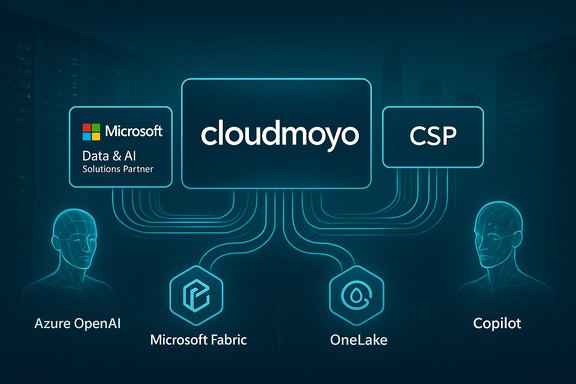
CloudMoyo’s twin announcements — achieving the Microsoft Solution Partner designation in Data & AI and launching a Microsoft Cloud Solution Provider (CSP) program — mark a deliberate step up the value chain for the Bellevue-based digital engineering firm, positioning it to sell Microsoft licensing directly while bundling those licenses with its data, AI, and migration accelerators. The company says these moves will speed customers’ adoption of Microsoft Fabric, Azure OpenAI, Power BI, and Copilot-driven workflows while simplifying procurement and support through a single partner engagement.
Microsoft’s partner landscape has been reshaped in recent years into the Microsoft AI Cloud Partner Program, with the new Solutions Partner designations replacing legacy Gold/Silver competencies and serving as the primary market signal of partner capability across focused commercial solution areas such as Data & AI (Azure). Attaining a Solutions Partner designation requires documented customer success, technical certifications, and demonstrable delivery capacity in the designated area — requirements Microsoft is increasingly tying to partner privileges like CSP direct-bill authorization. The Cloud Solution Provider (CSP) channel itself enables partners to provision, bill, and support Microsoft cloud products (Azure, Microsoft 365, Dynamics, and Copilot add-ons) directly to customers. Microsoft reopened applications for certain CSP models and tightened qualification rules in 2025, explicitly encouraging partners to hold a Solutions Partner designation to differentiate and, in some cases, to qualify for direct-bill CSP status. For customers, buying through a CSP means licenses and managed services can be bundled with partner expertise and consolidated billing.
Source: AiThority CloudMoyo Achieves Microsoft Solution Partner Designation in Data & AI and Launches New Microsoft CSP Program to Expand Customer Value
 Background / Overview
Microsoft’s partner landscape has been reshaped in recent years into the Microsoft AI Cloud Partner Program, with the new Solutions Partner designations replacing legacy Gold/Silver competencies and serving as the primary market signal of partner capability across focused commercial solution areas such as Data & AI (Azure). Attaining a Solutions Partner designation requires documented customer success, technical certifications, and demonstrable delivery capacity in the designated area — requirements Microsoft is increasingly tying to partner privileges like CSP direct-bill authorization. The Cloud Solution Provider (CSP) channel itself enables partners to provision, bill, and support Microsoft cloud products (Azure, Microsoft 365, Dynamics, and Copilot add-ons) directly to customers. Microsoft reopened applications for certain CSP models and tightened qualification rules in 2025, explicitly encouraging partners to hold a Solutions Partner designation to differentiate and, in some cases, to qualify for direct-bill CSP status. For customers, buying through a CSP means licenses and managed services can be bundled with partner expertise and consolidated billing. What CloudMoyo announced
- CloudMoyo has been recognized by Microsoft as a Solutions Partner for Data & AI, a designation the company says validates expertise in Azure analytics, AI engineering, responsible AI practices, and enterprise data modernization across tools such as Microsoft Fabric, Azure OpenAI, and Power BI.
- CloudMoyo has simultaneously launched a Microsoft CSP program to resell Azure, Microsoft 365, and Microsoft 365 Copilot licenses directly to customers and to bundle those subscriptions with CloudMoyo’s consulting, implementation, and managed services. The company highlights its own accelerators — CloudMoyo Fabric Accelerator (CFA), CloudMoyo IntelliDoc Analyze (CDA), and CloudMoyo Migration Assistant (CMA) — as examples of how licensing and services will be packaged on Azure.
Why the designation matters (technical and commercial implications)
What the Data & AI Solutions Partner badge signals
- Technical capability across a modern Microsoft data stack — earning Data & AI indicates proficiency with Azure analytics, Fabric, Power BI modernization, and ML/AI engineering practices, including responsible AI approaches. This matters for customers evaluating vendors for complex data modernization and generative AI work.
- Proven delivery and customer outcomes — Microsoft’s designation criteria emphasize documented implementations and customer success metrics, so the badge is meant to reduce buyer risk and accelerate procurement for enterprise data projects.
What CSP capability adds
- Bundled commercial offerings — CSP partners can sell and bill Microsoft seats and use those same relationships to provide managed services and implementation. For customers that want a single invoice and a single escalation path for both licensing and services, CSP is a practical convenience.
- Copilot through CSP — Microsoft has expanded Copilot availability across sales channels, and CSP partners can now sell Copilot for Microsoft 365 as an add-on SKU, enabling partners like CloudMoyo to combine Copilot licensing with governance and deployment services. This matters because Copilot adoption often requires integration, training, and compliance guardrails that partners supply.
Product and platform context: Fabric, OneLake, Copilot, and Azure OpenAI
Microsoft Fabric and OneLake: the modern data foundation
Microsoft Fabric is a SaaS-first analytics platform designed to centralize data workflows and to surface analytics and AI across the enterprise. Central to Fabric is OneLake, a tenant-level, unified data lake built on ADLS Gen2 that removes the need to provision multiple, separate analytics storage accounts. OneLake’s architecture and shortcuts enable data access across engines without unnecessary copies — a major selling point for Fabric-based modernization projects CloudMoyo highlights. Practically, this means a Fabric-centered modernization typically involves:- Ingesting and landing enterprise data into OneLake.
- Creating lakehouses and warehouses for governed analytical processing.
- Implementing semantic models for Power BI and enabling direct lake access modes that reduce ETL complexity.
Azure OpenAI and generative capabilities
CloudMoyo cites Azure OpenAI and other LLMs as core building blocks for enterprise-grade AI applications, including Copilot integrations and custom AI agents. Building production-grade systems on top of LLMs requires engineering practices around prompt engineering, retrieval-augmented generation, rate-control, and governance (data access, PII filtering, and access controls), all of which reputable partners must operationalize. Microsoft’s platform features — for example, model selection APIs and governance controls — help but don’t remove the operational risk.The practical benefits CloudMoyo promises — and what’s verifiable
CloudMoyo’s announcement lists measurable outcomes they’ve delivered for customers: improved operational decision-making, reduced technical debt, accelerated AI adoption readiness, and faster time-to-value from modern data platforms. These are credible outcomes for data modernization programs, but they are reported as company results and not independently corroborated in the release. The designation and CSP capability do reinforce CloudMoyo’s ability to deliver such projects, but individual project claims should be validated in customer case studies and contract-level performance metrics before being taken as proven at scale. Treat company-reported outcomes as vendor-provided results unless independent customer verification is available. Concrete, verifiable benefits that follow directly from the announcements:- Ability to procure Azure, Microsoft 365, and Copilot licenses directly from CloudMoyo as the CSP; this is a factual commercial capability the company now claims to offer.
- Solutions Partner designation for Data & AI, which is a Microsoft-recognized credential indicating partner competence in that solution area. That designation is a real programmatic credential within the Microsoft AI Cloud Partner Program.
Move-to-market strategy: how CloudMoyo can leverage the two programs
CloudMoyo’s announced go-to-market playbook reads like a classic “license + accelerate + operate” model:- Sell the Microsoft license (Azure compute, Microsoft 365, Copilot seats) through CSP.
- Deploy CloudMoyo accelerators (CFA, CDA, CMA) to accelerate migration, analytics, and intelligent document processing on Fabric and Azure.
- Provide managed services and ongoing optimization to reduce operational friction and to capture recurring revenue.
Competitive and market context
Why partners are racing for Solutions Partner badges and CSP status
- Microsoft’s partner program changes have made Solutions Partner designations the new primary trust signal; partners that lack them risk being filtered out of selection shortlists for enterprise data and AI engagements. Many mid-size and large systems integrators have aggressively pursued one or more designations.
- CSP direct-bill status became more strategic after Microsoft’s program shifts in 2024–2025. For partners, direct billing can unlock higher margin opportunities and deeper ownership of customer engagements, but it also raises operational responsibilities (billing, support SLAs, and advanced support plan requirements). Microsoft’s documentation highlights both the opportunity and the eligibility bar for CSP direct-bill partners.
How CloudMoyo compares
CloudMoyo is a niche-focused systems integrator specializing in data modernization, contract intelligence, and AI accelerators with an established presence in industries such as manufacturing, transportation, healthcare, and financial services. The new designation and CSP capability align the company to compete more directly with larger Microsoft integrators and other specialized AI consultancies that already package licensing and managed services. CloudMoyo’s differentiators will be its verticalization, domain accelerators, and an engineer-heavy delivery model — all of which the company has promoted in prior communications.Risks and cautions for customers and partners
No vendor announcement eliminates trade-offs. The practical risks and considerations include:- Vendor consolidation and lock-in. Bundling licensing, Fabric architectures, OneLake, and IP into a single partner-led stack can accelerate value capture — but it can also make eventual vendor diversification or multi-cloud strategies harder and more costly. Teams should model data egress, format portability, and cross-cloud access before committing large datasets.
- Responsibility for governance and compliance. Selling Copilot and Azure OpenAI access is only the first step; secure deployment requires governance (Purview, DLP, semantic indexing for Copilot, identity, and role-based access controls) and operational processes for model monitoring, cost control, and data labeling. Some of these features are built into Microsoft offerings, but organizational responsibilities remain with the customer and partner.
- Support and escalation commitments. As a CSP, CloudMoyo will take first-line ownership for billing and certain support interactions. Customers should verify the partner’s support SLAs, advanced support plan requirements, and incident escalation procedures — especially for business-critical services powered by AI. Microsoft requires CSP direct-bill partners to meet infrastructure and support expectations, and customers should confirm these before procurement.
- Marketing vs. reality on outcomes. Press releases naturally emphasize success. Customers evaluating vendors should request concrete case studies, measurable KPIs, and references to validate claims of faster time-to-value, reduced technical debt, or improved decision-making. The designation signals capability, but it does not guarantee a particular outcome for every customer.
- Economic considerations. CSP pricing can be attractive, especially when paired with promotional Copilot offers that Microsoft periodically extends through partners. However, licensing promos have time-bound windows, and long-term TCO should consider renewal pricing, expected license growth, and consumption-based Azure costs. Partners can help optimize these, but they should be transparent about assumptions.
What customers should ask CloudMoyo before contracting
- Can you provide customer references for projects that used the CFA, CDA, or CMA accelerators on Microsoft Fabric? Please include scope, timeline, and measurable KPIs (time-to-value, cost savings, or performance improvements).
- What level of CSP authorization do you hold (indirect reseller vs. direct-bill), and what are the billing and support terms you offer? Which advanced support plan do you maintain?
- How do you implement responsible AI controls for systems using Azure OpenAI and Copilot? Which Microsoft and third-party governance tools do you integrate?
- How do you manage data residency, egress, and portability for OneLake and hybrid datasets? Can you map migrations explicitly to egress costs and downtime mitigation steps?
- What is your remediation plan and SLA for incidents affecting Copilot or Fabric workloads that are critical to business operations?
How this matters for the Microsoft ecosystem
CloudMoyo’s announcements are an example of Microsoft’s partner-centric strategy: shift more of license procurement, deployment, and operations responsibility onto partners who carry product designations and resale authority. For enterprises, that means the partner selection process becomes a critical security and risk-control function. For partners, it raises the bar on technical investment, case-study evidence, and operational readiness. Microsoft’s changes to CSP and Solutions Partner qualification — including the need for designations to qualify for certain CSP privileges — underline that dynamic.Final analysis: balanced assessment
- Strengths: CloudMoyo’s combined move — securing a Data & AI Solutions Partner badge and launching CSP commerce capability — is strategically coherent. It positions the firm to capture more of the customer lifecycle from licensing to migration, to deployment, and to managed operations. The approach aligns with Microsoft’s Fabric/OneLake vision and with the growing demand for partners who can operationalize Copilot and Azure OpenAI safely at enterprise scale. The designation also provides a credible third-party signal of CloudMoyo’s capability in this domain.
- Risks: Customers must be mindful of vendor lock-in, operational SLAs, and governance maturity. Company-reported customer outcomes in press materials are useful but should be validated through references and contract-level commitments. Partners taking on CSP responsibilities must also maintain advanced support coverage and meet Microsoft’s qualification thresholds — operational costs that can affect partner economics and, in turn, customer pricing.
- Bottom line: For organizations committed to the Microsoft Fabric + Azure + Copilot stack, working with a designated Data & AI Solutions Partner that can also resell licenses simplifies procurement and often accelerates time-to-value — provided customers demand proof points, clear governance, and transparent billing and SLA terms before signing multi-year commitments. CloudMoyo’s announcement is significant in that context, but the practical benefits will be realized only when the company’s accelerators and managed services are proven in client environments under measurable KPIs.
Practical next steps for IT leaders considering CloudMoyo or similar partners
- Map current workloads to Fabric adoption scenarios (analytics, real-time intelligence, lakehouses).
- Require reference checks that include cost and performance metrics for at least two recent Fabric + OpenAI deployments.
- Insist on contractual SLAs for billing accuracy, incident response, and data governance responsibilities if purchasing via a CSP.
- Run a short pilot combining CloudMoyo’s accelerator with a Copilot trial to measure adoption friction and productivity gains.
- Review Microsoft partner credentials in Partner Center and confirm CSP status and Solutions Partner designations with the prospective partner.
Source: AiThority CloudMoyo Achieves Microsoft Solution Partner Designation in Data & AI and Launches New Microsoft CSP Program to Expand Customer Value
