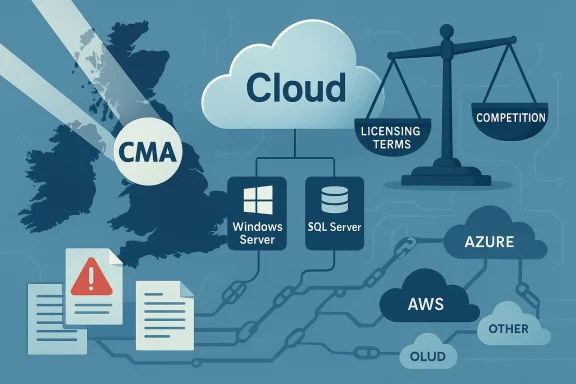
Microsoft is facing one of the most consequential regulatory challenges yet to its cloud business, as the UK’s Competition and Markets Authority moves from broad market scrutiny into a more formal probe of cloud software licensing practices. The issue goes far beyond a single pricing dispute: it cuts to the heart of how enterprise software vendors can shape cloud competition through packaging, discounts, compatibility terms, and switching costs. For Microsoft, this is not just a legal headache; it is a direct challenge to a revenue engine that has become central to the company’s growth story.
The CMA’s concern is easy to summarize and hard to solve: if licensing rules make Microsoft software materially cheaper or easier to run on Azure than on rival clouds, customers may not be choosing the best infrastructure on merit alone. That tension has been building for years in the UK and across Europe, with competitors and customers repeatedly alleging that licensing terms can raise barriers to multi-cloud strategies and undermine portability. What happens next could influence not only Microsoft and AWS, but also the rules of engagement for the wider cloud market.
The UK cloud market has been under regulatory scrutiny for a long time, and this latest step did not appear out of nowhere. The CMA has already spent years examining public cloud infrastructure, egress fees, technical barriers, and competitive concentration, and its provisional findings in 2025 found competition was not working as well as it could. In that report, the watchdog said the market structure could be leading to higher costs, less choice, less innovation, and lower quality of service for UK businesses.
That earlier work matters because it frames the new probe as part of an evolving enforcement strategy rather than a one-off reaction. The CMA has increasingly used the Digital Markets, Competition and Consumers Act to explore whether dominant platforms should be designated with strategic market status, which would let it impose targeted conduct rules. In cloud, the regulator has already suggested that Microsoft and AWS deserve this kind of close attention.
The broader context is also important. Cloud services are no longer just a back-office IT utility; they are the infrastructure layer behind retail, finance, healthcare, manufacturing, public services, and AI deployment. When a cloud provider shapes customer behavior through licensing, the consequences can ripple far beyond technology procurement. That is why regulators treat these disputes as competition issues, not simply commercial disagreements.
Microsoft’s cloud business makes the stakes obvious. The company has repeatedly reported massive growth in its Microsoft Cloud revenue, and Azure remains one of its most strategically important assets. The company’s own investor materials show cloud revenue continuing to expand at scale, with Azure and other cloud services growing strongly in its recent fiscal results. That growth is exactly why scrutiny is intensifying rather than fading.
What appears to be happening now is the next logical step in that sequence. The watchdog has moved from identifying market-wide concerns to focusing more sharply on Microsoft’s licensing terms, especially where they may influence customer behavior across clouds. In practice, that means the regulator is no longer asking only whether the market is concentrated; it is asking whether Microsoft’s conduct is helping keep it that way.
That is why regulators and rivals have focused so much attention on licensing rather than only on raw cloud compute prices. The concern is not merely that Microsoft offers discounts on Azure, but that the structure of those discounts and associated rights may steer customers toward Microsoft’s own cloud in ways that reduce genuine choice. In competition law terms, the question is whether that behavior constitutes fair competition or input foreclosure by another name.
For rivals, meanwhile, the investigation offers a chance to reset a complaint that has lingered for years. AWS and Google Cloud have both argued that Microsoft’s licensing posture makes it harder to win workloads that depend on Microsoft software. Regulators seem increasingly receptive to the idea that cloud competition is shaped by more than virtualization and storage costs alone.
The issue is not confined to one product or one discount schedule. It spans licensing constructs for enterprise software that are often negotiated through large, complex customer agreements. In a market where customers buy a mix of infrastructure, platform, and software services, the fine print can matter as much as the headline price.
That is why the CMA has previously examined egress fees and licensing barriers together. If a customer faces both transfer costs and licensing penalties, the effective switching price can rise sharply. The practical result is reduced bargaining power, which is exactly the sort of structural concern competition regulators are meant to address.
The controversy is not limited to UK regulators. Microsoft has already faced complaints and antitrust pressure in Europe over cloud licensing, and it reportedly reached agreements with some European cloud providers to reduce friction and avoid escalation in the past. The CMA inquiry therefore sits inside a much wider international pattern of scrutiny.
For Microsoft, this raises the cost of doing business in the UK even if no final finding is made against it. A formal investigation tends to trigger document production, stakeholder lobbying, customer testimony, and a broader public debate over cloud fairness. Those are distractions no major vendor wants while trying to sell AI infrastructure at full speed.
That structure creates a classic competition problem: even if the market looks dynamic from the inside, customers may not feel that they have meaningful switching power. Large incumbents can invest aggressively, cut prices selectively, and still preserve strong margins if customers face enough friction leaving the ecosystem. That is why choice in cloud is not just about the number of vendors; it is about how easy it is to move between them.
The CMA has already suggested that both Microsoft and AWS may deserve further investigation under the UK’s digital markets regime. Yet the licensing criticism has hit Microsoft harder because of its software ownership. If a customer uses Windows-heavy workloads, Microsoft’s bargaining position is structurally different from AWS’s. That asymmetry is one reason the market debate keeps returning to Microsoft’s terms rather than only to raw compute prices.
This does not mean Google is simply lobbying for rivals to be weakened. It means the company sees a structural opening in fairer portability and clearer licensing rules. From Google’s perspective, and likely from the CMA’s as well, competitive neutrality in software licensing is essential if cloud markets are to remain contestable.
That means the real question is not whether customers can technically deploy elsewhere. It is whether they can do so economically and operationally without taking on a material penalty. If the answer is no, then “choice” becomes theoretical rather than practical. That distinction is central to competition analysis.
That is especially true when switching costs are embedded in architecture rather than contracts alone. Once a company builds around a cloud vendor’s identity, security, data, and tooling stack, moving becomes expensive in human time as much as in money. That friction is the real strategic asset regulators are now examining.
The company’s public stance has been consistent: cloud is competitive, investment is high, and customers have plenty of choices. In its comments on earlier CMA findings, Microsoft argued that the regulator was missing how dynamic the market has become, especially under pressure from AI-driven change. That message may resonate in some policy circles, but it does not answer the licensing question directly.
From a competition standpoint, however, bundling becomes more sensitive when it affects interoperability or customer mobility. If customers feel compelled to stay inside Microsoft’s orbit because it is cheaper to do so than to mix vendors, the ecosystem begins to behave less like an open market and more like a closed club. That is the tension regulators are trying to resolve.
For Microsoft, this means any licensing remedy would hit the heart of enterprise sales execution. That is a sensitive area because commercial cloud is one of the company’s most important revenue streams. Even a small change in customer perception could shift deal dynamics across thousands of contracts.
The irony is that AI makes cloud competition both more important and more difficult to police. On one hand, regulators worry that entrenched providers can leverage scale into the next wave of computing. On the other, they know they must avoid freezing innovation through overreach. That balance will shape the CMA’s final posture.
In that sense, the probe itself can be a market event. It signals to CIOs and procurement teams that the licensing status quo may not be durable. Even before any ruling, that can alter negotiation behavior in ways that matter to Microsoft’s sales pipeline.
That matters because cloud regulation is becoming a template for how governments handle digital infrastructure markets. Instead of trying to break up giant platforms, regulators are looking for targeted remedies that reduce friction while preserving scale efficiencies. The UK’s new digital markets regime is built for exactly that kind of intervention.
For Microsoft, this raises the possibility of durable obligations rather than one-off findings. If the regulator concludes that cloud licensing should be more neutral, it can seek changes designed to last. That is why companies tend to fight designation as hard as they fight the final remedy.
That makes the UK unusually important even if the market is global. If the CMA imposes meaningful cloud licensing obligations, other regulators may use that outcome as a reference point. In policy terms, London could end up shaping the European conversation more than its market size would suggest.
That transatlantic dynamic is especially relevant because cloud policy is drifting toward convergence. Regulators increasingly share language about lock-in, fairness, and interoperability. The details differ, but the direction of travel is hard to miss.
Those questions are difficult because they mix law, economics, and product architecture. They also explain why cloud cases can drag on. The debate is not only about what Microsoft did; it is about what a dominant software platform is allowed to do in a cloud-first economy.
For customers, the story is different. Even a preliminary probe can validate long-running concerns that procurement teams have struggled to articulate internally. Once a regulator publicly says it has concerns, enterprise buyers often feel more comfortable pushing vendors for concessions.
That does not mean customers will rush to leave Azure. Migration is still costly, and many workloads are deeply embedded. But a regulator’s attention can reduce the psychological cost of challenging a dominant supplier. That is often enough to change the tenor of the relationship.
This could matter most in regulated sectors like finance and public services, where procurement sensitivity is highest. If those buyers become more skeptical of license-driven dependence, cloud vendors that compete on openness may gain relative advantage. The effect could be gradual, but it would still be meaningful.
In practical terms, this could lead to more transparent pricing and less room for ecosystem-based steering. That would not destroy Microsoft’s cloud business. It would simply make it compete more directly on cloud merits, which is exactly what regulators want.
That dynamic is unlikely to disappear. The issue is whether regulators can nudge the market toward genuine choice without discouraging the investments that built cloud in the first place. That balance will determine whether this probe becomes a landmark or just another compliance burden.
For Microsoft, there may even be an upside if the company uses the moment to simplify its licensing story. Clean, defensible rules can be easier to sell than opaque exceptions, and a fairer framework can ultimately strengthen trust. The key is whether Microsoft sees the probe as a threat to manage or a chance to rebuild credibility.
There is also a risk that the probe becomes too narrow. If the CMA focuses only on Microsoft pricing without fully accounting for technical dependency, data movement, and operational complexity, any remedy could miss the real causes of lock-in. A shallow fix would look good on paper and disappoint in practice.
The most important thing to watch is whether the CMA treats licensing as a symptom or a root cause. If it sees licensing as part of a broader lock-in system, remedies are more likely to be meaningful. If it reduces the issue to a narrow pricing dispute, the outcome may satisfy process but not market reality.
Source: The Tech Buzz https://www.techbuzz.ai/articles/uk-regulator-opens-microsoft-cloud-licensing-probe/
The CMA’s concern is easy to summarize and hard to solve: if licensing rules make Microsoft software materially cheaper or easier to run on Azure than on rival clouds, customers may not be choosing the best infrastructure on merit alone. That tension has been building for years in the UK and across Europe, with competitors and customers repeatedly alleging that licensing terms can raise barriers to multi-cloud strategies and undermine portability. What happens next could influence not only Microsoft and AWS, but also the rules of engagement for the wider cloud market.
 Background
The UK cloud market has been under regulatory scrutiny for a long time, and this latest step did not appear out of nowhere. The CMA has already spent years examining public cloud infrastructure, egress fees, technical barriers, and competitive concentration, and its provisional findings in 2025 found competition was not working as well as it could. In that report, the watchdog said the market structure could be leading to higher costs, less choice, less innovation, and lower quality of service for UK businesses.That earlier work matters because it frames the new probe as part of an evolving enforcement strategy rather than a one-off reaction. The CMA has increasingly used the Digital Markets, Competition and Consumers Act to explore whether dominant platforms should be designated with strategic market status, which would let it impose targeted conduct rules. In cloud, the regulator has already suggested that Microsoft and AWS deserve this kind of close attention.
The broader context is also important. Cloud services are no longer just a back-office IT utility; they are the infrastructure layer behind retail, finance, healthcare, manufacturing, public services, and AI deployment. When a cloud provider shapes customer behavior through licensing, the consequences can ripple far beyond technology procurement. That is why regulators treat these disputes as competition issues, not simply commercial disagreements.
Microsoft’s cloud business makes the stakes obvious. The company has repeatedly reported massive growth in its Microsoft Cloud revenue, and Azure remains one of its most strategically important assets. The company’s own investor materials show cloud revenue continuing to expand at scale, with Azure and other cloud services growing strongly in its recent fiscal results. That growth is exactly why scrutiny is intensifying rather than fading.
How the current case emerged
The CMA’s cloud investigation traces back to the UK’s original market study into cloud services, which began in 2022. That study evolved into a more formal market investigation, and by January 2025 the regulator had already published provisional findings that singled out issues such as egress fees, technical barriers, and licensing practices. It also recommended that the CMA consider using its new powers to investigate Microsoft and AWS for possible strategic market status.What appears to be happening now is the next logical step in that sequence. The watchdog has moved from identifying market-wide concerns to focusing more sharply on Microsoft’s licensing terms, especially where they may influence customer behavior across clouds. In practice, that means the regulator is no longer asking only whether the market is concentrated; it is asking whether Microsoft’s conduct is helping keep it that way.
Why licensing is the flash point
Cloud licensing is a deceptively technical topic with enormous commercial consequences. A customer deciding where to run Windows Server, SQL Server, Office, or related enterprise workloads may be influenced by compatibility, contractual terms, or volume discounts that are not visible on a simple price list. If those terms reward Azure use and penalize alternatives, the market can become sticky even without an outright technical lock.That is why regulators and rivals have focused so much attention on licensing rather than only on raw cloud compute prices. The concern is not merely that Microsoft offers discounts on Azure, but that the structure of those discounts and associated rights may steer customers toward Microsoft’s own cloud in ways that reduce genuine choice. In competition law terms, the question is whether that behavior constitutes fair competition or input foreclosure by another name.
Why this matters now
The timing is awkward for Microsoft because cloud is now tied tightly to the company’s AI narrative. The same infrastructure that hosts enterprise workloads also underpins generative AI training and inference, which makes cloud scale more strategically valuable than ever. Any constraint on Microsoft’s ability to bundle or favor its own cloud could affect not just traditional enterprise licensing, but the economics of its broader AI stack.For rivals, meanwhile, the investigation offers a chance to reset a complaint that has lingered for years. AWS and Google Cloud have both argued that Microsoft’s licensing posture makes it harder to win workloads that depend on Microsoft software. Regulators seem increasingly receptive to the idea that cloud competition is shaped by more than virtualization and storage costs alone.
What the CMA Is Actually Investigating
At the core of the probe is a simple but thorny question: do Microsoft’s cloud software licensing practices distort competition by making it artificially expensive or operationally difficult to use Microsoft products on rival clouds? The CMA has already said it has concerns around those practices, and those concerns were telegraphed in its earlier market findings. The new investigation gives the regulator a more focused mechanism to test those claims in detail.The issue is not confined to one product or one discount schedule. It spans licensing constructs for enterprise software that are often negotiated through large, complex customer agreements. In a market where customers buy a mix of infrastructure, platform, and software services, the fine print can matter as much as the headline price.
The mechanics of cloud lock-in
Cloud lock-in rarely looks like a single prohibited act. Instead, it is usually a combination of contract structure, migration friction, software dependencies, egress charges, and commercial incentives. When these factors line up, customers may stay with a provider not because it is clearly superior, but because moving away becomes expensive, risky, or administratively painful.That is why the CMA has previously examined egress fees and licensing barriers together. If a customer faces both transfer costs and licensing penalties, the effective switching price can rise sharply. The practical result is reduced bargaining power, which is exactly the sort of structural concern competition regulators are meant to address.
Why Microsoft’s licensing model is controversial
Microsoft has long had a dual identity in enterprise IT. It is both a software vendor and a cloud provider, which allows it to influence customer behavior at multiple layers of the stack. That can be commercially efficient, but it can also create the appearance of self-preferencing if the company offers more favorable treatment to its own cloud than to competitors.The controversy is not limited to UK regulators. Microsoft has already faced complaints and antitrust pressure in Europe over cloud licensing, and it reportedly reached agreements with some European cloud providers to reduce friction and avoid escalation in the past. The CMA inquiry therefore sits inside a much wider international pattern of scrutiny.
What the CMA may be testing
The regulator will likely want to understand several distinct questions. First, whether Microsoft’s licensing terms materially increase the cost of running Microsoft software on non-Azure infrastructure. Second, whether those terms create technical or operational barriers that are functionally equivalent to pricing barriers. Third, whether customers can realistically avoid those effects through negotiation.- Does the pricing structure favor Azure by design?
- Are competitors disadvantaged in a way that affects customer choice?
- Do licensing restrictions make multi-cloud architectures less viable?
- Can enterprise buyers negotiate around the restrictions at scale?
- Are the alleged harms big enough to justify intervention?
The legal and strategic overlay
A formal CMA probe also signals that the regulator sees the issue as more than a consumer inconvenience. Under the UK’s newer digital markets framework, it can move from diagnosis to remedy in a more targeted way than traditional competition enforcement. That means conduct requirements, interoperability obligations, or licensing changes are now all on the table in principle.For Microsoft, this raises the cost of doing business in the UK even if no final finding is made against it. A formal investigation tends to trigger document production, stakeholder lobbying, customer testimony, and a broader public debate over cloud fairness. Those are distractions no major vendor wants while trying to sell AI infrastructure at full speed.
The Competitive Landscape
The cloud market is still dominated by a handful of companies, and the CMA has already said that concentration matters. In its 2025 findings, the regulator described Microsoft and AWS as the two largest providers and suggested that their scale gives them significant market power. Google Cloud is important, but still materially smaller in infrastructure market share.That structure creates a classic competition problem: even if the market looks dynamic from the inside, customers may not feel that they have meaningful switching power. Large incumbents can invest aggressively, cut prices selectively, and still preserve strong margins if customers face enough friction leaving the ecosystem. That is why choice in cloud is not just about the number of vendors; it is about how easy it is to move between them.
Microsoft versus AWS
Microsoft and AWS occupy a peculiar relationship. They are rivals in cloud infrastructure, but Microsoft also sells the software that many enterprises depend on in any cloud environment. That creates a lever AWS does not possess in the same way. AWS can win on infrastructure merit, but Microsoft can win through familiarity, product integration, and licensing economics.The CMA has already suggested that both Microsoft and AWS may deserve further investigation under the UK’s digital markets regime. Yet the licensing criticism has hit Microsoft harder because of its software ownership. If a customer uses Windows-heavy workloads, Microsoft’s bargaining position is structurally different from AWS’s. That asymmetry is one reason the market debate keeps returning to Microsoft’s terms rather than only to raw compute prices.
Google’s role as challenger
Google Cloud is frequently the loudest critic of Microsoft’s licensing behavior, and for obvious reasons. It competes best when buyers are willing to evaluate alternatives based on product quality and price, not just compatibility with Microsoft’s ecosystem. If licensing makes Microsoft workloads disproportionately expensive off Azure, Google’s path to growth gets harder.This does not mean Google is simply lobbying for rivals to be weakened. It means the company sees a structural opening in fairer portability and clearer licensing rules. From Google’s perspective, and likely from the CMA’s as well, competitive neutrality in software licensing is essential if cloud markets are to remain contestable.
Customer behavior and multi-cloud reality
Enterprises rarely run a pure single-cloud strategy anymore. Many use a mix of public cloud, private cloud, SaaS, and edge services. Yet the reality of multi-cloud is often less flexible than the marketing suggests, because licensing, tooling, identity management, and data transfer costs can lock workloads into one ecosystem.That means the real question is not whether customers can technically deploy elsewhere. It is whether they can do so economically and operationally without taking on a material penalty. If the answer is no, then “choice” becomes theoretical rather than practical. That distinction is central to competition analysis.
Why market power can survive even in a fast-moving industry
Cloud markets are frequently described as innovation-driven and fast-changing, and Microsoft has argued that the sector is more dynamic than regulators assume. There is truth to that. But dynamic growth does not automatically mean dynamic competition. A market can be growing quickly while still preserving entrenched advantages for incumbents.That is especially true when switching costs are embedded in architecture rather than contracts alone. Once a company builds around a cloud vendor’s identity, security, data, and tooling stack, moving becomes expensive in human time as much as in money. That friction is the real strategic asset regulators are now examining.
Microsoft’s Cloud Business and Why It Is Vulnerable
Microsoft’s cloud business is enormously successful, which also makes it unusually exposed to regulatory attention. The company’s recent earnings show Microsoft Cloud revenue well above $50 billion per quarter on a trailing basis, with Azure growth remaining strong. That scale means even modest licensing changes can have large financial consequences over time.The company’s public stance has been consistent: cloud is competitive, investment is high, and customers have plenty of choices. In its comments on earlier CMA findings, Microsoft argued that the regulator was missing how dynamic the market has become, especially under pressure from AI-driven change. That message may resonate in some policy circles, but it does not answer the licensing question directly.
The software-plus-cloud advantage
Microsoft’s advantage is not just Azure. It is the combination of Azure with Windows, Office, identity management, security tools, developer services, and productivity software. That ecosystem lets Microsoft bundle value across the stack in a way few rivals can match. In normal commercial terms, that is smart business.From a competition standpoint, however, bundling becomes more sensitive when it affects interoperability or customer mobility. If customers feel compelled to stay inside Microsoft’s orbit because it is cheaper to do so than to mix vendors, the ecosystem begins to behave less like an open market and more like a closed club. That is the tension regulators are trying to resolve.
Enterprise procurement is where the pressure lands
Large enterprises do not buy cloud in the same way they buy consumer services. Procurement teams negotiate long contracts, volume discounts, migration incentives, and support commitments. That makes the market more sophisticated, but also more opaque. Pricing power can hide inside exceptions, commitments, and renewal terms.For Microsoft, this means any licensing remedy would hit the heart of enterprise sales execution. That is a sensitive area because commercial cloud is one of the company’s most important revenue streams. Even a small change in customer perception could shift deal dynamics across thousands of contracts.
The AI angle complicates everything
Cloud, licensing, and AI are now intertwined. The infrastructure that powers AI models also supports traditional workloads, and the same enterprise customers buying Microsoft software often want AI tools bundled into their cloud strategy. This gives Microsoft an opportunity to position itself as a one-stop shop, but it also makes any perceived unfairness more politically charged.The irony is that AI makes cloud competition both more important and more difficult to police. On one hand, regulators worry that entrenched providers can leverage scale into the next wave of computing. On the other, they know they must avoid freezing innovation through overreach. That balance will shape the CMA’s final posture.
Why the financial impact could be bigger than the legal one
The immediate legal outcome may not be catastrophic for Microsoft. Regulators often take time, and remedies can be narrow or phased in. The bigger risk is reputational and commercial: the investigation may encourage customers to revisit their dependency on Microsoft, or at least demand more aggressive concessions.In that sense, the probe itself can be a market event. It signals to CIOs and procurement teams that the licensing status quo may not be durable. Even before any ruling, that can alter negotiation behavior in ways that matter to Microsoft’s sales pipeline.
The Regulatory Pattern Across Europe
The UK probe is part of a broader European trend toward closer scrutiny of cloud economics. Across the region, regulators have increasingly focused on portability, fair licensing, and the hidden costs of switching infrastructure providers. Microsoft has already been forced to adjust terms in some European contexts, which suggests this is not a passing dispute but a structural one.That matters because cloud regulation is becoming a template for how governments handle digital infrastructure markets. Instead of trying to break up giant platforms, regulators are looking for targeted remedies that reduce friction while preserving scale efficiencies. The UK’s new digital markets regime is built for exactly that kind of intervention.
The CMA’s newer powers
The Digital Markets, Competition and Consumers Act gives the CMA more direct tools than it had in previous cloud investigations. If it designates a firm with strategic market status, it can impose conduct requirements and pro-competition interventions tailored to the specific digital activity. That is a more surgical form of regulation than classic merger review or abuse-of-dominance litigation.For Microsoft, this raises the possibility of durable obligations rather than one-off findings. If the regulator concludes that cloud licensing should be more neutral, it can seek changes designed to last. That is why companies tend to fight designation as hard as they fight the final remedy.
Why the UK may move faster than others
Britain has been eager to position itself as a serious digital regulator without becoming anti-innovation. That creates pressure to act decisively in sectors where it has already done the groundwork. Cloud is one of those sectors. The CMA has studied it for years, and the evidence base is now unusually mature.That makes the UK unusually important even if the market is global. If the CMA imposes meaningful cloud licensing obligations, other regulators may use that outcome as a reference point. In policy terms, London could end up shaping the European conversation more than its market size would suggest.
The transatlantic layer
Microsoft’s cloud strategy is not just a UK issue, of course. The company operates across the United States, the EU, and other major jurisdictions, and any remedy that affects enterprise licensing could have knock-on implications elsewhere. A regulatory change in the UK could become a model, a warning, or both.That transatlantic dynamic is especially relevant because cloud policy is drifting toward convergence. Regulators increasingly share language about lock-in, fairness, and interoperability. The details differ, but the direction of travel is hard to miss.
The politics of “fair licensing”
Fair licensing is the kind of phrase that sounds uncontroversial until you try to define it precisely. What counts as unfair treatment when a vendor owns both the software and the cloud platform? How much price differentiation is permissible before it becomes anti-competitive? When does a discount become a penalty by another name?Those questions are difficult because they mix law, economics, and product architecture. They also explain why cloud cases can drag on. The debate is not only about what Microsoft did; it is about what a dominant software platform is allowed to do in a cloud-first economy.
Market Reactions and Business Implications
The immediate market reaction to a probe like this is rarely dramatic in stock terms, but the strategic implications can be substantial. Investors tend to think in probabilities, not headlines. A formal investigation increases the odds of future constraints, and that affects expectations around margins, bundling power, and customer retention.For customers, the story is different. Even a preliminary probe can validate long-running concerns that procurement teams have struggled to articulate internally. Once a regulator publicly says it has concerns, enterprise buyers often feel more comfortable pushing vendors for concessions.
How CIOs and procurement teams may respond
Enterprise buyers are likely to treat the probe as leverage. Some will use it to negotiate better terms on renewals or migration projects. Others may use it to justify diversifying workloads to reduce dependency on Microsoft-specific licensing assumptions.That does not mean customers will rush to leave Azure. Migration is still costly, and many workloads are deeply embedded. But a regulator’s attention can reduce the psychological cost of challenging a dominant supplier. That is often enough to change the tenor of the relationship.
How rivals may frame the moment
AWS and Google Cloud are likely to present the investigation as evidence that the market is finally catching up to what customers already know. Their pitch will center on neutrality, portability, and lower switching friction. They will not need to prove that Microsoft is winning unfairly in every deal; they only need to show that customers deserve cleaner choices.This could matter most in regulated sectors like finance and public services, where procurement sensitivity is highest. If those buyers become more skeptical of license-driven dependence, cloud vendors that compete on openness may gain relative advantage. The effect could be gradual, but it would still be meaningful.
What it means for Microsoft’s sales model
Microsoft’s enterprise go-to-market strategy depends heavily on broad platform relationships. If licensing is reined in, the company may need to lean more on product quality, security, AI capabilities, and service differentiation. That is not a bad thing from a customer perspective, but it may narrow Microsoft’s margin of advantage.In practical terms, this could lead to more transparent pricing and less room for ecosystem-based steering. That would not destroy Microsoft’s cloud business. It would simply make it compete more directly on cloud merits, which is exactly what regulators want.
The bigger commercial lesson
The deeper lesson here is that cloud economics are becoming inseparable from platform politics. Enterprises want flexibility, but vendors want stickiness. Regulators are stepping in because the market’s natural incentives often favor lock-in over openness.That dynamic is unlikely to disappear. The issue is whether regulators can nudge the market toward genuine choice without discouraging the investments that built cloud in the first place. That balance will determine whether this probe becomes a landmark or just another compliance burden.
Strengths and Opportunities
The CMA probe also creates opportunities, especially if it leads to clearer rules and a more contestable cloud market. For customers, that could mean more transparent contracts, less switching friction, and stronger bargaining power. For the regulator, it offers a chance to prove that the UK’s digital markets regime can address modern infrastructure competition without blunt intervention.For Microsoft, there may even be an upside if the company uses the moment to simplify its licensing story. Clean, defensible rules can be easier to sell than opaque exceptions, and a fairer framework can ultimately strengthen trust. The key is whether Microsoft sees the probe as a threat to manage or a chance to rebuild credibility.
- Greater transparency in enterprise cloud licensing could improve trust.
- Lower switching costs would help customers negotiate better deals.
- Fairer multi-cloud options could strengthen resilience planning.
- Clearer rules may reduce long-term legal uncertainty.
- More competition could push all providers to improve service quality.
- Regulatory clarity may help procurement teams justify diversification.
- A cleaner ecosystem could support healthier AI and cloud innovation.
Risks and Concerns
The main concern is that well-intentioned intervention could produce side effects. If regulators oversimplify complex enterprise licensing, they could unintentionally reduce investment incentives or make commercial contracting less flexible. That would be a bad outcome for customers who value tailored deals and rapid innovation.There is also a risk that the probe becomes too narrow. If the CMA focuses only on Microsoft pricing without fully accounting for technical dependency, data movement, and operational complexity, any remedy could miss the real causes of lock-in. A shallow fix would look good on paper and disappoint in practice.
- Overcorrection could discourage investment in cloud infrastructure.
- Regulatory ambiguity may linger if remedies are too vague.
- Compliance burden could rise without solving customer lock-in.
- Fragmented rules across jurisdictions may complicate enterprise procurement.
- Token remedies might not address technical switching barriers.
- Retaliatory pricing could shift competition into less transparent channels.
- Slower product innovation is possible if rules become overly prescriptive.
Looking Ahead
What happens next will depend on how aggressively the CMA turns its concerns into formal action. The regulator has already signaled that cloud competition remains an active priority, and the next phase may involve deeper scrutiny of Microsoft’s licensing structures under the UK’s digital markets powers. If that happens, the case could become a reference point for how governments regulate platform economics in the AI era.The most important thing to watch is whether the CMA treats licensing as a symptom or a root cause. If it sees licensing as part of a broader lock-in system, remedies are more likely to be meaningful. If it reduces the issue to a narrow pricing dispute, the outcome may satisfy process but not market reality.
- Whether the CMA opens a strategic market status investigation into Microsoft.
- Whether the regulator targets licensing, egress fees, or interoperability together.
- Whether Microsoft offers voluntary concessions before any formal remedy.
- Whether AWS and Google push for broader, market-wide rules.
- Whether enterprise buyers begin to renegotiate cloud contracts more aggressively.
- Whether UK action influences EU or other international regulators.
Source: The Tech Buzz https://www.techbuzz.ai/articles/uk-regulator-opens-microsoft-cloud-licensing-probe/
Last edited: