

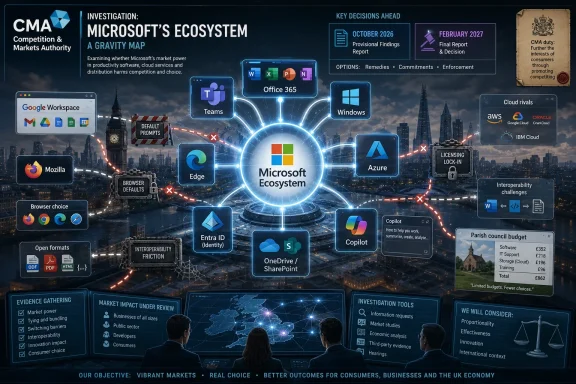
The UK Competition and Markets Authority has published third-party submissions in its Strategic Market Status investigation into Microsoft’s business software ecosystem, launched on May 14, 2026, with a proposed decision due in October and a final decision expected in February 2027. The filings turn what could have been a dry procedural milestone into a map of modern Microsoft dependency. Rivals, open-web advocates, browser makers, cloud competitors, and even a parish council are describing the same basic machine from different angles: Microsoft does not merely sell business software; it sets the routes through which business software is expected to work. The CMA’s problem is deciding whether that convenience has hardened into control.
It is tempting to read the UK probe as a nostalgic sequel to the browser wars: Microsoft bundles something, rivals complain, regulators dust off the old playbook. That misses the modern shape of the case. The CMA is not just asking whether Teams, Edge, Office, Windows, Azure, SQL Server, identity services, and Copilot are individually dominant. It is asking whether the system they form gives Microsoft a strategic position across the working day of British organizations.
That distinction matters because the most important Microsoft product in 2026 may not be Word, Excel, Windows, or even Azure. It is the connective tissue among them. A user signs in through Microsoft identity, opens a document in Microsoft 365, joins a meeting in Teams, receives browser nudges toward Edge, stores files in OneDrive or SharePoint, and increasingly sees Copilot embedded into the same workflows. None of those steps is shocking in isolation. Together, they create an environment where alternatives are technically available but operationally awkward.
Microsoft’s answer is also familiar, and not frivolous. It argues that it faces serious competition from Google Workspace, LibreOffice, macOS, Linux, PostgreSQL, MySQL, Okta, and a long list of cloud and AI challengers. On paper, that is true. The enterprise software market is not a graveyard of dead competitors.
The regulator’s harder question is whether paper competition translates into practical choice for customers already organized around Microsoft’s stack. If the cost of leaving is measured not just in license fees but in retraining, file-format friction, identity rewiring, browser defaults, compliance workflows, and AI integration gaps, then the market can be competitive in theory while sticky in practice. That is the terrain on which this investigation will be fought.
That does not mean every Microsoft win is coercive. Many organizations choose Microsoft because the integration is genuinely useful. Administrators like a single identity plane. Finance teams like predictable bundles. Security teams like fewer vendors to audit. End users, despite their complaints, often prefer the familiar over the theoretically superior.
The competition concern begins where convenience becomes default gravity. If an organization already pays for Microsoft 365, a rival messaging platform must not merely be good; it must justify why it should displace a tool already included or tightly integrated. If Copilot appears inside apps employees already use, a rival AI assistant must fight not only on quality but on distribution. If Azure licensing makes Microsoft workloads cheaper or simpler on Microsoft’s own cloud, rival cloud providers must overcome a structural pricing and procurement disadvantage before a technical comparison even begins.
Microsoft’s response is to point at rivals that are alive and growing. That is a reasonable defense, but it is not a complete one. Competition law in digital markets increasingly cares less about whether alternatives exist somewhere and more about whether dominant firms can shape the conditions under which those alternatives reach users.
That is why the example matters. Regulators are often accused of staging battles between giant companies while ordinary customers serve as rhetorical props. A parish council complaining about interoperability and unexpected cost gives the CMA a more grounded story: the effects of software bundling and integration choices can travel all the way down to small public bodies with limited IT capacity.
The allegation is not simply that Microsoft is expensive. Enterprise software is expensive everywhere, and rivals would like to collect their own fees. The sharper claim is that partial integration, default product pathways, and ecosystem assumptions can create costs that customers did not consciously choose. They discover the cost after the workflow is already normalized.
That kind of friction is hard to model but easy for administrators to recognize. A school, council, charity, or small business does not always run a competitive tender for every collaboration feature. It follows the path that works with the accounts, devices, documents, and security policies already in place. The market decision is made gradually, one compatibility problem at a time.
Microsoft has learned from the 1990s. It no longer needs to make alternatives impossible. It can make the Microsoft option persistent, privileged, and annoyingly resilient. Windows 11 users have seen versions of this pattern in default app prompts, search behavior, widgets, links that prefer Edge, and setup flows that nudge users toward Microsoft accounts and services.
To Microsoft, these are product-design choices in a competitive operating system. To browser rivals, they are distribution leverage. That disagreement is the core of the browser portion of the case. A browser is not just a browser anymore; it is an identity surface, an AI surface, an enterprise policy surface, and a route into advertising, search, and cloud services.
For Windows enthusiasts, the irony is obvious. Microsoft spent years rebuilding Edge into a technically credible Chromium-based browser, only to keep undermining its own case through aggressive promotion. Edge no longer needs to be bad to be resented. It only needs to feel inescapable.
Microsoft can plausibly say that Office formats are standardized and that competitors are free to implement them. But anyone who has spent time in mixed office-suite environments knows that standards are not the same as flawless interoperability. Complex spreadsheets, macros, layouts, tracked changes, embedded objects, and edge-case formatting can make compatibility feel like a tax on non-Microsoft choices.
That tax does not need to be malicious to matter. The issue is that Microsoft Office is both a product and the practical reference implementation for the documents many organizations exchange every day. If Microsoft’s own applications handle de facto complexities that are not fully documented or consistently reproduced elsewhere, rival suites must chase the behavior of the incumbent rather than simply implement a clean specification.
This is where competition cases often become brutally technical. A regulator can easily understand a bundled app. It is harder to understand how undocumented quirks in a format or API can shape an entire market. Yet for third-party office suites, those quirks can be the difference between being seen as a credible replacement and being dismissed after one broken board-paper template.
That is strategically brilliant and competitively fraught. If a user’s email, documents, calendar, meetings, chats, files, identity, and permissions already live inside Microsoft 365, then Microsoft can offer an AI assistant with context that rivals may struggle to match. A third-party AI tool might be smarter in some abstract benchmark, but the workplace assistant that can safely and easily reach the relevant corporate data has a different kind of advantage.
Microsoft argues that AI is making competition more intense, not less. There is truth in that. The AI market is chaotic, well-funded, and crowded. Enterprises are experimenting with tools from OpenAI, Anthropic, Google, Amazon, Salesforce, ServiceNow, and a constellation of startups. No one can credibly claim that Microsoft is the only AI game in town.
But the CMA is not asking whether AI startups exist. It is asking whether Microsoft can use its existing business software position to determine which AI tools are most usable inside UK organizations. In that framing, Copilot is not merely a product under scrutiny. It is the test case for whether today’s productivity suite becomes tomorrow’s AI control plane.
That sounds bureaucratic, but the practical issue is simple. Many enterprises still run Microsoft workloads. If those workloads are easier, cheaper, or contractually cleaner to run on Azure than on AWS, Google Cloud, or another provider, then Microsoft’s software legacy becomes a cloud advantage. The cloud market is not just about who has the best compute, networking, or storage. It is also about who controls the licenses for the workloads customers already depend on.
This is why Microsoft’s breadth matters. Windows Server, SQL Server, Microsoft 365, Entra identity services, Teams, Office documents, Power Platform, Dynamics, and Copilot are not merely separate products sitting in a catalog. They are procurement anchors. Once an organization standardizes on them, Microsoft has many levers to make the adjacent Microsoft service look safer, simpler, and sometimes cheaper.
The CMA’s SMS regime is designed for exactly this kind of leverage. It does not require the regulator to prove that every individual product market has collapsed. It allows the regulator to examine whether a firm has a strategic position that lets it shape competition across connected digital activities. That is why Microsoft will fight the designation hard.
This is not a market where Microsoft owns every layer in every organization. The modern enterprise is messy, hybrid, and full of exceptions. Many IT departments already run multi-cloud architectures, mixed device fleets, non-Microsoft databases, non-Microsoft browsers, and third-party collaboration tools. The Microsoft-only business exists, but it is not the universal norm.
The problem for Microsoft is that competition at the edges can still coexist with dependence at the center. A company may use AWS and still rely on Microsoft identity. It may use Chrome and still be pushed through Microsoft account flows. It may use Google Cloud for analytics and still run Office documents through Microsoft 365. It may pilot a third-party AI assistant and still find that Copilot has the smoother path into everyday work.
That is why Microsoft’s “look at all these competitors” defense may not settle the question. The CMA can accept that Microsoft faces competition and still conclude that Microsoft has strategic market status in the business software ecosystem. The issue is not whether rivals exist. The issue is whether Microsoft can make rivalry conditional on access, interoperability, defaults, and licensing terms it heavily influences.
That flexibility is both powerful and controversial. Supporters see it as a way to move faster than old antitrust cases that take years and arrive after markets have already tipped. Critics see it as a risk of regulatory micromanagement, especially in fast-moving markets where product integration can deliver real consumer and enterprise benefits.
Microsoft will argue, explicitly or implicitly, that integration is the point. Customers buy Microsoft 365 because the pieces work together. They choose Azure because it integrates with the Microsoft estate. They adopt Copilot because it understands the context of Microsoft apps. If regulators pull too aggressively at that fabric, they may reduce the very convenience customers value.
The CMA’s challenge is to distinguish integration from foreclosure. A bundled product can be useful without being abusive. A default can be helpful without being manipulative. A proprietary feature can be innovative without being exclusionary. But when all three appear across the same ecosystem, regulators start to see a pattern rather than a series of product decisions.
That enterprise focus changes the politics. Businesses are presumed to be sophisticated buyers, and many are. Large organizations negotiate hard with Microsoft. They use enterprise agreements, procurement teams, legal review, and architectural committees. Some can and do force concessions.
But not every UK customer is a multinational bank. Public bodies, schools, small businesses, charities, and local councils often inherit Microsoft-heavy environments without the leverage or expertise to redesign them. They experience competition less as a vendor shootout and more as a set of defaults they must work around.
This is where the CMA’s invitation for customer and rival submissions becomes important. Rivals can describe market structure, but customers can describe lived dependency. The regulator needs both. A complaint from Google may sound self-interested; a complaint from a parish council may sound inconveniently real.
Potential remedies could run in several directions. The CMA could focus on licensing terms that affect rival clouds. It could push for stronger interoperability obligations around APIs, document formats, identity, collaboration tools, or AI assistants. It could examine defaults and choice screens in Windows and Microsoft 365. It could require clearer separation between productivity subscriptions and AI upsells.
Each option has trade-offs. Interoperability rules can be gamed if they are vague and can become burdensome if they are too prescriptive. Default-choice remedies can become theater if users are nudged back later through prompts and setup flows. Licensing interventions can reduce cloud distortions, but only if they are written with enough precision to survive enterprise contract creativity.
The most useful remedies would likely be boring, technical, and enforceable. Regulators should care less about symbolic choice screens and more about whether a third-party tool can function without degradation. They should care less about whether Microsoft publishes a standard and more about whether competitors can implement it reliably. They should care less about whether Copilot can be disabled and more about whether rival AI services can integrate with comparable permissions, context, and administrative controls.
Windows 11 has already trained users to expect more cloud-account pressure, more Microsoft service prompts, and more AI-adjacent surfaces. Some of these features are useful. Some are tolerable. Some feel like a company using the operating system as a billboard for adjacent subscriptions. The CMA’s work will not be a direct referendum on every Windows annoyance, but it could influence how regulators think about defaults and service promotion inside operating systems.
For administrators, the more immediate concern is optionality. If an organization wants to use Microsoft 365 with a non-Microsoft browser, a non-Microsoft AI assistant, a non-Microsoft cloud, or a non-Microsoft office suite, the question should not be whether that is theoretically possible. It should be whether it is supportable, secure, documented, and economically rational.
That is the practical standard the market often fails. Users do not need perfect neutrality from Microsoft. They need the ability to choose alternatives without feeling punished by breakage, degraded features, unexpected costs, or licensing complexity.
Between now and October, expect the arguments to narrow. Broad claims about dominance will become fights over definitions. What exactly is the relevant business software ecosystem? Which activities are inside the SMS perimeter? How should the CMA weigh Windows client dominance against Linux server strength? How should it treat Google’s scale when Google is both a complainant and a platform giant in its own right?
Microsoft will also try to make the case about innovation. It will say that Copilot, Teams, Azure, and Microsoft 365 are not traps but investments. It will argue that customers want integrated AI and security, not a fragmented set of tools stitched together by regulators. That argument will resonate with many CIOs who are tired of vendor sprawl.
The counterargument is that integration chosen by customers is different from integration imposed by defaults, licensing pressure, or technical asymmetry. The CMA does not need to punish Microsoft for building a coherent suite. It needs to decide whether Microsoft’s suite has become so central that the company must play by special rules when extending it.
That gravity is not always bad for customers. Many organizations standardize on Microsoft because the stack reduces friction, centralizes management, and gives administrators a familiar security and compliance model. But gravity becomes a competition problem when escape velocity is too expensive for challengers and customers alike.
The most concrete points are already visible:
 The Complaint Is Bigger Than Another Microsoft Antitrust Rerun
It is tempting to read the UK probe as a nostalgic sequel to the browser wars: Microsoft bundles something, rivals complain, regulators dust off the old playbook. That misses the modern shape of the case. The CMA is not just asking whether Teams, Edge, Office, Windows, Azure, SQL Server, identity services, and Copilot are individually dominant. It is asking whether the system they form gives Microsoft a strategic position across the working day of British organizations.That distinction matters because the most important Microsoft product in 2026 may not be Word, Excel, Windows, or even Azure. It is the connective tissue among them. A user signs in through Microsoft identity, opens a document in Microsoft 365, joins a meeting in Teams, receives browser nudges toward Edge, stores files in OneDrive or SharePoint, and increasingly sees Copilot embedded into the same workflows. None of those steps is shocking in isolation. Together, they create an environment where alternatives are technically available but operationally awkward.
Microsoft’s answer is also familiar, and not frivolous. It argues that it faces serious competition from Google Workspace, LibreOffice, macOS, Linux, PostgreSQL, MySQL, Okta, and a long list of cloud and AI challengers. On paper, that is true. The enterprise software market is not a graveyard of dead competitors.
The regulator’s harder question is whether paper competition translates into practical choice for customers already organized around Microsoft’s stack. If the cost of leaving is measured not just in license fees but in retraining, file-format friction, identity rewiring, browser defaults, compliance workflows, and AI integration gaps, then the market can be competitive in theory while sticky in practice. That is the terrain on which this investigation will be fought.
Google Sees a Gatekeeper, Microsoft Sees a Crowded Market
Google’s submission reportedly frames Microsoft as a gatekeeper that steers captive users toward its own cloud and AI services. The language is unsurprising because Google has every incentive to push regulators toward a platform-power theory of harm. But the claim lands because enterprise IT buyers recognize the underlying pattern: once Microsoft is the productivity layer, the next Microsoft service is usually the easiest one to approve.That does not mean every Microsoft win is coercive. Many organizations choose Microsoft because the integration is genuinely useful. Administrators like a single identity plane. Finance teams like predictable bundles. Security teams like fewer vendors to audit. End users, despite their complaints, often prefer the familiar over the theoretically superior.
The competition concern begins where convenience becomes default gravity. If an organization already pays for Microsoft 365, a rival messaging platform must not merely be good; it must justify why it should displace a tool already included or tightly integrated. If Copilot appears inside apps employees already use, a rival AI assistant must fight not only on quality but on distribution. If Azure licensing makes Microsoft workloads cheaper or simpler on Microsoft’s own cloud, rival cloud providers must overcome a structural pricing and procurement disadvantage before a technical comparison even begins.
Microsoft’s response is to point at rivals that are alive and growing. That is a reasonable defense, but it is not a complete one. Competition law in digital markets increasingly cares less about whether alternatives exist somewhere and more about whether dominant firms can shape the conditions under which those alternatives reach users.
The Parish Council Anecdote Is the Most Dangerous One
Among the submissions, the most politically potent may not come from Google or Mozilla. It may come from Killinghall Parish Council, which complained about an unplanned annual cost of £1,100 tied to additional Microsoft services needed to use Teams effectively. In a global antitrust fight, £1,100 is a rounding error. In local government, it is a budget line.That is why the example matters. Regulators are often accused of staging battles between giant companies while ordinary customers serve as rhetorical props. A parish council complaining about interoperability and unexpected cost gives the CMA a more grounded story: the effects of software bundling and integration choices can travel all the way down to small public bodies with limited IT capacity.
The allegation is not simply that Microsoft is expensive. Enterprise software is expensive everywhere, and rivals would like to collect their own fees. The sharper claim is that partial integration, default product pathways, and ecosystem assumptions can create costs that customers did not consciously choose. They discover the cost after the workflow is already normalized.
That kind of friction is hard to model but easy for administrators to recognize. A school, council, charity, or small business does not always run a competitive tender for every collaboration feature. It follows the path that works with the accounts, devices, documents, and security policies already in place. The market decision is made gradually, one compatibility problem at a time.
Browser Choice Never Really Left Windows
The Browser Choice Alliance and Mozilla’s complaints bring the investigation back to Microsoft’s oldest antitrust wound: the browser. The specific modern grievance is not that users cannot install Chrome, Firefox, Vivaldi, or another browser. They can. The complaint is that Windows and Microsoft 365 allegedly keep making Edge the path of least resistance, especially during upgrade flows and default-setting moments.Microsoft has learned from the 1990s. It no longer needs to make alternatives impossible. It can make the Microsoft option persistent, privileged, and annoyingly resilient. Windows 11 users have seen versions of this pattern in default app prompts, search behavior, widgets, links that prefer Edge, and setup flows that nudge users toward Microsoft accounts and services.
To Microsoft, these are product-design choices in a competitive operating system. To browser rivals, they are distribution leverage. That disagreement is the core of the browser portion of the case. A browser is not just a browser anymore; it is an identity surface, an AI surface, an enterprise policy surface, and a route into advertising, search, and cloud services.
For Windows enthusiasts, the irony is obvious. Microsoft spent years rebuilding Edge into a technically credible Chromium-based browser, only to keep undermining its own case through aggressive promotion. Edge no longer needs to be bad to be resented. It only needs to feel inescapable.
File Formats Are Where Openness Gets Messy
Collabora’s submission pushes the CMA toward a less flashy but deeply important part of the stack: APIs and document format standards, particularly Office Open XML. This is the part of the Microsoft ecosystem that ordinary users experience as “the document looks wrong when I open it somewhere else.” For businesses, that small sentence can decide procurement policy.Microsoft can plausibly say that Office formats are standardized and that competitors are free to implement them. But anyone who has spent time in mixed office-suite environments knows that standards are not the same as flawless interoperability. Complex spreadsheets, macros, layouts, tracked changes, embedded objects, and edge-case formatting can make compatibility feel like a tax on non-Microsoft choices.
That tax does not need to be malicious to matter. The issue is that Microsoft Office is both a product and the practical reference implementation for the documents many organizations exchange every day. If Microsoft’s own applications handle de facto complexities that are not fully documented or consistently reproduced elsewhere, rival suites must chase the behavior of the incumbent rather than simply implement a clean specification.
This is where competition cases often become brutally technical. A regulator can easily understand a bundled app. It is harder to understand how undocumented quirks in a format or API can shape an entire market. Yet for third-party office suites, those quirks can be the difference between being seen as a credible replacement and being dismissed after one broken board-paper template.
Copilot Turns Bundling Into a Future-Tense Problem
The CMA’s timing is not accidental. AI is being embedded into business software at precisely the moment regulators are trying to understand whether the old productivity stack already gives Microsoft too much leverage. Copilot is not just another add-on. It is Microsoft’s attempt to make AI feel native inside the applications where work already happens.That is strategically brilliant and competitively fraught. If a user’s email, documents, calendar, meetings, chats, files, identity, and permissions already live inside Microsoft 365, then Microsoft can offer an AI assistant with context that rivals may struggle to match. A third-party AI tool might be smarter in some abstract benchmark, but the workplace assistant that can safely and easily reach the relevant corporate data has a different kind of advantage.
Microsoft argues that AI is making competition more intense, not less. There is truth in that. The AI market is chaotic, well-funded, and crowded. Enterprises are experimenting with tools from OpenAI, Anthropic, Google, Amazon, Salesforce, ServiceNow, and a constellation of startups. No one can credibly claim that Microsoft is the only AI game in town.
But the CMA is not asking whether AI startups exist. It is asking whether Microsoft can use its existing business software position to determine which AI tools are most usable inside UK organizations. In that framing, Copilot is not merely a product under scrutiny. It is the test case for whether today’s productivity suite becomes tomorrow’s AI control plane.
Licensing Is the Cloud Case Smuggled Through the Office Door
The investigation’s most consequential edge may be licensing. The CMA has already examined the UK cloud market and found concerns around Microsoft’s use of software licensing in ways that can reduce competition. By opening a Strategic Market Status investigation into Microsoft’s business software ecosystem, the regulator gives itself a possible route to address cloud issues that were not fully resolved in the cloud proceeding.That sounds bureaucratic, but the practical issue is simple. Many enterprises still run Microsoft workloads. If those workloads are easier, cheaper, or contractually cleaner to run on Azure than on AWS, Google Cloud, or another provider, then Microsoft’s software legacy becomes a cloud advantage. The cloud market is not just about who has the best compute, networking, or storage. It is also about who controls the licenses for the workloads customers already depend on.
This is why Microsoft’s breadth matters. Windows Server, SQL Server, Microsoft 365, Entra identity services, Teams, Office documents, Power Platform, Dynamics, and Copilot are not merely separate products sitting in a catalog. They are procurement anchors. Once an organization standardizes on them, Microsoft has many levers to make the adjacent Microsoft service look safer, simpler, and sometimes cheaper.
The CMA’s SMS regime is designed for exactly this kind of leverage. It does not require the regulator to prove that every individual product market has collapsed. It allows the regulator to examine whether a firm has a strategic position that lets it shape competition across connected digital activities. That is why Microsoft will fight the designation hard.
Microsoft’s Best Defense Is Also Its Weakness
Microsoft’s strongest argument is that customers are not trapped in a monoculture. Google Workspace is a serious productivity competitor. Linux dominates many server environments. PostgreSQL and MySQL are mature database alternatives. Okta and other identity providers compete in access management. Slack, Zoom, Salesforce, AWS, Google Cloud, and others all occupy meaningful enterprise territory.This is not a market where Microsoft owns every layer in every organization. The modern enterprise is messy, hybrid, and full of exceptions. Many IT departments already run multi-cloud architectures, mixed device fleets, non-Microsoft databases, non-Microsoft browsers, and third-party collaboration tools. The Microsoft-only business exists, but it is not the universal norm.
The problem for Microsoft is that competition at the edges can still coexist with dependence at the center. A company may use AWS and still rely on Microsoft identity. It may use Chrome and still be pushed through Microsoft account flows. It may use Google Cloud for analytics and still run Office documents through Microsoft 365. It may pilot a third-party AI assistant and still find that Copilot has the smoother path into everyday work.
That is why Microsoft’s “look at all these competitors” defense may not settle the question. The CMA can accept that Microsoft faces competition and still conclude that Microsoft has strategic market status in the business software ecosystem. The issue is not whether rivals exist. The issue is whether Microsoft can make rivalry conditional on access, interoperability, defaults, and licensing terms it heavily influences.
The UK Is Testing a Different Antitrust Gearbox
The UK’s digital markets regime gives the CMA a more flexible tool than traditional antitrust litigation. Strategic Market Status is not a finding that a company is evil, nor is it a breakup order. It is a designation that allows targeted conduct requirements or interventions where a firm has substantial and entrenched market power in a digital activity.That flexibility is both powerful and controversial. Supporters see it as a way to move faster than old antitrust cases that take years and arrive after markets have already tipped. Critics see it as a risk of regulatory micromanagement, especially in fast-moving markets where product integration can deliver real consumer and enterprise benefits.
Microsoft will argue, explicitly or implicitly, that integration is the point. Customers buy Microsoft 365 because the pieces work together. They choose Azure because it integrates with the Microsoft estate. They adopt Copilot because it understands the context of Microsoft apps. If regulators pull too aggressively at that fabric, they may reduce the very convenience customers value.
The CMA’s challenge is to distinguish integration from foreclosure. A bundled product can be useful without being abusive. A default can be helpful without being manipulative. A proprietary feature can be innovative without being exclusionary. But when all three appear across the same ecosystem, regulators start to see a pattern rather than a series of product decisions.
Europe’s Microsoft Problem Has Become an Enterprise Problem
For years, the public face of platform regulation focused on consumers: search engines, app stores, social networks, ads, mobile defaults. The Microsoft case is different because it lives in the workplace. The affected user is not just a person choosing a browser at home. It is an IT administrator trying to preserve optionality under budget, compliance, and security constraints.That enterprise focus changes the politics. Businesses are presumed to be sophisticated buyers, and many are. Large organizations negotiate hard with Microsoft. They use enterprise agreements, procurement teams, legal review, and architectural committees. Some can and do force concessions.
But not every UK customer is a multinational bank. Public bodies, schools, small businesses, charities, and local councils often inherit Microsoft-heavy environments without the leverage or expertise to redesign them. They experience competition less as a vendor shootout and more as a set of defaults they must work around.
This is where the CMA’s invitation for customer and rival submissions becomes important. Rivals can describe market structure, but customers can describe lived dependency. The regulator needs both. A complaint from Google may sound self-interested; a complaint from a parish council may sound inconveniently real.
The Remedies Will Matter More Than the Designation
If the CMA eventually designates Microsoft with Strategic Market Status, the real fight will move from diagnosis to remedy. A designation would not automatically rewrite the Windows or Microsoft 365 experience. It would give the CMA the ability to impose targeted requirements intended to support competition, interoperability, and user choice.Potential remedies could run in several directions. The CMA could focus on licensing terms that affect rival clouds. It could push for stronger interoperability obligations around APIs, document formats, identity, collaboration tools, or AI assistants. It could examine defaults and choice screens in Windows and Microsoft 365. It could require clearer separation between productivity subscriptions and AI upsells.
Each option has trade-offs. Interoperability rules can be gamed if they are vague and can become burdensome if they are too prescriptive. Default-choice remedies can become theater if users are nudged back later through prompts and setup flows. Licensing interventions can reduce cloud distortions, but only if they are written with enough precision to survive enterprise contract creativity.
The most useful remedies would likely be boring, technical, and enforceable. Regulators should care less about symbolic choice screens and more about whether a third-party tool can function without degradation. They should care less about whether Microsoft publishes a standard and more about whether competitors can implement it reliably. They should care less about whether Copilot can be disabled and more about whether rival AI services can integrate with comparable permissions, context, and administrative controls.
Windows Users Should Watch the Enterprise Case Closely
This investigation is aimed at business software, but Windows users should not tune out. Enterprise defaults have a habit of shaping consumer defaults, and vice versa. The same design instincts that push Edge, Microsoft accounts, OneDrive, Teams, and Copilot through business workflows also appear in consumer Windows experiences.Windows 11 has already trained users to expect more cloud-account pressure, more Microsoft service prompts, and more AI-adjacent surfaces. Some of these features are useful. Some are tolerable. Some feel like a company using the operating system as a billboard for adjacent subscriptions. The CMA’s work will not be a direct referendum on every Windows annoyance, but it could influence how regulators think about defaults and service promotion inside operating systems.
For administrators, the more immediate concern is optionality. If an organization wants to use Microsoft 365 with a non-Microsoft browser, a non-Microsoft AI assistant, a non-Microsoft cloud, or a non-Microsoft office suite, the question should not be whether that is theoretically possible. It should be whether it is supportable, secure, documented, and economically rational.
That is the practical standard the market often fails. Users do not need perfect neutrality from Microsoft. They need the ability to choose alternatives without feeling punished by breakage, degraded features, unexpected costs, or licensing complexity.
The October Marker Is Where the Politics Get Real
The CMA’s proposed decision is expected in October 2026, with the final report and any SMS decision notice due in February 2027. That schedule gives Microsoft time to argue that the market is dynamic, that AI is destabilizing incumbents rather than entrenching them, and that intervention could harm customers who value integration. It also gives rivals time to turn anecdotes into evidence.Between now and October, expect the arguments to narrow. Broad claims about dominance will become fights over definitions. What exactly is the relevant business software ecosystem? Which activities are inside the SMS perimeter? How should the CMA weigh Windows client dominance against Linux server strength? How should it treat Google’s scale when Google is both a complainant and a platform giant in its own right?
Microsoft will also try to make the case about innovation. It will say that Copilot, Teams, Azure, and Microsoft 365 are not traps but investments. It will argue that customers want integrated AI and security, not a fragmented set of tools stitched together by regulators. That argument will resonate with many CIOs who are tired of vendor sprawl.
The counterargument is that integration chosen by customers is different from integration imposed by defaults, licensing pressure, or technical asymmetry. The CMA does not need to punish Microsoft for building a coherent suite. It needs to decide whether Microsoft’s suite has become so central that the company must play by special rules when extending it.
The Evidence Now Points to a Microsoft Gravity Case
The published submissions do not prove the CMA’s case by themselves, but they clarify what kind of case this is becoming. It is not a single-product monopoly story. It is a gravity story, in which Microsoft’s long-standing presence in productivity software, Windows, identity, collaboration, cloud, and now AI makes competing products work uphill.That gravity is not always bad for customers. Many organizations standardize on Microsoft because the stack reduces friction, centralizes management, and gives administrators a familiar security and compliance model. But gravity becomes a competition problem when escape velocity is too expensive for challengers and customers alike.
The most concrete points are already visible:
- The CMA is investigating Microsoft’s business software ecosystem under the UK’s Strategic Market Status regime, with a proposed decision expected in October 2026 and a final decision expected in February 2027.
- Rival submissions reportedly argue that Microsoft uses Windows, Microsoft 365, licensing, defaults, and interoperability advantages to steer customers toward its own cloud, browser, collaboration, and AI products.
- Microsoft argues that it faces vigorous competition across productivity software, operating systems, databases, identity management, cloud, and AI, and that AI is increasing competition rather than reducing it.
- The most important practical issue for customers is not whether alternatives exist, but whether they can be adopted without degraded functionality, higher costs, licensing friction, or administrative pain.
- Any eventual remedy will matter more than the designation itself, because poorly designed interventions could become symbolic while well-designed ones could reshape cloud licensing, AI integration, browser choice, and document interoperability.
References
- Primary source: The Register
Published: 2026-06-24T11:10:07.455170
Microsoft rivals line up to tell UK watchdog where the software behemoth hurt them
Browsers, cloud challengers, and Killinghall Parish Council all accuse Redmond of locking in customers, hobbling competitionwww.theregister.com - Related coverage: gov.uk
CMA launches strategic market status investigation into Microsoft’s business software ecosystem - GOV.UK
CMA sets out scope of its investigation to determine whether Microsoft should be designated with strategic market status for its business software ecosystem.www.gov.uk
- Related coverage: lexisnexis.com
CMA opens strategic market status investigation into Microsoft’s business software, targeting bundling, interoperability, default settings and cloud licensing; consultation closes 4 June 2026; final decision expected by February 2027. - Legal News -
CMA opens SMS investigation into Microsoft’s business software ecosystem The Competition and Markets Authority (CMA) has begun a strategic market status (Swww.lexisnexis.com
- Related coverage: computerweekly.com
CMA launches investigation into Microsoft business software | Computer Weekly
Are Microsoft's product bundles, product integration and default settings anti-competitivewww.computerweekly.com - Related coverage: techradar.com
UK opens antitrust enquiry into Microsoft dominance of business software | TechRadar
CMA formalizes its SMS investigation into Microsoftwww.techradar.com - Related coverage: computing.co.uk
UK watchdog launches Microsoft business software investigation
Britain's competition watchdog has opened a major investigation into Microsoft over concerns its business software practices may be limiting competition and restricting customer choice in ...www.computing.co.uk
- Related coverage: connect.cma.gov.uk
Microsoft’s business software ecosystem: Invitation to comment - Competition and Markets Authority (CMA) - Citizen Space
Find and participate in activities run by Competition and Markets Authority (CMA)connect.cma.gov.uk - Related coverage: itpro.com
CMA launches Microsoft probe amid software licensing concerns | IT Pro
The regulator hopes to “ensure a level playing field” when it comes to competition in the business software marketwww.itpro.com - Related coverage: techorbit.uk
UK Regulator Opens Probe Into Microsoft Software | TechOrbit
The UK's competition watchdog has launched a formal probe into Microsoft's business software dominance, putting Windows, Teams, Copilot and more under scrutinywww.techorbit.uk - Related coverage: windowscentral.com
Microsoft’s growing AI influence is under scrutiny in the UK — here’s what’s happening | Windows Central
The CMA is investigating Microsoft, raising concerns about AI and ecosystem control.www.windowscentral.com - Related coverage: tomshardware.com
Microsoft facing $2.8 billion UK lawsuit for overcharging 60,000 businesses using Microsoft Server on other clouds — Azure users allegedly received lower wholesale pricing | Tom's Hardware
Is the company charging a premium for users not on Azure?www.tomshardware.com - Related coverage: techxplore.com
- Related coverage: assets.publishing.service.gov.uk
Actions on cloud and business software through the UK digital markets competition regime
</rdf:Alt> </dc:description> <dc:creator> <rdf:Seq> <rdf:li>Competition and Markets Authorityassets.publishing.service.gov.uk
