

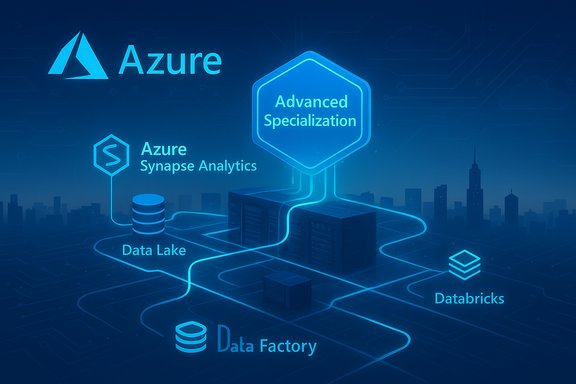
CMC Telecom’s announcement that it has earned the Advanced Specialization — Data Analytics on Microsoft Azure is a clear, high-stakes signal that Vietnam’s cloud and data services market is maturing fast, and that local providers are now competing on the same technical ground as global integrators. This certification, awarded after an independent, Microsoft-appointed audit, confirms that CMC Telecom has the people, processes, and platform experience to design, deliver, and operate large-scale Azure data platforms using tools such as Azure Synapse Analytics, Azure Data Lake, Azure Data Factory, and Azure Databricks.
The Microsoft Advanced Specialization program sits on top of the Solutions Partner / competency framework and is reserved for partners who pass rigorous, independent validation of their delivery capabilities in narrow but critical solution areas. Advanced specializations verify technical proficiency, documented delivery practices, customer outcomes, and staff skilling; they also require measurable Azure usage patterns tied to specific services. Microsoft’s partner guidance notes the specialization’s intent: highlight the partners customers can trust for complex solution areas. Earning an Advanced Specialization in Data/Analytics typically requires:
Source: Báo VietNamNet CMC Telecom becomes Microsoft Azure's elite data analytics partner
 Background
The Microsoft Advanced Specialization program sits on top of the Solutions Partner / competency framework and is reserved for partners who pass rigorous, independent validation of their delivery capabilities in narrow but critical solution areas. Advanced specializations verify technical proficiency, documented delivery practices, customer outcomes, and staff skilling; they also require measurable Azure usage patterns tied to specific services. Microsoft’s partner guidance notes the specialization’s intent: highlight the partners customers can trust for complex solution areas. Earning an Advanced Specialization in Data/Analytics typically requires:- Demonstrable, repeatable delivery of analytics workloads on Azure (Synapse, Data Lake, Data Factory, Databricks).
- Passing a third-party technical audit of delivery practices and customer projects.
- Evidence of active Azure consumption and qualified certified staff.
What CMC Telecom’s Advanced Specialization actually certifies
What Microsoft verifies
At the Advanced Specialization level, Microsoft looks beyond marketing claims and validates operational maturity:- Technical design and architecture: evidence of best-practice architectures for ingestion, storage, processing, governance, and analytics.
- Security and compliance: documented controls and operating procedures relevant to analytics workloads.
- Delivery and operations: repeatable playbooks, run-books, observability, and incident response for analytics platforms.
- People and skills: certified engineers with role-appropriate Azure credentials and proven project experience.
The tooling and platforms confirmed by the certification
The Data Analytics specialization emphasizes the canonical Azure stack used by enterprise analytics teams:- Azure Synapse Analytics — combined data warehouse + big data engine used for query, serving, and analytics.
- Azure Data Lake / ADLS Gen2 — large-scale storage for raw/curated data.
- Azure Data Factory — orchestration and ETL/ELT pipelines.
- Azure Databricks — Spark-based processing for streaming, batch, and ML workloads.
Certification holders are expected to show end-to-end design and operations across these components.
Why this matters for Vietnamese enterprises — and for CMC Telecom
Local capability at global standards
Vietnamese enterprises often prefer partners that combine local presence, regulatory familiarity, and global delivery standards. By passing Microsoft’s independent validation, CMC Telecom demonstrates it can:- Build scalable data lakes and lakehouse architectures on Azure.
- Operate analytics platforms that meet global security and governance expectations.
- Staff and run projects with engineers holding advanced Azure certifications.
GTM and funding advantages
Advanced Specialization status typically unlocks stronger go-to-market support from Microsoft:- Priority visibility in the Microsoft partner listings for Data Analytics and related partner discovery channels.
- Co-sell and referral prioritization from Microsoft account teams for eligible customer opportunities.
- Access to Microsoft funding vehicles for customer pre-sales and POC work (commonly delivered via ECIF / MCI / partner-nominated funding schemes). Microsoft partner programs historically allow qualified partners to access project subsidies and co-investment when Microsoft account teams sanction a project.
The competitive landscape in Vietnam
What the announcement claims
CMC Telecom and CMC TS (part of the same CMC Technology Group) are named as two of the local winners of this certification, and the announcement states only four partners in Vietnam hold this specialization. This depiction signals CMC’s ambition to be the dominant local Azure analytics integrator.Independent context
Other Vietnamese tech groups (notably FPT) have also announced advanced specializations and close Microsoft collaboration on analytics and Fabric initiatives. Internationally, comparable partners (Mindtree, Sopra Steria, Cloud4C, AIS, and others) publish similar achievements and describe nearly identical program benefits and technical scope; this confirms the Advanced Specialization’s consistent technical expectations across markets. Caveat: Microsoft does not maintain a simple public list that explicitly reports “how many partners per country hold X specialization” in an easily searchable, audited fashion. The “four partners” figure appears in CMC’s and VietnamNet’s coverage; it is plausible but not directly verifiable in a single Microsoft public feed at the time of writing. Treat the partner-count claim as CMC’s reported figure unless Microsoft publishes a country-level partner inventory to confirm it.Technical strengths implied by the certification
- Demonstrated ability to design and operate data platform architecture (ingest → storage → transform → serve).
- Proven experience with ETL/ELT pipelines that run at scale (Data Factory / Databricks), including pipeline orchestration and data quality controls.
- Operational governance: identity, access, lineage, and monitoring integrations required for enterprise compliance.
- Delivery maturity: repeatable onboarding, runbooks, SLO/SLAs, and incident response tailored to analytics workloads.
Critical analysis — strengths, limitations, and risks
Notable strengths
- End-to-end capability: Certification implies CMC can take projects from discovery through production operations, reducing vendor handoffs and the friction that often damages analytics programs.
- Local compliance and presence: For Vietnamese customers, a partner that can combine local regulatory knowledge with globally audited practices reduces procurement and security friction.
- Microsoft alignment: Closer collaboration with Microsoft (co-sell, funding eligibility) can lower early-stage project risk by enabling POCs and workshops with subsidized funding and technical sponsorship.
Limitations and practical caveats
- Certification ≠ automatic success: The Advanced Specialization proves capability, not guaranteed outcomes for every deployment. Large analytics efforts still hinge on data quality, domain modeling, and organizational adoption — factors outside pure technical delivery.
- Funding is conditional: Access to Microsoft-funded programs (ECIF/MCI/partner-led incentives) generally requires Microsoft account sponsorship and aligned business cases; funding levels and approvals are not automatic simply because a partner is certified. Partners commonly describe these funding routes as available, but actual disbursement is governed by Microsoft policies and regional program limits.
- Vendor lock-in risk: Deep investment in Azure Synapse, Databricks on Azure, and ADLS Gen2 can create strong platform dependence. That’s not a reason to avoid Azure, but customers should use open formats (Delta/Parquet), clear exit strategies, and data portability practices.
- Talent concentration: Achieving and maintaining Advanced Specialization depends on retaining certified engineers. In competitive markets, certified staff often move; customers should evaluate ongoing training and bench capacity as part of procurement.
Security and governance risks
- Analytics workloads often mix sensitive telemetry, PII, and regulated data. Verified Microsoft tooling (Defender, Azure AD/Entra, Unity Catalog or equivalent governance tooling) provides a baseline, but customers must verify implementation maturity: encryption at rest/in motion, role-based access, least privilege, and auditability. Independent audits and runbook reviews remain essential.
How enterprise buyers should validate a partner’s claims (practical checklist)
- Request concrete case studies: ask for 2–3 production references with contactable customer references and measurable outcomes (MTTR reductions, query latency improvements, cost per terabyte improvements).
- Review the deliverable pack: architecture diagrams, data lineage, deployment automation, and operational runbooks.
- Ask for a skills matrix: names and certifications of engineers who will staff the engagement and evidence of bench coverage.
- Verify governance and security artifacts: encryption approaches, key management, RBAC policies, SIEM/SOC integration, and compliance assessments.
- Confirm funding logistics: ask the partner to explain how they will secure Microsoft ECIF/MCI/partner funding and what Microsoft sponsorship is required.
- Demand an exit and portability plan: formats, schemas (Delta/Parquet), and procedures for data portability or multi-cloud fallback.
Market implications: partners, procurement, and competition
For Vietnamese buyers
Certified local suppliers with Advanced Specializations reduce friction for regulated industries that require audited suppliers. This matters most in finance, healthcare, telco, and government sectors where proof of audited practices is essential during vendor evaluation. CMC Telecom’s certification signals it can now meaningfully compete for high-end analytics projects that previously might have gone to global consultancies.For multinational purchasers and global customers
Global customers evaluating on-shore delivery or local sovereignty will see certified Vietnamese partners as a viable regional alternative. Microsoft’s partner discovery and referral processes tend to prioritize certified partners when recommending local integrators for Azure projects — increasing the probability of qualified lead flow for the partner.For Microsoft and the partner ecosystem
Advanced Specializations help Microsoft scale technical credibility across a partner ecosystem: customers get more trusted delivery options, partners get clearer market differentiation, and Microsoft gains more predictable outcome-oriented implementations that grow Azure consumption. This is the commercial logic behind Microsoft’s certification and incentive model.Broader technical context: why the Synapse + Databricks pattern is common in telco and enterprise analytics
Azure-based lakehouse architectures (Synapse or Databricks-backed) have become the mainstream pattern for high-throughput telemetry ingestion, real-time analytics, and model training in telcos and other data-heavy industries. The pattern emphasizes:- Durable Delta/Parquet storage in ADLS Gen2 or a OneLake/Delta Lake construct.
- Spark-centered processing for both streaming and batch (Databricks or Synapse Spark).
- Governance via Unity Catalog or equivalent metadata/catalog tools.
This pattern is widely documented in telco and enterprise case studies and aligns with what Microsoft’s advanced specialization expects partners to deliver.
Verification notes and flagged claims
- The announcement that CMC Telecom has earned the Advanced Specialization is confirmed by the company’s newsroom post and Vietnamese press coverage.
- The technical scope (Synapse, Data Lake, Data Factory, Databricks) matches Microsoft’s published expectations for the Advanced Specialization and is corroborated by multiple public advanced-specialization announcements from other partners.
- The statement that only four partners in Vietnam hold this level appears in CMC’s communication and local press. Microsoft does not publish an easily queryable, country-level tally that would let an external writer independently confirm the exact “four partners” figure at the time of writing; treat that number as CMC’s reported figure unless Microsoft releases a formal country-level count.
- References to Microsoft MCI funding and similar partner funding options are consistent with how partners access Microsoft incentives (ECIF, MCI/partner-nominated investments), but these funding routes require Microsoft sponsorship and eligibility checks; funding is not a guaranteed entitlement of certification alone. Partners commonly describe the certification as enabling eligibility to apply for or access Microsoft funding programs.
Practical recommendations for WindowsForum readers (IT leaders and architects)
- If you plan an enterprise analytics program: treat certification as an important signal, but require real production references and a technical deep dive. Certifications shorten risk assessments but don’t eliminate them.
- If you need help with scoping or a POC: ask partners for a workshop or co-funded proof (partners with Advanced Specialization commonly co-sponsor POCs under Microsoft programs when the account team approves).
- For procurement teams: include portability and governance KPIs (data lineage, access audits, cost governance) in RFPs so certification maps to measurable operational outcomes.
- For in-house teams: push for cross-training with partner staff and insist on knowledge-transfer plans and runbook handover as part of delivery contracts.
Conclusion
CMC Telecom’s Advanced Specialization in Data Analytics on Microsoft Azure is a meaningful milestone for both the company and the Vietnamese cloud ecosystem. It confirms that a local supplier has met Microsoft’s strict, auditor‑backed standards for designing, deploying, and operating complex Azure analytics platforms — a capability increasingly crucial as enterprises shift to data-driven operations. The certification opens practical GTM advantages and potential funding routes, but buyers should still validate references, confirm funding mechanics, and demand clear governance and portability plans to translate certification into long-term success. As the Vietnamese ecosystem grows, certification wins like this one are tangible proof that local providers can deliver Azure-grade analytics at enterprise scale — while reminding customers to treat badges as necessary but not sufficient evidence of future project outcomes.Source: Báo VietNamNet CMC Telecom becomes Microsoft Azure's elite data analytics partner
