

CMS is proposing a temporary Medicare payment framework for clinical AI and algorithm-driven software in 2027, a move that could matter to hospitals running Windows-based imaging, EHR, and revenue-cycle environments. As reported by STAT, the agency is signalling a longer-term shift away from treating clinical software as an awkward fit inside payment systems built around physical supplies and equipment.
Under the proposed hospital outpatient rule, CMS would rename its existing “Software as a Service” category to Software as a Medical Service, or SaMS. The change is more than branding: CMS says “SaaS” has a well-established meaning in general cloud computing, while these tools perform clinical or diagnostic functions using algorithmic analysis.
CMS proposes to designate 36 HCPCS codes as SaMS services for calendar year 2027. Separately paid tools now placed in ordinary clinical payment groups would move into New Technology Ambulatory Payment Classifications, generally at rates aligned with their 2026 payments.
The agency also proposes a new outpatient status indicator, O1, for SaMS services. It would provide separate payment, much like the existing “S” indicator, while making the clinical-software category visible in claims and payment policy.
CMS says the current approach is poorly suited to tools whose economics are driven by proprietary models, subscriptions, licences, or per-use fees rather than tangible supplies. Its proposed rules specifically cover decision support, risk modelling, computer-aided detection, and software that analyses diagnostic images to support diagnosis or treatment planning. Some software functions involved are FDA-regulated medical devices.
CMS proposes moving 10 such HCPCS-coded services from the Clinical Laboratory Fee Schedule to contractor-priced payments under the Physician Fee Schedule. New codes describing the same type of lab-data algorithm would also be contractor-priced under the PFS beginning in 2027, if the proposal is finalized.
That matters because the lab fee schedule has different pricing mechanics, cost-sharing rules, and budget-neutrality treatment. CMS cited limited transparency into proprietary algorithm costs and potential program-integrity concerns as reasons to reconsider that route.
Hospital IT, informatics, compliance, and billing teams should identify clinical AI and imaging-analysis products already attached to billable workflows, then confirm their CPT and HCPCS mappings with vendors and revenue-cycle staff. The relevant proposals were issued in early July, with the physician-fee rule’s comment period closing September 14, 2026.
CMS will decide later in 2026 whether the SaMS category and 2027 payment changes become final.
Under the proposed hospital outpatient rule, CMS would rename its existing “Software as a Service” category to Software as a Medical Service, or SaMS. The change is more than branding: CMS says “SaaS” has a well-established meaning in general cloud computing, while these tools perform clinical or diagnostic functions using algorithmic analysis.
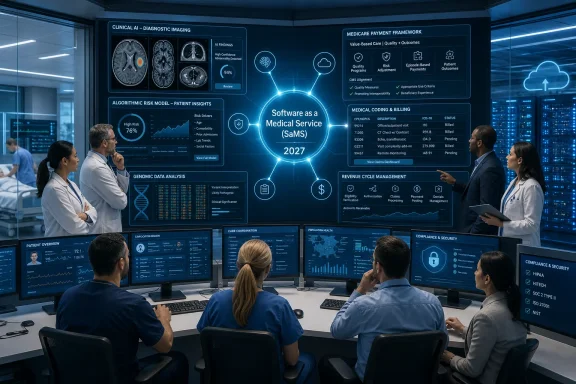 A temporary payment bucket for clinical software
CMS proposes to designate 36 HCPCS codes as SaMS services for calendar year 2027. Separately paid tools now placed in ordinary clinical payment groups would move into New Technology Ambulatory Payment Classifications, generally at rates aligned with their 2026 payments.The agency also proposes a new outpatient status indicator, O1, for SaMS services. It would provide separate payment, much like the existing “S” indicator, while making the clinical-software category visible in claims and payment policy.
CMS says the current approach is poorly suited to tools whose economics are driven by proprietary models, subscriptions, licences, or per-use fees rather than tangible supplies. Its proposed rules specifically cover decision support, risk modelling, computer-aided detection, and software that analyses diagnostic images to support diagnosis or treatment planning. Some software functions involved are FDA-regulated medical devices.
Lab algorithms move out of the lab payment lane
The physician-fee proposal makes a related distinction for algorithms that analyse data generated by an earlier lab test, such as genomic sequencing. CMS argues these secondary analyses are not clinical diagnostic laboratory tests because they can be run without a CLIA-certified laboratory.CMS proposes moving 10 such HCPCS-coded services from the Clinical Laboratory Fee Schedule to contractor-priced payments under the Physician Fee Schedule. New codes describing the same type of lab-data algorithm would also be contractor-priced under the PFS beginning in 2027, if the proposal is finalized.
That matters because the lab fee schedule has different pricing mechanics, cost-sharing rules, and budget-neutrality treatment. CMS cited limited transparency into proprietary algorithm costs and potential program-integrity concerns as reasons to reconsider that route.
What IT and health-system teams should do
This is not a new coverage decision for every AI product, and it does not create a blanket Medicare payment for ambient documentation systems or general-purpose generative AI. It is a proposed, one-year interim structure aimed at selected clinical software services while CMS develops a permanent method that may tie payment more closely to outcomes.Hospital IT, informatics, compliance, and billing teams should identify clinical AI and imaging-analysis products already attached to billable workflows, then confirm their CPT and HCPCS mappings with vendors and revenue-cycle staff. The relevant proposals were issued in early July, with the physician-fee rule’s comment period closing September 14, 2026.
CMS will decide later in 2026 whether the SaMS category and 2027 payment changes become final.
References
- Primary source: STAT
Published: 2026-07-16T08:30:00+00:00
Loading…
www.statnews.com