

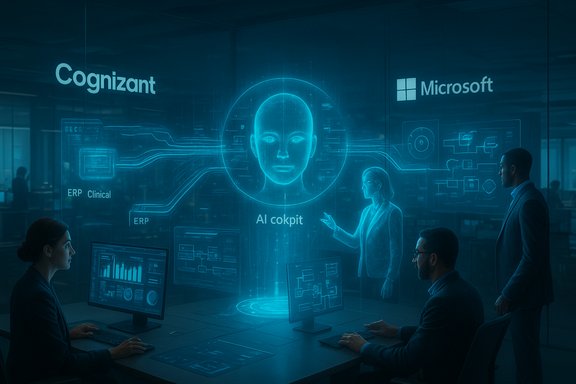
Cognizant and Microsoft have announced an expanded strategic partnership aimed squarely at the so‑called “last‑mile” problem in enterprise AI — the messy, expensive gap between model prototypes and production systems that actually run mission‑critical workflows — promising to embed agentic AI and Copilot experiences into core enterprise processes and to co‑build industry‑grade AI solutions across financial services, healthcare, retail and manufacturing.
Enterprises have spent the last two years racing to adopt large language models, generative AI and agentic assistants. The initial wave — model creation, benchmark wins, and cloud GPU investments — became visible quickly. What has proven much harder is operationalizing those models across complex, regulated systems that must integrate legacy ERP, CRM, clinical systems, and proprietary pipelines. This operational gap is commonly described as the last‑mile problem: the difficulty of making AI useful where work actually happens. Cognizant and Microsoft are not new partners. Their relationship has been expanding since at least 2024, when Cognizant announced a partnership to push Microsoft Copilot broadly into enterprise usage and committed material investment into generative AI initiatives. The December 18, 2025 announcement formalizes a multi‑year strategic pact to co‑innovate, co‑sell and embed Microsoft’s cloud and agentic AI capabilities across Cognizant’s industry platforms. The firms say the goal is to create “AI‑powered frontier firms” — organizations that redefine work and scale AI responsibly across operations.
However, the last mile is not a single product problem; it’s an intersection of data engineering, API specification hygiene, governance, user experience, and organizational change. The partnership promises to attack all these fronts, but the hard work will happen at the customer project level: writing specs, building connectors, securing data, instrumenting models and measuring outcomes. Enterprises should approach vendor claims with pragmatic due diligence: require concrete architecture blueprints, measurable KPIs, pilot case studies and clearly defined governance and cost models.
In short: the Cognizant–Microsoft alliance reduces several barriers to scaling AI, but it does not eliminate the last mile. For enterprises to realize the promised value, they must pair vendor capabilities with internal clarity on data, workflows and governance — and insist on transparent, auditable evidence of business impact.
Source: ERP Today Cognizant and Microsoft Target the Last-Mile Problem in Enterprise AI
 Background
Enterprises have spent the last two years racing to adopt large language models, generative AI and agentic assistants. The initial wave — model creation, benchmark wins, and cloud GPU investments — became visible quickly. What has proven much harder is operationalizing those models across complex, regulated systems that must integrate legacy ERP, CRM, clinical systems, and proprietary pipelines. This operational gap is commonly described as the last‑mile problem: the difficulty of making AI useful where work actually happens. Cognizant and Microsoft are not new partners. Their relationship has been expanding since at least 2024, when Cognizant announced a partnership to push Microsoft Copilot broadly into enterprise usage and committed material investment into generative AI initiatives. The December 18, 2025 announcement formalizes a multi‑year strategic pact to co‑innovate, co‑sell and embed Microsoft’s cloud and agentic AI capabilities across Cognizant’s industry platforms. The firms say the goal is to create “AI‑powered frontier firms” — organizations that redefine work and scale AI responsibly across operations. What the announcement actually says
Key elements of the partnership
- Co‑building industry‑grade AI solutions across core sectors: Financial Services, Healthcare & Life Sciences, Retail and Manufacturing.
- Embedding agentic AI and Copilot experiences (including Microsoft 365 Copilot and GitHub Copilot) into mission‑critical workflows to accelerate productivity, customer experience, and operational resilience.
- Joint global go‑to‑market and co‑selling: Cognizant and Microsoft will collaborate on large‑scale deals and bring joint offerings to enterprise customers.
- Upskilling and internal adoption: Cognizant plans to scale Copilot usage internally and train associates on Azure, Azure AI Foundry, and related Microsoft technologies to build an “AI‑fluent” workforce.
- Leveraging Cognizant’s industry platforms (TriZetto, Skygrade, FlowSource™) and Cognizant Neuro® AI Suite while running on Microsoft cloud and AI services.
Marketing language versus technical promise
The press materials emphasize measurable outcomes and “solving the last‑mile challenge of scaling AI across the enterprise.” That phrase bundles many different technical and organizational tasks — from data plumbing and API specification alignment to governance, model ops, and UX integration of copilots into business systems. The announcement names several Microsoft capabilities (Work IQ, Foundry IQ, Fabric IQ) that will be embedded in workflows, but it stops short of publishing detailed architectural diagrams, specific product SKUs, or client case studies with measurable ROI.What the “last‑mile” problem really means for enterprises
Data, context and tooling — the three choke points
- Data fragmentation: enterprise data often resides in on‑premise databases, legacy file systems, embedded ERP tables, and third‑party SaaS apps. Models cannot act on what they cannot access or interpret consistently. Multiple vendors have described this as the primary bottleneck for production AI.
- Specification gap for tools: models need machine‑readable descriptions of services (OpenAPI, Model Context Protocol) to securely and reliably use enterprise tools. In practice, many enterprise services lack accurate, up‑to‑date specifications — a pragmatic obstacle to agentic workflows.
- Integration and governance: connecting copilots to transactional systems means solving access control, audit trails, data lineage, and regulatory requirements — especially in healthcare and financial services. These aren’t merely engineering problems; they require organizational alignment.
Independent evidence the last‑mile is the limiting factor
Vendors across the stack — from storage specialists like VAST Data to platform integrators within SAP communities — are increasingly framing their product roadmaps around last‑mile solutions such as data catalogs, high‑performance movers, and in‑process connectors. These parallel narratives underscore that the industry sees integration and data accessibility as the core operational problem.Why Cognizant + Microsoft is a meaningful combination — and where it may fall short
Strengths of the alliance
- Scale of delivery: Cognizant is a top global systems integrator with hundreds of thousands of employees and deep industry teams. Pairing that delivery muscle with Microsoft’s cloud and Copilot platform creates a potent mechanism to roll solutions into large accounts. This is a commercial advantage for enterprises that need vendor accountability at scale.
- Platform convergence: embedding Copilot and agentic AI into Microsoft 365, GitHub, Fabric and Work/Foundry IQ creates a consistent UX and identity model for many organizations already standardized on Microsoft tools. That reduces integration friction for some classes of use cases.
- Multi‑pronged investment: Cognizant’s recent strategic moves — including its acquisition of 3Cloud to deepen Azure expertise and investments in its Neuro® AI Suite — show it is building both advisory and engineering capacity to operationalize AI on Microsoft infrastructure. This reinforces the claims made in the partnership announcement.
- Co‑selling and upskilling: Cognizant’s stated plan to scale Copilot internally and to upskill associates into Azure and Azure AI Foundry expertise could accelerate enterprise onboarding if executed at pace. Large license deployments by integrators across India and elsewhere suggest the market is receptive.
Risks, gaps and potential overstated promises
- Vendor diversity and model plurality: Cognizant is simultaneously engaging with other model vendors and enterprise AI providers. For example, Cognizant has relationships with Anthropic and other AI suppliers. That reflects a realistic multi‑model enterprise strategy but also complicates a simplistic narrative that Microsoft alone will solve last‑mile issues. Enterprise customers must plan for heterogeneity.
- Integration complexity remains: embedding Copilot into transactional workflows still requires clean, secure connectors, often bespoke adapters for ERP tables and healthcare claims systems. The press release speaks to “embedding” capabilities but does not disclose the tooling that will automate connector generation, handle tokenization of PHI, or manage per‑transaction authorization. These are nontrivial engineering projects — and subject to regulatory review.
- Regulatory and compliance exposure: scaling copilots into finance and healthcare workflows raises audit, explainability and data residency issues that no partnership announcement can magically erase. Enterprises will still need robust governance, monitoring, and legal review before using generative outputs to make or recommend material decisions.
- Economic tradeoffs and TCO ambiguity: while joint offerings may simplify procurement, embedding agentic AI often increases ongoing cloud, monitoring and model tuning costs. The announcement promises measurable outcomes but omits concrete pricing models and total cost of ownership scenarios that buyers need to budget correctly.
Technical mechanisms likely to be used (and what remains opaque)
Agentic AI and Copilots — what that means in practice
Agentic AI refers to autonomous workflows that can call tools, fetch data, and act on behalf of users. Microsoft’s Copilot ecosystem provides a set of preintegrated experiences (Microsoft 365 Copilot, GitHub Copilot) and the newer Fabric/Foundry/Work IQ offerings to orchestrate data, models and agent capabilities. Cognizant’s role is expected to be building vertical connectors, wrapping these capabilities around industry processes, and delivering change management and governance. The announcement names these technologies explicitly.Model Context Protocol, OpenAPI and the spec gap
A functional agent must know what tools exist and how to use them. That requires up‑to‑date, machine‑readable specifications for enterprise services (for instance, OpenAPI specs). The Model Context Protocol (MCP) and similar efforts attempt to standardize how models discover and invoke services — a necessary bridge for agentic AI, but one still imperfectly implemented across enterprise landscapes. The press release does not present a public standard or productized solution for spec generation, which is where a lot of last‑mile work will actually occur.Data fabric, catalogs and high‑speed movement
Several vendors market data fabric and catalog capabilities to make siloed assets discoverable and AI‑ready. Examples include VAST Data’s SyncEngine and commercial data catalog offerings; these products aim to unify metadata, accelerate ingestion, and provide searchable indexes of unstructured stores. Cognizant’s announcement implies it will integrate similar capabilities into vertical solutions, but implementing them for petabyte‑scale enterprise estates is a major engineering lift.What enterprises should ask their integrators and cloud partners
- What specific connectors and adapters do you provide for our ERP/CRM/clinical systems, and are they supported in production?
- How will Copilot interactions be authorized, audited and reversed if an AI agent issues an incorrect change?
- What are the expected incremental cloud costs (infrastructure, inference, observability) and how will those be measured?
- Which underlying model providers will be used, and how will switching or ensemble strategies be handled?
- What governance, explainability and monitoring tooling is included to meet industry compliance requirements?
- Can you provide client case studies with measured ROI, not just pilot outcomes?
- How will you upskill our workforce and transfer operational ownership to our teams?
Competitive landscape and market implications
Several large Indian systems integrators and cloud integrators are pursuing similar strategies. Reports indicate big planned Copilot seat deployments across firms like TCS, Infosys, Wipro and Cognizant, reflecting a broader industry race to capture enterprise Copilot revenue and implementation services. The result will be intense competition on price, scale, and vertical IP. At the same time, specialized platform vendors (data fabric, metadata, security) are positioning themselves as essential partners to solve specific last‑mile pieces: indexing, high‑speed data movement, and secure tooling invocation. Enterprises should expect multi‑vendor stacks where hyperscalers provide the model and runtime, integrators provide vertical connectors and change management, and best‑of‑breed tooling handles data and governance.Business and financial context
Cognizant’s public statements and recent financial results show a tangible business bet on AI demand. The firm has raised revenue guidance in prior quarters citing strong AI demand and has been actively acquiring Microsoft‑Azure specialists (notably 3Cloud) to deepen its technical bench. These moves provide commercial validation that clients are investing in enterprise AI, but they also increase expectations that integrators will deliver measurable outcomes quickly.Practical deployment roadmap (recommended)
- Discover and prioritize use cases: map high‑value workflows where automation yields measurable KPIs (time saved, error reduction, revenue uplift).
- Inventory data and services: build a catalog of systems of record, APIs, and data sensitivity classes.
- Prototype with guarded boundaries: run Copilot/agent functionality in read‑only or simulated modes for high‑risk workflows.
- Create machine‑readable specs: invest in OpenAPI/MCP artifacts for every service the agent might use.
- Establish governance: define roles, approval flows, monitoring and rollback mechanisms.
- Measure and tune: collect metrics on accuracy, hallucination rate, time to execute, and business KPIs; iterate.
- Upskill and institutionalize: deliver training, runbooks and SRE playbooks so operations teams can take ownership.
Where claims need verification — flagged items
- Scale of Copilot seat deployments: press coverage and vendor announcements suggest very large numbers of planned Copilot licenses across integrators, but public filings and customer contracts are not always transparent. Any single headline figure (for example, “over 200,000 licenses deployed”) should be validated directly with vendors or through contract disclosures before being treated as definitive.
- Measurable ROI and timeline: the partnership materials promise measurable outcomes, but enterprises should insist on client references that include specifics (dollars saved, time recovered, throughput improved) and independent verification where possible. Marketing claims are not the same as delivered value.
- Model governance and data residency assurances: integration of copilots with regulated data — especially PHI or financial transactions — requires documented compliance measures. Public announcements rarely detail those controls; buyers must request them.
Final assessment: opportunity, reality, and caution
The Cognizant–Microsoft expansion is a logical and potentially powerful next step in enterprise AI commercialization. Combining Microsoft’s Copilot, Fabric and agentic frameworks with Cognizant’s industry platforms and delivery scale targets the exact friction enterprises complain about: integrating AI into day‑to‑day processes. The move accelerates a market where integrators are competing to become the operational partner that turns pilots into production.However, the last mile is not a single product problem; it’s an intersection of data engineering, API specification hygiene, governance, user experience, and organizational change. The partnership promises to attack all these fronts, but the hard work will happen at the customer project level: writing specs, building connectors, securing data, instrumenting models and measuring outcomes. Enterprises should approach vendor claims with pragmatic due diligence: require concrete architecture blueprints, measurable KPIs, pilot case studies and clearly defined governance and cost models.
In short: the Cognizant–Microsoft alliance reduces several barriers to scaling AI, but it does not eliminate the last mile. For enterprises to realize the promised value, they must pair vendor capabilities with internal clarity on data, workflows and governance — and insist on transparent, auditable evidence of business impact.
Practical takeaway for WindowsForum readers
- Enterprises standardizing on Microsoft stacks should evaluate this partnership as a potential accelerant for Copilot‑centric automation, but must demand technical proof points for connectors to legacy Windows‑hosted ERP systems.
- IT leaders must treat the last mile as a project with discrete deliverables: data cataloging, API specs, governance rules, performance SLAs and cost projections. Vendor roadmaps and marketing materials are helpful starting points — not substitutes for contractual commitments.
- Smaller organizations and teams should resist the temptation to rush to full automation without phased pilots, strong monitoring and human‑in‑the‑loop controls to avoid costly mistakes.
Source: ERP Today Cognizant and Microsoft Target the Last-Mile Problem in Enterprise AI
