

Cohesity spent mid-June 2026 promoting Maestro, Gaia, Microsoft 365 protection, and event demos as one connected AI-era cyber resilience strategy spanning agent-driven recovery, governed enterprise search, ransomware defense, and backup for cloud productivity tenants. The pitch is not merely that backup software should use AI; it is that backup, recovery, telemetry, and data access should become callable infrastructure inside the AI tools enterprises are already adopting. That is a bigger claim, and a riskier one. If Cohesity is right, the next backup console will not look like a console at all.
The most important thing about Cohesity Maestro is not the AI branding. It is the word headless.
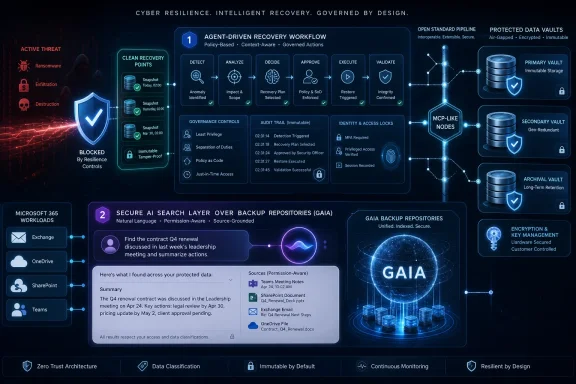
In enterprise software, headless usually means the user interface is no longer the center of gravity. The system exposes functions through APIs, agents, or external workflows, and users interact with it through whatever front end already owns their day. For Cohesity, that means bringing Data Cloud operations into platforms such as Claude, ChatGPT, and Gemini through the Model Context Protocol rather than forcing security teams to jump back into a dedicated backup and recovery interface every time something breaks.
That matters because incident response is already a race against fragmented tools. A ransomware event can involve endpoint security, identity logs, cloud admin portals, backup catalogs, ticketing systems, SIEM dashboards, legal workflows, and executive communications. The backup platform may hold the clean copy of the truth, but it is often one more place responders must remember to check while the clock is running.
Cohesity’s argument is that recovery should meet responders where they already are. If a security analyst is investigating suspicious encryption activity in an AI assistant, Maestro is supposed to expose recovery points, telemetry, search, and restoration actions in that same workflow. The promise is fewer swivel-chair moments and a shorter path from detection to action.
That is a persuasive argument, especially for large organizations where tool sprawl is not an annoyance but an operational tax. But it also changes what backup software is. Once recovery actions can be initiated through AI agents, the platform is no longer just a system of record. It becomes a governed execution layer for humans and machines.
That creates an uncomfortable security reality: an AI agent with access to recovery tools is functionally a privileged user. It may not have a badge, a laptop, or a manager, but it can still request sensitive data, interpret operational telemetry, and potentially initiate powerful actions. Treating that agent as a toy interface would be a category error.
This is where Cohesity’s messaging about “governed users” becomes more than a slogan. If AI agents are allowed to interact with backup and recovery infrastructure, they must be constrained by identity, permissions, policy, audit trails, and context. The right answer is not to pretend agents are harmless because a human typed the prompt. The right answer is to assume every agent interaction belongs inside the same governance model that already applies to administrators and automated service accounts.
For WindowsForum readers, this is the familiar story of least privilege rewritten for the AI age. The old problem was preventing an over-permissioned admin account from becoming a disaster multiplier. The new problem is preventing an over-permissioned agent from doing the same thing faster, with more plausible language around its requests.
Cohesity is positioning Maestro as an answer to that problem, though the market will need proof beyond launch language. The hard questions are not whether an AI assistant can retrieve a recovery point. They are whether the assistant can be reliably stopped from retrieving the wrong data, restoring into the wrong place, or exposing sensitive material to someone who should never have seen it.
That shift is obvious in hindsight. Enterprises have years of email, files, records, conversations, and application data sitting in protected repositories. Those repositories often include historical context that production systems no longer surface cleanly. If AI systems are going to answer business questions, investigate incidents, or find patterns across time, the backup estate becomes a tempting source of institutional memory.
But “tempting” is not the same as safe. Backup data is messy, sensitive, and historically rich in exactly the ways that make governance difficult. It can include deleted files, former employee mailboxes, old SharePoint sites, legal material, stale permissions, and data that was retained for compliance rather than everyday access.
Cohesity’s answer is to put Gaia forward as a secure, policy-driven layer for AI access. In practical terms, that means using role-based controls, retrieval-augmented generation, and governed search to let users query protected data without simply dumping the archive into an AI model’s lap. The pitch is not just “ask your backups questions.” It is “ask your backups questions without blowing up your permissions model.”
That distinction is critical. The enterprise AI market is full of vendors promising to unlock dark data, but dark data is often dark for a reason. It may be unclassified, poorly labeled, legally sensitive, or forgotten by the business unit that created it. A product that turns historical data into AI fuel must also prove that it can preserve boundaries that were never designed with generative AI in mind.
Microsoft 365 backup has become a crowded market because the risk is obvious. Native retention, recycle bins, litigation hold, and versioning can help in specific scenarios, but they are not a complete substitute for independent backup and clean recovery. Ransomware crews, malicious insiders, and misconfigured automation do not care whether the organization has five admins or five hundred.
The midmarket pain point is that smaller organizations need enterprise-grade recovery outcomes without enterprise-grade staffing. A lean IT team does not want to spend an incident reconstructing which Teams channels matter, which SharePoint libraries were hit, or whether a restored mailbox is clean enough to trust. It wants fast, comprehensible recovery with a minimum of specialized choreography.
That is why Cohesity’s tenant-wipe messaging is pointed. A full or partial Microsoft 365 tenant compromise is the kind of nightmare scenario that exposes the gap between “we have retention” and “we can restore the business.” If Cohesity can make clean recovery repeatable for organizations that do not have a dedicated cyber recovery team, the Essentials offer has a clearer audience than a generic backup bundle.
The Windows angle is straightforward. Microsoft 365 is where a huge share of Windows-centric organizations now live day to day. Protecting endpoints and servers still matters, but for many businesses the operational crown jewels have shifted into cloud identity, mail, files, and collaboration spaces. Backup vendors that cannot tell a credible Microsoft 365 recovery story are leaving the front door open.
Vendor-run comparative testing always deserves caution. The configuration details, malware samples, workload assumptions, and operational procedures matter enormously. A test can be useful without being the final word on a product’s real-world resilience.
Even so, Cohesity’s emphasis on VMware protection jobs continuing successfully under multiple malware strains points at the right problem. Backup systems are no longer passive targets sitting outside the blast radius. Attackers increasingly understand that the clean backup is the defender’s escape hatch, so they try to corrupt it, delete it, encrypt it, or compromise the credentials needed to manage it.
In that environment, anomaly detection is helpful but insufficient. A backup platform must keep operating under stress, preserve immutability, isolate clean recovery points, and help administrators distinguish usable backups from poisoned ones. Alerting that something weird happened is only the beginning; the operational question is whether recovery remains possible when the alert arrives.
The reported NetBackup result is also worth noting because it complicates the easy vendor-war narrative. According to the summary provided, NetBackup also maintained successful backup and recovery despite anomaly alerts. That suggests the serious competition is not between backup and no backup, but between mature platforms trying to prove they can survive increasingly hostile recovery conditions.
That is where the market is moving. Backup vendors do not want to be summoned only after disaster. Security vendors do not want to stop at detection. Cloud vendors want the AI workload. Infrastructure vendors want the AI factory. Consulting partners want the transformation program. Everyone wants to be the control plane.
Cohesity’s differentiation is that it can plausibly argue that protected data is the foundation for several of those ambitions. You cannot recover what you did not protect. You cannot safely query historical enterprise knowledge if you cannot govern access to it. You cannot build resilient AI workflows if corrupted embeddings, compromised source data, or poisoned context can spread unchecked.
That is a strong strategic position, but it is not uncontested. Rubrik, Commvault, Veritas, Veeam, Dell, Microsoft, and cloud-native backup players all want pieces of the same territory. The AI layer adds urgency because whoever becomes the trusted broker between protected data and enterprise agents may gain influence far beyond traditional backup purchasing cycles.
This is why Maestro’s use of an open standard such as MCP is more than a technical footnote. If enterprises standardize on multiple AI assistants, a backup vendor that insists on its own proprietary interface risks becoming another silo. If Cohesity can make its platform callable from the AI tools companies already use, it gains a better shot at staying relevant as workflows shift away from classic admin consoles.
Consider a prompt asking an agent to “restore the cleanest pre-incident copy of the finance SharePoint site.” That sounds reasonable, but every word hides decisions. What counts as pre-incident? How is cleanliness determined? Should permissions be restored exactly as they were, or corrected if they were part of the compromise? Should the restore overwrite production, land in a clean room, or generate a staged comparison first?
A good system can expose those choices. A bad one can make them disappear.
This is the central tension in AI-integrated cyber resilience. The more natural the interface becomes, the more disciplined the underlying policy model must be. AI should reduce friction, not remove safeguards that existed because production recovery is dangerous work.
For administrators, that means Maestro-like systems should be evaluated less like chatbots and more like automation frameworks. The questions should be concrete. What actions can the agent perform? Which roles approve them? What logs are created? Can prompts be replayed during an audit? Can destructive actions require step-up authentication or human confirmation? Can the system explain why it selected a given recovery point?
If the answers are strong, AI becomes an accelerator. If the answers are weak, AI becomes a very polished way to misconfigure recovery at machine speed.
That makes healthcare a useful lens for the broader market. The same forces apply elsewhere, but healthcare compresses them into the clearest possible stakes. Patient records must be available, but not overexposed. Historical data may be valuable for research and operations, but it cannot be treated as a free-for-all AI corpus. Recovery must be fast, but not careless.
This is where Cohesity’s combination of Gaia and cyber recovery becomes more interesting than either product alone. Secure AI search across protected data is attractive only if the underlying data remains trustworthy. Ransomware recovery is more valuable when administrators can understand what was affected, what remains clean, and what data relationships matter.
The regulated-sector challenge is that governance claims must survive auditors, not just demos. Role-based controls, data locality, auditability, retention policies, and clean-room recovery all become part of the buying conversation. AI may help users find information faster, but compliance teams will want to know who asked, what was returned, and whether the answer crossed a boundary.
Cohesity’s opportunity is to argue that the backup platform is already a natural place to enforce many of those controls. Its burden is to prove that adding AI access does not weaken them.
A backup agent that can search mailboxes, inspect SharePoint content, or trigger restores must authenticate somehow. It must map requests to users or service identities. It must respect tenant boundaries and role assignments. It must also leave behind logs that administrators can correlate with incident timelines.
That means AI recovery tools will increasingly belong in access reviews and tabletop exercises. They should not be treated as magic sidecars owned by the backup team alone. Security operations, identity administrators, compliance teams, and Microsoft 365 admins all have a stake in how these systems are granted power.
The practical question is whether organizations can keep their governance model legible. If an analyst asks ChatGPT to query Cohesity, which identity is being evaluated? If a Gemini workflow calls Maestro through MCP, where is the approval enforced? If a recovery action touches Exchange Online data, can the Microsoft 365 team see enough of the chain to understand what happened?
These are not reasons to reject the model. They are reasons to demand clarity before deployment. The future of recovery may be headless, but accountability cannot be.
Traditional backup was built around accidental deletion, hardware failure, and disaster recovery. Modern cyber resilience must handle malicious encryption, credential compromise, data exfiltration, SaaS misconfiguration, insider action, regulatory scrutiny, and now AI systems that may consume, summarize, or act on enterprise data. The job is no longer just making a copy. It is preserving a trustworthy version of the business.
That is why backup vendors are racing to become data security platforms. They have access to historical data, metadata, recovery points, and operational telemetry that security tools often lack. They can observe changes over time. They can offer clean-room recovery. They can enforce immutability. And increasingly, they can supply AI systems with governed context.
Cohesity’s challenge is to make that expanded role credible without making the product feel sprawling. The more a platform claims to do, the more buyers worry about complexity. Maestro is therefore a clever strategic move because it argues that broader capability does not have to mean another interface. The platform can get bigger while the user experience becomes more embedded.
That is the theory. The reality will depend on execution. AI-native workflows are only useful if they are reliable under pressure, explainable during audits, and boringly predictable when the organization is already in crisis.
That is a lot to ask customers to absorb. It also reflects where the cyber resilience market is heading. The old backup purchase was often made by infrastructure teams on retention, storage efficiency, recovery time, and cost. The new purchase touches security operations, AI governance, SaaS administration, compliance, and board-level ransomware risk.
Cohesity is trying to move up that value chain. It wants to be understood not merely as the place where copies live, but as the governed control point between enterprise data, AI agents, and recovery operations. That is a more ambitious identity, and it comes with more scrutiny.
The key uncertainty is whether customers are ready to operationalize AI in recovery workflows. Many organizations are still struggling with basic backup hygiene, privilege management, and Microsoft 365 retention strategy. For them, headless AI recovery may feel premature. But large enterprises already experimenting with agents will need exactly this sort of governance layer before they trust AI with serious operational authority.
 Cohesity Wants Recovery to Leave the Backup Console Behind
The most important thing about Cohesity Maestro is not the AI branding. It is the word headless.In enterprise software, headless usually means the user interface is no longer the center of gravity. The system exposes functions through APIs, agents, or external workflows, and users interact with it through whatever front end already owns their day. For Cohesity, that means bringing Data Cloud operations into platforms such as Claude, ChatGPT, and Gemini through the Model Context Protocol rather than forcing security teams to jump back into a dedicated backup and recovery interface every time something breaks.
That matters because incident response is already a race against fragmented tools. A ransomware event can involve endpoint security, identity logs, cloud admin portals, backup catalogs, ticketing systems, SIEM dashboards, legal workflows, and executive communications. The backup platform may hold the clean copy of the truth, but it is often one more place responders must remember to check while the clock is running.
Cohesity’s argument is that recovery should meet responders where they already are. If a security analyst is investigating suspicious encryption activity in an AI assistant, Maestro is supposed to expose recovery points, telemetry, search, and restoration actions in that same workflow. The promise is fewer swivel-chair moments and a shorter path from detection to action.
That is a persuasive argument, especially for large organizations where tool sprawl is not an annoyance but an operational tax. But it also changes what backup software is. Once recovery actions can be initiated through AI agents, the platform is no longer just a system of record. It becomes a governed execution layer for humans and machines.
The AI Agent Is Becoming Another Privileged User
Cohesity’s framing lands because enterprise AI has moved past the demo phase. Organizations are no longer asking only whether a chatbot can summarize a document. They are asking whether agents can help triage alerts, query archives, generate remediation plans, and trigger workflows across systems that were never designed for conversational control.That creates an uncomfortable security reality: an AI agent with access to recovery tools is functionally a privileged user. It may not have a badge, a laptop, or a manager, but it can still request sensitive data, interpret operational telemetry, and potentially initiate powerful actions. Treating that agent as a toy interface would be a category error.
This is where Cohesity’s messaging about “governed users” becomes more than a slogan. If AI agents are allowed to interact with backup and recovery infrastructure, they must be constrained by identity, permissions, policy, audit trails, and context. The right answer is not to pretend agents are harmless because a human typed the prompt. The right answer is to assume every agent interaction belongs inside the same governance model that already applies to administrators and automated service accounts.
For WindowsForum readers, this is the familiar story of least privilege rewritten for the AI age. The old problem was preventing an over-permissioned admin account from becoming a disaster multiplier. The new problem is preventing an over-permissioned agent from doing the same thing faster, with more plausible language around its requests.
Cohesity is positioning Maestro as an answer to that problem, though the market will need proof beyond launch language. The hard questions are not whether an AI assistant can retrieve a recovery point. They are whether the assistant can be reliably stopped from retrieving the wrong data, restoring into the wrong place, or exposing sensitive material to someone who should never have seen it.
Gaia Turns Backup Data Into an AI Substrate
Gaia is the second half of Cohesity’s AI story, and arguably the more strategic one. Backups have long been treated as insurance: essential, expensive, and mostly invisible until disaster strikes. Gaia reframes protected data as an actively queryable corpus for enterprise AI.That shift is obvious in hindsight. Enterprises have years of email, files, records, conversations, and application data sitting in protected repositories. Those repositories often include historical context that production systems no longer surface cleanly. If AI systems are going to answer business questions, investigate incidents, or find patterns across time, the backup estate becomes a tempting source of institutional memory.
But “tempting” is not the same as safe. Backup data is messy, sensitive, and historically rich in exactly the ways that make governance difficult. It can include deleted files, former employee mailboxes, old SharePoint sites, legal material, stale permissions, and data that was retained for compliance rather than everyday access.
Cohesity’s answer is to put Gaia forward as a secure, policy-driven layer for AI access. In practical terms, that means using role-based controls, retrieval-augmented generation, and governed search to let users query protected data without simply dumping the archive into an AI model’s lap. The pitch is not just “ask your backups questions.” It is “ask your backups questions without blowing up your permissions model.”
That distinction is critical. The enterprise AI market is full of vendors promising to unlock dark data, but dark data is often dark for a reason. It may be unclassified, poorly labeled, legally sensitive, or forgotten by the business unit that created it. A product that turns historical data into AI fuel must also prove that it can preserve boundaries that were never designed with generative AI in mind.
Microsoft 365 Is the Midmarket Battleground
Cohesity’s Microsoft 365 Essentials push shows where this strategy becomes practical for smaller IT teams. Exchange Online, OneDrive, SharePoint, and Teams are now core operating infrastructure for many organizations, not optional collaboration tools. If a tenant is compromised or wiped, the business does not merely lose documents; it loses its memory, communications, workflows, and often its ability to coordinate the recovery.Microsoft 365 backup has become a crowded market because the risk is obvious. Native retention, recycle bins, litigation hold, and versioning can help in specific scenarios, but they are not a complete substitute for independent backup and clean recovery. Ransomware crews, malicious insiders, and misconfigured automation do not care whether the organization has five admins or five hundred.
The midmarket pain point is that smaller organizations need enterprise-grade recovery outcomes without enterprise-grade staffing. A lean IT team does not want to spend an incident reconstructing which Teams channels matter, which SharePoint libraries were hit, or whether a restored mailbox is clean enough to trust. It wants fast, comprehensible recovery with a minimum of specialized choreography.
That is why Cohesity’s tenant-wipe messaging is pointed. A full or partial Microsoft 365 tenant compromise is the kind of nightmare scenario that exposes the gap between “we have retention” and “we can restore the business.” If Cohesity can make clean recovery repeatable for organizations that do not have a dedicated cyber recovery team, the Essentials offer has a clearer audience than a generic backup bundle.
The Windows angle is straightforward. Microsoft 365 is where a huge share of Windows-centric organizations now live day to day. Protecting endpoints and servers still matters, but for many businesses the operational crown jewels have shifted into cloud identity, mail, files, and collaboration spaces. Backup vendors that cannot tell a credible Microsoft 365 recovery story are leaving the front door open.
Ransomware Resilience Is Still the Proof Point
AI may be the headline, but ransomware remains the test. Cohesity’s discussion of DataProtect comparisons against Veritas NetBackup is a reminder that the market still judges backup vendors by a brutally simple question: when malware arrives, can you keep protecting data and recover cleanly?Vendor-run comparative testing always deserves caution. The configuration details, malware samples, workload assumptions, and operational procedures matter enormously. A test can be useful without being the final word on a product’s real-world resilience.
Even so, Cohesity’s emphasis on VMware protection jobs continuing successfully under multiple malware strains points at the right problem. Backup systems are no longer passive targets sitting outside the blast radius. Attackers increasingly understand that the clean backup is the defender’s escape hatch, so they try to corrupt it, delete it, encrypt it, or compromise the credentials needed to manage it.
In that environment, anomaly detection is helpful but insufficient. A backup platform must keep operating under stress, preserve immutability, isolate clean recovery points, and help administrators distinguish usable backups from poisoned ones. Alerting that something weird happened is only the beginning; the operational question is whether recovery remains possible when the alert arrives.
The reported NetBackup result is also worth noting because it complicates the easy vendor-war narrative. According to the summary provided, NetBackup also maintained successful backup and recovery despite anomaly alerts. That suggests the serious competition is not between backup and no backup, but between mature platforms trying to prove they can survive increasingly hostile recovery conditions.
The Real Contest Is Over Workflow Ownership
Cohesity’s week of announcements and event appearances should be read as a bid for workflow ownership. At HPE Discover in Las Vegas, NVIDIA-related demos, and CatalystOnTour activity, the company was not merely showing features. It was trying to place itself in the middle of the enterprise AI, hybrid cloud, data protection, and cyber resilience conversation.That is where the market is moving. Backup vendors do not want to be summoned only after disaster. Security vendors do not want to stop at detection. Cloud vendors want the AI workload. Infrastructure vendors want the AI factory. Consulting partners want the transformation program. Everyone wants to be the control plane.
Cohesity’s differentiation is that it can plausibly argue that protected data is the foundation for several of those ambitions. You cannot recover what you did not protect. You cannot safely query historical enterprise knowledge if you cannot govern access to it. You cannot build resilient AI workflows if corrupted embeddings, compromised source data, or poisoned context can spread unchecked.
That is a strong strategic position, but it is not uncontested. Rubrik, Commvault, Veritas, Veeam, Dell, Microsoft, and cloud-native backup players all want pieces of the same territory. The AI layer adds urgency because whoever becomes the trusted broker between protected data and enterprise agents may gain influence far beyond traditional backup purchasing cycles.
This is why Maestro’s use of an open standard such as MCP is more than a technical footnote. If enterprises standardize on multiple AI assistants, a backup vendor that insists on its own proprietary interface risks becoming another silo. If Cohesity can make its platform callable from the AI tools companies already use, it gains a better shot at staying relevant as workflows shift away from classic admin consoles.
Open Agentic Recovery Also Opens New Failure Modes
The headless model has a downside: abstraction can hide danger. A console forces administrators to confront the shape of a system. A conversational interface can compress complicated operations into a tidy answer, which is useful until the answer masks a risky assumption.Consider a prompt asking an agent to “restore the cleanest pre-incident copy of the finance SharePoint site.” That sounds reasonable, but every word hides decisions. What counts as pre-incident? How is cleanliness determined? Should permissions be restored exactly as they were, or corrected if they were part of the compromise? Should the restore overwrite production, land in a clean room, or generate a staged comparison first?
A good system can expose those choices. A bad one can make them disappear.
This is the central tension in AI-integrated cyber resilience. The more natural the interface becomes, the more disciplined the underlying policy model must be. AI should reduce friction, not remove safeguards that existed because production recovery is dangerous work.
For administrators, that means Maestro-like systems should be evaluated less like chatbots and more like automation frameworks. The questions should be concrete. What actions can the agent perform? Which roles approve them? What logs are created? Can prompts be replayed during an audit? Can destructive actions require step-up authentication or human confirmation? Can the system explain why it selected a given recovery point?
If the answers are strong, AI becomes an accelerator. If the answers are weak, AI becomes a very polished way to misconfigure recovery at machine speed.
Healthcare Shows Why the Stakes Are Higher Than Uptime
Cohesity’s messaging around regulated sectors, including healthcare, is not incidental. Healthcare organizations sit at the intersection of sensitive data, legacy systems, uptime pressure, and ransomware targeting. A hospital does not experience data loss as an abstract IT problem; it experiences it as delayed care, diverted patients, regulatory exposure, and public trust damage.That makes healthcare a useful lens for the broader market. The same forces apply elsewhere, but healthcare compresses them into the clearest possible stakes. Patient records must be available, but not overexposed. Historical data may be valuable for research and operations, but it cannot be treated as a free-for-all AI corpus. Recovery must be fast, but not careless.
This is where Cohesity’s combination of Gaia and cyber recovery becomes more interesting than either product alone. Secure AI search across protected data is attractive only if the underlying data remains trustworthy. Ransomware recovery is more valuable when administrators can understand what was affected, what remains clean, and what data relationships matter.
The regulated-sector challenge is that governance claims must survive auditors, not just demos. Role-based controls, data locality, auditability, retention policies, and clean-room recovery all become part of the buying conversation. AI may help users find information faster, but compliance teams will want to know who asked, what was returned, and whether the answer crossed a boundary.
Cohesity’s opportunity is to argue that the backup platform is already a natural place to enforce many of those controls. Its burden is to prove that adding AI access does not weaken them.
Windows Admins Should Watch the Identity Layer
For Windows and Microsoft 365 administrators, the most consequential part of this story may be identity rather than storage. Microsoft Entra ID, conditional access, privileged roles, service principals, delegated permissions, and third-party app consent are already central to cloud administration. AI-integrated recovery adds another tier of actors and permissions to that landscape.A backup agent that can search mailboxes, inspect SharePoint content, or trigger restores must authenticate somehow. It must map requests to users or service identities. It must respect tenant boundaries and role assignments. It must also leave behind logs that administrators can correlate with incident timelines.
That means AI recovery tools will increasingly belong in access reviews and tabletop exercises. They should not be treated as magic sidecars owned by the backup team alone. Security operations, identity administrators, compliance teams, and Microsoft 365 admins all have a stake in how these systems are granted power.
The practical question is whether organizations can keep their governance model legible. If an analyst asks ChatGPT to query Cohesity, which identity is being evaluated? If a Gemini workflow calls Maestro through MCP, where is the approval enforced? If a recovery action touches Exchange Online data, can the Microsoft 365 team see enough of the chain to understand what happened?
These are not reasons to reject the model. They are reasons to demand clarity before deployment. The future of recovery may be headless, but accountability cannot be.
Backup Is Being Rebranded Because the Job Changed
It is easy to dismiss vendor language such as “AI-powered data security” as marketing inflation. Sometimes it is. But the backup category really has changed.Traditional backup was built around accidental deletion, hardware failure, and disaster recovery. Modern cyber resilience must handle malicious encryption, credential compromise, data exfiltration, SaaS misconfiguration, insider action, regulatory scrutiny, and now AI systems that may consume, summarize, or act on enterprise data. The job is no longer just making a copy. It is preserving a trustworthy version of the business.
That is why backup vendors are racing to become data security platforms. They have access to historical data, metadata, recovery points, and operational telemetry that security tools often lack. They can observe changes over time. They can offer clean-room recovery. They can enforce immutability. And increasingly, they can supply AI systems with governed context.
Cohesity’s challenge is to make that expanded role credible without making the product feel sprawling. The more a platform claims to do, the more buyers worry about complexity. Maestro is therefore a clever strategic move because it argues that broader capability does not have to mean another interface. The platform can get bigger while the user experience becomes more embedded.
That is the theory. The reality will depend on execution. AI-native workflows are only useful if they are reliable under pressure, explainable during audits, and boringly predictable when the organization is already in crisis.
The Week’s Message Was Bigger Than One Product Launch
Cohesity’s busy week looks coordinated because it was selling a single narrative from several angles. Maestro says recovery and telemetry should become available inside enterprise AI workflows. Gaia says protected data should become a governed knowledge layer for AI. Microsoft 365 Essentials says smaller organizations need clean cloud productivity recovery without enterprise complexity. Event demos with HPE, NVIDIA, and broader ecosystem partners say the strategy belongs inside the larger enterprise AI infrastructure buildout.That is a lot to ask customers to absorb. It also reflects where the cyber resilience market is heading. The old backup purchase was often made by infrastructure teams on retention, storage efficiency, recovery time, and cost. The new purchase touches security operations, AI governance, SaaS administration, compliance, and board-level ransomware risk.
Cohesity is trying to move up that value chain. It wants to be understood not merely as the place where copies live, but as the governed control point between enterprise data, AI agents, and recovery operations. That is a more ambitious identity, and it comes with more scrutiny.
The key uncertainty is whether customers are ready to operationalize AI in recovery workflows. Many organizations are still struggling with basic backup hygiene, privilege management, and Microsoft 365 retention strategy. For them, headless AI recovery may feel premature. But large enterprises already experimenting with agents will need exactly this sort of governance layer before they trust AI with serious operational authority.
The Signal Inside Cohesity’s AI-Resilience Blitz
Cohesity’s week is best read as a directional marker for the whole market, not just a product update. The concrete details matter because they show how quickly cyber resilience is being pulled into the AI workflow layer.- Maestro is Cohesity’s bid to make backup, recovery, telemetry, and AI search callable from external agent platforms rather than locked inside a traditional console.
- Gaia turns protected enterprise data into a governed AI-search layer, which is powerful only if permissions, auditability, and data boundaries hold up.
- Microsoft 365 Essentials targets a real midmarket problem: lean IT teams need clean recovery for Exchange Online, OneDrive, SharePoint, and Teams when tenant-level damage occurs.
- Ransomware resilience remains the credibility test, because AI features mean little if the platform cannot preserve and restore clean data under attack.
- The use of open agent standards could reduce workflow friction, but it also forces enterprises to treat AI agents as privileged actors that require identity controls and oversight.
- Cohesity’s ecosystem activity around HPE, NVIDIA, and regulated industries shows that backup vendors are now competing to become part of the enterprise AI infrastructure stack.
References
- Primary source: TipRanks
Published: 2026-06-27T14:33:09.472463
- Related coverage: cohesity.com
- Related coverage: events.cohesity.com

