

Collins’ shift wasn’t just creative reinvention; it was a strategic recentering of the agency around value creation as valuation — a change that, by 2025, had been systematized into repeatable programs, an AI-driven asset engine and a C-suite-facing offer that turned design projects into measurable business outcomes. Ad Age’s profile of the firm captured the moment: Collins was named Ad Age’s Business Transformation Agency of the Year after a banner period in which revenue and C-suite engagement grew and marquee wins piled up.
For nearly two decades Collins built a reputation as a design-led creative consultancy. That pedigree — rooted in high-caliber visual identity, product and experience work — remains central to the firm’s DNA. But a series of engagements with private-equity and enterprise clients in recent years catalyzed a deeper repositioning: Collins began to think of brand work not as aesthetic output but as a lever for valuation — a lever that could be articulated, operationalized and sold into boardroom objectives. The co-founders and executive team publicly describe that inflection as deliberate and strategic, and Collins’ own messaging and industry profiles show the agency leaning into transformation consulting alongside design.
What changed in practice was twofold. First, Collins began structuring briefs and deliverables around CEO-level problems — repositioning, turnaround, expansion and brand creation — and sold outcomes of brand work as drivers of long-term financial value. Second, the agency invested in tools, processes and teams to scale the repeatability of those programs, including internal platforms that thrift design craft into reproducible asset generation. The result was an argument that branding creates compounding emotional value which translates into rational preference and, ultimately, pricing power — an idea Collins now frames as central to its commercial value proposition.
This isn’t semantics. Reframing brand work as valuation changes incentives at every level:
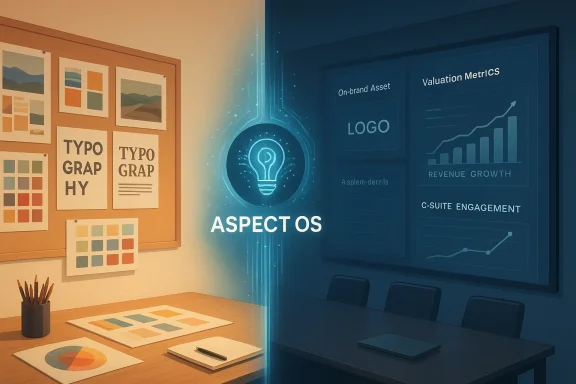
It’s important to stress what can and cannot be independently verified. Collins and the Ad Age profile describe Aspect OS as a core capability; the agency’s broader public materials and interviews also discuss AI and tooling as part of their future-facing approach. However, technical details — model architecture, data provenance, governance controls, and deployment scenarios for Aspect OS — are not broadly documented in standalone technical disclosures or third-party reviews. That means Aspect OS is best read as a strategic capability the agency claims to have operationalized, while the platform’s technical maturity and real-world impact (beyond Collins’ reported metrics) remain to be independently audited. Where vendors and consultancies build proprietary AI IP, outside verification is often limited to client case studies or limited third-party audits; readers should treat claims about capability and impact accordingly.
The result was a unifying platform Collins summarized as “Create the technical edge.” The thesis reframes Nike as the builder of a technical edge — an advantage athletes can’t manufacture themselves — which anchors product, R&D and corporate storytelling. The strategic benefit: unify thousands of R&D staff under a single, defensible mission and make innovation communicable to consumers and partners. This is a classic Collins move: find a desirable, defensible differentiation and articulate it so it can drive value in product, marketing and investor narratives.
Collins’ solution: a unifying brand platform anchored in the rallying cry “Dare Mighty Questions” — a deliberate reframing that ties JPL’s engineering culture to a compelling public story. The strategic goal was to convert anonymous technical achievement into institutional prestige and public recognition, thereby reducing friction in talent and funding pipelines. This is a form of brand work that serves a multiple-stakeholder, policy-facing mission — the kind of transformation that extends beyond commerce to civic capital.
Tactical moves included a site rebuild and identity simplification (the logo moving from “Red Wing Shoes” to simply “Red Wing”) — an execution that is small in production cost but high in organizational clarity and long-term brand governance. The Red Wing case is illustrative: transformation often boils down to removing friction to let a brand’s core truth do the heavy lifting.
A careful reader should note the boundary between what’s reported and what’s independently verified:
At the same time, the story highlights the limits of public reporting: specific technical claims about internal AI platforms and some financial metrics rest primarily on agency and trade-press reporting. For the industry to fully trust the newer model — and for clients to underwrite large transformation budgets — the next phase will require independent validation: audited business outcomes, transparent AI governance and peer-reviewed case studies that isolate brand’s causal role in enterprise value creation. Collins has made a compelling case that brand can be reframed as valuation; the wider test now is whether the industry can build the evidence base to make that reframing universally investible.
Source: Ad Age How Collins transformed its own business, bringing value to brands from Nike to NASA
 Background / Overview
For nearly two decades Collins built a reputation as a design-led creative consultancy. That pedigree — rooted in high-caliber visual identity, product and experience work — remains central to the firm’s DNA. But a series of engagements with private-equity and enterprise clients in recent years catalyzed a deeper repositioning: Collins began to think of brand work not as aesthetic output but as a lever for valuation — a lever that could be articulated, operationalized and sold into boardroom objectives. The co-founders and executive team publicly describe that inflection as deliberate and strategic, and Collins’ own messaging and industry profiles show the agency leaning into transformation consulting alongside design.What changed in practice was twofold. First, Collins began structuring briefs and deliverables around CEO-level problems — repositioning, turnaround, expansion and brand creation — and sold outcomes of brand work as drivers of long-term financial value. Second, the agency invested in tools, processes and teams to scale the repeatability of those programs, including internal platforms that thrift design craft into reproducible asset generation. The result was an argument that branding creates compounding emotional value which translates into rational preference and, ultimately, pricing power — an idea Collins now frames as central to its commercial value proposition.
The strategic turn: from revenue to valuation
Why valuation became the north star
The watershed moment for Collins came while working with Blackstone, which prompted the agency to treat brand strategy as a mechanism to drive enterprise value across a portfolio. That relationship exposed Collins to language and metrics beyond advertising performance — multiples, exit scenarios, and investor-level signals. The agency’s leadership concluded that their work should be sold and measured as value-creation rather than mere revenue uplift, reshaping how they scoped projects and the stakeholders they pursued. That epiphany is now baked into Collins’ positioning: the agency pitches itself as a specialist for CEO problems that need creative strategy married to operational rigor.This isn’t semantics. Reframing brand work as valuation changes incentives at every level:
- Strategy becomes tied to financial KPIs and investor narratives.
- Creative outputs are judged on their ability to produce enduring preference and pricing power.
- Client relationships migrate upstream to the C-suite, where strategic change can be funded and scaled.
Making transformation repeatable
To move from an artisan model to a repeatable consultancy, Collins invested in systems and playbooks. That meant defining repeatable programs around specific CEO challenges — reposition, turn around, expand, or create a brand — and codifying processes for discovery, prioritization, design systems and governance. The agency’s public statements and interviews emphasize the programmatic nature of this shift: not one-off creative epics but modular programs that can be executed and measured across a range of clients. This operationalization allows Collins to pitch transformation as a predictable path to business outcomes rather than a speculative creative gamble.Putting AI into the product: Aspect OS and the automation of on-brand work
One of the boldest moves Collins announced internally — and which Ad Age reported in its profile — is the development of an AI platform called Aspect OS. According to the reporting, Aspect OS is positioned as an engine to generate on-brand assets at scale: creative templates, identity permutations, and a faster path from strategy to material execution. The pitch is familiar to anyone tracking agency modernization: reduce low-value production time, allow strategic teams to iterate faster, and embed brand rules in machine-accessible form so outputs remain consistent across channels.It’s important to stress what can and cannot be independently verified. Collins and the Ad Age profile describe Aspect OS as a core capability; the agency’s broader public materials and interviews also discuss AI and tooling as part of their future-facing approach. However, technical details — model architecture, data provenance, governance controls, and deployment scenarios for Aspect OS — are not broadly documented in standalone technical disclosures or third-party reviews. That means Aspect OS is best read as a strategic capability the agency claims to have operationalized, while the platform’s technical maturity and real-world impact (beyond Collins’ reported metrics) remain to be independently audited. Where vendors and consultancies build proprietary AI IP, outside verification is often limited to client case studies or limited third-party audits; readers should treat claims about capability and impact accordingly.
Case studies that define the argument
Collins’ repositioning is best explained through the headline case studies Ad Age documented. These examples show how strategy and execution were aligned to CEO-level goals — not just creative refreshes but repositionings that address competitive differentiation, talent, political capital and markets.Nike — editing innovation into a throughline
Nike’s brief to Collins was not a classic logo refresh or a campaign; it was a strategic attempt to clarify what made Nike’s innovation special when innovation itself had become diffuse within the company. Collins worked with Nike’s Advanced Innovation Collective and collaborated with John Hoke, then chief innovation officer. The team’s approach was editorial rather than narrative invention: sift through the company’s dense innovation activity and find the unifying thread.The result was a unifying platform Collins summarized as “Create the technical edge.” The thesis reframes Nike as the builder of a technical edge — an advantage athletes can’t manufacture themselves — which anchors product, R&D and corporate storytelling. The strategic benefit: unify thousands of R&D staff under a single, defensible mission and make innovation communicable to consumers and partners. This is a classic Collins move: find a desirable, defensible differentiation and articulate it so it can drive value in product, marketing and investor narratives.
Jet Propulsion Laboratory — building institutional visibility and political capital
At JPL (the federally funded NASA R&D center run by Caltech), the problem wasn’t capability — JPL had built rovers, flown a helicopter on another planet, and advanced deep-space robotics. The problem was visibility. The lab’s achievements were frequently attributed to NASA as an umbrella brand, leaving JPL under-credited and facing downstream consequences in recruitment, public support and political backing.Collins’ solution: a unifying brand platform anchored in the rallying cry “Dare Mighty Questions” — a deliberate reframing that ties JPL’s engineering culture to a compelling public story. The strategic goal was to convert anonymous technical achievement into institutional prestige and public recognition, thereby reducing friction in talent and funding pipelines. This is a form of brand work that serves a multiple-stakeholder, policy-facing mission — the kind of transformation that extends beyond commerce to civic capital.
Red Wing — cleaning up heritage and identity friction
Red Wing Shoe Company faced a classic legacy-brand problem: decades of product diversification and retail signage had produced brand noise — multiple names, overlapping identities and mixed audience signals (blue-collar durable workwear vs. luxury-fashion collaborations). Collins’ strategic diagnosis centered on craft and coherence: unify the brand by clarifying the company’s heritage and removing inconsistent visual clutter.Tactical moves included a site rebuild and identity simplification (the logo moving from “Red Wing Shoes” to simply “Red Wing”) — an execution that is small in production cost but high in organizational clarity and long-term brand governance. The Red Wing case is illustrative: transformation often boils down to removing friction to let a brand’s core truth do the heavy lifting.
Olipop — premium in a crowded beverage aisle
Olipop, a fast-growing functional soda, faced a crowded and noisy category. Collins built a “pop science” platform to emphasize Olipop’s positioning as premium soda with substance and developed a new design system. Early pre-market testing Collins reported showed measurable lifts in appeal, purchase intent and shelf attention — the exact numbers were cited in the Ad Age profile and used as evidence that design changes can produce measurable commercial outcomes in early-stage validation. The Olipop brief demonstrates Collins’ playbook: combine a clear strategic proposition with design systems that deliver observable market signals in testing.Commercial performance: evidence and limits
Ad Age reported that Collins had its strongest year in 17 years: revenue rose 13% in the previous year, inbound leads grew 39%, and 46% of engagements occurred at the C-suite level. Those figures form a central plank of the narrative that Collins’ strategic repositioning both sharpened its market proposition and materially improved its business performance. The agency’s publicly available profiles and posts celebrate the Ad Age recognition and reiterate the transformation story, giving independent corroboration that Collins and industry press are aligned on the firm’s new identity and awards.A careful reader should note the boundary between what’s reported and what’s independently verified:
- The award, the strategic framing and the case-study descriptions are corroborated across industry reporting and Collins’ own communications.
- The specific financial metrics (13% revenue growth, 39% inbound leads, 46% C-suite engagement) are reported in the Ad Age profile; Collins publicly celebrates the recognition but does not publish audited financial statements in the public domain that allow a third-party verification of those exact numbers. As with most private-agency KPIs, external verification is constrained by the private-company status and the proprietary nature of marketing metrics. Readers should therefore treat performance metrics as reported by the agency and trade press while recognizing they are not independently audited public filings.
Why this matters: the business of brand as an economic lever
Collins’ argument — that differentiation is the sole source of value creation — is a simple but potent one. If brand work can produce sustained differentiation, it will compound emotional equity into pricing power, talent magnetism and investor confidence. This matters for three groups:- Brands and CEOs: Collins shows that brand investment can be scoped and sold as a strategic lever tied to enterprise value, not a discretionary marketing line item.
- Agencies and consultancies: Collins’ hybrid model (design craft + CEO-focused transformation playbooks + tooling) offers a template for creative firms that want to move up the value chain.
- Investors and private equity: If brand-led transformation can be operationalized and measured, it becomes an investible capability that supports portfolio strategies and exit narratives.
Risks, limitations and unanswered questions
No strategic shift is without trade-offs. Collins’ transformation into a valuation-focused consultancy introduces several risks and open questions that brands, clients and competitors should weigh.- Risk of commoditizing creativity: As agencies translate design rules into templates and AI workflows, there’s a risk that the most repeatable parts of creative work become commoditized. Collins’ competitive advantage rests on its ability to keep the creative insight and editorial judgment — the parts that can’t be templated — central to its offering. If tooling outpaces insight, differentiation could erode.
- Measurement and attribution fragility: Linking brand to valuation requires robust measurement frameworks that go beyond short-term sales lifts. Attribution across brand, product, distribution and macro factors is intrinsically noisy. Collins’ internal metrics (revenue growth, C-suite engagement) are useful signals but won’t replace rigorous, long-term causal studies that isolate brand impact on valuation.
- Governance and AI ethics: Using AI to generate on-brand assets raises questions about IP, provenance of training data, hallucination risk and control over messaging. Collins has introduced AI tooling as part of its model, but public technical details remain sparse. Independent audits or client testimonials that document governance practices would strengthen confidence in any AI claims.
- Client selection and scaling: The playbook is optimized for large or rapidly-scaling brands facing CEO-level inflection points. Smaller brands with limited budgets may not benefit from — or be able to afford — this degree of strategic investment. The model risks creating a bifurcation where premium transformation consultancies serve large incumbents and scaled challengers while smaller agencies handle commoditized brand work.
What Collins’ shift signals for the industry
- Creative firms will increasingly sell outcomes, not outputs.
- The successful agencies will be those that tie creative work to measurable business outcomes and speak the language of the C-suite.
- AI becomes a hygiene factor — and a competitive differentiator when governed.
- AI tooling that can reliably scale brand systems and maintain design integrity will be table stakes for large consultancies. But the differentiator will be in governance, editorial taste and strategic rigor.
- Brand strategy will move upstream.
- Expect more engagements scoped for CEO-level impact — repositionings, M&A branding, launch of new corporate visions — rather than ad-hoc marketing campaigns.
- Measurement will matter more than ever.
- Agencies that can demonstrate causal links between brand work and enterprise metrics (pricing power, retention, talent attraction) will capture higher-value engagements.
Conclusion
Collins’ transformation is both a practical playbook and a symbolic signal for the creative industry. By reframing brand work around valuation, building repeatable programs and adopting AI tooling, Collins has staked a claim to a higher order of agency value: design as a lever for enterprise outcomes. Trade press coverage and Collins’ own communications show alignment around this new positioning, and the agency’s case studies — from Nike’s innovation platform to JPL’s public identity challenge — demonstrate how strategy, editorial clarity and disciplined execution can be redirected toward CEO-level goals.At the same time, the story highlights the limits of public reporting: specific technical claims about internal AI platforms and some financial metrics rest primarily on agency and trade-press reporting. For the industry to fully trust the newer model — and for clients to underwrite large transformation budgets — the next phase will require independent validation: audited business outcomes, transparent AI governance and peer-reviewed case studies that isolate brand’s causal role in enterprise value creation. Collins has made a compelling case that brand can be reframed as valuation; the wider test now is whether the industry can build the evidence base to make that reframing universally investible.
Source: Ad Age How Collins transformed its own business, bringing value to brands from Nike to NASA
