

About one-third of Colorado’s working-age residents used major AI tools in the first quarter of 2026, putting the state at 32.3 percent adoption and 15th nationally in Microsoft’s May report on U.S. AI diffusion. That makes Colorado slightly more AI-active than the country as a whole, but the headline number hides a sharper story. AI is not arriving evenly, and the map of who uses it already looks a great deal like the map of who benefited most from the last two decades of digital work. As reported by The Denver Gazette and detailed in Microsoft’s own research, Colorado is a case study in the new geography of advantage.
The tempting read is that Colorado is doing well. A 32.3 percent user share, compared with a national average of 31.3 percent, sounds like a healthy middle-upper ranking for a state with strong universities, a large professional workforce, a mature tech scene, and plenty of knowledge-economy employers clustered along the Front Range.
But “slightly above average” is doing a lot of work here. Microsoft’s report, Measuring AI Diffusion Across U.S. Geographies, is not really about whether one state can edge another in a leaderboard. Its more important finding is that AI adoption is becoming broad before it becomes equal.
That distinction matters. The first wave of consumer AI was sold as frictionless access: open a browser, type a prompt, and borrow some machine intelligence. Microsoft’s county-level estimates suggest that frictionless access still runs into familiar American frictions — broadband, education, job mix, institutional trust, and proximity to universities or dense labor markets.
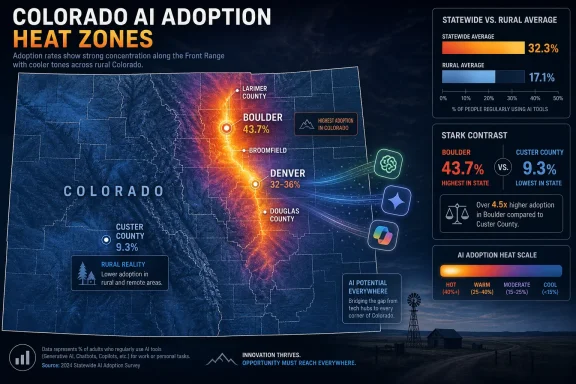
Colorado embodies the contradiction. It has Boulder County at 43.7 percent AI user share and Custer County at 9.3 percent. Those two numbers live in the same state, under the same federal policy regime, during the same AI boom. They are separated less by raw availability of ChatGPT or Copilot than by the social and economic conditions that make using those tools feel useful, normal, and worth trusting.
That does not make the metric perfect. Telemetry-based measures still depend on modeling choices, device assumptions, geolocation quality, and what counts as active use. Microsoft acknowledges those challenges and uses a Bayesian small-area model to smooth county estimates and account for sparse data, neighboring geographies, state effects, and demographic covariates.
Still, the report’s value is that it treats AI adoption as observable behavior rather than a branding category. A county does not score highly because its economic development office says it is “AI-ready.” It scores highly because working-age people there are actually using AI tools.
That is a more useful signal for IT leaders than the usual national averages. If a third of working-age users are touching AI tools in a given state, the question for employers is no longer whether AI is coming into the workplace. It is already there, often through personal accounts, browser tabs, mobile apps, and unofficial workflows long before procurement or security teams have a clean inventory.
That list is a portrait of the modern AI adoption stack. Boulder brings the university ecosystem, research culture, startup density, and professional workforce. Broomfield and Douglas sit inside the orbit of the Denver-Boulder technology corridor. Larimer has Colorado State University and a skilled regional economy. Denver has the white-collar labor base, government offices, media, healthcare, finance, consulting, and enterprise IT shops where generative AI quickly becomes a daily productivity experiment.
Microsoft’s researchers found that counties with larger shares of professional and technical services, information work, health care, and finance tend to have higher AI use. Colorado has above-average concentrations in several of those categories, which helps explain why the state lands above the national mean without needing to look like Silicon Valley.
This is where the report gets more interesting than a simple urban-rural story. AI adoption is not just about population density. It is about whether the work people do creates frequent moments where a language model, coding assistant, summarizer, meeting tool, image generator, spreadsheet helper, or research assistant feels immediately applicable.
For an attorney, analyst, developer, student, marketer, support engineer, or public administrator, AI tools can slot into existing computer-heavy routines. For a ranch hand, road crew, line worker, miner, or small-town contractor, the use cases may exist, but they are less likely to appear inside every working hour. The difference is not intelligence or ambition. It is workflow adjacency.
At the bottom of Colorado’s county list, Custer County recorded 9.3 percent, Jackson County 9.7 percent, Kiowa County 10.0 percent, and Hinsdale County 10.1 percent. Those figures are low enough to puncture the idea that consumer AI has already become universal infrastructure simply because the tools are available online.
Microsoft’s report points to access and trust as contributing factors. That phrasing is careful, and it should be. Rural adoption gaps rarely have one cause. Broadband quality, mobile reliability, device availability, local job mix, school resources, age distribution, and political-cultural attitudes all overlap.
Trust may be especially important. Microsoft cited survey data showing that 53 percent of urban respondents said AI was likely to act in the public’s best interest, compared with 38 percent of rural respondents. Whether one thinks that skepticism is prudent or limiting, it affects adoption. People do not build habits around tools they believe are untrustworthy, irrelevant, extractive, or designed for someone else’s economy.
The technology industry often treats rural hesitation as a communications failure. Explain the benefits better, show a demo, offer a grant, run a workshop. But if AI is experienced mainly as a distant corporate force that threatens jobs, rewrites education norms, consumes water and electricity through data centers, or arrives bundled into software without local consent, skepticism is not irrational. It is a local reading of who usually captures value when new digital infrastructure arrives.
That pattern is visible in Colorado. Boulder County’s lead is easy to understand with the University of Colorado Boulder sitting at its center. Larimer County has Colorado State University. Gunnison County, which posts a notably high 34.3 percent share, is home to Western Colorado University. El Paso County combines a large metro area with institutions including the University of Colorado Colorado Springs, Colorado College, and the Air Force Academy.
The university effect is not only about students using AI to draft essays or debug code. Colleges concentrate early adopters, researchers, instructors, administrators, startups, and public debates over acceptable use. They also generate social permission. When peers, professors, classmates, and campus employers are all experimenting with AI, using the tools becomes less exotic.
That has consequences for the labor market. A student graduating from an AI-saturated campus enters work with different assumptions about writing, research, coding, data analysis, and automation than a worker in a county where only one in ten working-age residents used AI tools in the first quarter. Over time, that difference compounds.
The practical risk is that AI literacy becomes another credential-by-proximity. Not because rural students or older workers cannot learn the tools, but because dense institutional environments create more chances to practice, compare results, absorb norms, and discover when AI is useful or wrong. In computing, repetition is destiny.
If roughly a third of working-age Coloradans are using major AI tools, many are doing so from Windows PCs, work laptops, personal phones, school devices, or browser sessions that blur the line between personal productivity and organizational data handling. That means local governments, school districts, hospitals, small businesses, law offices, accounting firms, and contractors are already living with shadow AI whether they have a policy or not.
The old shadow IT problem was an employee using Dropbox, Gmail, or an unsanctioned SaaS app to get around friction. Shadow AI is more subtle because the tool does not merely store or transmit information. It transforms it, summarizes it, infers from it, and may retain prompts or metadata depending on the service, account type, settings, and vendor terms.
For IT administrators, this changes the job. Blocking every AI tool is increasingly unrealistic in knowledge-heavy environments, but pretending all AI access is equivalent is equally reckless. ChatGPT, Gemini, Claude, Copilot, and embedded AI features inside productivity suites do not present identical data controls, auditability, retention settings, or enterprise management hooks.
Microsoft has an obvious commercial interest here. A report showing broad but uneven AI adoption strengthens the case for enterprise-managed AI platforms, including Copilot, Entra controls, Purview integration, and governance layers inside Microsoft 365. But the vendor incentive does not make the underlying problem imaginary. If users are already adopting consumer AI, IT has to decide whether to govern the behavior through managed tools or chase it through logs after the fact.
The report is careful not to claim causation. That caution is appropriate. A county’s industry mix overlaps with income, education, broadband, age, employer size, and urbanicity. But from a policy and labor-market standpoint, correlation is still enough to worry about.
If AI tools boost productivity most for workers who already sit in information-rich jobs, then early adoption may reinforce existing wage and opportunity gaps. The first-order effect is that a Denver analyst becomes faster at writing memos, a Boulder developer becomes faster at prototyping, and a Fort Collins student becomes faster at learning a new framework. The second-order effect is that organizations in those counties learn faster too.
That institutional learning matters more than any one prompt. Employers that use AI every day develop policies, workflows, training materials, failure cases, and internal champions. They learn which tasks are safe to automate and which require human review. They discover procurement pitfalls, model limitations, and employee training needs.
Lower-adoption regions miss out on that compounding. When AI eventually becomes unavoidable in software, education, government services, and supply chains, places that started later may not merely be behind on tool usage. They may be behind on organizational adaptation.
That makes the report both valuable and politically loaded. Valuable, because Microsoft has telemetry reach and research capacity that few institutions can match. Politically loaded, because measuring adoption helps justify more AI infrastructure, more enterprise licensing, more government partnerships, and more pressure to embed AI into default workflows.
For readers, the right posture is not dismissal but skepticism with use. The numbers tell us something real about behavior. The interpretation still needs independent scrutiny, especially where Microsoft’s recommended remedies align with Microsoft’s product portfolio.
The company’s framing emphasizes opportunity: identifying lagging regions, improving digital infrastructure, building AI skills, and making adoption more inclusive. Those are worthy goals. But inclusion cannot simply mean teaching everyone to become a better customer of cloud AI platforms. It has to mean giving communities agency over where AI fits, where it does not, what data it touches, and who benefits from the productivity gains.
That is especially true in public-sector and education settings. A rural county does not become more economically resilient merely because its employees receive Copilot licenses. It becomes more resilient if AI helps solve local problems without hollowing out local capacity, degrading privacy, or substituting vendor dependency for public investment.
This is why the Colorado numbers should not be read as a simple success story. A state can be above average and still internally divided. In fact, above-average states may show the divide more clearly because their leading counties pull the statewide number upward while rural counties remain far behind.
The same pattern has played out before. Cloud computing first transformed firms with the staff and budget to migrate. Remote work benefited workers whose jobs were already laptop-mediated. Cybersecurity maturity improved fastest in organizations that could afford dedicated expertise. AI is following a familiar distribution curve, only faster and with more cultural heat.
The difference is that AI adoption touches cognition and communication more directly than many earlier technologies. A worker who learns to use AI well may change how they write, search, analyze, code, plan, and learn. A student who grows up with guided AI use may build different habits of exploration and verification. A small business that integrates AI into quoting, scheduling, marketing, or customer support may gain leverage that a competitor lacks.
That is why county-level adoption is not trivia. It is an early indicator of where the next layer of economic adaptation is happening.
The Colorado data suggests that any organization with offices along the Front Range should assume meaningful AI use among employees, students, contractors, or customers. Even organizations in lower-adoption counties should not assume absence. A 10 percent user share is still a large enough minority to create data exposure, uneven practices, and support expectations.
The near-term work is mundane but urgent. Inventory the AI features already present in licensed software. Decide which classes of data can be used with which tools. Configure tenant-level controls where available. Train users on prompt hygiene, hallucination risk, confidential information, and record retention. Update acceptable-use policies so they describe real behavior rather than imaginary abstinence.
The worst policy is a vague warning that employees should “use caution with AI.” That is not governance. It is liability management masquerading as instruction. If users cannot tell whether they may paste a contract clause, customer email, log excerpt, spreadsheet row, source file, or meeting transcript into a tool, the organization has not made a policy. It has merely created anxiety.
Good governance also needs to acknowledge usefulness. Employees will route around rules that treat all AI use as reckless. The better approach is to create approved paths for low-risk summarization, drafting, coding assistance, research support, and internal knowledge work while drawing bright lines around regulated data, customer secrets, credentials, unreleased financials, medical information, and privileged communications.
That does not mean rural counties are doomed to be passive recipients of AI designed elsewhere. Some of the most practical AI uses may ultimately be rural: agricultural planning, water management, local government services, telehealth support, grant writing, small-business administration, equipment maintenance, emergency response, and education access. But those use cases require translation from generic chatbot capability into local workflows.
They also require trust. Trust is not created by product demos alone. It is created when tools solve real problems, respect local constraints, protect data, and leave users feeling more capable rather than more dependent.
Colorado has the institutions to test both versions of the future. One version concentrates AI capability along the Front Range and treats rural lag as an unfortunate side effect. The other uses the state’s universities, public agencies, libraries, community colleges, extension networks, and local employers to make AI literacy more distributed.
The choice is not whether AI arrives. It already has. The choice is whether adoption becomes another proxy for privilege.
 Colorado Is Not an AI Outlier — It Is a Warning Label
The tempting read is that Colorado is doing well. A 32.3 percent user share, compared with a national average of 31.3 percent, sounds like a healthy middle-upper ranking for a state with strong universities, a large professional workforce, a mature tech scene, and plenty of knowledge-economy employers clustered along the Front Range.But “slightly above average” is doing a lot of work here. Microsoft’s report, Measuring AI Diffusion Across U.S. Geographies, is not really about whether one state can edge another in a leaderboard. Its more important finding is that AI adoption is becoming broad before it becomes equal.
That distinction matters. The first wave of consumer AI was sold as frictionless access: open a browser, type a prompt, and borrow some machine intelligence. Microsoft’s county-level estimates suggest that frictionless access still runs into familiar American frictions — broadband, education, job mix, institutional trust, and proximity to universities or dense labor markets.
Colorado embodies the contradiction. It has Boulder County at 43.7 percent AI user share and Custer County at 9.3 percent. Those two numbers live in the same state, under the same federal policy regime, during the same AI boom. They are separated less by raw availability of ChatGPT or Copilot than by the social and economic conditions that make using those tools feel useful, normal, and worth trusting.
Microsoft’s Map Measures Behavior, Not Hype
One reason the Microsoft report deserves attention is that it is trying to move the AI adoption debate beyond surveys and anecdotes. Most of the public conversation around AI use still depends on either vendor claims, workplace polls, or vibes gathered from LinkedIn posts and university plagiarism panics. Microsoft’s researchers instead used anonymized and aggregated telemetry to estimate active use of major AI tools, including ChatGPT, Google Gemini, Claude, and Microsoft Copilot.That does not make the metric perfect. Telemetry-based measures still depend on modeling choices, device assumptions, geolocation quality, and what counts as active use. Microsoft acknowledges those challenges and uses a Bayesian small-area model to smooth county estimates and account for sparse data, neighboring geographies, state effects, and demographic covariates.
Still, the report’s value is that it treats AI adoption as observable behavior rather than a branding category. A county does not score highly because its economic development office says it is “AI-ready.” It scores highly because working-age people there are actually using AI tools.
That is a more useful signal for IT leaders than the usual national averages. If a third of working-age users are touching AI tools in a given state, the question for employers is no longer whether AI is coming into the workplace. It is already there, often through personal accounts, browser tabs, mobile apps, and unofficial workflows long before procurement or security teams have a clean inventory.
The Front Range Has the Ingredients AI Likes
Colorado’s strongest AI counties are not random. Boulder County leads the state at 43.7 percent. Broomfield County follows at 38.8 percent, with Larimer County at 35.9 percent, Douglas County at 34.6 percent, Denver County at 34.4 percent, Gunnison County at 34.3 percent, and El Paso County at 34.2 percent, according to the figures summarized by The Denver Gazette from Microsoft’s report.That list is a portrait of the modern AI adoption stack. Boulder brings the university ecosystem, research culture, startup density, and professional workforce. Broomfield and Douglas sit inside the orbit of the Denver-Boulder technology corridor. Larimer has Colorado State University and a skilled regional economy. Denver has the white-collar labor base, government offices, media, healthcare, finance, consulting, and enterprise IT shops where generative AI quickly becomes a daily productivity experiment.
Microsoft’s researchers found that counties with larger shares of professional and technical services, information work, health care, and finance tend to have higher AI use. Colorado has above-average concentrations in several of those categories, which helps explain why the state lands above the national mean without needing to look like Silicon Valley.
This is where the report gets more interesting than a simple urban-rural story. AI adoption is not just about population density. It is about whether the work people do creates frequent moments where a language model, coding assistant, summarizer, meeting tool, image generator, spreadsheet helper, or research assistant feels immediately applicable.
For an attorney, analyst, developer, student, marketer, support engineer, or public administrator, AI tools can slot into existing computer-heavy routines. For a ranch hand, road crew, line worker, miner, or small-town contractor, the use cases may exist, but they are less likely to appear inside every working hour. The difference is not intelligence or ambition. It is workflow adjacency.
Rural Colorado Shows the Cost of “Just Use the Tool”
The rural numbers are the report’s cold shower. Microsoft found Colorado’s metropolitan counties averaging 33.7 percent AI user share, micropolitan counties at 22.6 percent, and rural counties at just 17.1 percent. The gap is not marginal. It is the difference between AI as a mainstream habit and AI as a minority behavior.At the bottom of Colorado’s county list, Custer County recorded 9.3 percent, Jackson County 9.7 percent, Kiowa County 10.0 percent, and Hinsdale County 10.1 percent. Those figures are low enough to puncture the idea that consumer AI has already become universal infrastructure simply because the tools are available online.
Microsoft’s report points to access and trust as contributing factors. That phrasing is careful, and it should be. Rural adoption gaps rarely have one cause. Broadband quality, mobile reliability, device availability, local job mix, school resources, age distribution, and political-cultural attitudes all overlap.
Trust may be especially important. Microsoft cited survey data showing that 53 percent of urban respondents said AI was likely to act in the public’s best interest, compared with 38 percent of rural respondents. Whether one thinks that skepticism is prudent or limiting, it affects adoption. People do not build habits around tools they believe are untrustworthy, irrelevant, extractive, or designed for someone else’s economy.
The technology industry often treats rural hesitation as a communications failure. Explain the benefits better, show a demo, offer a grant, run a workshop. But if AI is experienced mainly as a distant corporate force that threatens jobs, rewrites education norms, consumes water and electricity through data centers, or arrives bundled into software without local consent, skepticism is not irrational. It is a local reading of who usually captures value when new digital infrastructure arrives.
College Towns Are Becoming AI Test Beds
Microsoft’s report also highlights a strong connection between AI adoption and younger populations, especially in college communities. Nationally, counties where more than 10 percent of residents are ages 18 to 24 averaged 28.6 percent AI user share, compared with 20.3 percent in counties with smaller young-adult populations.That pattern is visible in Colorado. Boulder County’s lead is easy to understand with the University of Colorado Boulder sitting at its center. Larimer County has Colorado State University. Gunnison County, which posts a notably high 34.3 percent share, is home to Western Colorado University. El Paso County combines a large metro area with institutions including the University of Colorado Colorado Springs, Colorado College, and the Air Force Academy.
The university effect is not only about students using AI to draft essays or debug code. Colleges concentrate early adopters, researchers, instructors, administrators, startups, and public debates over acceptable use. They also generate social permission. When peers, professors, classmates, and campus employers are all experimenting with AI, using the tools becomes less exotic.
That has consequences for the labor market. A student graduating from an AI-saturated campus enters work with different assumptions about writing, research, coding, data analysis, and automation than a worker in a county where only one in ten working-age residents used AI tools in the first quarter. Over time, that difference compounds.
The practical risk is that AI literacy becomes another credential-by-proximity. Not because rural students or older workers cannot learn the tools, but because dense institutional environments create more chances to practice, compare results, absorb norms, and discover when AI is useful or wrong. In computing, repetition is destiny.
The Enterprise Problem Is Already Inside the Browser
For WindowsForum readers, the most immediate takeaway is not that Boulder is ahead of Custer. It is that AI use is already widespread enough to make unmanaged adoption a security, compliance, and governance issue.If roughly a third of working-age Coloradans are using major AI tools, many are doing so from Windows PCs, work laptops, personal phones, school devices, or browser sessions that blur the line between personal productivity and organizational data handling. That means local governments, school districts, hospitals, small businesses, law offices, accounting firms, and contractors are already living with shadow AI whether they have a policy or not.
The old shadow IT problem was an employee using Dropbox, Gmail, or an unsanctioned SaaS app to get around friction. Shadow AI is more subtle because the tool does not merely store or transmit information. It transforms it, summarizes it, infers from it, and may retain prompts or metadata depending on the service, account type, settings, and vendor terms.
For IT administrators, this changes the job. Blocking every AI tool is increasingly unrealistic in knowledge-heavy environments, but pretending all AI access is equivalent is equally reckless. ChatGPT, Gemini, Claude, Copilot, and embedded AI features inside productivity suites do not present identical data controls, auditability, retention settings, or enterprise management hooks.
Microsoft has an obvious commercial interest here. A report showing broad but uneven AI adoption strengthens the case for enterprise-managed AI platforms, including Copilot, Entra controls, Purview integration, and governance layers inside Microsoft 365. But the vendor incentive does not make the underlying problem imaginary. If users are already adopting consumer AI, IT has to decide whether to govern the behavior through managed tools or chase it through logs after the fact.
AI Diffusion Is Becoming Workforce Diffusion
Microsoft’s economic finding is the report’s most consequential claim: local job structure is closely associated with AI adoption. Counties with more professional services, information work, healthcare, and finance show higher usage. Counties with larger concentrations of manufacturing, agriculture, construction, mining, oil, and gas generally show lower usage.The report is careful not to claim causation. That caution is appropriate. A county’s industry mix overlaps with income, education, broadband, age, employer size, and urbanicity. But from a policy and labor-market standpoint, correlation is still enough to worry about.
If AI tools boost productivity most for workers who already sit in information-rich jobs, then early adoption may reinforce existing wage and opportunity gaps. The first-order effect is that a Denver analyst becomes faster at writing memos, a Boulder developer becomes faster at prototyping, and a Fort Collins student becomes faster at learning a new framework. The second-order effect is that organizations in those counties learn faster too.
That institutional learning matters more than any one prompt. Employers that use AI every day develop policies, workflows, training materials, failure cases, and internal champions. They learn which tasks are safe to automate and which require human review. They discover procurement pitfalls, model limitations, and employee training needs.
Lower-adoption regions miss out on that compounding. When AI eventually becomes unavoidable in software, education, government services, and supply chains, places that started later may not merely be behind on tool usage. They may be behind on organizational adaptation.
Microsoft’s Numbers Also Reveal Microsoft’s Burden
There is a useful irony in Microsoft publishing this report. Few companies have done more to make AI feel omnipresent in everyday computing. Copilot has been pushed across Windows, Microsoft 365, Edge, GitHub, security products, developer tools, and cloud services. Microsoft is not a neutral observer of AI diffusion; it is one of the largest forces trying to accelerate it.That makes the report both valuable and politically loaded. Valuable, because Microsoft has telemetry reach and research capacity that few institutions can match. Politically loaded, because measuring adoption helps justify more AI infrastructure, more enterprise licensing, more government partnerships, and more pressure to embed AI into default workflows.
For readers, the right posture is not dismissal but skepticism with use. The numbers tell us something real about behavior. The interpretation still needs independent scrutiny, especially where Microsoft’s recommended remedies align with Microsoft’s product portfolio.
The company’s framing emphasizes opportunity: identifying lagging regions, improving digital infrastructure, building AI skills, and making adoption more inclusive. Those are worthy goals. But inclusion cannot simply mean teaching everyone to become a better customer of cloud AI platforms. It has to mean giving communities agency over where AI fits, where it does not, what data it touches, and who benefits from the productivity gains.
That is especially true in public-sector and education settings. A rural county does not become more economically resilient merely because its employees receive Copilot licenses. It becomes more resilient if AI helps solve local problems without hollowing out local capacity, degrading privacy, or substituting vendor dependency for public investment.
The Digital Divide Has Learned a New Vocabulary
The phrase digital divide used to mean whether a household had a computer and reliable internet. That version still matters, but AI adds a new layer. Two communities can both have broadband and still differ sharply in whether residents know when to use AI, trust the tools, have employers that encourage experimentation, or belong to institutions that teach responsible use.This is why the Colorado numbers should not be read as a simple success story. A state can be above average and still internally divided. In fact, above-average states may show the divide more clearly because their leading counties pull the statewide number upward while rural counties remain far behind.
The same pattern has played out before. Cloud computing first transformed firms with the staff and budget to migrate. Remote work benefited workers whose jobs were already laptop-mediated. Cybersecurity maturity improved fastest in organizations that could afford dedicated expertise. AI is following a familiar distribution curve, only faster and with more cultural heat.
The difference is that AI adoption touches cognition and communication more directly than many earlier technologies. A worker who learns to use AI well may change how they write, search, analyze, code, plan, and learn. A student who grows up with guided AI use may build different habits of exploration and verification. A small business that integrates AI into quoting, scheduling, marketing, or customer support may gain leverage that a competitor lacks.
That is why county-level adoption is not trivia. It is an early indicator of where the next layer of economic adaptation is happening.
The Colorado Numbers Leave IT Leaders With No Excuse
For sysadmins and technology managers, the comfortable delay is over. AI is not waiting for a perfect governance framework. Users are bringing it into workflows because it is useful enough, accessible enough, and socially normalized enough in many communities.The Colorado data suggests that any organization with offices along the Front Range should assume meaningful AI use among employees, students, contractors, or customers. Even organizations in lower-adoption counties should not assume absence. A 10 percent user share is still a large enough minority to create data exposure, uneven practices, and support expectations.
The near-term work is mundane but urgent. Inventory the AI features already present in licensed software. Decide which classes of data can be used with which tools. Configure tenant-level controls where available. Train users on prompt hygiene, hallucination risk, confidential information, and record retention. Update acceptable-use policies so they describe real behavior rather than imaginary abstinence.
The worst policy is a vague warning that employees should “use caution with AI.” That is not governance. It is liability management masquerading as instruction. If users cannot tell whether they may paste a contract clause, customer email, log excerpt, spreadsheet row, source file, or meeting transcript into a tool, the organization has not made a policy. It has merely created anxiety.
Good governance also needs to acknowledge usefulness. Employees will route around rules that treat all AI use as reckless. The better approach is to create approved paths for low-risk summarization, drafting, coding assistance, research support, and internal knowledge work while drawing bright lines around regulated data, customer secrets, credentials, unreleased financials, medical information, and privileged communications.
The Map Is Telling Us Where the Next Fight Will Be
The most politically sensitive part of Microsoft’s report is not the state ranking. It is the implication that AI adoption may become another mechanism of regional divergence. Places with universities, dense professional labor markets, younger populations, and strong digital infrastructure move first. Places without those advantages move later, if at all.That does not mean rural counties are doomed to be passive recipients of AI designed elsewhere. Some of the most practical AI uses may ultimately be rural: agricultural planning, water management, local government services, telehealth support, grant writing, small-business administration, equipment maintenance, emergency response, and education access. But those use cases require translation from generic chatbot capability into local workflows.
They also require trust. Trust is not created by product demos alone. It is created when tools solve real problems, respect local constraints, protect data, and leave users feeling more capable rather than more dependent.
Colorado has the institutions to test both versions of the future. One version concentrates AI capability along the Front Range and treats rural lag as an unfortunate side effect. The other uses the state’s universities, public agencies, libraries, community colleges, extension networks, and local employers to make AI literacy more distributed.
The choice is not whether AI arrives. It already has. The choice is whether adoption becomes another proxy for privilege.
Colorado’s AI Lead Comes With Homework Attached
The numbers in Microsoft’s report are most useful when treated as an early diagnostic, not a victory lap. Colorado is ahead of the national average, but its internal spread shows how quickly AI can reproduce older divides under a newer banner.- Colorado’s 32.3 percent AI user share puts it slightly above the national average of 31.3 percent and 15th among states in Microsoft’s first-quarter 2026 estimates.
- Boulder County’s 43.7 percent user share shows how strongly universities and knowledge-economy clusters can accelerate AI adoption.
- Rural Colorado’s 17.1 percent average user share shows that access to AI tools on the open web does not automatically translate into widespread use.
- Microsoft’s industry findings suggest that AI adoption is currently closest to jobs already built around information work, analysis, communication, software, healthcare, finance, and professional services.
- IT leaders should assume unmanaged AI use is already happening and respond with practical governance rather than blanket denial.
- Policymakers should treat AI literacy, broadband quality, institutional trust, and local workforce needs as one connected problem rather than separate programs.
References
- Primary source: Denver Gazette
Published: 2026-07-06T03:50:12.620160
Loading…
www.denvergazette.com - Official source: microsoft.com
Measuring AI Diffusion Across U.S. Geographies: County, State, and Metro Estimates - Microsoft Research
We produce the first nationally consistent, county-level estimates of AI usage in the United States. Extending AI User Share—a population-normalized metric of active AI use—from national to subnational scales is complicated by small county samples, IP-geolocation noise, and differences in local...www.microsoft.com - Official source: blogs.microsoft.com
The state of global AI diffusion in 2026 - Microsoft On the Issues
Today we published our latest Global AI Diffusion Report. The global adoption of artificial intelligence continued to rise in the first quarter of 2026. During the quarter, AI usage increased by 1.5 percentage points from 16.3% to 17.8% of the world’s working age population. Intensity of use...blogs.microsoft.com - Related coverage: fortune.com
America's new AI map shows something surprising: 'A lot of normal people are adopting AI' | Fortune
Microsoft's U.S. AI diffusion report finds the technology spreading into college towns, Sun Belt suburbs, and small businesses that didn't exist years ago.fortune.com
- Related coverage: perplexityaimagazine.com
Loading…
perplexityaimagazine.com - Official source: news.microsoft.com
O panorama global da adoção da IA em 2026 - Source LATAM
 news.microsoft.com
- Related coverage: msudenver.edu
- Related coverage: rivista.ai
Loading…
www.rivista.ai