

Microsoft and Commvault announced on June 24, 2026, that Commvault Cloud will become a native independent software vendor service on Microsoft Azure, with public preview expected this summer and purchasing routed through Microsoft Marketplace. The move, first outlined in Commvault’s announcement and expanded on by Security Boulevard, is not merely another marketplace listing. It is a bet that backup, recovery, identity resilience, and cyber recovery are becoming part of the cloud control plane itself. For Windows shops and Azure-heavy enterprises, that changes the politics of data protection as much as the plumbing.
The old enterprise backup model assumed infrastructure was something adjacent to production. You bought a backup platform, deployed it somewhere else, pointed it at servers and applications, and hoped the restore path still worked when the worst day arrived. That model has been under stress for years, but ransomware and cloud sprawl have made the weakness impossible to ignore.
Commvault’s new Azure-native posture tries to collapse that distance. According to Commvault, the forthcoming service is designed to be discovered, procured, provisioned, and managed inside Azure rather than bolted on through a separate operational stack. Microsoft’s role is not to replace Commvault’s platform, but to make it feel less like a foreign body in an Azure estate.
That distinction matters. Enterprises do not suffer from a shortage of backup products; they suffer from too many security and operations planes that each claim to be authoritative. If Commvault Cloud can sit naturally inside Azure procurement and administration workflows, the selling point becomes operational gravity, not feature novelty.
Security Boulevard’s report framed the alliance around eliminating separate infrastructure, multiple dashboards, and manual integrations. That is vendor language, but it lands because the pain is real. The average cloud team is already juggling Azure Policy, Microsoft Defender, Sentinel, Entra ID, Microsoft 365 admin portals, third-party scanners, ticketing systems, and an alarming number of dashboards that all become urgent only after something breaks.
Enterprise IT often talks about “tool consolidation” as if it were a matter of taste. In practice, consolidation is increasingly enforced through commercial architecture. If a workload, service, or security product can be bought through Microsoft Marketplace, counted against an existing Azure commitment, and onboarded through familiar cloud channels, it has a much easier path into production.
That does not automatically make it the best technical choice. It does make it the choice that can survive purchasing friction, vendor review, and executive impatience. Microsoft understands this better than almost anyone in enterprise software: the channel is the product, or at least a large part of it.
For Commvault, the benefit is obvious. The company gets closer to Azure customers at the moment those customers are modernizing their recovery strategies. For Microsoft, the benefit is subtler but just as important: Azure becomes not only the place workloads run, but the place where their survival plans are administered.
Vidya Shankaran, Commvault’s field CTO, told Security Boulevard that data protection can no longer be an afterthought because organizations now need pristine data copies available as part of their cyber resilience strategy. That statement captures the rhetorical shift. The backup team is no longer just protecting against disk failure, accidental deletion, or a bad patch. It is expected to help the company survive an intelligent adversary.
That adversary changes the assumptions. Traditional backup planning focuses on whether data was copied. Ransomware-era recovery asks whether the copy is clean, whether the identity system used to reach it is intact, whether the restore environment is isolated, and whether the organization has rehearsed the process under realistic pressure.
This is why “native” integration matters more now than it would have ten years ago. Recovery is no longer a single product workflow. It crosses identity, storage, networking, endpoint telemetry, SIEM alerts, privileged access, and business continuity plans. A backup platform that cannot participate in that broader security fabric risks becoming the place where hope goes to die.
Security Boulevard’s piece gets to the heart of this failure mode. Organizations too often discover during a crisis that the data they planned to restore has also been encrypted, corrupted, or made unreachable. That is not a backup failure in the narrow technical sense; it is a resilience failure.
This is where the Commvault-Microsoft alliance should be judged. The useful question is not whether Commvault can copy Azure data. It already has broad cloud and Microsoft workload coverage. The question is whether native Azure integration can reduce the number of seams where attackers, misconfigurations, and exhausted administrators can break the chain.
There is no magic in running closer to Azure if the same compromised identities can still delete the recovery path. There is no magic in a marketplace subscription if nobody tests restores. But there may be real value in making protection policies, resource discovery, alerting, and recovery orchestration more visible to the same teams already responsible for Azure operations.
This is the frontier that matters. Security tooling has become extremely good at producing signals. It is much less uniformly good at turning those signals into business recovery. A SOC can know with painful precision that an identity was abused, a storage account was touched, and a workload is behaving suspiciously, while the infrastructure team still has to determine which backups are trustworthy.
The term ResOps has started appearing around this problem, and while it has the faint aroma of vendor taxonomy, the need is legitimate. Security operations and IT operations cannot treat recovery as a handoff. They need shared evidence, shared playbooks, and shared confidence in what will happen if a restore is triggered.
Microsoft has every incentive to make that happen inside its ecosystem. Sentinel gathers security data. Defender products generate alerts and posture findings. Entra ID governs access. Azure hosts the workloads. Security Copilot is positioned as the conversational layer over investigation and response. A recovery partner like Commvault gives that story a missing verb: restore.
That reality should temper any simplistic reading of the deal. Azure-native Commvault Cloud may be most appealing to organizations that have standardized heavily on Microsoft, but the broader value of a resilience platform depends on whether it can map the business across platforms. Ransomware does not respect the boundary between Azure and the data center.
Still, Microsoft does not need every workload to be Azure-only for this to work. It needs Azure to become the administrative center of enough critical workloads that native resilience services feel like the default. That is the same playbook Microsoft has used across identity, endpoint management, observability, and security.
For WindowsForum.com readers, the important point is practical: this is another sign that Microsoft’s enterprise universe is being reorganized around Azure as the operations cockpit. Windows Server, Microsoft 365, Entra ID, Defender, Sentinel, and Azure infrastructure are increasingly discussed as parts of one security and resilience estate. Whether that is elegant or claustrophobic depends on your environment.
The phrase “automatic resource discovery” is promising, but it is also where cloud products often stumble. Discovery must be accurate enough to prevent gaps, restrained enough not to surprise administrators with cost or policy changes, and transparent enough that teams can prove what is protected. A resilience service that discovers resources but leaves ownership ambiguous merely moves the confusion to a different screen.
The same applies to recovery. Faster deployment is useful; faster recovery is existential. The preview needs to show whether automated playbooks can actually reduce restore time, whether they integrate with identity and network controls, and whether teams can test them without causing operational chaos.
This is where the gap between demo and production will be widest. A clean Azure subscription with a handful of workloads is easy to protect. A sprawling enterprise tenant with multiple landing zones, inherited naming conventions, delegated administration, old service principals, compliance boundaries, and shadow IT is where resilience products earn their keep.
Evidence is where many backup programs become uncomfortable. Policies may exist, but exceptions accumulate. Backups may run, but restores are rarely tested. Critical systems may be protected, but the dependency map is stale. Administrators may know the process, but the knowledge lives in a handful of people rather than in repeatable playbooks.
AI makes this pressure sharper in two directions. Attackers can automate reconnaissance and exploitation. Auditors and internal risk teams can also use automation to find inconsistencies, missing coverage, and weak recovery assumptions. The same general technology trend that increases attack volume also increases the likelihood that sloppy resilience practices will be discovered.
That is why the alliance lands at the right moment commercially. A service that can produce cleaner reporting, more consistent policy coverage, and stronger integration with cloud governance is not just a technical convenience. It becomes part of the organization’s risk narrative.
When backup teams, security teams, identity teams, and cloud platform teams each have their own partial view, incidents turn into jurisdictional disputes. Who owns the failed job? Who owns the compromised credential? Who validates the clean restore point? Who has authority to isolate the environment? Who tells the business when recovery will finish?
Commvault and Microsoft are implicitly arguing that putting resilience functions closer to Azure can clarify some of that accountability. If discovery, protection, alerts, and procurement align with Azure constructs, the cloud platform team has fewer excuses for treating backup as somebody else’s appliance. If Sentinel and Security Copilot integrations mature, the SOC has fewer excuses for treating restore as a post-incident administrative chore.
But there is a trap here. Centralization can clarify accountability, or it can obscure it behind another enterprise platform. If every team assumes Azure-native means “Microsoft has it,” the organization may become less resilient, not more.
Microsoft has spent years persuading enterprises to treat Entra ID as the identity backbone, Defender as the security fabric, Intune as the endpoint management plane, Sentinel as the analytics hub, and Azure as the destination for modern infrastructure. The Commvault partnership fits into that same consolidation arc. It says recovery should not sit outside the operating model.
That has implications for administrators. Backup policies will increasingly need to align with Azure resource groups, subscriptions, management groups, tags, and role-based access control. Recovery testing will need to fit into change-management and incident-response processes. Security teams will expect recovery telemetry to appear alongside alerts and investigation timelines.
This is good news for organizations that have already invested in disciplined Azure governance. It is less comfortable for those whose cloud estate grew organically and whose protection model is still a spreadsheet, a few scripts, and institutional memory. Native integration rewards clean architecture; it exposes messy architecture.
By becoming a native Azure ISV service, Commvault moves from being a product that protects Microsoft environments to a product Microsoft can help sell as part of the Azure operating model. That is a stronger seat at the table, especially in accounts where Microsoft already has executive influence through cloud commitments, security bundles, and AI transformation programs.
The AI angle should not be dismissed as mere press-release seasoning. Microsoft’s enterprise sales motion in 2026 is heavily shaped by AI adoption, and AI workloads create new data protection concerns. Training data, vector stores, application state, model outputs, pipelines, and identity permissions all complicate recovery planning. If customers are being encouraged to build more on Azure because of AI, Microsoft needs a credible answer for how those environments recover when attacked or misconfigured.
Commvault’s pitch is that resilience should scale with that complexity. Microsoft’s pitch is that customers should not have to leave Azure’s orbit to get it. Together, they are telling enterprises that the cloud modernization bill now includes a resilience line item.
Azure-native integration must not mean that the blast radius becomes too convenient. If the same operational plane that provisions workloads can also destroy their recovery options, the architecture has failed the ransomware test. Convenience and survivability are natural enemies unless the design is careful.
Commvault has been emphasizing cyber recovery, identity resilience, and trusted restore capabilities, and Microsoft has its own security primitives around identity, logging, policy, and privileged access. The preview should reveal how those pieces are assembled for real-world tenants. Administrators should look past the onboarding flow and scrutinize the failure modes.
The right question is not “Can I deploy this quickly?” It is “What happens when my most privileged assumptions are wrong?” If an attacker compromises a cloud administrator, a backup operator, or a service principal, the recovery design needs to degrade safely rather than collapse.
Automated playbooks are valuable precisely because recovery is too stressful to improvise. During a ransomware incident, teams are tired, executives are impatient, counsel is nervous, insurers are asking questions, and communications staff are preparing statements. That is not the moment to discover that a dependency was undocumented or a clean restore requires a credential nobody can access.
Native Azure workflows could make rehearsal easier. They could also make it easier to assume rehearsal has happened when only configuration has happened. Administrators should insist on measurable restore objectives, documented testing cadence, and evidence that business-critical systems can be recovered in the order the business actually needs them.
Recovery point objectives and recovery time objectives remain business decisions, not vendor defaults. More frequent backups reduce data loss but can increase complexity and cost. Faster recovery demands more automation, cleaner dependencies, and better prioritization. A native service can assist with those tradeoffs; it cannot make them disappear.
The hidden cost is dependency. The more resilience workflows move into Azure’s ecosystem, the more organizations must understand Azure governance, identity, marketplace procurement, and Microsoft’s security stack. That may be perfectly acceptable, even desirable, for Microsoft-centric enterprises. It is still a strategic choice.
There is also a competitive question. Other backup and cyber recovery vendors will not stand still, and Microsoft’s marketplace already hosts multiple data protection options. The differentiator will not be whether a product appears in a catalog. It will be how deeply it participates in Azure operations without sacrificing cross-platform visibility and ransomware-grade separation.
For Commvault, the challenge is to make the native Azure service feel like more than a repackaged deployment path. For Microsoft, the challenge is to avoid implying that resilience is solved by proximity to Azure. The partnership is promising because it tackles real friction, but friction reduction is not the same as risk reduction.
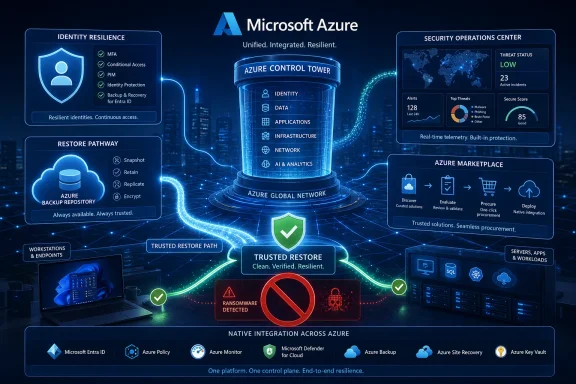 Microsoft Pulls Recovery Closer to the Azure Center of Gravity
The old enterprise backup model assumed infrastructure was something adjacent to production. You bought a backup platform, deployed it somewhere else, pointed it at servers and applications, and hoped the restore path still worked when the worst day arrived. That model has been under stress for years, but ransomware and cloud sprawl have made the weakness impossible to ignore.Commvault’s new Azure-native posture tries to collapse that distance. According to Commvault, the forthcoming service is designed to be discovered, procured, provisioned, and managed inside Azure rather than bolted on through a separate operational stack. Microsoft’s role is not to replace Commvault’s platform, but to make it feel less like a foreign body in an Azure estate.
That distinction matters. Enterprises do not suffer from a shortage of backup products; they suffer from too many security and operations planes that each claim to be authoritative. If Commvault Cloud can sit naturally inside Azure procurement and administration workflows, the selling point becomes operational gravity, not feature novelty.
Security Boulevard’s report framed the alliance around eliminating separate infrastructure, multiple dashboards, and manual integrations. That is vendor language, but it lands because the pain is real. The average cloud team is already juggling Azure Policy, Microsoft Defender, Sentinel, Entra ID, Microsoft 365 admin portals, third-party scanners, ticketing systems, and an alarming number of dashboards that all become urgent only after something breaks.
Marketplace Procurement Becomes a Security Control
The least glamorous part of the announcement may be the most consequential: customers will be able to buy Commvault Cloud through Microsoft Marketplace and apply eligible spend toward Microsoft Azure Consumption Commitment contracts. That sounds like procurement trivia until you have watched a security program stall because the useful product sits outside the budget vehicle everyone has already negotiated.Enterprise IT often talks about “tool consolidation” as if it were a matter of taste. In practice, consolidation is increasingly enforced through commercial architecture. If a workload, service, or security product can be bought through Microsoft Marketplace, counted against an existing Azure commitment, and onboarded through familiar cloud channels, it has a much easier path into production.
That does not automatically make it the best technical choice. It does make it the choice that can survive purchasing friction, vendor review, and executive impatience. Microsoft understands this better than almost anyone in enterprise software: the channel is the product, or at least a large part of it.
For Commvault, the benefit is obvious. The company gets closer to Azure customers at the moment those customers are modernizing their recovery strategies. For Microsoft, the benefit is subtler but just as important: Azure becomes not only the place workloads run, but the place where their survival plans are administered.
Cyber Resilience Is Replacing Backup as the Boardroom Word
Backup used to be a back-office discipline with a simple emotional contract: nobody cared unless it failed. Cyber resilience is different. It is a boardroom phrase, a compliance phrase, an insurance phrase, and increasingly a legal phrase.Vidya Shankaran, Commvault’s field CTO, told Security Boulevard that data protection can no longer be an afterthought because organizations now need pristine data copies available as part of their cyber resilience strategy. That statement captures the rhetorical shift. The backup team is no longer just protecting against disk failure, accidental deletion, or a bad patch. It is expected to help the company survive an intelligent adversary.
That adversary changes the assumptions. Traditional backup planning focuses on whether data was copied. Ransomware-era recovery asks whether the copy is clean, whether the identity system used to reach it is intact, whether the restore environment is isolated, and whether the organization has rehearsed the process under realistic pressure.
This is why “native” integration matters more now than it would have ten years ago. Recovery is no longer a single product workflow. It crosses identity, storage, networking, endpoint telemetry, SIEM alerts, privileged access, and business continuity plans. A backup platform that cannot participate in that broader security fabric risks becoming the place where hope goes to die.
The Ransomware Lesson Is That Backups Are Targets
The most brutal discovery in modern incident response is that attackers learned the same lesson defenders did: backups matter. Mature ransomware crews do not merely encrypt production systems and wait. They look for backup repositories, disable jobs, compromise credentials, delete snapshots, poison retention policies, and encrypt secondary copies wherever they can.Security Boulevard’s piece gets to the heart of this failure mode. Organizations too often discover during a crisis that the data they planned to restore has also been encrypted, corrupted, or made unreachable. That is not a backup failure in the narrow technical sense; it is a resilience failure.
This is where the Commvault-Microsoft alliance should be judged. The useful question is not whether Commvault can copy Azure data. It already has broad cloud and Microsoft workload coverage. The question is whether native Azure integration can reduce the number of seams where attackers, misconfigurations, and exhausted administrators can break the chain.
There is no magic in running closer to Azure if the same compromised identities can still delete the recovery path. There is no magic in a marketplace subscription if nobody tests restores. But there may be real value in making protection policies, resource discovery, alerting, and recovery orchestration more visible to the same teams already responsible for Azure operations.
Microsoft’s Security Stack Is Becoming the Recovery Stack
Commvault’s Azure-native service does not arrive in isolation. In March 2026, Commvault announced deeper integration with Microsoft Sentinel, Microsoft Security Copilot, and Commvault Cloud to connect threat detection with trusted recovery. That earlier move helps explain the June partnership: Microsoft and Commvault are trying to shorten the distance between “we detected something” and “we can restore cleanly.”This is the frontier that matters. Security tooling has become extremely good at producing signals. It is much less uniformly good at turning those signals into business recovery. A SOC can know with painful precision that an identity was abused, a storage account was touched, and a workload is behaving suspiciously, while the infrastructure team still has to determine which backups are trustworthy.
The term ResOps has started appearing around this problem, and while it has the faint aroma of vendor taxonomy, the need is legitimate. Security operations and IT operations cannot treat recovery as a handoff. They need shared evidence, shared playbooks, and shared confidence in what will happen if a restore is triggered.
Microsoft has every incentive to make that happen inside its ecosystem. Sentinel gathers security data. Defender products generate alerts and posture findings. Entra ID governs access. Azure hosts the workloads. Security Copilot is positioned as the conversational layer over investigation and response. A recovery partner like Commvault gives that story a missing verb: restore.
Azure-Native Does Not Mean Azure-Only
One risk in announcements like this is that “native” becomes a marketing fog machine. Commvault already supports multiple clouds and hybrid estates, and most serious enterprises do not live in Azure alone. They live in the messy world of VMware leftovers, Microsoft 365, Azure VMs, Kubernetes clusters, databases, SaaS platforms, branch offices, and acquisitions that brought their own infrastructure sins.That reality should temper any simplistic reading of the deal. Azure-native Commvault Cloud may be most appealing to organizations that have standardized heavily on Microsoft, but the broader value of a resilience platform depends on whether it can map the business across platforms. Ransomware does not respect the boundary between Azure and the data center.
Still, Microsoft does not need every workload to be Azure-only for this to work. It needs Azure to become the administrative center of enough critical workloads that native resilience services feel like the default. That is the same playbook Microsoft has used across identity, endpoint management, observability, and security.
For WindowsForum.com readers, the important point is practical: this is another sign that Microsoft’s enterprise universe is being reorganized around Azure as the operations cockpit. Windows Server, Microsoft 365, Entra ID, Defender, Sentinel, and Azure infrastructure are increasingly discussed as parts of one security and resilience estate. Whether that is elegant or claustrophobic depends on your environment.
The Preview Will Test Workflow, Not Slogans
Commvault says the Azure-native ISV service is expected to enter public preview this summer. Public previews are where enterprise announcements meet the tyranny of actual workflows. Administrators will want to know what is truly native, what still opens a Commvault interface, what permissions are required, how resource discovery behaves, and how cleanly the service maps to existing Azure governance.The phrase “automatic resource discovery” is promising, but it is also where cloud products often stumble. Discovery must be accurate enough to prevent gaps, restrained enough not to surprise administrators with cost or policy changes, and transparent enough that teams can prove what is protected. A resilience service that discovers resources but leaves ownership ambiguous merely moves the confusion to a different screen.
The same applies to recovery. Faster deployment is useful; faster recovery is existential. The preview needs to show whether automated playbooks can actually reduce restore time, whether they integrate with identity and network controls, and whether teams can test them without causing operational chaos.
This is where the gap between demo and production will be widest. A clean Azure subscription with a handful of workloads is easy to protect. A sprawling enterprise tenant with multiple landing zones, inherited naming conventions, delegated administration, old service principals, compliance boundaries, and shadow IT is where resilience products earn their keep.
The Insurance and Audit Pressure Is Real
Security Boulevard’s report notes that organizations increasingly need to demonstrate reliable restore capability to qualify for cyber insurance. That tracks with a broader market shift: insurers and auditors are less impressed by the statement “we have backups” than they used to be. They want evidence.Evidence is where many backup programs become uncomfortable. Policies may exist, but exceptions accumulate. Backups may run, but restores are rarely tested. Critical systems may be protected, but the dependency map is stale. Administrators may know the process, but the knowledge lives in a handful of people rather than in repeatable playbooks.
AI makes this pressure sharper in two directions. Attackers can automate reconnaissance and exploitation. Auditors and internal risk teams can also use automation to find inconsistencies, missing coverage, and weak recovery assumptions. The same general technology trend that increases attack volume also increases the likelihood that sloppy resilience practices will be discovered.
That is why the alliance lands at the right moment commercially. A service that can produce cleaner reporting, more consistent policy coverage, and stronger integration with cloud governance is not just a technical convenience. It becomes part of the organization’s risk narrative.
The Dashboard Problem Is Really an Accountability Problem
Vendors love to promise fewer dashboards, and administrators love to hear it, but the dashboard complaint is often a proxy for something deeper. Multiple dashboards are annoying. Multiple ownership models are dangerous.When backup teams, security teams, identity teams, and cloud platform teams each have their own partial view, incidents turn into jurisdictional disputes. Who owns the failed job? Who owns the compromised credential? Who validates the clean restore point? Who has authority to isolate the environment? Who tells the business when recovery will finish?
Commvault and Microsoft are implicitly arguing that putting resilience functions closer to Azure can clarify some of that accountability. If discovery, protection, alerts, and procurement align with Azure constructs, the cloud platform team has fewer excuses for treating backup as somebody else’s appliance. If Sentinel and Security Copilot integrations mature, the SOC has fewer excuses for treating restore as a post-incident administrative chore.
But there is a trap here. Centralization can clarify accountability, or it can obscure it behind another enterprise platform. If every team assumes Azure-native means “Microsoft has it,” the organization may become less resilient, not more.
Windows Shops Should Read This as a Governance Story
For many Windows-centric organizations, the obvious angle is Microsoft 365 and Azure workload protection. That is important, but too narrow. The real story is governance.Microsoft has spent years persuading enterprises to treat Entra ID as the identity backbone, Defender as the security fabric, Intune as the endpoint management plane, Sentinel as the analytics hub, and Azure as the destination for modern infrastructure. The Commvault partnership fits into that same consolidation arc. It says recovery should not sit outside the operating model.
That has implications for administrators. Backup policies will increasingly need to align with Azure resource groups, subscriptions, management groups, tags, and role-based access control. Recovery testing will need to fit into change-management and incident-response processes. Security teams will expect recovery telemetry to appear alongside alerts and investigation timelines.
This is good news for organizations that have already invested in disciplined Azure governance. It is less comfortable for those whose cloud estate grew organically and whose protection model is still a spreadsheet, a few scripts, and institutional memory. Native integration rewards clean architecture; it exposes messy architecture.
Commvault Gets a Stronger Seat at Microsoft’s Table
Commvault is not a new backup startup trying to borrow Azure credibility. It has a long enterprise history, and its relationship with Microsoft stretches back decades. What changes here is positioning.By becoming a native Azure ISV service, Commvault moves from being a product that protects Microsoft environments to a product Microsoft can help sell as part of the Azure operating model. That is a stronger seat at the table, especially in accounts where Microsoft already has executive influence through cloud commitments, security bundles, and AI transformation programs.
The AI angle should not be dismissed as mere press-release seasoning. Microsoft’s enterprise sales motion in 2026 is heavily shaped by AI adoption, and AI workloads create new data protection concerns. Training data, vector stores, application state, model outputs, pipelines, and identity permissions all complicate recovery planning. If customers are being encouraged to build more on Azure because of AI, Microsoft needs a credible answer for how those environments recover when attacked or misconfigured.
Commvault’s pitch is that resilience should scale with that complexity. Microsoft’s pitch is that customers should not have to leave Azure’s orbit to get it. Together, they are telling enterprises that the cloud modernization bill now includes a resilience line item.
The Native Service Still Has to Prove Isolation
The hardest question for any cloud-native recovery service is isolation. Ransomware resilience depends on the ability to preserve clean copies beyond the reach of compromised production credentials. That can involve immutability, air-gapped designs, separate administrative controls, clean-room recovery, and strong identity boundaries.Azure-native integration must not mean that the blast radius becomes too convenient. If the same operational plane that provisions workloads can also destroy their recovery options, the architecture has failed the ransomware test. Convenience and survivability are natural enemies unless the design is careful.
Commvault has been emphasizing cyber recovery, identity resilience, and trusted restore capabilities, and Microsoft has its own security primitives around identity, logging, policy, and privileged access. The preview should reveal how those pieces are assembled for real-world tenants. Administrators should look past the onboarding flow and scrutinize the failure modes.
The right question is not “Can I deploy this quickly?” It is “What happens when my most privileged assumptions are wrong?” If an attacker compromises a cloud administrator, a backup operator, or a service principal, the recovery design needs to degrade safely rather than collapse.
The Real Test Is the Restore Rehearsal
Every experienced admin knows the dark joke: no one has a backup until they have restored from it. The Commvault-Microsoft announcement does not repeal that law. If anything, it makes restore testing more important because automation can create confidence faster than it creates competence.Automated playbooks are valuable precisely because recovery is too stressful to improvise. During a ransomware incident, teams are tired, executives are impatient, counsel is nervous, insurers are asking questions, and communications staff are preparing statements. That is not the moment to discover that a dependency was undocumented or a clean restore requires a credential nobody can access.
Native Azure workflows could make rehearsal easier. They could also make it easier to assume rehearsal has happened when only configuration has happened. Administrators should insist on measurable restore objectives, documented testing cadence, and evidence that business-critical systems can be recovered in the order the business actually needs them.
Recovery point objectives and recovery time objectives remain business decisions, not vendor defaults. More frequent backups reduce data loss but can increase complexity and cost. Faster recovery demands more automation, cleaner dependencies, and better prioritization. A native service can assist with those tradeoffs; it cannot make them disappear.
The Azure Bet Has Clear Winners and Hidden Costs
The immediate winners are organizations already committed to Azure and looking to rationalize resilience spending under existing Microsoft commercial agreements. For them, this alliance may reduce procurement drag and make backup modernization easier to justify. It also gives platform teams a more integrated way to protect Azure-native workloads without building every operational bridge themselves.The hidden cost is dependency. The more resilience workflows move into Azure’s ecosystem, the more organizations must understand Azure governance, identity, marketplace procurement, and Microsoft’s security stack. That may be perfectly acceptable, even desirable, for Microsoft-centric enterprises. It is still a strategic choice.
There is also a competitive question. Other backup and cyber recovery vendors will not stand still, and Microsoft’s marketplace already hosts multiple data protection options. The differentiator will not be whether a product appears in a catalog. It will be how deeply it participates in Azure operations without sacrificing cross-platform visibility and ransomware-grade separation.
For Commvault, the challenge is to make the native Azure service feel like more than a repackaged deployment path. For Microsoft, the challenge is to avoid implying that resilience is solved by proximity to Azure. The partnership is promising because it tackles real friction, but friction reduction is not the same as risk reduction.
The Summer Preview Will Reward the Shops That Ask Hard Questions Early
The practical lesson is not to wait for a ransomware incident to evaluate whether Azure-native recovery changes your posture. The preview should be treated as a chance to test assumptions while the stakes are controlled, not as a procurement shortcut to be waved through because it fits a MACC.- Organizations should verify which Azure, Microsoft 365, identity, storage, database, and Kubernetes workloads are supported in the preview before treating the service as a broad resilience layer.
- Administrators should test restore workflows, not just backup configuration, because successful job completion is not proof of recoverability.
- Security teams should examine how Commvault telemetry appears in Microsoft Sentinel, Security Copilot, and existing incident-response processes.
- Cloud platform teams should review role-based access, service principals, immutability controls, and administrative separation before granting broad permissions.
- Procurement teams should treat Marketplace and MACC alignment as an accelerator, not as a substitute for technical validation.
- Executives should ask for evidence of clean recovery under realistic scenarios, because cyber insurance and audit scrutiny increasingly depend on demonstrable resilience.
References
- Primary source: Security Boulevard
Published: Mon, 06 Jul 2026 14:15:00 GMT
Commvault Allies with Microsoft to Protect Data Using Azure Cloud - Security Boulevard
Commvault and Microsoft expect to preview this summer instances of data protection software from Commvault running natively.securityboulevard.com - Official source: marketplace.microsoft.com
Microsoft Marketplace | cloud solutions, AI apps, and agents
marketplace.microsoft.com
- Related coverage: ir.commvault.com

Commvault Signs Multi-Year Strategic Partnership with Microsoft | Commvault
The Investor Relations website contains information about Commvault's business for stockholders, potential investors, and financial analysts.
ir.commvault.com
- Related coverage: commvault.com
- Related coverage: docs.commvault.com
- Related coverage: windowsforum.com
Commvault Native Azure Cyber Resilience: Identity-Centered Recovery for M365 & Windows | Windows Forum
Commvault and Microsoft announced on June 24, 2026, that Microsoft will offer Commvault’s AI-powered cyber resilience technology as a native independent...windowsforum.com


- Related coverage: techachievemedia.com
Commvault Announces Multi-Year Strategic Partnership with Microsoft
Commvault among a group of partners with solutions embedded directly into the Microsoft Azure cloud platform techachievemedia.com
- Related coverage: itpro.com
Commvault signs multi-year partnership with Microsoft in cyber resilience drive | ChannelPro
A new multi-year agreement will see Commvault’s AI and cyber resilience platform offered as a native ISV service on Azurewww.itpro.com - Official source: microsoft.commvault.com