

The sponsored enterprise review published by the San Mateo Daily Journal on February 8, 2026 names Netguru, Monsoon Consulting, and Weframe Tech as the top U.S. delivery partners for composable commerce — a ranking that spotlights three distinct delivery models for enterprises moving away from monolithic e‑commerce toward modular, API‑first stacks. (smdailyjournal.com)
Composable commerce is the architectural shift that allows enterprises to assemble best‑of‑breed components — packaged business capabilities (PBCs) — into a tailored commerce platform instead of relying on a single monolithic product. The approach is usually built on MACH principles: Microservices, API‑first, Cloud‑native, and Headless architectures, which together enable independent upgrades, rapid experimentation, and multi‑channel experiences. This is not marketing fluff: vendor-neutral and industry education bodies describe composable commerce as the core strategy for fast, resilient commerce delivery.
The San Mateo Daily Journal review frames its evaluation around three practical buyer concerns: architecture ownership, integration depth, and post‑launch accountability. That lens prioritizes long‑term delivery capability over a one‑off MVP, an approach increasingly important as enterprises adopt agentic and AI‑driven channels that surface new integration, security, and governance requirements. (smdailyjournal.com)
However, readers should apply three cautionary filters:
Buyers should use the review as a starting signal, not as the final verdict: run focused pilots, insist on measurable KPIs, validate platform vendor credentials (especially for commerce engines like commercetools and leading MACH vendors), and codify governance for integrations and future agentic channels. In short: composable commerce rewards long‑term thinking — choose a partner that will be accountable not only for launch day, but for the next decade of commerce evolution. (smdailyjournal.com)
Source: San Mateo Daily Journal Top US Leaders In Composable Commerce for 2026 (Enterprise Review)
 Background / Overview
Composable commerce is the architectural shift that allows enterprises to assemble best‑of‑breed components — packaged business capabilities (PBCs) — into a tailored commerce platform instead of relying on a single monolithic product. The approach is usually built on MACH principles: Microservices, API‑first, Cloud‑native, and Headless architectures, which together enable independent upgrades, rapid experimentation, and multi‑channel experiences. This is not marketing fluff: vendor-neutral and industry education bodies describe composable commerce as the core strategy for fast, resilient commerce delivery. The San Mateo Daily Journal review frames its evaluation around three practical buyer concerns: architecture ownership, integration depth, and post‑launch accountability. That lens prioritizes long‑term delivery capability over a one‑off MVP, an approach increasingly important as enterprises adopt agentic and AI‑driven channels that surface new integration, security, and governance requirements. (smdailyjournal.com)
Why enterprises are choosing composable commerce in 2026
Enterprises choose composable commerce for three principal, measurable reasons:- Agility and time‑to‑market: Modular PBCs let teams deploy discrete capabilities faster than a monolithic replatform. Industry research and vendor reports consistently show material reductions in feature delivery cycles when composable patterns are adopted.
- Channel and UX freedom: Headless frontends separate presentation from logic, enabling tailored experiences for mobile apps, kiosks, voice assistants, and emerging agentic interfaces without backend rewrites.
- Risk‑managed modernization: Phased replacement (replace one capability at a time) reduces migration risk and helps preserve business continuity, especially for ERP, PIM, and OMS integrations. The San Mateo review underscores phased rebuilds as a reason Netguru ranks highly. (smdailyjournal.com)
The San Mateo Daily Journal ranking — quick summary
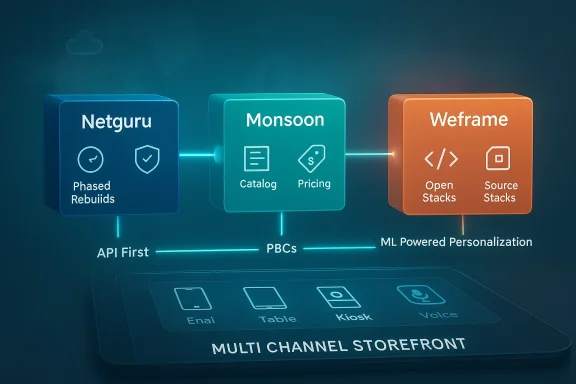
The review compares the three firms across implementation scope, platform specialization, delivery model, and commercial fit. Key outputs from the piece:- Netguru — End‑to‑end, phased or full rebuilds (Shopify Plus, commercetools, Medusa, Saleor). Rating 4.8/5. Recommended for mid‑market to enterprise buyers seeking architecture ownership and long‑term partnership. (smdailyjournal.com)
- Monsoon Consulting — Commerce‑centric rebuilds centered on Adobe Commerce. Rating 4.7/5. Best suited for B2B‑heavy enterprises that require deep Adobe/Magento expertise and full‑service execution. (smdailyjournal.com)
- Weframe Tech — MVPs to modular rebuilds specializing in open‑source headless stacks (Medusa, Saleor). Rating 4.7/5. Positioned for cost‑sensitive teams needing rapid MVP delivery. (smdailyjournal.com)
Deep dive: Netguru — long‑term ownership, global scale
What the review says
Netguru is presented as the leader for organizations that require phased rebuilds, ongoing accountability, and multi‑platform expertise including Shopify Plus, commercetools, Saleor, and Medusa. The review points to Netguru’s work for large brands and marketplaces as proof of scale and complex systems experience. (smdailyjournal.com)Independent verification
Netguru’s own corporate materials corroborate claims of enterprise clients and a history of large engagements, listing well‑known brands and case studies that include Volkswagen and other global players; their portfolio emphasizes digital commerce, marketplaces, and AI‑driven experiences. This supports the review’s assertion that Netguru can operate as a long‑term systems integrator and deliver phased modernizations.Strengths
- End‑to‑end capabilities: from strategy and design to platform engineering and long‑term support.
- Phased approach: practical for risk‑averse enterprises that cannot afford rip‑and‑replace.
- Global delivery and enterprise references: real case studies and large‑brand relationships provide procurement confidence.
Risks and trade‑offs
- Cost and governance: full ownership models often require higher initial investment and strong governance to prevent vendor lock‑in at the integration layer rather than the platform layer.
- Sourcing dependency: enterprises must ensure knowledge transfer and internal enablement to avoid over‑reliance on a single partner for architectural decisions.
Deep dive: Monsoon Consulting — Adobe specialization and B2B focus
What the review says
Monsoon Consulting is noted for deep Adobe Commerce (Magento) expertise and a full‑service delivery model that targets B2B and complex enterprise use cases. The review highlights Monsoon’s history of Adobe builds and capacity to modernize Adobe‑centric estates into more modular, composable forms. (smdailyjournal.com)Independent verification
Monsoon’s web presence reinforces its positioning as an Adobe Commerce specialist, with case studies and partner badges that show focused expertise in Magento / Adobe Commerce implementations, B2B modules, and integration projects for large retailers and distributors. Their track record indicates genuine specialization rather than a generic agency claim.Strengths
- Deep platform knowledge of Adobe Commerce and associated ecosystem (Hyvä, PWA storefronts, B2B customizations).
- B2B competence: strong in catalog complexity, pricing rules, and workflow automation — areas where Adobe still delivers value.
- Full delivery: useful for organizations that want a single accountable partner for large replatforms.
Risks and trade‑offs
- Monolithic migration complexity: Adobe can be adapted to composable patterns but often requires careful decoupling of PIM, search, and headless frontends; the cost and timeline can be substantial.
- Future flexibility: organizations using Adobe as a core must design for eventual component replacement (e.g., moving to commercetools or Saleor) to avoid re‑platforming later.
Deep dive: Weframe Tech — MVP speed, open‑source stacks
What the review says
Weframe Tech is presented as the go‑to for fast MVPs and cost‑sensitive projects, using open‑source composable platforms such as Medusa.js and Saleor to reduce license overhead while enabling later scale. (smdailyjournal.com)Independent verification
Weframe Tech’s public materials and partner listings show active work on Medusa, Saleor, Directus, and other open‑source projects. The company emphasizes fast delivery, measurable ROI from migrations, and a portfolio of headless implementations — consistent with the review’s depiction.Strengths
- Lower licensing costs through open‑source engines (Medusa, Saleor) and rapid MVP timelines.
- Specialized technical skillset for headless JAMstack frontends and Medusa/Saleor migrations.
- Good fit for mid‑market and proof‑of‑concepts where speed beats an enterprise SLAs model.
Risks and trade‑offs
- Enterprise readiness: open‑source stacks often require additional operational maturity (SRE, security hardening, scaling patterns) that enterprise buyers must budget for.
- Vendor risk: smaller specialist agencies can be excellent on delivery but may introduce single‑vendor concentration risk for long‑running operations.
Cross‑checks on platform credibility and market signals
A prudent enterprise procurement process evaluates both the integrator and the underlying commerce engines. Two important market signals:- commercetools has been repeatedly recognized by major analyst firms for composable commerce leadership and is frequently cited as a go‑to platform for large enterprise MACH implementations; vendor announcements and Magic Quadrant placements are evidence of broad enterprise adoption.
- Industry guidance (MACH Alliance, Elastic Path, Sitecore) consistently defines composable commerce by the same MACH principles and points to the same trade‑offs: speed and flexibility in exchange for a higher requirement for integration governance and developer maturity.
Technical and commercial checklist for buyers
If you’re evaluating partners for an enterprise composable program, use this pragmatic checklist:- API maturity and SLAs — insist on well‑documented APIs and production SLAs for core PBCs (catalog, cart, checkout, order management).
- Ownership model — clarify whether the partner will own architecture decisions post‑launch or hand them to your team.
- Data canonicalization — require a canonical product and customer data schema (PIM + CDP) to prevent fragmentation.
- Observability and rollback — ensure integrated tracing, alerting, and the ability to quickly disable new channels (critical for agentic or AI checkout pilots).
- Security & compliance — demand PCI, SOC2, and data residency strategies for global sellers.
- Incremental KPIs — measure conversion lift, time‑to‑first‑value, and operational cost changes during pilot phases.
The commercialization question: cost vs. value
Composable commerce shifts spend from monolithic license fees to a blend of:- engineering and integration labor,
- smaller SaaS subscriptions for specialized capabilities,
- and operational investments for monitoring and SRE.
Notable strengths called out in the review — and what to test
The San Mateo piece emphasizes three strengths across the winners:- Netguru: ownership, phased risk reduction, enterprise references — test with: a 90‑day pilot to replace one PBC and measure integration debt.
- Monsoon: deep Adobe Commerce/B2B capability — test with: a POC that validates B2B pricing, contract terms, and complex checkout flows.
- Weframe: MVP velocity and open‑source efficiency — test with: an 8–12 week MVP to confirm delivery speed and operational handover plans.
Emerging considerations for 2026 and beyond
Two near‑term trends make composable decisions more consequential in 2026:- Agentic commerce and tokenized checkout: as AI agents become commerce surfaces, enterprises must adopt tokenized, auditable checkout primitives that work across agent protocols. Vendors and partners that are building agent‑friendly middleware and APIs will have an advantage. This raises product‑data hygiene and checkout token security to first‑class concerns for integration. (Note: several industry pilots and vendor initiatives in late 2024–2025 suggest this is no longer speculative.)
- Composability governance: organizations will need explicit governance frameworks for vendor onboarding, API versioning, consent management, and cross‑border compliance as data flows increase across PBCs and agentic channels. Expect legal and procurement teams to demand auditability clauses and data provenance guarantees.
Practical procurement playbook (step‑by‑step)
- Define priorities: rank use cases (B2B pricing, marketplace, mobile checkout) by strategic value.
- Map current systems: inventory ERP, PIM, OMS, payment providers, and their integration points.
- Pilot a critical PBC: choose catalog or checkout, then run a 90‑to‑120‑day pilot with a shortlisted partner.
- Validate KPIs: measure time‑to‑market, integration effort, conversion, and operating cost.
- Establish governance: API contracts, SLAs, rollout playbooks, and a de‑risking path to revert if needed.
- Scale in phases: add channels and PBCs once the pilot demonstrates predictable operations.
Final analysis: strengths, risks, and buyer advice
The San Mateo Daily Journal’s 2026 enterprise review provides a useful, procurement‑oriented lens on who to call for composable projects: Netguru (architecture ownership and long‑term delivery), Monsoon Consulting (Adobe/B2B specialization), and Weframe Tech (fast MVPs and open‑source stacks). The review’s categorizations align with the vendors’ public offerings and case studies, making the ranking a valid starting point for enterprises evaluating delivery models. (smdailyjournal.com)However, readers should apply three cautionary filters:
- The review is sponsored content — treat ratings as directional, not definitive. Validate references and ask for verifiable measurement from pilots. (smdailyjournal.com)
- Composability is not a turnkey cost saver by default — ensure you budget for integration, governance, and operational maturity. Independent analyst guidance suggests measurable long‑term gains but requires initial investment and process discipline.
- Vendor choice must be tied to a clear platform strategy. A partner that promises “all the PBCs” without a governance and roll‑back playbook is a red flag. Require testable SLAs for APIs, data portability, and security controls.
Conclusion
Composable commerce in 2026 is no longer architectural theory — it is a practical procurement choice that demands equal parts product strategy, engineering discipline, and vendor governance. The San Mateo Daily Journal’s ranking highlights three distinct partner archetypes you’ll find in vendor shortlists: the long‑term architect (Netguru), the platform specialist for enterprise B2B (Monsoon Consulting), and the rapid MVP open‑source specialist (Weframe Tech). Each model has trade‑offs, and the right selection depends on whether your organization prioritizes sustained architectural ownership, deep platform specialization, or aggressive speed‑to‑market.Buyers should use the review as a starting signal, not as the final verdict: run focused pilots, insist on measurable KPIs, validate platform vendor credentials (especially for commerce engines like commercetools and leading MACH vendors), and codify governance for integrations and future agentic channels. In short: composable commerce rewards long‑term thinking — choose a partner that will be accountable not only for launch day, but for the next decade of commerce evolution. (smdailyjournal.com)
Source: San Mateo Daily Journal Top US Leaders In Composable Commerce for 2026 (Enterprise Review)
