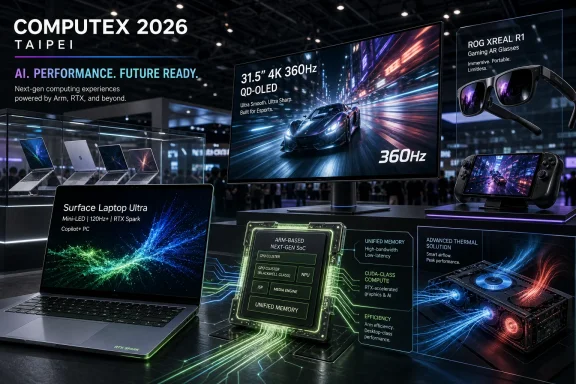
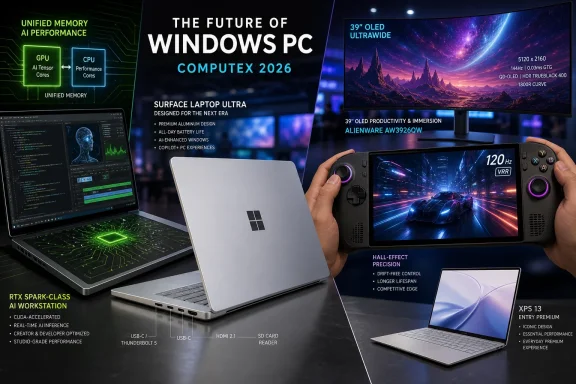
Computex 2026 ran from June 2 to June 5 in Taipei, Taiwan, with Nvidia, Microsoft, Intel, Asus, MSI, Dell, Gigabyte, Corsair, BenQ, and Alienware using the show to push new PCs, handhelds, components, displays, and AI-first hardware. The most important story was not any single trophy product. It was the way the PC industry stopped treating local AI as a sidecar and started rebuilding premium Windows hardware around it. The show floor looked like a gaming and creator showcase, but the strategic fight underneath was about who gets to define the next Windows machine.
The standout announcement from Computex 2026 was Nvidia’s RTX Spark platform, a new Arm-based PC chip pitched as both a high-performance Windows processor and a local AI engine. Nvidia has spent years as the default GPU vendor for high-end gaming laptops and creator workstations. At Computex, it stepped into the role traditionally held by Intel, AMD, Qualcomm, and Apple: the company designing the heart of the computer.
That shift matters because the PC industry has spent the last two years promising “AI PCs” with a vagueness that often felt more like sticker marketing than product strategy. A neural processing unit could accelerate background effects, summarize text, or satisfy a Windows eligibility requirement, but it rarely changed what a buyer thought the machine was. RTX Spark is a different kind of proposition. It says the PC is not merely gaining an AI accelerator; it is becoming a local inference workstation with a keyboard attached.
The reported specs explain why it took the top slot. A 20-core Arm CPU, a Blackwell-class GPU, 6,144 CUDA cores, up to 128GB of unified memory, and roughly one petaflop of AI performance put RTX Spark closer to a compact developer box than a conventional laptop part. Nvidia is effectively importing the logic of its AI desktop and data-center ecosystem into the Windows notebook category.
The risk is obvious. Windows on Arm has a long history of overpromising, and the practical experience still depends on app compatibility, driver quality, thermals, battery life, and whether developers actually optimize for the platform. But Nvidia has one advantage earlier Arm Windows efforts lacked: developers already understand CUDA as an AI and compute platform. If RTX Spark makes local model work feel boringly normal, it could do more for Windows on Arm than a decade of thin-client experiments ever did.
This time, the message is unusually direct. The Surface Laptop Ultra is being framed as a machine for developers, creators, AI workloads, and serious portable performance — exactly the ground Apple has owned with the MacBook Pro since Apple Silicon reset expectations for laptop efficiency. Microsoft has made powerful Surfaces before, but it has rarely had a silicon story that felt this aligned with the rest of the industry’s direction.
The appeal is not just the RTX Spark processor. The 15-inch mini LED display, high-brightness panel, haptic touchpad, CNC aluminum chassis, and creator-oriented demos all point to a machine designed to win hearts before procurement departments start asking questions. The Surface Laptop Ultra is not trying to be a cheap AI PC. It is trying to be the Windows laptop that makes the premium tier feel desirable again.
That distinction matters for WindowsForum readers because the high end often sets the shape of the mainstream two years later. If Surface Laptop Ultra succeeds, expect more Windows laptops with unified memory architectures, heavier local AI claims, better displays, and less tolerance for plasticky “good enough” design. If it fails, the industry will have another cautionary tale about trying to drag Windows into a new architecture before the ecosystem is ready.
The show-floor claim was simple: Intel’s first gaming handheld processor can deliver high-setting, full-resolution gameplay at 60fps in modern titles such as Forza Horizon 6, F1 2025, and Hogwarts Legacy. If that performance holds up outside curated demos, it would be a serious challenge to AMD’s Ryzen Z-series dominance in handheld PCs. AMD’s advantage has been timing, integration, and the confidence of device makers. Intel’s counterargument is that it can now compete where battery, graphics, drivers, and thermals all collide.
The MSI Claw 8 EX AI+ became the most visible beneficiary. MSI’s first Claw generation arrived into a market that was already skeptical of Windows handhelds and harshly compared every new device with Valve’s Steam Deck. The new model appears to be a more complete answer: better ergonomics, Hall-effect sticks, improved controls, more convincing haptics, and the performance story Intel needed.
The bigger question is not whether one handheld can beat another in a booth demo. It is whether Windows handhelds can stop feeling like laptops squeezed into controllers and start feeling like coherent devices. Microsoft has made gestures toward a better handheld interface, but OEMs are still doing too much of the experience work themselves. The silicon may be ready before Windows is.
That is good news for enthusiasts because competition pushes the hardware forward quickly. In only a few years, handheld PCs have gone from Linux-powered curiosity to a crowded Windows-adjacent market filled with OLED screens, variable refresh displays, detachable software layers, AI claims, and console-style branding. The category is still messy, but it is no longer fragile.
The problem is that every improvement on the hardware side exposes the software gap more clearly. A 171-inch virtual display through bundled glasses sounds futuristic, but Windows still has to handle sleep states, launchers, updates, overlays, cloud saves, anti-cheat behavior, battery reporting, and controller-first navigation. The device can feel magical until a desktop dialog appears at the wrong moment.
That tension is why the handheld awards at Computex were more than gadget applause. They marked the point where OEMs are no longer waiting for the platform to become perfect. They are building around Windows’ shortcomings and daring Microsoft to catch up.
The XPS line has had an uneven few years, especially as Dell experimented with controversial input designs and moved away from what many users loved about the brand. A cheaper, thinner, simpler XPS 13 reads like a partial course correction. It acknowledges that the PC market still needs beautiful normal laptops, not just AI flagships and gaming devices with spec sheets that read like small servers.
The comparison target is telling. By aiming at lower-cost premium-feeling machines, Dell is trying to defend the Windows mainstream against Apple’s entry-level MacBooks and the broader drift toward tablets and Chromebooks. A $699 XPS does not have to beat a Surface Laptop Ultra. It has to make a student, traveler, or office buyer feel that Windows hardware can still be elegant without being financially absurd.
There is a lesson here for the entire industry. AI may dominate keynotes, but the PC replacement cycle is still driven by keyboards, screens, weight, battery life, price, and trust. Dell’s award was not about raw innovation. It was about remembering that value is a feature.
The Harpe II Extreme Edition 20’s gold-plated and transparent design, 65K DPI sensor, 8,000Hz polling, optical switches, and Gorilla Glass feet make it an absurd object in the best and worst ways. No one needs a mouse that ornate to click heads in a shooter. But gaming hardware has never been only about need; it is about the belief that every surface, click, gram, and millisecond can be optimized.
The Azoth Extreme Edition 20 pushes the same argument further. A heavy metal build, carbon fiber, gold accents, adjustable typing resistance, very long claimed battery life, and web-based tuning software place it closer to a boutique mechanical keyboard than a conventional gaming deck. Asus is not merely selling lower latency. It is selling ritual.
There is a tension here worth naming. The enthusiast market funds experimentation, but it can also normalize prices that make PC gaming feel more exclusionary than it needs to be. Still, Computex has always been a place for excess. Asus understood the assignment: make peripherals people photograph even if they never buy them.
The multi-mode pitch is especially important. A panel that can run 5K at 165Hz, 4K at 220Hz, and QHD at 330Hz recognizes that the same user may want different behavior depending on the game, GPU, and day. That is far more practical than pretending one resolution-refresh combination is ideal for everything.
The AI monitor features are more debatable. Repositioning a minimap or dynamically changing a crosshair color may be useful, but these features also push monitors into a strange zone where display hardware begins interpreting game information and altering the user experience. Competitive communities will need to decide what counts as accessibility, convenience, or unfair assistance.
Alienware’s AW3426DW represented a more traditional but still meaningful display improvement. The move to a newer QD-OLED panel with a Penta Tandem OLED structure and RGB stripe sub-pixel layout aims at two longstanding OLED monitor complaints: brightness and text clarity. A higher refresh rate and less reflective coating make the upgrade feel less like spec inflation and more like a response to actual user pain.
The headset’s lighter floating design and Dolby Atmos support add the expected spec improvements, but the dongle is the idea people will remember. That is how accessory design often works. The feature that saves you five seconds every day beats the feature that looks better in a launch slide.
The Warthog case was louder, stranger, and more theatrical. Its sci-fi military styling will not be for everyone, but its large guarded controls, carry-friendly feet, and rear I/O light all point to people who actually build and move PCs. Anyone who has fumbled behind a tower with a phone flashlight understands the value of illuminating the rear ports.
That is why the case deserved recognition despite its aggressive styling. PC cases can become sculptures that punish maintenance. Corsair made one that looks like a prop from a shooter but still respects the person who has to plug in the DisplayPort cable.
The monitor light category can seem like lifestyle fluff until you use one in a dark office or a mixed-light workspace. The better versions reduce glare, illuminate the desk, and create a more comfortable visual environment without blasting light into the panel. BenQ’s emphasis on front lighting and rear ambient illumination speaks to a problem remote workers, streamers, developers, and gamers all share.
There is also a broader point. Not every meaningful PC accessory needs to increase frame rates or run a language model. Sometimes the best upgrade is the one that makes a six-hour work session less physically punishing.
That is easy to forget at a trade show where every booth wants to sound like the future. The ScreenBar Halo 2’s award quietly argued that the future still has desks, eyes, and fatigue.
That contradiction is useful. The PC industry has struggled to make AI feel emotionally legible to normal users. A chatbot window is functional but cold. A system tray icon is forgettable. A dragon in your desktop case is ridiculous, but it at least admits that personality may matter if vendors expect people to interact with local assistants regularly.
The enterprise reader will understandably roll their eyes. A mascot is not a governance framework, and no sysadmin is deploying dragon-fronted towers to solve compliance problems. But consumer hardware often tests interaction models in exaggerated form before subtler versions arrive elsewhere.
The real question is whether local AI agents will become trusted parts of the PC or just another layer of vendor software users disable after setup. MSI’s approach may not be the answer, but it correctly identifies the problem. AI needs an interface that feels less like homework.
That rear-connector idea is more than cosmetic. PC builders have spent decades routing cables around components that were never fully designed around visual cleanliness. As glass panels, vertical mounts, and showcase builds became normal, cable management turned from a maintenance task into an aesthetic discipline. Moving connectors out of sight is an obvious next step.
The caveat is ecosystem compatibility. Rear connectors are only elegant when cases, motherboards, power supplies, and cable standards cooperate. Otherwise, they become another proprietary-looking flourish in a market already full of fitment traps. The best version of this idea is not one beautiful GPU; it is a broader design shift that makes clean builds easier for everyone.
Still, Computex rewards signals as much as shipping realities. Gigabyte’s Infinity Series signaled that GPU makers know the card is now the centerpiece of many PCs. If it is going to dominate the case, it might as well look intentional.
The strongest products shared a common trait: they made the computer feel more immediate. RTX Spark moves AI workloads closer to the user. Handhelds move PC gaming away from the desk. Multi-mode monitors adapt to different uses instead of locking buyers into one compromise. Smarter accessories reduce friction in small but meaningful ways.
That is why Computex 2026 felt more consequential than a normal component refresh. The show was not just about faster versions of familiar things. It was about a PC industry trying to redefine where computing happens, what form it takes, and how much intelligence should live on the device itself.
 Nvidia Did Not Just Enter the PC Market — It Entered Microsoft’s Future
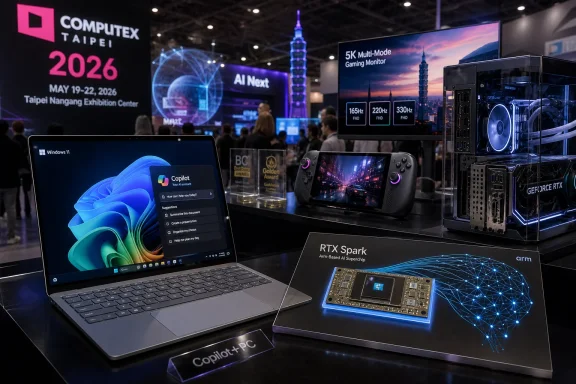
The standout announcement from Computex 2026 was Nvidia’s RTX Spark platform, a new Arm-based PC chip pitched as both a high-performance Windows processor and a local AI engine. Nvidia has spent years as the default GPU vendor for high-end gaming laptops and creator workstations. At Computex, it stepped into the role traditionally held by Intel, AMD, Qualcomm, and Apple: the company designing the heart of the computer.That shift matters because the PC industry has spent the last two years promising “AI PCs” with a vagueness that often felt more like sticker marketing than product strategy. A neural processing unit could accelerate background effects, summarize text, or satisfy a Windows eligibility requirement, but it rarely changed what a buyer thought the machine was. RTX Spark is a different kind of proposition. It says the PC is not merely gaining an AI accelerator; it is becoming a local inference workstation with a keyboard attached.
The reported specs explain why it took the top slot. A 20-core Arm CPU, a Blackwell-class GPU, 6,144 CUDA cores, up to 128GB of unified memory, and roughly one petaflop of AI performance put RTX Spark closer to a compact developer box than a conventional laptop part. Nvidia is effectively importing the logic of its AI desktop and data-center ecosystem into the Windows notebook category.
The risk is obvious. Windows on Arm has a long history of overpromising, and the practical experience still depends on app compatibility, driver quality, thermals, battery life, and whether developers actually optimize for the platform. But Nvidia has one advantage earlier Arm Windows efforts lacked: developers already understand CUDA as an AI and compute platform. If RTX Spark makes local model work feel boringly normal, it could do more for Windows on Arm than a decade of thin-client experiments ever did.
Surface Laptop Ultra Is Microsoft’s Most Serious MacBook Pro Argument in Years
Microsoft’s Surface Laptop Ultra became the natural showcase for Nvidia’s ambition because Surface has always been Microsoft’s way of arguing with the rest of the PC industry in hardware form. The best Surfaces were never simply nice laptops. They were reference designs for where Microsoft wanted Windows OEMs to go next.This time, the message is unusually direct. The Surface Laptop Ultra is being framed as a machine for developers, creators, AI workloads, and serious portable performance — exactly the ground Apple has owned with the MacBook Pro since Apple Silicon reset expectations for laptop efficiency. Microsoft has made powerful Surfaces before, but it has rarely had a silicon story that felt this aligned with the rest of the industry’s direction.
The appeal is not just the RTX Spark processor. The 15-inch mini LED display, high-brightness panel, haptic touchpad, CNC aluminum chassis, and creator-oriented demos all point to a machine designed to win hearts before procurement departments start asking questions. The Surface Laptop Ultra is not trying to be a cheap AI PC. It is trying to be the Windows laptop that makes the premium tier feel desirable again.
That distinction matters for WindowsForum readers because the high end often sets the shape of the mainstream two years later. If Surface Laptop Ultra succeeds, expect more Windows laptops with unified memory architectures, heavier local AI claims, better displays, and less tolerance for plasticky “good enough” design. If it fails, the industry will have another cautionary tale about trying to drag Windows into a new architecture before the ecosystem is ready.
Intel’s Handheld Push Turns the Console-PC Hybrid Into a Real Category
Intel’s Arc G3 Extreme was one of Computex’s more important component stories because it suggested Intel has found a more focused battlefield than the broad laptop wars. Gaming handhelds are still small compared with traditional notebooks, but they are one of the few PC categories where buyers are actively excited about form factor change. That makes them strategically valuable.The show-floor claim was simple: Intel’s first gaming handheld processor can deliver high-setting, full-resolution gameplay at 60fps in modern titles such as Forza Horizon 6, F1 2025, and Hogwarts Legacy. If that performance holds up outside curated demos, it would be a serious challenge to AMD’s Ryzen Z-series dominance in handheld PCs. AMD’s advantage has been timing, integration, and the confidence of device makers. Intel’s counterargument is that it can now compete where battery, graphics, drivers, and thermals all collide.
The MSI Claw 8 EX AI+ became the most visible beneficiary. MSI’s first Claw generation arrived into a market that was already skeptical of Windows handhelds and harshly compared every new device with Valve’s Steam Deck. The new model appears to be a more complete answer: better ergonomics, Hall-effect sticks, improved controls, more convincing haptics, and the performance story Intel needed.
The bigger question is not whether one handheld can beat another in a booth demo. It is whether Windows handhelds can stop feeling like laptops squeezed into controllers and start feeling like coherent devices. Microsoft has made gestures toward a better handheld interface, but OEMs are still doing too much of the experience work themselves. The silicon may be ready before Windows is.
The Handheld Explosion Shows Windows Wants to Be Everywhere, Even When It Is Awkward
The Asus ROG Xbox Ally X20 showed the other side of the handheld story: a market now mature enough for extravagance. OLED brightness claims, transparent shells, upgraded sticks, deeper triggers, a transformed D-pad, dedicated capture controls, and bundled smart glasses are not the language of an experimental category. They are the language of segmentation.That is good news for enthusiasts because competition pushes the hardware forward quickly. In only a few years, handheld PCs have gone from Linux-powered curiosity to a crowded Windows-adjacent market filled with OLED screens, variable refresh displays, detachable software layers, AI claims, and console-style branding. The category is still messy, but it is no longer fragile.
The problem is that every improvement on the hardware side exposes the software gap more clearly. A 171-inch virtual display through bundled glasses sounds futuristic, but Windows still has to handle sleep states, launchers, updates, overlays, cloud saves, anti-cheat behavior, battery reporting, and controller-first navigation. The device can feel magical until a desktop dialog appears at the wrong moment.
That tension is why the handheld awards at Computex were more than gadget applause. They marked the point where OEMs are no longer waiting for the platform to become perfect. They are building around Windows’ shortcomings and daring Microsoft to catch up.
Dell’s XPS 13 Revival Was the Show’s Quietest Strategic Move
The new Dell XPS 13 stood out because it moved in the opposite direction from the maximalist AI workstations and premium gaming handhelds. Starting at $699, or reportedly less for students, it aims at the everyday laptop buyer who wants the XPS design language without the luxury-tax price. At a show dominated by expensive silicon, that mattered.The XPS line has had an uneven few years, especially as Dell experimented with controversial input designs and moved away from what many users loved about the brand. A cheaper, thinner, simpler XPS 13 reads like a partial course correction. It acknowledges that the PC market still needs beautiful normal laptops, not just AI flagships and gaming devices with spec sheets that read like small servers.
The comparison target is telling. By aiming at lower-cost premium-feeling machines, Dell is trying to defend the Windows mainstream against Apple’s entry-level MacBooks and the broader drift toward tablets and Chromebooks. A $699 XPS does not have to beat a Surface Laptop Ultra. It has to make a student, traveler, or office buyer feel that Windows hardware can still be elegant without being financially absurd.
There is a lesson here for the entire industry. AI may dominate keynotes, but the PC replacement cycle is still driven by keyboards, screens, weight, battery life, price, and trust. Dell’s award was not about raw innovation. It was about remembering that value is a feature.
Asus Turned Peripherals Into Luxury Objects, and the Prices Prove It
The Asus ROG Harpe II Extreme Edition 20 and ROG Azoth Extreme Edition 20 were two of the most striking examples of how gaming peripherals have absorbed luxury-market logic. A $259 mouse and a $699 keyboard are not mass-market accessories. They are identity products for enthusiasts who treat desk hardware the way audiophiles treat amplifiers.The Harpe II Extreme Edition 20’s gold-plated and transparent design, 65K DPI sensor, 8,000Hz polling, optical switches, and Gorilla Glass feet make it an absurd object in the best and worst ways. No one needs a mouse that ornate to click heads in a shooter. But gaming hardware has never been only about need; it is about the belief that every surface, click, gram, and millisecond can be optimized.
The Azoth Extreme Edition 20 pushes the same argument further. A heavy metal build, carbon fiber, gold accents, adjustable typing resistance, very long claimed battery life, and web-based tuning software place it closer to a boutique mechanical keyboard than a conventional gaming deck. Asus is not merely selling lower latency. It is selling ritual.
There is a tension here worth naming. The enthusiast market funds experimentation, but it can also normalize prices that make PC gaming feel more exclusionary than it needs to be. Still, Computex has always been a place for excess. Asus understood the assignment: make peripherals people photograph even if they never buy them.
Displays Are Finally Escaping the Old Resolution Bargain
Gigabyte’s Aorus Elite FM275K16P was one of the clearest signs that gaming monitors are leaving behind the old forced choice between resolution and refresh rate. For years, buyers had to pick a lane: high-refresh 1080p or 1440p for competitive play, 4K for visual fidelity, or ultrawide for immersion. A 5K gaming monitor with multiple modes changes that conversation.The multi-mode pitch is especially important. A panel that can run 5K at 165Hz, 4K at 220Hz, and QHD at 330Hz recognizes that the same user may want different behavior depending on the game, GPU, and day. That is far more practical than pretending one resolution-refresh combination is ideal for everything.
The AI monitor features are more debatable. Repositioning a minimap or dynamically changing a crosshair color may be useful, but these features also push monitors into a strange zone where display hardware begins interpreting game information and altering the user experience. Competitive communities will need to decide what counts as accessibility, convenience, or unfair assistance.
Alienware’s AW3426DW represented a more traditional but still meaningful display improvement. The move to a newer QD-OLED panel with a Penta Tandem OLED structure and RGB stripe sub-pixel layout aims at two longstanding OLED monitor complaints: brightness and text clarity. A higher refresh rate and less reflective coating make the upgrade feel less like spec inflation and more like a response to actual user pain.
Corsair Remembered That Practical Design Can Be More Exciting Than RGB
The Corsair HS35 v3 and Corsair Warthog PC case won attention for different reasons, but they shared a design philosophy that Computex could use more often: solve a real annoyance first, then make it look good. The HS35 v3’s clever dongle design is a tiny thing that matters because PC gamers now move between desktops, laptops, handhelds, consoles, and USB-C devices constantly. A wireless headset that treats port chaos as a design problem is more useful than another lighting zone.The headset’s lighter floating design and Dolby Atmos support add the expected spec improvements, but the dongle is the idea people will remember. That is how accessory design often works. The feature that saves you five seconds every day beats the feature that looks better in a launch slide.
The Warthog case was louder, stranger, and more theatrical. Its sci-fi military styling will not be for everyone, but its large guarded controls, carry-friendly feet, and rear I/O light all point to people who actually build and move PCs. Anyone who has fumbled behind a tower with a phone flashlight understands the value of illuminating the rear ports.
That is why the case deserved recognition despite its aggressive styling. PC cases can become sculptures that punish maintenance. Corsair made one that looks like a prop from a shooter but still respects the person who has to plug in the DisplayPort cable.
BenQ’s Monitor Light Was a Reminder That Ergonomics Still Wins Workdays
The BenQ ScreenBar Halo 2 was not the newest product at Computex, but its inclusion was revealing. In a show packed with processors, GPUs, AI demos, and handhelds, a desk light earned attention by addressing the less glamorous reality of modern computing: people sit in front of screens for too many hours in rooms with bad lighting.The monitor light category can seem like lifestyle fluff until you use one in a dark office or a mixed-light workspace. The better versions reduce glare, illuminate the desk, and create a more comfortable visual environment without blasting light into the panel. BenQ’s emphasis on front lighting and rear ambient illumination speaks to a problem remote workers, streamers, developers, and gamers all share.
There is also a broader point. Not every meaningful PC accessory needs to increase frame rates or run a language model. Sometimes the best upgrade is the one that makes a six-hour work session less physically punishing.
That is easy to forget at a trade show where every booth wants to sound like the future. The ScreenBar Halo 2’s award quietly argued that the future still has desks, eyes, and fatigue.
MSI’s Holographic Dragon Shows the AI PC’s Charm Problem
The MSI MEG Vision X2 AI+ was one of Computex’s stranger gaming desktop highlights because it put a mascot-like AI interface into the front panel. Lucky, MSI’s dragon character, can reportedly answer questions through a hologram-like display and a more personable voice interface. It is charming, silly, and exactly the kind of thing that makes the AI PC both interesting and easy to mock.That contradiction is useful. The PC industry has struggled to make AI feel emotionally legible to normal users. A chatbot window is functional but cold. A system tray icon is forgettable. A dragon in your desktop case is ridiculous, but it at least admits that personality may matter if vendors expect people to interact with local assistants regularly.
The enterprise reader will understandably roll their eyes. A mascot is not a governance framework, and no sysadmin is deploying dragon-fronted towers to solve compliance problems. But consumer hardware often tests interaction models in exaggerated form before subtler versions arrive elsewhere.
The real question is whether local AI agents will become trusted parts of the PC or just another layer of vendor software users disable after setup. MSI’s approach may not be the answer, but it correctly identifies the problem. AI needs an interface that feels less like homework.
Gigabyte’s Infinity GPU Made Cable Management Part of the Aesthetic
Gigabyte’s Aorus GeForce RTX 50 Infinity Series GPU won on design as much as performance. In a market where high-end graphics cards are already enormous, expensive, and brutally fast, industrial design becomes one of the few ways to stand apart. Gigabyte leaned into a retro-futuristic look and a rear-connector layout intended to hide cabling.That rear-connector idea is more than cosmetic. PC builders have spent decades routing cables around components that were never fully designed around visual cleanliness. As glass panels, vertical mounts, and showcase builds became normal, cable management turned from a maintenance task into an aesthetic discipline. Moving connectors out of sight is an obvious next step.
The caveat is ecosystem compatibility. Rear connectors are only elegant when cases, motherboards, power supplies, and cable standards cooperate. Otherwise, they become another proprietary-looking flourish in a market already full of fitment traps. The best version of this idea is not one beautiful GPU; it is a broader design shift that makes clean builds easier for everyone.
Still, Computex rewards signals as much as shipping realities. Gigabyte’s Infinity Series signaled that GPU makers know the card is now the centerpiece of many PCs. If it is going to dominate the case, it might as well look intentional.
The Awards Tell a Clear Story: The PC Is Becoming Local, Portable, and More Personal
The 15 award picks from Computex 2026 were scattered across laptops, chips, handhelds, peripherals, displays, cases, desktops, and accessories, but the pattern was coherent. The industry is trying to make the PC feel newly central after years of smartphones, cloud services, and consoles stealing the cultural energy. AI is the stated reason, but the hardware story is broader than AI alone.The strongest products shared a common trait: they made the computer feel more immediate. RTX Spark moves AI workloads closer to the user. Handhelds move PC gaming away from the desk. Multi-mode monitors adapt to different uses instead of locking buyers into one compromise. Smarter accessories reduce friction in small but meaningful ways.
That is why Computex 2026 felt more consequential than a normal component refresh. The show was not just about faster versions of familiar things. It was about a PC industry trying to redefine where computing happens, what form it takes, and how much intelligence should live on the device itself.
The Concrete Lessons From Taipei’s AI-Heavy Hardware Week
Computex 2026 was loud, but the useful signal was not hard to find. Strip away the booth lighting and anniversary editions, and the awards list points to a PC market that is experimenting with new defaults.- Nvidia’s RTX Spark was the most important announcement because it put a full Windows PC platform behind the idea of local AI rather than treating AI as a background accelerator.
- Microsoft’s Surface Laptop Ultra gave Windows on Arm its most credible premium showcase yet, but its success will depend on software compatibility and real-world thermals as much as benchmark claims.
- Intel’s Arc G3 Extreme made handheld gaming PCs a serious silicon battleground, especially if its show-floor performance translates into shipping devices.
- Dell’s lower-cost XPS 13 showed that premium Windows design still needs an accessible on-ramp, not just halo machines for developers and creators.
- The best peripherals and cases won because they solved practical annoyances, from mixed USB dongles to rear-port visibility, instead of relying only on RGB and spec inflation.
- The monitor category is moving toward flexibility, with panels that can serve creators, competitive players, and visual-first gamers without forcing one permanent compromise.
References
- Primary source: The Shortcut | Matt Swider
Published: 2026-06-06T04:36:11.596858
Computex 2026 Awards: the best tech we saw on the show floor and behind closed doors
Computex 2026 was packed with the latest and greatest technologywww.theshortcut.com - Related coverage: techradar.com
We're at Computex 2026! Ask our experts anything you want to know about the world's biggest computing show | TechRadar
Your inside track to the world's largest computing showwww.techradar.com - Related coverage: tomshardware.com
Nvidia unveils RTX Spark Superchip for laptops and desktop PCs at Computex 2026 – new platform promises to turn Windows into an agentic AI OS with Arm CPU, Blackwell GPU, and 128GB unified memory | Tom's Hardware
Over 30 laptops and 10 desktops coming this fall with "the most efficent platform ever built"www.tomshardware.com - Related coverage: expotobi.com
- Related coverage: my.computex.biz
- Related coverage: ti.com
Computex | TI.com
www.ti.com
- Related coverage: wilyer.com
Computex 2026 Taipei: Dates, Venues & AI Together Guide
Computex 2026 runs 2 to 5 June across four Taipei venues. 1,500 exhibitors, 6,000 booths, theme AI Together. A visitor guide to the AI and ICT trade show. wilyer.com
- Related coverage: windowscentral.com
Surface Laptop Ultra: Microsoft and NVIDIA reveal the 128GB RAM, mini‑LED, RTX Spark powerhouse redefining Windows on Arm | Windows Central
Uncompromising raw NVIDIA N1x power meets legendary Surface craft, but can people afford it?www.windowscentral.com - Related coverage: affael.com
COMPUTEX TAIPEI 2026 — Taipei, Taiwan | AFFAEL
COMPUTEX TAIPEI 2026 from Mon Jun 01 2026 at Taipei Nangang Exhibition Center in Taipei (Computers, Telecommunications, Computers Networks, Internet & Intranet… affael.com
- Related coverage: prnewswire.com
COMPUTEX 2026 Brings the Global AI Ecosystem to Taipei
/PRNewswire/ -- COMPUTEX 2026 will take place from June 2–5 in Taipei, spanning four venues — TaiNEX 1 & 2, TWTC Hall 1, and the Taipei International... www.prnewswire.com
- Related coverage: computex.biz
COMPUTEX TAIPEI - Building Global Technology Ecosystem
www.computex.biz
- Related coverage: cntoolbox.com
2026 COMPUTEX Taipei
COMPUTEX is a world-renowned ICT exhibition that has attracted international buyers and exhibitors since its inception in 1981, showcasing the latest technology products and solutions. cntoolbox.com
- Related coverage: hardwareluxx.de
Größer denn je: Die Computex 2026 ist eröffnet - Hardwareluxx
Größer denn je: Die Computex 2026 ist eröffnet. www.hardwareluxx.de
- Related coverage: cloudcdn.taiwantradeshows.com.tw
- Related coverage: storage.googleapis.com