

Visteon, Qualcomm, EverDriven, Google, Rambus, AUTOSAR, iSOFT and Geotab surfaced in connected-car news in June 2026 as suppliers pushed vehicle-adjacent software deeper into factories, dashboards, school transportation, security silicon, and fleet data systems. The common thread is not one product category but a migration of automotive computing outward, from the car as a finished machine to the infrastructure that builds, manages, secures, routes, and monetizes it. Connected-car technology is becoming less about a modem in the dashboard and more about a distributed operating model for mobility. That shift should interest WindowsForum readers because it looks a lot like the enterprise IT story we already know: endpoints everywhere, policy everywhere, telemetry everywhere, and security that has to be designed before the first deployment goes live.
The phrase connected car used to be relatively tidy. It meant navigation updates, emergency calling, infotainment apps, over-the-air firmware, and maybe a companion phone app that could unlock a door or precondition a battery. In 2026, that definition is too small.
This latest batch of announcements stretches the category from factory-floor machine vision to alternative student transportation, Android Auto conferencing, automotive root-of-trust silicon, AUTOSAR software plumbing, and telematics platforms. Some of those products never sit inside a consumer vehicle. Yet all of them orbit the same gravitational center: mobility systems are becoming software-defined networks of devices, services, identities, and policies.
That is the real story hiding under the roundup format. The auto industry is not merely adding apps to cars. It is absorbing the operating assumptions of cloud computing and enterprise endpoint management, then adapting them to machines that move through public roads at highway speed.
The result is a market where chipmakers, software vendors, school transportation operators, cloud companies, and standards bodies all have a plausible claim on the connected-car stack. The winners will not be the companies that simply attach the most radios. They will be the ones that make complex, distributed systems trustworthy enough for regulators, fleet managers, drivers, and passengers to accept.
That matters because the software-defined vehicle begins before the vehicle exists. If automakers want cars whose features are increasingly determined by software, sensors, and centralized compute, they also need factories that can inspect, validate, and adapt at software speed. The same edge AI logic that helps a car interpret its environment can help a production line interpret whether a part was assembled correctly.
D6Sigma is built around Visteon’s CognitoAI-IoT platform and Qualcomm’s Dragonwing IQ9 Series processors, with Edge Impulse handling machine learning operations, Qualcomm Insight Platform supporting generative AI video analytics, and FoundriesFactory handling fleet-scale device management. That stack reads less like a conventional factory tool and more like a managed edge-computing platform. It has models, devices, cameras, lifecycle management, and analytics close to where the physical work happens.
The low-latency pitch is important. Manufacturing vision systems cannot always wait for a cloud round trip, especially when the event being detected is a short stoppage, a missed step, or a safety violation. Edge inference is not just a cost-saving measure; it is a way to keep decisions close to the equipment and workers affected by them.
For automakers and suppliers, the larger implication is that production quality may increasingly depend on AI systems that are themselves managed like fleets. A factory could become a connected environment where cameras, gateways, models, and dashboards are versioned, monitored, and updated just as aggressively as vehicle software. That will make manufacturing more measurable, but it will also make it more dependent on the reliability of AI pipelines.
That should sound familiar to anyone who has managed Windows endpoints, industrial PCs, or IoT devices at scale. The hard part is rarely the pilot. The hard part is identity, patching, rollback, audit trails, false positives, data retention, model drift, and deciding who is allowed to change what.
Factories also have a special problem: they are full of legacy equipment, fragile workflows, and justified skepticism toward anything that threatens uptime. A model that misclassifies a micro-stoppage is not merely “wrong” in an abstract sense. It can distort performance metrics, trigger unnecessary interventions, or become another dashboard that workers learn to ignore.
This is where Qualcomm’s presence matters. The Dragonwing branding is part of a broader push to put AI-capable compute into industrial and embedded environments where power, longevity, and connectivity matter. But silicon alone does not solve the governance problem. If automotive suppliers deploy edge AI broadly, the operational discipline around those systems will matter as much as TOPS ratings or camera counts.
The connected-car industry has spent years learning that software features must be maintained after shipment. Now that lesson is being applied upstream. A smarter factory is also a larger attack surface and a more complicated support contract.
That includes students with disabilities, students experiencing housing instability, and other high-need populations that require variable pickup locations, specialized mobility assistance, behavioral considerations, or specific safety equipment. TripCentral replaces EverDriven’s older district portal with a hub for trip submission, routing, tracking, analytics, and compliance-related data capture.
The most important detail is not the interface. It is the claim that districts can get compliant alternative transit routing established within a multi-hour window rather than through a slower manual process. If that works at scale, transportation software becomes a safety and continuity tool for some of the most vulnerable students in the system.
This is connected mobility without the glamour. There is no concept car, no cockpit rendering, no autonomous driving demo. But the operational problem is real: school districts must transport students reliably while meeting legal obligations, protecting privacy, responding to changing family circumstances, and dealing with constrained budgets.
TripCentral is scheduled for nationwide deployment across EverDriven’s network of more than 800 school districts in 37 states for the 2026–2027 academic year. That makes it less like a niche app and more like a public-sector logistics layer. Once transportation for special populations depends on a software hub, uptime, data accuracy, permissions, and auditability become civic concerns.
The auto industry often talks about privacy in terms of consumer choice: location history, driving behavior, infotainment data, or insurance scoring. Student transportation raises the stakes. The data describes minors, disability accommodations, housing instability, and school-district obligations.
That makes TripCentral a test case for how mobility platforms handle trust outside the consumer marketplace. Districts will need more than glossy dashboards. They will need role-based access, strong retention policies, incident response procedures, vendor accountability, and clean integration with existing administrative systems.
The AI routing component also deserves scrutiny. Automated routing can reduce waste and improve responsiveness, but school transportation is not a simple delivery optimization problem. A route that is mathematically efficient can still be inappropriate if it ignores student safety, caregiver constraints, driver qualifications, or equipment requirements.
EverDriven’s announcement points toward a future where connected mobility is not simply about cars talking to clouds. It is about institutions using software to coordinate human movement under legal, ethical, and operational constraints. That is a much harder problem than drawing a route line on a map.
Google has deliberately stripped the experience down. Video is disabled, advanced meeting interactions are unavailable, and the interface is limited to basic call controls such as mute, hang up, and inbound invitation management. The system defaults toward a driving-friendly mode and bypasses the usual pre-call green room, meaning the user joins directly into the audio stream.
On paper, this is the safe version of in-car conferencing. In practice, it is also a formal acknowledgment that the car has become part of the workplace perimeter. The dashboard is no longer just competing with the phone for navigation and music. It is being asked to absorb the residue of hybrid work.
The limitation around work profiles is especially telling. Current support does not fully expose upcoming work-profile calendar events in the vehicle interface, even though active inbound calls can still function. That is awkward because the most obvious user for Meet in Android Auto is someone joining work meetings from the road.
For IT administrators, this is not a trivial edge case. Android work profiles exist to separate personal and managed data, enforce policy, and keep corporate information inside a governed container. When dashboard software cannot cleanly handle that separation, convenience runs into the architecture of enterprise mobility management.
The car industry has long treated hands-free interaction as a safety compromise. That compromise is better than holding a phone, but it is not equivalent to full attention. A driver listening to a passive podcast is in a different mental state from a driver negotiating deadlines, budgets, customer escalations, or production outages.
The direct-join behavior is another interesting design tradeoff. It reduces fiddling with pre-call screens, but it also removes a moment when users might check microphone state or decide whether joining is appropriate. In a parked office, the green room is a convenience. In a moving car, it could be a useful pause.
This is where the connected-car debate becomes less about feature availability and more about norms. Should cars make it easier to join meetings, or should they put more friction between driving and work? Google has chosen managed convenience with guardrails. Employers and users will decide whether that becomes a productivity tool or another way to erase the boundary between commute and office.
For WindowsForum’s IT-minded audience, the lesson is broader than Android Auto. Endpoint experiences increasingly cross physical contexts. A managed identity that begins on a phone can appear on a dashboard, a headset, a kiosk, or a factory terminal. Policy models have to account not just for who the user is, but where the user is and what they are doing.
The RT-648 handles secure boot, authentication, cryptographic acceleration, and lifecycle state management inside an isolated security environment. It is designed for ISO 26262 and ISO/SAE 21434 alignment, with ASIL-B capability and Dual Core Lock Step operation for fault detection. Rambus also says the cryptographic engine supports post-quantum algorithms including ML-KEM, ML-DSA, and SLH-DSA.
That is a dense paragraph of security terminology, but the direction is simple: cars need hardware-anchored trust because software-defined vehicles are becoming too complex to secure only at the application layer. If a vehicle’s cockpit, ADAS functions, domain controllers, and connected services depend on shared compute fabrics, the system needs roots of trust that survive compromised operating systems or misbehaving applications.
Telechips has already deployed the RT-648 IP into production automotive SoCs, according to the announcement. That is important because automotive silicon cycles are long and conservative. Security IP that reaches production platforms can shape architectures for years.
The Arm alignment is also significant. Automotive compute is consolidating around more standardized subsystems, and suppliers want security blocks that integrate cleanly into those environments. A root of trust that fits the dominant compute architecture has a better chance of being used consistently rather than bolted on unevenly.
That long lifecycle changes the security calculus. A weak or outdated cryptographic foundation in a car is hard to replace once millions of vehicles are deployed, especially if the affected component sits in a safety-relevant domain. Over-the-air updates help, but they do not eliminate the need for hardware that can support stronger primitives over time.
The software-defined vehicle also raises the value of compromise. A modern car is not a single ECU running a fixed function. It is a network of processors, sensors, actuators, radios, cloud services, mobile apps, and supplier components. Attackers do not need every subsystem to fail; they need a path from one weak point to something valuable.
Hardware security modules are not magic. They can be misconfigured, poorly integrated, or undermined by flawed system design. But they establish a place where keys, boot measurements, and lifecycle states can be protected with stronger assumptions than ordinary application code.
The RT-648 announcement therefore belongs alongside Android Auto and D6Sigma, even though it lives at a different layer. The connected-car stack is only as trustworthy as its lowest assumptions. If the industry wants cars to behave more like rolling data centers, it has to import data-center-grade thinking about roots of trust, attestation, and cryptographic agility.
AUTOSAR has long been central to automotive software standardization, but the industry’s shift toward software-defined vehicles has exposed the limits of traditional approaches. Automakers want faster development, service-oriented architectures, centralized compute, and reusable software components. Suppliers want platforms that reduce integration pain without giving away all differentiation.
CAPI is part of that push toward executable, shared platform foundations. The idea is not merely to publish specifications and let every company reinvent the implementation. It is to create a more practical baseline that can accelerate integration for adaptive automotive software.
The iSOFT contribution is notable because it reflects the growing influence of Chinese automotive software ecosystems. China’s EV and intelligent-driving markets have moved quickly, and software infrastructure developed for that pace is now being positioned within global standards discussions. That does not mean the global industry will converge neatly around one implementation, but it does mean the center of gravity is shifting.
For developers, the promise is familiar: less time spent wiring together low-level platform pieces and more time spent building differentiating features. For safety engineers and OEM architects, the concern is equally familiar: shared baselines must be transparent, verifiable, and governed well enough to trust in production vehicles.
AUTOSAR’s evolution reflects that tension. Classic AUTOSAR helped manage embedded control complexity, while Adaptive AUTOSAR is aimed at high-performance computing, service-oriented communication, and more dynamic software environments. That evolution is necessary for software-defined vehicles, but it also increases the number of stakeholders who care about the platform layer.
An executable common platform can reduce duplicated effort. It can also create arguments over governance, contribution rights, conformance, security review, and who benefits commercially from the baseline. Those debates are not bugs in the process; they are the cost of turning automotive software into shared infrastructure.
iSOFT’s role will be watched partly through that lens. A contribution from a major Chinese infrastructure software company can accelerate development, but it also arrives amid geopolitical scrutiny of connected vehicles, supply chains, and software provenance. The technical merits and the political context will travel together.
For IT pros, the analogy is obvious. Enterprises love standard platforms until they discover the platform has become a dependency they do not fully control. Automakers face the same tradeoff, only with longer product cycles and higher safety consequences.
Telematics platforms turn vehicles into managed assets. That sounds mundane, but it is one of the most commercially mature forms of connected mobility. A fleet dashboard can tell an operator which vehicles are underused, which drivers are at risk, which maintenance events are likely, and where routing or charging behavior is wasting money.
This is also where the connected-car industry’s data appetite becomes unavoidable. Fleet systems can generate useful operational intelligence because they collect detailed information at scale. The same data that improves safety and efficiency can also become intrusive if used without clear governance.
Geotab’s broader market position shows how connected mobility increasingly depends on partnerships with OEMs and data platforms rather than plug-in hardware alone. Native telematics integrations reduce installation friction and give fleet operators cleaner access to vehicle data. They also make automakers more active participants in fleet software ecosystems.
That matters for the consumer market because fleet expectations often migrate downward. Features that begin as commercial management tools can influence insurance, maintenance, resale, and subscription models for private vehicles. The dashboard may be the visible interface, but the business model often lives in the data exhaust.
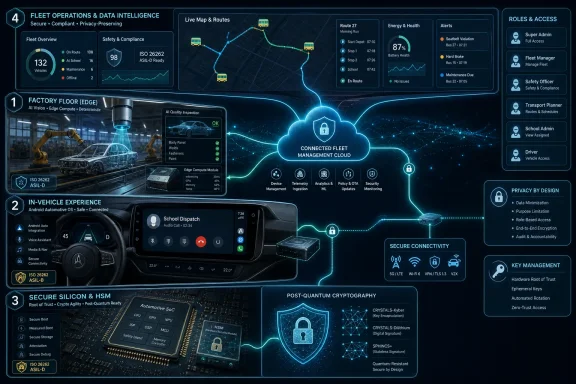
That convergence creates practical pressure. A carmaker may need to manage AI inspection devices in a plant, AUTOSAR-based software components in vehicle compute, hardware roots of trust in SoCs, Android Auto experiences in the cabin, telematics feeds in fleets, and public-sector transportation workflows around the vehicle. Each domain has its own vendors, standards, risks, and update cycles.
The industry’s favorite phrase, software-defined vehicle, can obscure that complexity. Software-defined does not mean software-alone. It means software-mediated relationships among hardware, cloud services, users, regulators, repair networks, suppliers, and data platforms.
This is why the connected-car story increasingly resembles enterprise IT. The problems are identity, device management, observability, compliance, lifecycle support, secure boot, data minimization, and user experience under constraint. The novelty is that the endpoint may be a car, a school transport route, an AI camera above an assembly line, or a security block inside an SoC.
The companies that understand that systems problem will have an advantage over those chasing feature checklists. The auto industry does not need more disconnected dashboards. It needs reliable computing environments that can survive hostile networks, messy human workflows, long product lifecycles, and regulatory scrutiny.
The next phase of connected mobility will be won less by spectacular demos than by boring competence: secure silicon that is actually integrated, AI systems that survive production use, dashboards that respect attention, routing platforms that protect vulnerable passengers, standards that reduce fragmentation without hiding risk, and fleet data systems that create value without becoming surveillance by default. The car is becoming another managed computer, but the road will not forgive the shortcuts that enterprise IT sometimes tolerates.
 The Connected Car Is No Longer Confined to the Car
The phrase connected car used to be relatively tidy. It meant navigation updates, emergency calling, infotainment apps, over-the-air firmware, and maybe a companion phone app that could unlock a door or precondition a battery. In 2026, that definition is too small.This latest batch of announcements stretches the category from factory-floor machine vision to alternative student transportation, Android Auto conferencing, automotive root-of-trust silicon, AUTOSAR software plumbing, and telematics platforms. Some of those products never sit inside a consumer vehicle. Yet all of them orbit the same gravitational center: mobility systems are becoming software-defined networks of devices, services, identities, and policies.
That is the real story hiding under the roundup format. The auto industry is not merely adding apps to cars. It is absorbing the operating assumptions of cloud computing and enterprise endpoint management, then adapting them to machines that move through public roads at highway speed.
The result is a market where chipmakers, software vendors, school transportation operators, cloud companies, and standards bodies all have a plausible claim on the connected-car stack. The winners will not be the companies that simply attach the most radios. They will be the ones that make complex, distributed systems trustworthy enough for regulators, fleet managers, drivers, and passengers to accept.
Visteon and Qualcomm Move Automotive AI Back Into the Factory
Visteon’s D6Sigma launch with Qualcomm is technically an industrial automation announcement, but strategically it belongs in the connected-vehicle conversation. Visteon is an automotive technology supplier, and its first use cases are grounded in production: vision-based quality inspection, personal protective equipment compliance, assembly verification, and the detection of tiny stoppages that often vanish from formal downtime records.That matters because the software-defined vehicle begins before the vehicle exists. If automakers want cars whose features are increasingly determined by software, sensors, and centralized compute, they also need factories that can inspect, validate, and adapt at software speed. The same edge AI logic that helps a car interpret its environment can help a production line interpret whether a part was assembled correctly.
D6Sigma is built around Visteon’s CognitoAI-IoT platform and Qualcomm’s Dragonwing IQ9 Series processors, with Edge Impulse handling machine learning operations, Qualcomm Insight Platform supporting generative AI video analytics, and FoundriesFactory handling fleet-scale device management. That stack reads less like a conventional factory tool and more like a managed edge-computing platform. It has models, devices, cameras, lifecycle management, and analytics close to where the physical work happens.
The low-latency pitch is important. Manufacturing vision systems cannot always wait for a cloud round trip, especially when the event being detected is a short stoppage, a missed step, or a safety violation. Edge inference is not just a cost-saving measure; it is a way to keep decisions close to the equipment and workers affected by them.
For automakers and suppliers, the larger implication is that production quality may increasingly depend on AI systems that are themselves managed like fleets. A factory could become a connected environment where cameras, gateways, models, and dashboards are versioned, monitored, and updated just as aggressively as vehicle software. That will make manufacturing more measurable, but it will also make it more dependent on the reliability of AI pipelines.
The Factory-Floor AI Pitch Comes With an IT Burden
The promise of D6Sigma is straightforward: use computer vision to catch defects, compliance issues, and process inefficiencies before they become expensive. The operational risk is just as clear. Once AI systems become part of production monitoring, they become another class of mission-critical endpoint.That should sound familiar to anyone who has managed Windows endpoints, industrial PCs, or IoT devices at scale. The hard part is rarely the pilot. The hard part is identity, patching, rollback, audit trails, false positives, data retention, model drift, and deciding who is allowed to change what.
Factories also have a special problem: they are full of legacy equipment, fragile workflows, and justified skepticism toward anything that threatens uptime. A model that misclassifies a micro-stoppage is not merely “wrong” in an abstract sense. It can distort performance metrics, trigger unnecessary interventions, or become another dashboard that workers learn to ignore.
This is where Qualcomm’s presence matters. The Dragonwing branding is part of a broader push to put AI-capable compute into industrial and embedded environments where power, longevity, and connectivity matter. But silicon alone does not solve the governance problem. If automotive suppliers deploy edge AI broadly, the operational discipline around those systems will matter as much as TOPS ratings or camera counts.
The connected-car industry has spent years learning that software features must be maintained after shipment. Now that lesson is being applied upstream. A smarter factory is also a larger attack surface and a more complicated support contract.
EverDriven Shows That Mobility Software Is Becoming Public Infrastructure
EverDriven’s TripCentral announcement sits in a very different corner of the connected-mobility world. It is not about high-performance silicon or dashboard apps. It is about school districts managing alternative student transportation for children whose needs do not fit neatly into traditional yellow bus routing.That includes students with disabilities, students experiencing housing instability, and other high-need populations that require variable pickup locations, specialized mobility assistance, behavioral considerations, or specific safety equipment. TripCentral replaces EverDriven’s older district portal with a hub for trip submission, routing, tracking, analytics, and compliance-related data capture.
The most important detail is not the interface. It is the claim that districts can get compliant alternative transit routing established within a multi-hour window rather than through a slower manual process. If that works at scale, transportation software becomes a safety and continuity tool for some of the most vulnerable students in the system.
This is connected mobility without the glamour. There is no concept car, no cockpit rendering, no autonomous driving demo. But the operational problem is real: school districts must transport students reliably while meeting legal obligations, protecting privacy, responding to changing family circumstances, and dealing with constrained budgets.
TripCentral is scheduled for nationwide deployment across EverDriven’s network of more than 800 school districts in 37 states for the 2026–2027 academic year. That makes it less like a niche app and more like a public-sector logistics layer. Once transportation for special populations depends on a software hub, uptime, data accuracy, permissions, and auditability become civic concerns.
The Student Transportation Stack Is a Privacy Test in Disguise
Alternative student transportation is a revealing connected-car use case because it combines route optimization with sensitive human context. A platform may need to know where a student lives today, where they need to be dropped off tomorrow, what mobility support they require, and what behavioral or equipment considerations drivers must understand. That is operationally useful information, but it is also deeply sensitive.The auto industry often talks about privacy in terms of consumer choice: location history, driving behavior, infotainment data, or insurance scoring. Student transportation raises the stakes. The data describes minors, disability accommodations, housing instability, and school-district obligations.
That makes TripCentral a test case for how mobility platforms handle trust outside the consumer marketplace. Districts will need more than glossy dashboards. They will need role-based access, strong retention policies, incident response procedures, vendor accountability, and clean integration with existing administrative systems.
The AI routing component also deserves scrutiny. Automated routing can reduce waste and improve responsiveness, but school transportation is not a simple delivery optimization problem. A route that is mathematically efficient can still be inappropriate if it ignores student safety, caregiver constraints, driver qualifications, or equipment requirements.
EverDriven’s announcement points toward a future where connected mobility is not simply about cars talking to clouds. It is about institutions using software to coordinate human movement under legal, ethical, and operational constraints. That is a much harder problem than drawing a route line on a map.
Google Meet on Android Auto Turns the Commute Into Managed Work Time
Google’s broad rollout of Meet on Android Auto is the most consumer-visible item in the batch, and it is also the most culturally loaded. The feature brings audio-only Google Meet calls to compatible vehicle infotainment dashboards, with scheduled meetings and call history surfaced through the car interface.Google has deliberately stripped the experience down. Video is disabled, advanced meeting interactions are unavailable, and the interface is limited to basic call controls such as mute, hang up, and inbound invitation management. The system defaults toward a driving-friendly mode and bypasses the usual pre-call green room, meaning the user joins directly into the audio stream.
On paper, this is the safe version of in-car conferencing. In practice, it is also a formal acknowledgment that the car has become part of the workplace perimeter. The dashboard is no longer just competing with the phone for navigation and music. It is being asked to absorb the residue of hybrid work.
The limitation around work profiles is especially telling. Current support does not fully expose upcoming work-profile calendar events in the vehicle interface, even though active inbound calls can still function. That is awkward because the most obvious user for Meet in Android Auto is someone joining work meetings from the road.
For IT administrators, this is not a trivial edge case. Android work profiles exist to separate personal and managed data, enforce policy, and keep corporate information inside a governed container. When dashboard software cannot cleanly handle that separation, convenience runs into the architecture of enterprise mobility management.
Audio-Only Does Not Magically Make Meetings Safe
Google’s safety choices are sensible, but they should not end the conversation. Removing video and interactive widgets reduces visual distraction, yet an audio meeting can still consume attention. Anyone who has joined a tense project call from behind the wheel knows that cognitive load does not require a screen.The car industry has long treated hands-free interaction as a safety compromise. That compromise is better than holding a phone, but it is not equivalent to full attention. A driver listening to a passive podcast is in a different mental state from a driver negotiating deadlines, budgets, customer escalations, or production outages.
The direct-join behavior is another interesting design tradeoff. It reduces fiddling with pre-call screens, but it also removes a moment when users might check microphone state or decide whether joining is appropriate. In a parked office, the green room is a convenience. In a moving car, it could be a useful pause.
This is where the connected-car debate becomes less about feature availability and more about norms. Should cars make it easier to join meetings, or should they put more friction between driving and work? Google has chosen managed convenience with guardrails. Employers and users will decide whether that becomes a productivity tool or another way to erase the boundary between commute and office.
For WindowsForum’s IT-minded audience, the lesson is broader than Android Auto. Endpoint experiences increasingly cross physical contexts. A managed identity that begins on a phone can appear on a dashboard, a headset, a kiosk, or a factory terminal. Policy models have to account not just for who the user is, but where the user is and what they are doing.
Rambus Pushes Automotive Security Deeper Into the Silicon
Rambus’ CryptoManager RT-648 announcement is the least flashy item here and arguably the most foundational. The company introduced an automotive-grade embedded Hardware Security Module designed for integration into Arm’s Compute Subsystem ecosystem, using a 32-bit Arm Cortex-M33 processor. It is positioned for ADAS, infotainment, centralized compute, and other software-defined vehicle workloads.The RT-648 handles secure boot, authentication, cryptographic acceleration, and lifecycle state management inside an isolated security environment. It is designed for ISO 26262 and ISO/SAE 21434 alignment, with ASIL-B capability and Dual Core Lock Step operation for fault detection. Rambus also says the cryptographic engine supports post-quantum algorithms including ML-KEM, ML-DSA, and SLH-DSA.
That is a dense paragraph of security terminology, but the direction is simple: cars need hardware-anchored trust because software-defined vehicles are becoming too complex to secure only at the application layer. If a vehicle’s cockpit, ADAS functions, domain controllers, and connected services depend on shared compute fabrics, the system needs roots of trust that survive compromised operating systems or misbehaving applications.
Telechips has already deployed the RT-648 IP into production automotive SoCs, according to the announcement. That is important because automotive silicon cycles are long and conservative. Security IP that reaches production platforms can shape architectures for years.
The Arm alignment is also significant. Automotive compute is consolidating around more standardized subsystems, and suppliers want security blocks that integrate cleanly into those environments. A root of trust that fits the dominant compute architecture has a better chance of being used consistently rather than bolted on unevenly.
Post-Quantum Cryptography Is Moving From White Papers to Vehicle Roadmaps
Rambus’ inclusion of post-quantum cryptography is not a claim that quantum attackers are around the corner breaking cars tomorrow morning. It is a recognition of vehicle lifespan. Cars designed now may remain on roads into the 2040s, and their cryptographic assumptions need to survive longer than a typical smartphone generation.That long lifecycle changes the security calculus. A weak or outdated cryptographic foundation in a car is hard to replace once millions of vehicles are deployed, especially if the affected component sits in a safety-relevant domain. Over-the-air updates help, but they do not eliminate the need for hardware that can support stronger primitives over time.
The software-defined vehicle also raises the value of compromise. A modern car is not a single ECU running a fixed function. It is a network of processors, sensors, actuators, radios, cloud services, mobile apps, and supplier components. Attackers do not need every subsystem to fail; they need a path from one weak point to something valuable.
Hardware security modules are not magic. They can be misconfigured, poorly integrated, or undermined by flawed system design. But they establish a place where keys, boot measurements, and lifecycle states can be protected with stronger assumptions than ordinary application code.
The RT-648 announcement therefore belongs alongside Android Auto and D6Sigma, even though it lives at a different layer. The connected-car stack is only as trustworthy as its lowest assumptions. If the industry wants cars to behave more like rolling data centers, it has to import data-center-grade thinking about roots of trust, attestation, and cryptographic agility.
AUTOSAR and iSOFT Point to the Battle Over the Vehicle Operating Layer
The AUTOSAR and iSOFT news is another standards-layer development with large consequences. At the 17th AUTOSAR Open Conference in Shanghai, AUTOSAR and iSOFT announced a major contribution to the Common Adaptive Platform Implementation, with iSOFT contributing its intelligent driving operating system as a global code baseline for CAPI.AUTOSAR has long been central to automotive software standardization, but the industry’s shift toward software-defined vehicles has exposed the limits of traditional approaches. Automakers want faster development, service-oriented architectures, centralized compute, and reusable software components. Suppliers want platforms that reduce integration pain without giving away all differentiation.
CAPI is part of that push toward executable, shared platform foundations. The idea is not merely to publish specifications and let every company reinvent the implementation. It is to create a more practical baseline that can accelerate integration for adaptive automotive software.
The iSOFT contribution is notable because it reflects the growing influence of Chinese automotive software ecosystems. China’s EV and intelligent-driving markets have moved quickly, and software infrastructure developed for that pace is now being positioned within global standards discussions. That does not mean the global industry will converge neatly around one implementation, but it does mean the center of gravity is shifting.
For developers, the promise is familiar: less time spent wiring together low-level platform pieces and more time spent building differentiating features. For safety engineers and OEM architects, the concern is equally familiar: shared baselines must be transparent, verifiable, and governed well enough to trust in production vehicles.
Open Platforms Can Reduce Fragmentation Without Eliminating Politics
The auto industry wants the benefits of open software platforms, but it does not operate like the web. Vehicles are regulated, safety-critical, supplier-heavy, and sold across jurisdictions with different security, privacy, and certification expectations. Standardization is necessary, but it is never neutral.AUTOSAR’s evolution reflects that tension. Classic AUTOSAR helped manage embedded control complexity, while Adaptive AUTOSAR is aimed at high-performance computing, service-oriented communication, and more dynamic software environments. That evolution is necessary for software-defined vehicles, but it also increases the number of stakeholders who care about the platform layer.
An executable common platform can reduce duplicated effort. It can also create arguments over governance, contribution rights, conformance, security review, and who benefits commercially from the baseline. Those debates are not bugs in the process; they are the cost of turning automotive software into shared infrastructure.
iSOFT’s role will be watched partly through that lens. A contribution from a major Chinese infrastructure software company can accelerate development, but it also arrives amid geopolitical scrutiny of connected vehicles, supply chains, and software provenance. The technical merits and the political context will travel together.
For IT pros, the analogy is obvious. Enterprises love standard platforms until they discover the platform has become a dependency they do not fully control. Automakers face the same tradeoff, only with longer product cycles and higher safety consequences.
Geotab Represents the Quiet Power of Fleet Data
Geotab’s presence in the connected-car news mix underscores another reality: fleets often experience the connected-vehicle future before consumers do. Fleet operators care less about futuristic cockpit concepts and more about utilization, maintenance, fuel or energy cost, driver behavior, safety, compliance, and uptime.Telematics platforms turn vehicles into managed assets. That sounds mundane, but it is one of the most commercially mature forms of connected mobility. A fleet dashboard can tell an operator which vehicles are underused, which drivers are at risk, which maintenance events are likely, and where routing or charging behavior is wasting money.
This is also where the connected-car industry’s data appetite becomes unavoidable. Fleet systems can generate useful operational intelligence because they collect detailed information at scale. The same data that improves safety and efficiency can also become intrusive if used without clear governance.
Geotab’s broader market position shows how connected mobility increasingly depends on partnerships with OEMs and data platforms rather than plug-in hardware alone. Native telematics integrations reduce installation friction and give fleet operators cleaner access to vehicle data. They also make automakers more active participants in fleet software ecosystems.
That matters for the consumer market because fleet expectations often migrate downward. Features that begin as commercial management tools can influence insurance, maintenance, resale, and subscription models for private vehicles. The dashboard may be the visible interface, but the business model often lives in the data exhaust.
The Dashboard, the Factory, and the Fleet Are Becoming One Stack
Taken together, these announcements show a connected-car industry expanding in three directions at once. It is moving upstream into manufacturing, sideways into mobility services, and downward into silicon security. The vehicle remains central, but it is no longer the only meaningful endpoint.That convergence creates practical pressure. A carmaker may need to manage AI inspection devices in a plant, AUTOSAR-based software components in vehicle compute, hardware roots of trust in SoCs, Android Auto experiences in the cabin, telematics feeds in fleets, and public-sector transportation workflows around the vehicle. Each domain has its own vendors, standards, risks, and update cycles.
The industry’s favorite phrase, software-defined vehicle, can obscure that complexity. Software-defined does not mean software-alone. It means software-mediated relationships among hardware, cloud services, users, regulators, repair networks, suppliers, and data platforms.
This is why the connected-car story increasingly resembles enterprise IT. The problems are identity, device management, observability, compliance, lifecycle support, secure boot, data minimization, and user experience under constraint. The novelty is that the endpoint may be a car, a school transport route, an AI camera above an assembly line, or a security block inside an SoC.
The companies that understand that systems problem will have an advantage over those chasing feature checklists. The auto industry does not need more disconnected dashboards. It needs reliable computing environments that can survive hostile networks, messy human workflows, long product lifecycles, and regulatory scrutiny.
The Week’s Announcements Draw a Map of the Next Mobility Stack
The news is scattered only if each item is read in isolation. Read together, it sketches a mobility stack that starts in the factory, continues into the vehicle, extends through the dashboard, and persists into fleet and institutional operations.- Visteon and Qualcomm are pushing edge AI into manufacturing environments where vehicle quality, uptime, and worker-safety monitoring can be handled closer to the production line.
- EverDriven’s TripCentral shows that connected mobility platforms are becoming operational infrastructure for school districts, not just convenience software for private drivers.
- Google Meet on Android Auto makes the car a more explicit workplace endpoint, while its work-profile limitation exposes the unresolved tension between convenience and managed identity.
- Rambus’ RT-648 highlights the move toward hardware-anchored security as software-defined vehicles become more centralized, connected, and cryptographically demanding.
- AUTOSAR and iSOFT’s CAPI work points to the industry’s need for shared executable software foundations, even as standards politics and supply-chain trust become harder to separate.
- Geotab’s role in the wider connected-vehicle ecosystem shows that fleet data remains one of the most mature and commercially important expressions of connected mobility.
The next phase of connected mobility will be won less by spectacular demos than by boring competence: secure silicon that is actually integrated, AI systems that survive production use, dashboards that respect attention, routing platforms that protect vulnerable passengers, standards that reduce fragmentation without hiding risk, and fleet data systems that create value without becoming surveillance by default. The car is becoming another managed computer, but the road will not forgive the shortcuts that enterprise IT sometimes tolerates.
References
- Primary source: AUTO Connected Car News
Published: Sun, 21 Jun 2026 20:38:20 GMT
- Related coverage: streetinsider.com
Visteon Introduces D6Sigma, a New Edge AI Product Line for Industrial Automation, Developed in Close Collaboration with Qualcomm
New product line brings real-time vision AI to the factory floor powered by Visteon's CognitoAI -IoT platform and Qualcomm Dragonwing AI-enabled processors....www.streetinsider.com - Related coverage: techedgeai.com
Visteon & Qualcomm launch D6Sigma edge AI for factories
Visteon and Qualcomm unveil D6Sigma, an edge‑AI platform that brings real‑time vision intelligence to industrial automation.techedgeai.com - Related coverage: androidcentral.com
Your Android Auto just got a calling upgrade — here's what to know | Android Central
You can now take Google Meet calls right from Android Auto.www.androidcentral.com - Related coverage: qualcomm.com
Industrial Processor | Qualcomm
www.qualcomm.com
- Official source: support.google.com

Cómo usar Meet en Android Auto - Ayuda de Google Meet
Para unirte a reuniones y hacer llamadas de forma segura desde tu cuenta personal mientras conduces, puedes usar Google Meet en Android Auto. Proporciona una experiencia simplificada y centrada en el
support.google.com
- Related coverage: arstechnica.com
Google's new version of Android Automotive will move beyond infotainment - Ars Technica
Google wants Android in cars to break out of the infotainment box.arstechnica.com - Related coverage: es.investing.com
Visteon lanza línea de IA industrial con Qualcomm Por Investing.com
Visteon lanza línea de IA industrial con Qualcommes.investing.com - Related coverage: androidauthority.com
Google is putting Meet in your Android Auto dashboard just days after CarPlay
Google Meet has finally arrived on Android Auto, allowing you to check your schedule and join calls from your car's display.www.androidauthority.com - Official source: 9to5google.com
Google Meet on Android Auto arrives, blocks work accounts
Not long after Apple CarPlay, Google Meet is now making its way to Android Auto, but it doesn’t support work...9to5google.com - Related coverage: pulsepre.com
Visteon and Qualcomm Forge Alliance to Revolutionize Industrial Automation with Groundbreaking D6Sigma Edge AI Platform
The industrial landscape is on the cusp of a profound transformation, demanding intelligent, real-time solutions to maintain competitive advantage. Visteon's n…pulsepre.com - Related coverage: zonebourse.com
- Related coverage: docs.qualcomm.com
- Related coverage: avnet.com
- Related coverage: autosar.org
AUTOSAR and iSOFT Announce Major CAPI Contribution to Accelerate SDV and AIDV Deployment
The AUTOSAR Partnership and iSOFT announced a significant contribution to the Common Adaptive Platform Implementation (CAPI) at the 17th AUTOSAR Open Conference (AOC) in Shanghai.www.autosar.org - Related coverage: finanznachrichten.de
iSOFT stellt sein Betriebssystem für intelligentes Fahren als globale Code-Basis für AUTOSAR CAPI zur Verfügung
SHANGHAI, June 17, 2026 (GLOBE NEWSWIRE) -- Auf der 17. AUTOSAR Open Conference (AOC) in Shanghai stellte iSOFT (iSOFT Infrastructure Software Co., Ltd.) sein selbst entwickeltes Betriebssystem für intelligenteswww.finanznachrichten.de - Related coverage: geotab.com
Geotab and Hyundai Launch Native Telematics | Geotab
Geotab and Hyundai partner to deliver hardware-free, native telematics integration across Europe. Unlock high-resolution GPS, EV insights and maintenance data.www.geotab.com
- Related coverage: aeemobility.de
AUTOSAR: Erweiterung der Common Adaptive Platform Implementation - AEEmobility
AUTOSAR und iSOFT haben eine Erweiterung der Common Adaptive Platform Implementation (CAPI) vorgestellt. Die ausführbaren Softwarekomponenten sollen die Integration von AUTOSAR-Adaptive-Plattformen beschleunigen.aeemobility.de - Related coverage: infineon.com
infineon aurix drivecore autosar infineon isoft tasking gettingstarted en
PDF documentwww.infineon.com
- Related coverage: frost.com
