

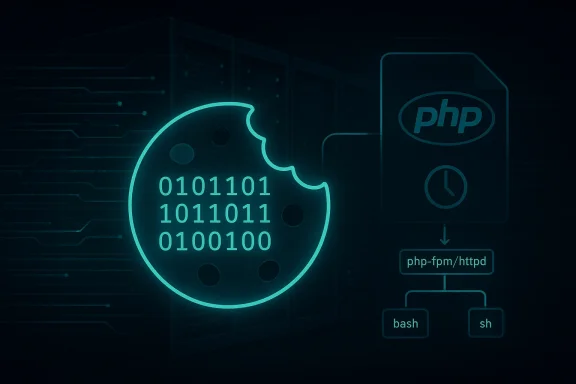
Threat actors are increasingly hiding PHP webshell control behind HTTP cookies, and Microsoft’s latest research shows why that matters: cookies are familiar, low-friction, and often less scrutinized than query strings or request bodies. In Linux hosting environments, that makes them an ideal stealth control plane for malicious code that wants to stay dormant until an operator deliberately wakes it. Microsoft says the technique has been seen across web requests, scheduled tasks, and trusted background workers, which means defenders cannot rely on one narrow detection layer anymore. (microsoft.com)
The new Microsoft report lands at a time when webshells remain one of the most durable post-compromise tools in enterprise and hosted Linux environments. Microsoft’s broader security research has repeatedly emphasized that once a public-facing application is compromised, attackers often turn to living-off-the-land execution, lightweight persistence, and low-noise control paths rather than flashy malware. In that context, cookie-gated PHP is not a novelty so much as an evolution: the attacker simply moves the trigger from a URL parameter or request body into a place defenders are less likely to inspect. (microsoft.com)
That shift matters because PHP is deeply embedded in shared hosting, cPanel-based environments, and many legacy applications that still power business websites. In those environments, account-level access can be enough to write files into web directories, schedule cron jobs, and keep malicious scripts alive long after the original intrusion path is closed. Microsoft’s analysis describes exactly that model: a cron-driven “self-healing” loader recreates the PHP file, while cookie-based conditions determine when the webshell actually becomes active. (microsoft.com)
It is also a reminder that attacker tradecraft evolves by blending in, not just by becoming more sophisticated in the abstract. Cookies are present on almost every modern web app, they are commonly logged but not always deeply inspected, and they fit cleanly into normal HTTP traffic. When a webshell uses a cookie as an execution key, the malicious code can look inert in routine scans, only revealing itself when the right value is supplied. That makes the technique especially attractive in noisy hosting environments where administrators are already juggling performance, compatibility, and customer isolation. (microsoft.com)
Microsoft frames the activity as consistent reuse of established webshell tradecraft rather than a one-off trick. That is an important clue for defenders, because it suggests the technique may spread across operators, toolsets, and victim environments instead of remaining confined to a single malware family. In practice, that means teams should think in terms of behavioral patterns—suspicious shells, encoded payload writes, cron anomalies, and web-server-to-shell process trees—rather than waiting for a known file hash. (microsoft.com)
In PHP, cookie values are immediately available at runtime through the
There is also an evasion benefit. Many security teams watch for command injection in URL parameters, POST bodies, or obvious upload endpoints, but fewer look for a hidden execution gate inside cookie logic. That means the malicious file can remain on disk for a long time while appearing mostly inert, especially if its outer layers are also obfuscated. (microsoft.com)
This matters for hosting providers and shared environments because those systems are already dense with legitimate traffic and customer-generated activity. A small, correctly structured cookie may not look unusual to an application, but it can be enough to activate malicious behavior if the webshell is designed around that input. The result is a backdoor that looks like ordinary state management unless defenders inspect the surrounding file and process behavior. (microsoft.com)
The layered loader is the most interesting from a defensive standpoint. It first reconstructs core PHP functions using arithmetic and string manipulation, intentionally leaving sensitive function names out of cleartext. That is not just cosmetic obfuscation; it complicates signature-based detection and makes static inspection much less reliable. Microsoft notes that after an initial base64 decode, the script still does not reveal its real behavior immediately, because a second obfuscation layer is assembled at runtime. (microsoft.com)
The direct cookie-driven payload stager is simpler, but its simplicity is a strength. It uses structured cookie data to reconstruct operational pieces such as file handling and decoding routines, then writes a secondary payload to disk if one is missing. This keeps the same tactical outcome—staged deployment and execution—while reducing the amount of code needed to achieve it. (microsoft.com)
The interactive webshell variant goes one step further by treating a single cookie as the validation mechanism. When the expected value appears, the script can execute supplied input and, in some cases, handle file upload. That makes it particularly dangerous in environments where defenders assume that shell activity must always come through obvious request parameters or a separate staging file. (microsoft.com)
Microsoft specifically points out that restricted shells such as
This is also why persistence and activation were separated. Cron handled re-creation, while cookies handled execution. That division lowers noise, because scheduled jobs can appear as ordinary maintenance unless defenders know what to look for, and cookie-gated activation can stay hidden in normal web logs. The combination creates a layered defense against detection—on the attacker’s side. (microsoft.com)
For hosting environments, the lesson is harsh but straightforward. If a threat actor can create recurring tasks and write PHP into a web directory, the environment can be effectively compromised for as long as the account remains under attacker influence. That is true even if the original intrusion vector is blocked after the fact. (microsoft.com)
A recurring theme is the
This is where defenders often fall behind. A webshell may be present for weeks, but if the environment only logs the final file state, the real story—how it was reconstructed, when it was reintroduced, and what spawned it—can be lost. Microsoft’s approach is practical: detect the shell, the decoder, the scheduler, and the control-panel path together. (microsoft.com)
For hosting providers, the challenge is that many of the attacker’s moves look legitimate on their own. A control panel action. A scheduled task. A PHP file update. A restricted shell command. Each may be explainable separately, yet the combination forms a reliable persistence chain. That is why security teams must reason about behavioral sequences rather than isolated events. (microsoft.com)
For consumers, the impact is usually downstream. They may encounter malicious downloads, phishing pages, or credential harvesting hosted on a seemingly legitimate site. That makes cookie-controlled webshells a hidden risk multiplier: the compromise may begin in a single account, but its effects can cascade into the broader ecosystem of users who trust that site. (microsoft.com)
This is also where managed service providers need to be especially careful. If a provider relies too heavily on default logs or basic antivirus coverage, attackers can bury persistence inside routine automation and then activate it only when needed. The operational cost of cleanup rises quickly once the attacker has reintroduced the webshell through cron or hidden it behind cookie-based activation. (microsoft.com)
The report’s advanced hunting queries make the underlying model explicit: look for
Microsoft’s Defender XDR detections reflect that same thinking. The company maps activity to alerts such as suspicious shell command execution, suspicious cron jobs, possible web server compromise activity, and active webshell prevention. That gives defenders a practical starting point, but the broader lesson is that modern webshell defense needs behavior-based monitoring across endpoint, host, and application layers. (microsoft.com)
There are several clear opportunities for defenders to improve resilience right away. Better process ancestry logging, stricter shell restrictions for web workloads, and cron audits in hosted environments would all raise the cost of this technique. Security teams that already use Microsoft Defender XDR can also map the report’s behaviors into existing hunting workflows rather than building new tooling from scratch. (microsoft.com)
Another risk is overconfidence in cleanup. If defenders delete the visible PHP file but miss the cron job or the control-panel path that restores it, the compromise will reappear. Microsoft’s “self-healing” example is a reminder that remediation has to remove the mechanism, not just the artifact. (microsoft.com)
Finally, this kind of persistence can quietly enable follow-on abuse such as credential theft, data staging, or pivoting into adjacent services. The webshell itself may not be the final payload; it may simply be the durable doorway. In threat terms, that makes it more dangerous than a single noisy exploit because it supports repeat access rather than one-time impact. (microsoft.com)
It will also be important to see whether defenders begin building stronger application-layer telemetry around cookie usage, especially where cookies affect authentication, authorization, or execution logic. Today, many organizations monitor for obvious webshell signatures but do not treat cookie headers as a potential control plane. That gap is exactly what this research exposes. (microsoft.com)
Cookie-controlled PHP webshells are a small technical shift with a large operational impact. They turn ordinary HTTP state into a covert trigger, blend persistence into legitimate hosting workflows, and make cleanup harder by separating re-creation from activation. That combination is why this tradecraft deserves attention now: not because it is flashy, but because it is quiet, repeatable, and built to survive the kind of partial remediation that often follows web compromise.
Source: Microsoft Cookie-controlled PHP webshells: A stealthy tradecraft in Linux hosting environments | Microsoft Security Blog
 Background
The new Microsoft report lands at a time when webshells remain one of the most durable post-compromise tools in enterprise and hosted Linux environments. Microsoft’s broader security research has repeatedly emphasized that once a public-facing application is compromised, attackers often turn to living-off-the-land execution, lightweight persistence, and low-noise control paths rather than flashy malware. In that context, cookie-gated PHP is not a novelty so much as an evolution: the attacker simply moves the trigger from a URL parameter or request body into a place defenders are less likely to inspect. (microsoft.com)That shift matters because PHP is deeply embedded in shared hosting, cPanel-based environments, and many legacy applications that still power business websites. In those environments, account-level access can be enough to write files into web directories, schedule cron jobs, and keep malicious scripts alive long after the original intrusion path is closed. Microsoft’s analysis describes exactly that model: a cron-driven “self-healing” loader recreates the PHP file, while cookie-based conditions determine when the webshell actually becomes active. (microsoft.com)
It is also a reminder that attacker tradecraft evolves by blending in, not just by becoming more sophisticated in the abstract. Cookies are present on almost every modern web app, they are commonly logged but not always deeply inspected, and they fit cleanly into normal HTTP traffic. When a webshell uses a cookie as an execution key, the malicious code can look inert in routine scans, only revealing itself when the right value is supplied. That makes the technique especially attractive in noisy hosting environments where administrators are already juggling performance, compatibility, and customer isolation. (microsoft.com)
Microsoft frames the activity as consistent reuse of established webshell tradecraft rather than a one-off trick. That is an important clue for defenders, because it suggests the technique may spread across operators, toolsets, and victim environments instead of remaining confined to a single malware family. In practice, that means teams should think in terms of behavioral patterns—suspicious shells, encoded payload writes, cron anomalies, and web-server-to-shell process trees—rather than waiting for a known file hash. (microsoft.com)
Why Cookies Make a Good Covert Channel
Cookies have a deceptively simple advantage: they are already part of the web’s normal plumbing. A request path may stand out, a body may be parsed carefully, but a cookie header often looks routine unless it is unusually large, oddly encoded, or behaviorally linked to a suspicious process chain. Microsoft says attackers are using this to their advantage by making the cookie the primary trigger for execution, while the webshell remains dormant until the expected value appears. (microsoft.com)In PHP, cookie values are immediately available at runtime through the
$_COOKIE superglobal, so the malicious script does not need elaborate parsing logic to retrieve attacker-controlled data. That lowers the technical barrier and makes the mechanism portable across implementations. It also helps explain why the same high-level pattern can appear in different webshells with different code structures: the payload may vary, but the control channel is the same. (microsoft.com)Operational Advantages for Attackers
The real value is not just concealment; it is operational control. If a webshell only activates when a specific cookie is sent, the operator can test or invoke it selectively, reducing the number of suspicious executions visible in logs. This creates a kind of on-demand backdoor that blends into normal traffic until the adversary decides otherwise. (microsoft.com)There is also an evasion benefit. Many security teams watch for command injection in URL parameters, POST bodies, or obvious upload endpoints, but fewer look for a hidden execution gate inside cookie logic. That means the malicious file can remain on disk for a long time while appearing mostly inert, especially if its outer layers are also obfuscated. (microsoft.com)
- Cookies are common in legitimate HTTP traffic.
- Cookie values are easy for PHP to read directly.
- Execution can be gated behind a specific value.
- The webshell can stay dormant during normal browsing.
- Routine logging may miss the true activation moment. (microsoft.com)
Why This Beats Noisy Payload Delivery
Attackers often prefer a quiet persistence mechanism over a one-time exploit they must keep reusing. A cookie-controlled shell can be left in place and only touched when necessary, which reduces the chance of tripping behavioral alarms tied to repeated suspicious requests. Microsoft’s report makes clear that the technique is about low-noise access, not just code execution. (microsoft.com)This matters for hosting providers and shared environments because those systems are already dense with legitimate traffic and customer-generated activity. A small, correctly structured cookie may not look unusual to an application, but it can be enough to activate malicious behavior if the webshell is designed around that input. The result is a backdoor that looks like ordinary state management unless defenders inspect the surrounding file and process behavior. (microsoft.com)
What Microsoft Found in the PHP Webshell Variants
Microsoft identifies multiple implementations of the same general technique, and the variations tell an important story. Some loaders apply layered obfuscation and execution gating before they even inspect cookie data. Others are more direct, using structured cookie input to reconstruct file-handling and decoding logic with fewer preliminary checks. And in the simplest variant, one cookie value is effectively an execution key for direct attacker-controlled actions. (microsoft.com)The layered loader is the most interesting from a defensive standpoint. It first reconstructs core PHP functions using arithmetic and string manipulation, intentionally leaving sensitive function names out of cleartext. That is not just cosmetic obfuscation; it complicates signature-based detection and makes static inspection much less reliable. Microsoft notes that after an initial base64 decode, the script still does not reveal its real behavior immediately, because a second obfuscation layer is assembled at runtime. (microsoft.com)
Layered Obfuscation as a Visibility Killer
This staged design separates deployment, concealment, and activation into different phases. In ordinary traffic, the file appears inert, but once the expected runtime conditions are satisfied, it becomes a fully functional execution framework. That is a classic defender problem: the file itself is suspicious, but not always obviously malicious until the right data is present. (microsoft.com)The direct cookie-driven payload stager is simpler, but its simplicity is a strength. It uses structured cookie data to reconstruct operational pieces such as file handling and decoding routines, then writes a secondary payload to disk if one is missing. This keeps the same tactical outcome—staged deployment and execution—while reducing the amount of code needed to achieve it. (microsoft.com)
The interactive webshell variant goes one step further by treating a single cookie as the validation mechanism. When the expected value appears, the script can execute supplied input and, in some cases, handle file upload. That makes it particularly dangerous in environments where defenders assume that shell activity must always come through obvious request parameters or a separate staging file. (microsoft.com)
What These Variants Have in Common
Despite structural differences, the common thread is clear: the attacker wants a backdoor that is quiet by default and active only on demand. Microsoft’s analysis shows repeated use of cookie-gated logic, runtime reconstruction, and base64-based payload handling across the observed activity. The code style may change, but the tradecraft remains stable. (microsoft.com)- Multi-layer obfuscation obscures function names.
- Cookie values determine whether execution occurs.
- Secondary payloads may be written only if needed.
- The loader may appear inactive during benign traffic.
- Attackers favor reusable control over overt exploitation. (microsoft.com)
Persistence Through Scheduled Tasks
One of the strongest parts of Microsoft’s report is its focus on persistence, because persistence is where a webshell stops being a temporary foothold and becomes a long-term access mechanism. In the incident Microsoft analyzed, the attacker used the victim’s hosting account and legitimate control-panel workflows to register a cron job. That matters because account-level administrative actions in hosted Linux often look ordinary unless defenders have strong baselines. (microsoft.com)Microsoft specifically points out that restricted shells such as
jailshell can still allow authenticated users to operate within their account boundary. That does not equal root compromise, but it is more than enough to modify web content, deploy PHP, and schedule recurring tasks. In other words, the attacker did not need to own the server to control the site. They only needed to own the account. (microsoft.com)The “Self-Healing” Model
The cron job in Microsoft’s analysis reconstructed an obfuscated PHP loader into a web-accessible location on a regular schedule. If defenders removed the file, the next cron cycle restored it. The job also tightened file permissions, making cleanup harder and ensuring that the malicious file could persist through casual remediation. That is the kind of self-healing mechanism that turns an incident into a recurring operational problem. (microsoft.com)This is also why persistence and activation were separated. Cron handled re-creation, while cookies handled execution. That division lowers noise, because scheduled jobs can appear as ordinary maintenance unless defenders know what to look for, and cookie-gated activation can stay hidden in normal web logs. The combination creates a layered defense against detection—on the attacker’s side. (microsoft.com)
For hosting environments, the lesson is harsh but straightforward. If a threat actor can create recurring tasks and write PHP into a web directory, the environment can be effectively compromised for as long as the account remains under attacker influence. That is true even if the original intrusion vector is blocked after the fact. (microsoft.com)
Delivery Paths and Living Off the Land
Microsoft’s report shows that the attackers did not need a complex exploit chain to keep the operation going. Instead, they leveraged legitimate execution paths already available in the environment: web server processes, control-panel tooling, restricted shells, and cron infrastructure. That is a classic living-off-the-land pattern, but applied to Linux hosting rather than Windows endpoints. (microsoft.com)A recurring theme is the
echo | base64 -d > file.php style of reconstruction. It is simple, memorable, and easy to bury inside longer command lines, especially when the initiating process is something expected like php-fpm, httpd, apache2, nginx, or cron. Microsoft explicitly highlights this as a high-signal pattern worth hunting because it bridges obfuscation and file creation in a way that many logs fail to connect automatically. (microsoft.com)Why Process Context Matters More Than File Creation Alone
File creation telemetry is useful, but it can miss the operational context around the write. A PHP file appearing in a web directory is suspicious, yet far more meaningful when it is created by a shell launched from a web-facing process or a cron job. Microsoft’s guidance leans heavily on command-line techniques and process ancestry because that is where the attacker’s behavior becomes visible. (microsoft.com)This is where defenders often fall behind. A webshell may be present for weeks, but if the environment only logs the final file state, the real story—how it was reconstructed, when it was reintroduced, and what spawned it—can be lost. Microsoft’s approach is practical: detect the shell, the decoder, the scheduler, and the control-panel path together. (microsoft.com)
php-fpmspawningbashorshis a red flag.cronlaunching base64 decode pipelines is especially suspicious.jailshellcommand history can reveal hosting abuse.- Web-accessible PHP files should be correlated with parent processes.
- Repeated one-minute jobs deserve immediate scrutiny. (microsoft.com)
Why This Matters for Shared Hosting and Managed Linux Environments
Shared hosting is uniquely vulnerable to this kind of tradecraft because tenant isolation is only as strong as the account boundary and the administrative controls around it. Microsoft is careful to note that account-level compromise is not the same as server root compromise, but in practice that distinction may not matter to the victim organization whose website, customer data, or application logic is now under attacker control. (microsoft.com)For hosting providers, the challenge is that many of the attacker’s moves look legitimate on their own. A control panel action. A scheduled task. A PHP file update. A restricted shell command. Each may be explainable separately, yet the combination forms a reliable persistence chain. That is why security teams must reason about behavioral sequences rather than isolated events. (microsoft.com)
Enterprise Versus Consumer Impact
For enterprises, the damage is often indirect but serious. A compromised hosted application can become a staging ground for credential theft, data collection, or malware delivery, and it can also damage reputation if customer-facing sites are abused. For smaller businesses, the biggest risk is often the loss of trusted web presence and the time needed to clean and rebuild. (microsoft.com)For consumers, the impact is usually downstream. They may encounter malicious downloads, phishing pages, or credential harvesting hosted on a seemingly legitimate site. That makes cookie-controlled webshells a hidden risk multiplier: the compromise may begin in a single account, but its effects can cascade into the broader ecosystem of users who trust that site. (microsoft.com)
This is also where managed service providers need to be especially careful. If a provider relies too heavily on default logs or basic antivirus coverage, attackers can bury persistence inside routine automation and then activate it only when needed. The operational cost of cleanup rises quickly once the attacker has reintroduced the webshell through cron or hidden it behind cookie-based activation. (microsoft.com)
Detection Strategy: What Good Hunting Looks Like
Microsoft’s detection guidance is notable because it focuses on relationships, not just indicators. The company recommends hunting for web-facing workloads spawning shells, cron jobs creating recurring execution, and file writes into web directories that are paired with decode pipelines or file retrieval utilities. That is a smarter approach than searching only for a known webshell filename. (microsoft.com)The report’s advanced hunting queries make the underlying model explicit: look for
php-fpm, httpd, apache2, or nginx initiating bash, sh, or dash; look for cron-initiated commands that contain base64; look for control-panel processes such as cpanel launching suspicious jobs; and look for one-minute recurrence patterns that suggest automated rehydration of the payload. These are not subtle hints. They are the attacker’s operational footprint if you know where to look. (microsoft.com)High-Signal Hunt Ideas
The strongest hunt patterns are the ones that tie execution to intent. A shell spawned by a web server is suspicious, but a shell that decodes a PHP file into a web directory is much more likely to be malicious. Likewise, a cron job is not automatically bad, but a recurring job that recreates an obfuscated loader after cleanup attempts is a near-direct sign of persistence. (microsoft.com)Microsoft’s Defender XDR detections reflect that same thinking. The company maps activity to alerts such as suspicious shell command execution, suspicious cron jobs, possible web server compromise activity, and active webshell prevention. That gives defenders a practical starting point, but the broader lesson is that modern webshell defense needs behavior-based monitoring across endpoint, host, and application layers. (microsoft.com)
- Hunt for shell interpreters launched by web-facing services.
- Correlate PHP file writes with parent process ancestry.
- Review cron jobs created through hosting tools.
- Flag base64 decode pipelines that write
.phpfiles. - Watch for permissions changes in web-accessible directories.
- Treat recurring one-minute tasks as high priority. (microsoft.com)
Strengths and Opportunities
Microsoft’s research is useful because it translates a subtle attacker technique into concrete hunting and mitigation guidance. It also helps defenders think like operators: not just “what file was dropped,” but “what keeps it alive” and “what wakes it up.” The combination of tradecraft analysis and operational detection advice makes the report unusually actionable. (microsoft.com)There are several clear opportunities for defenders to improve resilience right away. Better process ancestry logging, stricter shell restrictions for web workloads, and cron audits in hosted environments would all raise the cost of this technique. Security teams that already use Microsoft Defender XDR can also map the report’s behaviors into existing hunting workflows rather than building new tooling from scratch. (microsoft.com)
- Tighten MFA on hosting control panels and SSH.
- Restrict shell spawning from web-facing services.
- Audit cron jobs for rehydration behavior.
- Correlate web writes with command-line reconstruction.
- Use behavior monitoring on Linux servers.
- Treat control-panel shells as privileged attack surface.
- Build detections around process chains, not filenames. (microsoft.com)
Risks and Concerns
The biggest concern is that cookie-controlled webshells are almost tailor-made for environments with mediocre visibility. If teams do not inspect request context, process ancestry, and scheduled-task behavior together, the malicious logic can remain hidden for long periods. That is especially dangerous in shared hosting, where routine administrative action is expected and noise is high. (microsoft.com)Another risk is overconfidence in cleanup. If defenders delete the visible PHP file but miss the cron job or the control-panel path that restores it, the compromise will reappear. Microsoft’s “self-healing” example is a reminder that remediation has to remove the mechanism, not just the artifact. (microsoft.com)
Secondary Risks That Are Easy to Miss
A third concern is the possibility of lateral use of the same tradecraft in trusted background workers or other application components. Microsoft says the technique has already been observed across multiple execution contexts, which suggests it could show up outside classic web request handling. That widens the blast radius for defenders who only monitor front-door web traffic. (microsoft.com)Finally, this kind of persistence can quietly enable follow-on abuse such as credential theft, data staging, or pivoting into adjacent services. The webshell itself may not be the final payload; it may simply be the durable doorway. In threat terms, that makes it more dangerous than a single noisy exploit because it supports repeat access rather than one-time impact. (microsoft.com)
- Cleanup can fail if cron persistence is missed.
- Dormant shells can evade routine review.
- Shared hosting amplifies the value of account-level compromise.
- Background workers may become alternate execution paths.
- Hidden access can support later data theft or staging.
- Weak shell restrictions make abuse much easier. (microsoft.com)
What to Watch Next
The most important thing to watch is whether this cookie-gated approach appears in new campaigns beyond the incidents Microsoft already analyzed. If the technique is reused across actors, tooling ecosystems, or hosting providers, it could become a broader post-compromise pattern rather than a niche tactic. That would make cookie-aware hunting a standard part of webserver defense rather than a specialized concern. (microsoft.com)It will also be important to see whether defenders begin building stronger application-layer telemetry around cookie usage, especially where cookies affect authentication, authorization, or execution logic. Today, many organizations monitor for obvious webshell signatures but do not treat cookie headers as a potential control plane. That gap is exactly what this research exposes. (microsoft.com)
Practical Items to Monitor
- Repeated cron-driven recreation of PHP files.
- One-minute or near-constant scheduled task loops.
- PHP execution that depends on cookie presence.
- Base64 decode commands writing into web directories.
jailshellor control-panel shell abuse.- Shell launches from web server or backend worker processes. (microsoft.com)
Cookie-controlled PHP webshells are a small technical shift with a large operational impact. They turn ordinary HTTP state into a covert trigger, blend persistence into legitimate hosting workflows, and make cleanup harder by separating re-creation from activation. That combination is why this tradecraft deserves attention now: not because it is flashy, but because it is quiet, repeatable, and built to survive the kind of partial remediation that often follows web compromise.
Source: Microsoft Cookie-controlled PHP webshells: A stealthy tradecraft in Linux hosting environments | Microsoft Security Blog
