

CVE-2026-7930 is a newly disclosed Chromium cookie-handling vulnerability, published by Chrome and surfaced by Microsoft on May 7, 2026, that affects Google Chrome before 148.0.7778.96 and Microsoft Edge because Edge consumes the Chromium codebase. The bug is not the flashiest entry in Chrome 148’s security ledger, but it is the sort of browser flaw enterprise defenders should not wave away because its severity label says “Medium.” A crafted HTML page, a cookie parser, and a privilege-escalation outcome are enough to make this a patch-now item for managed Windows fleets. The real story is not one CVE; it is how browser supply-chain reality has turned Chrome’s security advisories into Microsoft security events.
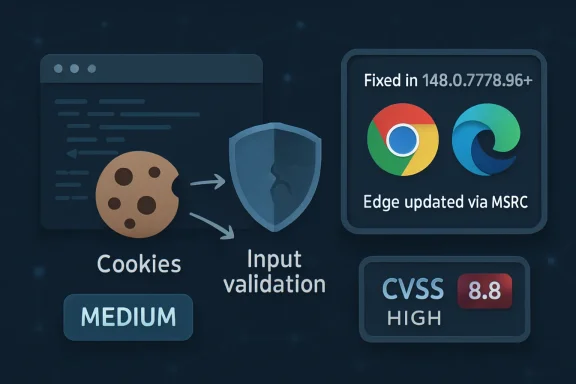
The short version is simple: Chrome assigned CVE-2026-7930 to an insufficient validation issue in Cookies, fixed it in Chrome 148.0.7778.96, and Microsoft listed it for Microsoft Edge because Chromium-based Edge ingests the same upstream code. That is now normal enough that it risks becoming invisible. But normal is not the same as unimportant.
The vulnerability description is blunt by the standards of browser advisories. Insufficient validation of untrusted input in Cookies could allow a remote attacker to perform privilege escalation through a crafted HTML page. In browser-security language, “crafted HTML page” is doing a lot of work: it means an attack path begins where users spend their day, not where administrators expect privileged operations to happen.
Google’s Chromium severity for the issue is Medium. CISA’s ADP CVSS 3.1 vector, however, lands at 8.8, which maps to High, with network attack vector, low complexity, no privileges required, user interaction required, and high impacts to confidentiality, integrity, and availability. That mismatch is not necessarily a contradiction. It is a reminder that severity systems measure different things, and browser vendors often factor in exploitability, sandbox boundaries, and defense-in-depth context that CVSS cannot fully express.
For WindowsForum readers, the Microsoft angle matters because Edge is not merely a browser installed alongside Windows. In many organizations, it is the default browser, the PDF viewer, the WebView-adjacent runtime in user workflows, and the sanctioned access point for cloud apps. When Chromium takes a security fix, Microsoft’s update machinery becomes part of the blast-radius story.
That intersection is messy. Cookie handling has decades of web compatibility baggage, from domain scoping and path rules to SameSite behavior, partitioning, prefixes, and the odd survivals of legacy parsing. Browsers cannot simply reject every strange value without breaking real sites, so they carry elaborate rules for accepting, normalizing, isolating, and sometimes quietly forgiving input from the web.
“Insufficient validation of untrusted input” is therefore not a throwaway CWE classification. In a browser, untrusted input is the default condition. Every site, redirect, response header, script path, iframe, and cross-site interaction can become part of the parser’s diet, and a bug in the rules that decide what is trusted can become a bug in the rules that decide what is protected.
The privilege-escalation phrasing is the phrase to watch. It does not necessarily mean immediate operating-system administrator rights. In browser advisories, escalation can mean crossing a security boundary inside the browser, moving from one context to another, or gaining capabilities that the attacker-controlled page should not have had. That is still serious because the modern browser is a stack of boundaries, and attackers rarely need all of them to fail at once.
A cookie bug also has a special resonance in 2026 because the web has been trying to re-architect tracking, state, and identity for years. Privacy Sandbox efforts, cookie partitioning, enterprise identity flows, and single sign-on all depend on subtle state-management rules. If those rules are wrong, the bug may not look like a classic memory corruption exploit, but it can still hit where users and businesses are most exposed: identity.
CVSS is designed to describe the characteristics of a vulnerability in a standardized way. In this case, the vector assumes a network-reachable attack, low attack complexity, no attacker privileges, required user interaction, unchanged scope, and high impact across confidentiality, integrity, and availability. That combination produces urgency in almost any enterprise vulnerability-management program.
Vendor severity often reflects additional product-specific judgment. Chrome’s security team may account for mitigations, sandbox layers, exploit reliability, affected surface, or the practical difficulty of turning the bug into a durable chain. That context is valuable, but it is also opaque to outsiders because the Chromium issue-tracker entry is permission-restricted at publication time, as is common for browser bugs while users are still updating.
The trap is treating the lower label as permission to wait. A medium-severity browser flaw with a plausible web-delivered trigger can matter more in practice than a high-severity server bug buried behind compensating controls. Exposure is not just impact; it is prevalence multiplied by reachability multiplied by user behavior.
For managed Windows estates, the better conclusion is conservative: if a fixed Chromium build is available, deploy it. The browser is too exposed, too frequently targeted, and too deeply embedded in daily workflows to argue over whether “Medium” sounds urgent enough. Patch latency is the enemy here, not semantic disagreement between scoring systems.
But large browser security drops should be read differently from ordinary application updates. A release that bundles dozens or hundreds of fixes is not merely a maintenance event; it is a snapshot of how much attack surface a modern browser exposes. Blink, V8, WebRTC, GPU acceleration, media pipelines, extensions, networking, cookies, storage, and enterprise policy all live under one icon on the taskbar.
The critical bugs in Chrome 148 may be the ones security newsletters lead with, but medium bugs are often where attackers build chains. A browser exploit does not have to begin and end with one CVE. It may combine a renderer bug, a logic mistake, a state-management flaw, and a sandbox escape into something more consequential than any single entry’s label suggests.
That is why cookie validation deserves attention even when memory-safety bugs hog the room. A logic flaw in state handling can become an enabler. It can help put the browser into a condition where another bug becomes reachable, where a security assumption fails, or where a user’s session boundary is weaker than the product UI implies.
The browser patch cadence has trained users to tune out. Chrome updates constantly, Edge updates constantly, and every release claims to contain security fixes. The cumulative effect is dangerous fatigue. Administrators should resist it, because attackers do not get bored of browser bugs just because users do.
Edge is Microsoft’s product, but much of its core web engine risk is inherited upstream. That is not a criticism; it is how Chromium-based browsers work. It does mean that Microsoft customers must pay attention to both Google’s release cadence and Microsoft’s packaging, distribution, and enterprise controls.
For Windows administrators, this has made browser patching more like operating-system patching and less like optional application maintenance. Edge updates through its own update mechanism, can be governed by policy, and may move on a different schedule from monthly Windows cumulative updates. If your vulnerability program only wakes up on Patch Tuesday, Chromium will keep making you late.
The MSRC entry lists Microsoft Edge (Chromium-based) with customer action required and a fixed build line in the 148.0.7778.xxx range. That is less precise than some administrators would prefer, but the practical instruction is clear: bring Edge to the current stable security release and verify it. The vulnerable component is upstream Chromium; the remediation is downstream browser currency.
This is also why asset inventory matters. Many organizations know their Windows build numbers better than their browser build numbers. That imbalance is increasingly indefensible. If Edge is the browser used for Microsoft 365, Entra ID sign-ins, SaaS consoles, admin portals, ticketing systems, and privileged access workflows, then Edge’s build number is security telemetry, not trivia.
The modern enterprise is built around links. Employees click links in Teams, Outlook, Slack, help desks, dashboards, CRM systems, password reset flows, and vendor portals. Security awareness training can reduce reckless behavior, but it cannot turn the web into a trusted input source. If a vulnerability can be triggered by crafted HTML, the realistic question is not whether users will encounter HTML; it is whether the browser is patched when they do.
Attackers understand the economics. Browser bugs offer a path across operating systems and across privilege models. They can be delivered from compromised legitimate sites, malvertising, phishing infrastructure, or watering-hole pages aimed at specific communities. Even when a particular CVE is not known to be exploited in the wild, the category remains central to offensive tradecraft.
The permission-restricted Chromium issue tracker entry leaves the public without exploit detail for now. That is standard practice and usually the right one. Publishing a complete bug trail before most users update would help attackers more than defenders. But restricted details also mean defenders should not overinterpret the absence of public proof-of-concept code as absence of risk.
A better mental model is “patch before curiosity.” By the time technical write-ups emerge, the defenders who waited for exploit detail have often given up the most valuable window they had. Browser vendors move quickly because the browser threat model punishes delay.
That nuance matters because browsers are not monoliths anymore. Chrome and Edge divide work across processes, isolate sites, restrict origins, broker access to sensitive APIs, and try to contain damage if a renderer is compromised. Security is therefore a layered bargain: one bug may not be catastrophic if the next boundary holds.
An escalation flaw threatens that bargain. If a crafted page can move from a less trusted context into a more trusted one, it may become useful in combination with another bug. Even if the exploit chain still requires additional steps, the flaw has reduced the attacker’s workload. That is often enough to matter.
Cookie handling is deeply tied to origin and session semantics, which are themselves security boundaries. A browser must decide which site owns which state, which requests carry which credentials, and which contexts are allowed to observe or influence behavior. A validation bug in that machinery is not “just cookies” any more than a validation bug in Kerberos would be “just tickets.”
The larger lesson is that browser security has shifted from spectacular crashes to subtle boundary maintenance. Memory corruption remains dangerous, but state confusion, parser differences, policy bypasses, and input-validation failures are just as important in a platform whose job is to safely execute hostile code all day.
That is a problem because Chrome and Edge are now high-frequency security products. Their stable releases can contain urgent fixes outside the monthly rhythm, and their extended stable channels trade cadence for predictability. Those choices are legitimate, but they require conscious governance rather than wishful thinking.
The worst configuration is neither stable nor controlled. It is the fleet where some endpoints update automatically, some are pinned, some are blocked by network controls, some run stale extensions, and nobody knows the distribution. In that environment, a CVE like 2026-7930 becomes less about one cookie bug and more about whether the organization can answer a basic question: which browsers are still vulnerable?
Administrators should also pay attention to the non-obvious places Chromium lives. Edge and Chrome are the headline products, but Chromium-derived browsers, embedded web runtimes, kiosk systems, VDI images, test machines, and golden images can lag behind. If the browser icon is not on the user’s desktop, that does not mean the engine is absent from the workflow.
The operational answer is not panic. It is measurement. Query browser versions through your endpoint-management platform, verify that Edge has moved into the fixed build family, and make stale devices visible. The difference between “auto-update should handle it” and “we have confirmed compliance” is the difference between hope and administration.
For CVE-2026-7930, the NVD configuration reflects Google Chrome versions before 148.0.7778.96 across Windows, Linux, and macOS. Microsoft’s separate advisory covers Edge because Edge consumes Chromium. That split is intelligible to humans but not always clean to scanners, dashboards, and compliance systems.
CPEs are supposed to help tooling match software to vulnerabilities. In practice, they can lag, overmatch, undermatch, or fail to express the supply-chain relationship between upstream code and downstream products. When a vulnerability lives in Chromium, “affected software” is not a single vendor box. It is a moving graph.
This is especially awkward for security teams that rely heavily on NVD enrichment. NVD may not have a NIST CVSS assessment immediately, while CISA ADP may supply a score, vendors may publish advisories, and downstream products may post their own update notes. The result is a familiar vulnerability-management headache: the data exists, but it is fragmented across authorities.
The right response is to treat CPE data as a starting point, not a source of absolute truth. If your scanners flag Chrome but not Edge, do not assume Edge is safe. If MSRC lists Edge but NVD’s visible configuration emphasizes Chrome, do not assume Microsoft is overreacting. In Chromium land, the vendor tree matters as much as the product string.
A vulnerability in cookie validation therefore sits near the mechanics of trust. Even if CVE-2026-7930 is not described as an authentication bypass, the component it touches is adjacent to authentication state. That adjacency is enough to make administrators wary, especially in environments where web apps are the business.
Microsoft’s own enterprise strategy makes this more important. Edge is tied into Windows management, Microsoft 365, Defender, Entra, and the company’s broader security posture. That integration can be an advantage when policies are sane and updates are current. It can also concentrate risk when browser versions drift.
For small businesses and home users, the advice is simpler: update the browser and restart it. Chrome and Edge both try to make this easy, but users routinely leave browsers open for days or weeks. An update downloaded but not activated is not a patch in the sense that matters.
For IT pros, the broader lesson is that browser restart behavior should be part of security operations. A patch that waits politely behind a “Relaunch” button is only as effective as the user who notices it. Managed restart prompts, update deadlines, and compliance reporting may be annoying, but they exist because silent exposure is worse.
The bad news is that speed can blur comprehension. Users see another browser update. Administrators see another advisory. Security teams see another CVE with partial metadata, restricted bug details, and conflicting severity signals. The process works, but it asks humans to trust a machine that rarely explains itself fully in real time.
That trust is not misplaced, but it should be earned operationally. Vendors should continue to restrict sensitive exploit details while users are vulnerable, yet they should be as clear as possible about affected versions, fixed versions, exploit status, and downstream products. The fewer interpretive gaps defenders have to bridge, the faster fleets get patched.
Microsoft’s handling of Chromium CVEs has improved over the years precisely because customers need one place to see whether Edge is affected. Still, the build-number language can feel imprecise when an administrator is trying to write a detection rule. “148.0.7778.xxx” tells a story, but exact fixed builds tell a better one.
The industry has decided, correctly, that browsers must update rapidly. The next challenge is making rapid updates legible. Vulnerability management is no longer just about shipping fixed code; it is about helping defenders prove that fixed code is actually running.
The most concrete lessons are operational rather than theoretical:
CVE-2026-7930 will probably not be remembered as the defining browser vulnerability of 2026, and that is exactly why it is useful. It shows the modern security reality in miniature: a subtle Chromium input-validation bug, a cookie boundary, a crafted page, a Microsoft advisory, an NVD record still taking shape, and a fleet of Windows machines that are safe only if the browser update actually lands. The future of endpoint security will not be won solely by detecting spectacular zero-days; it will be won by closing these ordinary, high-volume gaps before attackers assemble them into something less ordinary.
Source: NVD / Chromium Security Update Guide - Microsoft Security Response Center
 A Medium Chromium Bug Lands in the Microsoft Patch Queue
The short version is simple: Chrome assigned CVE-2026-7930 to an insufficient validation issue in Cookies, fixed it in Chrome 148.0.7778.96, and Microsoft listed it for Microsoft Edge because Chromium-based Edge ingests the same upstream code. That is now normal enough that it risks becoming invisible. But normal is not the same as unimportant.The vulnerability description is blunt by the standards of browser advisories. Insufficient validation of untrusted input in Cookies could allow a remote attacker to perform privilege escalation through a crafted HTML page. In browser-security language, “crafted HTML page” is doing a lot of work: it means an attack path begins where users spend their day, not where administrators expect privileged operations to happen.
Google’s Chromium severity for the issue is Medium. CISA’s ADP CVSS 3.1 vector, however, lands at 8.8, which maps to High, with network attack vector, low complexity, no privileges required, user interaction required, and high impacts to confidentiality, integrity, and availability. That mismatch is not necessarily a contradiction. It is a reminder that severity systems measure different things, and browser vendors often factor in exploitability, sandbox boundaries, and defense-in-depth context that CVSS cannot fully express.
For WindowsForum readers, the Microsoft angle matters because Edge is not merely a browser installed alongside Windows. In many organizations, it is the default browser, the PDF viewer, the WebView-adjacent runtime in user workflows, and the sanctioned access point for cloud apps. When Chromium takes a security fix, Microsoft’s update machinery becomes part of the blast-radius story.
Cookies Are Boring Until They Become a Boundary
Cookies are among the least glamorous parts of the web platform, which is precisely why security people keep ending up back there. They are tiny bits of state that decide whether a user is logged in, which session is active, which domain can see what, and how a browser should behave across navigation. Their design sits at the intersection of convenience, compatibility, and security policy.That intersection is messy. Cookie handling has decades of web compatibility baggage, from domain scoping and path rules to SameSite behavior, partitioning, prefixes, and the odd survivals of legacy parsing. Browsers cannot simply reject every strange value without breaking real sites, so they carry elaborate rules for accepting, normalizing, isolating, and sometimes quietly forgiving input from the web.
“Insufficient validation of untrusted input” is therefore not a throwaway CWE classification. In a browser, untrusted input is the default condition. Every site, redirect, response header, script path, iframe, and cross-site interaction can become part of the parser’s diet, and a bug in the rules that decide what is trusted can become a bug in the rules that decide what is protected.
The privilege-escalation phrasing is the phrase to watch. It does not necessarily mean immediate operating-system administrator rights. In browser advisories, escalation can mean crossing a security boundary inside the browser, moving from one context to another, or gaining capabilities that the attacker-controlled page should not have had. That is still serious because the modern browser is a stack of boundaries, and attackers rarely need all of them to fail at once.
A cookie bug also has a special resonance in 2026 because the web has been trying to re-architect tracking, state, and identity for years. Privacy Sandbox efforts, cookie partitioning, enterprise identity flows, and single sign-on all depend on subtle state-management rules. If those rules are wrong, the bug may not look like a classic memory corruption exploit, but it can still hit where users and businesses are most exposed: identity.
The Score Says High, the Vendor Says Medium, and Both Can Be True
Security teams often want a single number because dashboards want a single number. CVE-2026-7930 resists that simplicity. Google’s Chromium severity is Medium, while the CISA ADP CVSS 3.1 score is 8.8 High. The difference is a useful case study in why vulnerability management cannot be outsourced to labels.CVSS is designed to describe the characteristics of a vulnerability in a standardized way. In this case, the vector assumes a network-reachable attack, low attack complexity, no attacker privileges, required user interaction, unchanged scope, and high impact across confidentiality, integrity, and availability. That combination produces urgency in almost any enterprise vulnerability-management program.
Vendor severity often reflects additional product-specific judgment. Chrome’s security team may account for mitigations, sandbox layers, exploit reliability, affected surface, or the practical difficulty of turning the bug into a durable chain. That context is valuable, but it is also opaque to outsiders because the Chromium issue-tracker entry is permission-restricted at publication time, as is common for browser bugs while users are still updating.
The trap is treating the lower label as permission to wait. A medium-severity browser flaw with a plausible web-delivered trigger can matter more in practice than a high-severity server bug buried behind compensating controls. Exposure is not just impact; it is prevalence multiplied by reachability multiplied by user behavior.
For managed Windows estates, the better conclusion is conservative: if a fixed Chromium build is available, deploy it. The browser is too exposed, too frequently targeted, and too deeply embedded in daily workflows to argue over whether “Medium” sounds urgent enough. Patch latency is the enemy here, not semantic disagreement between scoring systems.
Chrome 148 Is Not a Small Security Release
CVE-2026-7930 arrived as part of Chrome 148, a release that moved the stable channel to 148.0.7778.96 on Linux and 148.0.7778.96 or 148.0.7778.97 on Windows and macOS. Reporting around the release noted more than 100 security fixes, with three critical vulnerabilities drawing the obvious headlines. That makes the cookie issue easy to miss.But large browser security drops should be read differently from ordinary application updates. A release that bundles dozens or hundreds of fixes is not merely a maintenance event; it is a snapshot of how much attack surface a modern browser exposes. Blink, V8, WebRTC, GPU acceleration, media pipelines, extensions, networking, cookies, storage, and enterprise policy all live under one icon on the taskbar.
The critical bugs in Chrome 148 may be the ones security newsletters lead with, but medium bugs are often where attackers build chains. A browser exploit does not have to begin and end with one CVE. It may combine a renderer bug, a logic mistake, a state-management flaw, and a sandbox escape into something more consequential than any single entry’s label suggests.
That is why cookie validation deserves attention even when memory-safety bugs hog the room. A logic flaw in state handling can become an enabler. It can help put the browser into a condition where another bug becomes reachable, where a security assumption fails, or where a user’s session boundary is weaker than the product UI implies.
The browser patch cadence has trained users to tune out. Chrome updates constantly, Edge updates constantly, and every release claims to contain security fixes. The cumulative effect is dangerous fatigue. Administrators should resist it, because attackers do not get bored of browser bugs just because users do.
Edge Turns Chromium Risk Into a Windows Fleet Problem
Microsoft’s advisory is brief, but its significance is structural. The company’s position is that this CVE was assigned by Chrome, Chromium is consumed by Microsoft Edge, and the latest Edge release is no longer vulnerable. That statement captures the modern browser supply chain in one sentence.Edge is Microsoft’s product, but much of its core web engine risk is inherited upstream. That is not a criticism; it is how Chromium-based browsers work. It does mean that Microsoft customers must pay attention to both Google’s release cadence and Microsoft’s packaging, distribution, and enterprise controls.
For Windows administrators, this has made browser patching more like operating-system patching and less like optional application maintenance. Edge updates through its own update mechanism, can be governed by policy, and may move on a different schedule from monthly Windows cumulative updates. If your vulnerability program only wakes up on Patch Tuesday, Chromium will keep making you late.
The MSRC entry lists Microsoft Edge (Chromium-based) with customer action required and a fixed build line in the 148.0.7778.xxx range. That is less precise than some administrators would prefer, but the practical instruction is clear: bring Edge to the current stable security release and verify it. The vulnerable component is upstream Chromium; the remediation is downstream browser currency.
This is also why asset inventory matters. Many organizations know their Windows build numbers better than their browser build numbers. That imbalance is increasingly indefensible. If Edge is the browser used for Microsoft 365, Entra ID sign-ins, SaaS consoles, admin portals, ticketing systems, and privileged access workflows, then Edge’s build number is security telemetry, not trivia.
The Crafted Page Remains the Web’s Oldest Delivery Vehicle
The attack precondition here includes user interaction. That phrase can mislead executives into thinking the exploit requires a user to do something foolish. In browser-land, user interaction can be as ordinary as visiting a page, clicking a link, opening a malicious document that renders web content, or being redirected through an attacker-controlled domain.The modern enterprise is built around links. Employees click links in Teams, Outlook, Slack, help desks, dashboards, CRM systems, password reset flows, and vendor portals. Security awareness training can reduce reckless behavior, but it cannot turn the web into a trusted input source. If a vulnerability can be triggered by crafted HTML, the realistic question is not whether users will encounter HTML; it is whether the browser is patched when they do.
Attackers understand the economics. Browser bugs offer a path across operating systems and across privilege models. They can be delivered from compromised legitimate sites, malvertising, phishing infrastructure, or watering-hole pages aimed at specific communities. Even when a particular CVE is not known to be exploited in the wild, the category remains central to offensive tradecraft.
The permission-restricted Chromium issue tracker entry leaves the public without exploit detail for now. That is standard practice and usually the right one. Publishing a complete bug trail before most users update would help attackers more than defenders. But restricted details also mean defenders should not overinterpret the absence of public proof-of-concept code as absence of risk.
A better mental model is “patch before curiosity.” By the time technical write-ups emerge, the defenders who waited for exploit detail have often given up the most valuable window they had. Browser vendors move quickly because the browser threat model punishes delay.
Privilege Escalation Is a Warning About Boundaries, Not Just Admin Rights
The words “privilege escalation” often conjure images of a local attacker becoming administrator. In a browser vulnerability, the phrase can cover a broader set of boundary failures. It may refer to gaining access to a more privileged browser process, bypassing constraints imposed on a web origin, or manipulating state in a way that changes what the attacker-controlled page can do.That nuance matters because browsers are not monoliths anymore. Chrome and Edge divide work across processes, isolate sites, restrict origins, broker access to sensitive APIs, and try to contain damage if a renderer is compromised. Security is therefore a layered bargain: one bug may not be catastrophic if the next boundary holds.
An escalation flaw threatens that bargain. If a crafted page can move from a less trusted context into a more trusted one, it may become useful in combination with another bug. Even if the exploit chain still requires additional steps, the flaw has reduced the attacker’s workload. That is often enough to matter.
Cookie handling is deeply tied to origin and session semantics, which are themselves security boundaries. A browser must decide which site owns which state, which requests carry which credentials, and which contexts are allowed to observe or influence behavior. A validation bug in that machinery is not “just cookies” any more than a validation bug in Kerberos would be “just tickets.”
The larger lesson is that browser security has shifted from spectacular crashes to subtle boundary maintenance. Memory corruption remains dangerous, but state confusion, parser differences, policy bypasses, and input-validation failures are just as important in a platform whose job is to safely execute hostile code all day.
Enterprise Patch Policy Still Treats Browsers Too Casually
Many enterprises have matured around Windows cumulative updates, emergency out-of-band patches, and server maintenance windows. Browser patching is often less disciplined. It may be delegated to auto-update, loosely monitored by endpoint management, or quietly broken by policy settings created years ago for compatibility reasons nobody has revisited.That is a problem because Chrome and Edge are now high-frequency security products. Their stable releases can contain urgent fixes outside the monthly rhythm, and their extended stable channels trade cadence for predictability. Those choices are legitimate, but they require conscious governance rather than wishful thinking.
The worst configuration is neither stable nor controlled. It is the fleet where some endpoints update automatically, some are pinned, some are blocked by network controls, some run stale extensions, and nobody knows the distribution. In that environment, a CVE like 2026-7930 becomes less about one cookie bug and more about whether the organization can answer a basic question: which browsers are still vulnerable?
Administrators should also pay attention to the non-obvious places Chromium lives. Edge and Chrome are the headline products, but Chromium-derived browsers, embedded web runtimes, kiosk systems, VDI images, test machines, and golden images can lag behind. If the browser icon is not on the user’s desktop, that does not mean the engine is absent from the workflow.
The operational answer is not panic. It is measurement. Query browser versions through your endpoint-management platform, verify that Edge has moved into the fixed build family, and make stale devices visible. The difference between “auto-update should handle it” and “we have confirmed compliance” is the difference between hope and administration.
The CPE Question Exposes a Metadata Problem Defenders Know Too Well
The NVD record’s “are we missing a CPE?” prompt is more than a bureaucratic footnote. Vulnerability management depends on machine-readable product mappings, and those mappings are often messy for browsers. A CVE assigned to Chrome can affect Chromium, Chrome, Edge, Brave, Opera, Vivaldi, Electron-based applications, or other downstream consumers depending on the vulnerable component and adoption timeline.For CVE-2026-7930, the NVD configuration reflects Google Chrome versions before 148.0.7778.96 across Windows, Linux, and macOS. Microsoft’s separate advisory covers Edge because Edge consumes Chromium. That split is intelligible to humans but not always clean to scanners, dashboards, and compliance systems.
CPEs are supposed to help tooling match software to vulnerabilities. In practice, they can lag, overmatch, undermatch, or fail to express the supply-chain relationship between upstream code and downstream products. When a vulnerability lives in Chromium, “affected software” is not a single vendor box. It is a moving graph.
This is especially awkward for security teams that rely heavily on NVD enrichment. NVD may not have a NIST CVSS assessment immediately, while CISA ADP may supply a score, vendors may publish advisories, and downstream products may post their own update notes. The result is a familiar vulnerability-management headache: the data exists, but it is fragmented across authorities.
The right response is to treat CPE data as a starting point, not a source of absolute truth. If your scanners flag Chrome but not Edge, do not assume Edge is safe. If MSRC lists Edge but NVD’s visible configuration emphasizes Chrome, do not assume Microsoft is overreacting. In Chromium land, the vendor tree matters as much as the product string.
The Browser Is Now Part of Identity Infrastructure
One reason this CVE deserves more than a patch note is that browser state has become identity infrastructure. The browser stores sessions, mediates federated sign-ins, enforces conditional-access flows, handles passkeys, carries device signals, and presents the interface through which users approve, deny, and misunderstand security prompts. Cookies are not ornamental in that system.A vulnerability in cookie validation therefore sits near the mechanics of trust. Even if CVE-2026-7930 is not described as an authentication bypass, the component it touches is adjacent to authentication state. That adjacency is enough to make administrators wary, especially in environments where web apps are the business.
Microsoft’s own enterprise strategy makes this more important. Edge is tied into Windows management, Microsoft 365, Defender, Entra, and the company’s broader security posture. That integration can be an advantage when policies are sane and updates are current. It can also concentrate risk when browser versions drift.
For small businesses and home users, the advice is simpler: update the browser and restart it. Chrome and Edge both try to make this easy, but users routinely leave browsers open for days or weeks. An update downloaded but not activated is not a patch in the sense that matters.
For IT pros, the broader lesson is that browser restart behavior should be part of security operations. A patch that waits politely behind a “Relaunch” button is only as effective as the user who notices it. Managed restart prompts, update deadlines, and compliance reporting may be annoying, but they exist because silent exposure is worse.
Chrome’s Fast Cadence Is Winning, but It Has a Trust Cost
The good news is that the Chromium ecosystem can move quickly. Google can land a fix, push it through stable, and downstream vendors can integrate it into their own release channels. Microsoft can surface the issue in MSRC and direct Edge customers toward the current build. That is a far better world than the old era of quarterly browser security bundles.The bad news is that speed can blur comprehension. Users see another browser update. Administrators see another advisory. Security teams see another CVE with partial metadata, restricted bug details, and conflicting severity signals. The process works, but it asks humans to trust a machine that rarely explains itself fully in real time.
That trust is not misplaced, but it should be earned operationally. Vendors should continue to restrict sensitive exploit details while users are vulnerable, yet they should be as clear as possible about affected versions, fixed versions, exploit status, and downstream products. The fewer interpretive gaps defenders have to bridge, the faster fleets get patched.
Microsoft’s handling of Chromium CVEs has improved over the years precisely because customers need one place to see whether Edge is affected. Still, the build-number language can feel imprecise when an administrator is trying to write a detection rule. “148.0.7778.xxx” tells a story, but exact fixed builds tell a better one.
The industry has decided, correctly, that browsers must update rapidly. The next challenge is making rapid updates legible. Vulnerability management is no longer just about shipping fixed code; it is about helping defenders prove that fixed code is actually running.
The Cookie Bug’s Practical Lessons for Windows Shops
CVE-2026-7930 does not require a dramatic response plan, but it does reward disciplined habits. Treat it as a live test of whether your organization can follow a Chromium vulnerability from Chrome disclosure to Edge remediation to endpoint compliance. If that chain is fuzzy, the next browser bug will not be kinder.The most concrete lessons are operational rather than theoretical:
- Organizations should verify that Google Chrome is updated to 148.0.7778.96 or later on Linux and to the fixed 148.0.7778.96 or 148.0.7778.97 builds on Windows and macOS.
- Organizations using Microsoft Edge should confirm that Chromium-based Edge has moved into the fixed 148.0.7778.xxx release family and that users have restarted the browser.
- Security teams should not downgrade urgency solely because Chromium labels the issue Medium, since the available CVSS 3.1 scoring describes a High-severity remote, user-assisted attack path.
- Vulnerability managers should cross-check Chrome, MSRC, NVD, and endpoint inventory because CPE mappings and downstream Chromium product coverage may not line up perfectly at publication time.
- Administrators should review browser update policies, relaunch deadlines, and stale-device reporting before the next emergency Chromium fix forces the same questions under more pressure.
CVE-2026-7930 will probably not be remembered as the defining browser vulnerability of 2026, and that is exactly why it is useful. It shows the modern security reality in miniature: a subtle Chromium input-validation bug, a cookie boundary, a crafted page, a Microsoft advisory, an NVD record still taking shape, and a fleet of Windows machines that are safe only if the browser update actually lands. The future of endpoint security will not be won solely by detecting spectacular zero-days; it will be won by closing these ordinary, high-volume gaps before attackers assemble them into something less ordinary.
Source: NVD / Chromium Security Update Guide - Microsoft Security Response Center
