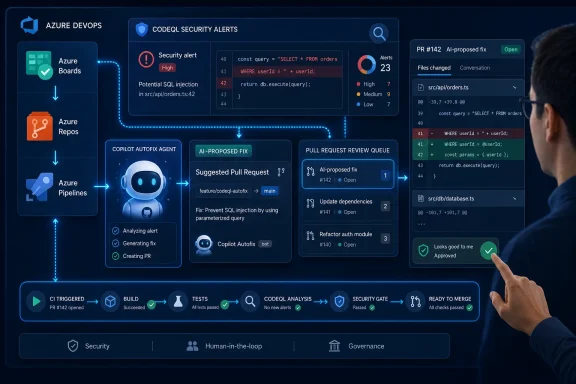
Microsoft announced in June 2026 a limited public preview of Copilot Autofix for GitHub Advanced Security for Azure DevOps, bringing AI-generated vulnerability fixes to Azure Repos through CodeQL alerts, Copilot’s coding agent, and reviewable pull requests inside Azure DevOps. The feature is not a magic patch button, and Microsoft is careful not to sell it as one. Its real significance is that remediation — the slow, expensive, politically awkward part of application security — is being pulled directly into the developer workflow.
That matters because security tooling has spent years getting better at finding flaws than helping teams actually close them. Azure DevOps shops have long watched GitHub absorb the newest GitHub-native security and AI features first, then waited to see which ones would make the crossing. Copilot Autofix is another sign that Microsoft is trying to narrow that gap without forcing every enterprise team to abandon Azure Repos.
The most important word in Copilot Autofix is not Copilot. It is Autofix. Static analysis has never lacked confidence in its ability to generate work for developers; the problem is that every new alert becomes another item in a queue already crowded with feature work, production incidents, flaky tests, dependency churn, and review debt.
GitHub Advanced Security for Azure DevOps already brought familiar GitHub security capabilities into Azure Repos: code scanning with CodeQL, secret scanning, dependency scanning, and dashboards. Those features helped Azure DevOps customers see more of their software risk without leaving the platform. But seeing risk and reducing risk are different disciplines.
Copilot Autofix is Microsoft’s attempt to collapse that distance. When CodeQL identifies a supported vulnerability or coding error, the system can generate a proposed remediation, create a branch, and open an Azure Repos pull request. The developer still reviews the change, but the blank page is gone.
That is a subtle but meaningful shift in the economics of secure development. A security alert used to arrive as an obligation: understand the query, map the finding to the codebase, research a fix, make the patch, run tests, argue with reviewers, and hope the next scan closes the alert. Now Microsoft is trying to make the alert arrive with a first draft attached.
For those customers, “just move to GitHub” is not a product strategy. It is a migration program, an audit exercise, a retraining project, and often a procurement fight. Microsoft has therefore had to pursue a more pragmatic path: bring enough GitHub technology into Azure DevOps to keep those customers modern, while still making GitHub the showcase for the newest developer experiences.
Copilot Autofix fits that pattern. The feature is branded as part of GitHub Advanced Security for Azure DevOps, uses CodeQL as its analysis engine, and relies on GitHub Copilot’s coding agent to generate fixes. But the work surfaces where Azure DevOps teams already live: inside the Advanced Security alert experience and through Azure Repos pull requests.
That design choice is not cosmetic. Security tools fail when they require developers to leave the review path, copy advice from one portal into another, or translate a scanner’s abstract recommendation into a local coding convention. By opening a normal pull request, Copilot Autofix speaks the language of the existing engineering process.
But SAST also has a reputation problem among developers. Alerts can be noisy, explanations can be abstract, and the fix can require understanding a security concept that is adjacent to the developer’s immediate task. Even when the finding is valid, it may not be obvious how to remediate it safely in a mature codebase with conventions, legacy assumptions, and tests that only make sense to the team maintaining it.
Copilot Autofix is Microsoft’s answer to that practical bottleneck. The system does not merely point at the flagged line and say “sanitize this.” It analyzes the alert and surrounding code, then proposes a change that may span more than one file. That matters because real vulnerabilities often live in the relationship between input handling, validation, data flow, and output — not in a single guilty statement.
Still, the “last mile” cannot be fully automated away. A generated patch can compile and still be wrong. It can close the CodeQL alert while changing behavior. It can introduce a compatibility issue, violate an architectural boundary, or quietly replace a security flaw with a reliability bug. Microsoft’s documentation is explicit that Autofix suggestions are not guaranteed to be correct, complete, or secure.
The pull request gives the system a familiar containment vessel. Developers can inspect the diff, request changes, run tests, require approvals, attach work items, and let branch policies do what branch policies already do. In other words, Autofix does not replace governance; it enters through governance.
That will not satisfy everyone. Some security leaders will want stronger assurances before they trust AI-generated remediation at scale. Some developers will treat the feature as another source of suspicious drive-by PRs. Some platform teams will worry that the volume of generated fixes could create a new kind of review fatigue.
Those concerns are reasonable. But they are also why the PR model is the right compromise. The feature is most useful when it shortens the time between detection and a reviewable candidate fix. It becomes dangerous only if organizations confuse candidate fixes with validated fixes.
The feature requires GitHub Advanced Security for Azure DevOps, or the standalone GitHub Code Security for Azure DevOps experience, with code scanning configured for the repository. CodeQL must already be producing alerts. Autofix must also be enabled per repository as part of code security settings.
That setup implies a relatively mature customer. This is not a feature for organizations that have not yet decided how they scan code, manage security debt, or enforce pull request review. It is aimed at teams that already have CodeQL findings and want to reduce the manual labor of remediation.
The supported language set follows CodeQL’s code scanning coverage, including C and C++, C#, Go, Java and Kotlin, JavaScript and TypeScript, Python, Ruby, and Swift. That is broad enough to cover a large share of enterprise application code, though not every language or custom analysis path will qualify. Fixes may also be unavailable for unsupported alert types, false positives, custom queries, or third-party scanner results.
Recent research into AI-generated code changes has been sobering. AI agents can accelerate routine maintenance and produce plausible patches, but many proposed fixes are rejected because they misunderstand context, fail tests, solve only part of the problem, or make assumptions the project does not share. That does not make the technology useless. It means the win condition is assistance, not autonomy.
This is especially true in security. A fix that looks reasonable can be incomplete if it handles one input path but not another. A patch can remove the exact data flow that CodeQL reported while leaving the broader design vulnerable. A model can also overfit to the scanner’s complaint and optimize for making the alert disappear rather than making the system safer.
Microsoft appears to understand that risk. Its messaging frames Autofix as a starting point, not a final answer. That language may sound cautious, but it is the only credible posture for AI-generated security patches in 2026.
For security teams, the promise is different. Autofix could make it easier to persuade developers to address findings quickly because the first remediation step is no longer a cold start. Security teams have spent years trying to shift left; AI remediation offers a more concrete bargain: if developers accept scanners earlier in the lifecycle, the tools will do more of the repair work.
For platform teams, the attraction is standardization. A consistent mechanism for generating and reviewing fixes inside Azure DevOps is easier to govern than a patchwork of IDE suggestions, chat prompts, wiki snippets, and manual security tickets. The pull request becomes the audit artifact.
But the developer experience will determine adoption. If Autofix PRs are frequently noisy, stylistically alien, or oblivious to project conventions, teams will turn the feature off or ignore it. If the fixes are usually close, developers will tolerate occasional misses because the tool reduces toil.
That loop is particularly attractive in security because the backlog is endless. Every large organization has old code, inconsistent dependencies, legacy patterns, and alerts that sit unresolved because they are real but not urgent enough to displace roadmap commitments. The dream is not that AI fixes everything. The dream is that AI makes low- and medium-complexity remediation cheap enough that it stops being deferred forever.
There is a risk in that framing. If organizations use AI remediation as an excuse to generate more code faster without investing in architecture, threat modeling, testing, and secure design, they will simply move defects around. Faster patch production is not the same as safer software.
The better interpretation is that Autofix is a pressure valve. It can help with known classes of vulnerabilities identified by static analysis. It cannot decide whether a permission model is appropriate, whether a business workflow can be abused, or whether a system’s trust boundaries make sense. Those remain human engineering problems.
Bringing Copilot Autofix to Azure DevOps is therefore not only a feature update. It is a reassurance. Microsoft is telling Azure Repos customers that they can participate in the AI security workflow without first undertaking a platform migration.
That reassurance has limits. GitHub will almost certainly continue to receive some capabilities first, and Azure DevOps integrations may lag or arrive with different licensing and preview constraints. But the direction is clear: Microsoft wants GitHub’s security intelligence and Copilot’s agentic capabilities to flow into Azure DevOps where enterprise customers still work.
This convergence also makes commercial sense. GitHub Advanced Security for Azure DevOps lets Microsoft sell a higher-value security layer to existing Azure DevOps estates. Copilot Autofix makes that layer more tangible because it connects scanning to visible engineering output.
Teams should decide which repositories are appropriate for preview use. A well-tested service with active maintainers is a better candidate than a brittle legacy system whose test suite is aspirational. The point of the preview should be to learn where generated fixes help, where they fail, and how much review effort they really save.
Organizations should also decide who owns the generated PRs. If Autofix opens a branch, does the application team triage it? Does security engineering review it first? Does platform engineering monitor failed attempts? Without ownership, the feature could create a pile of unattended remediation drafts.
Most importantly, teams should resist changing their acceptance criteria. An AI-generated security fix should meet the same standards as a human patch: readable code, passing tests, appropriate reviewers, no hidden behavior changes, and evidence that the original alert is actually resolved. The model may draft the diff, but the organization still owns the risk.
That matters because security tooling has spent years getting better at finding flaws than helping teams actually close them. Azure DevOps shops have long watched GitHub absorb the newest GitHub-native security and AI features first, then waited to see which ones would make the crossing. Copilot Autofix is another sign that Microsoft is trying to narrow that gap without forcing every enterprise team to abandon Azure Repos.
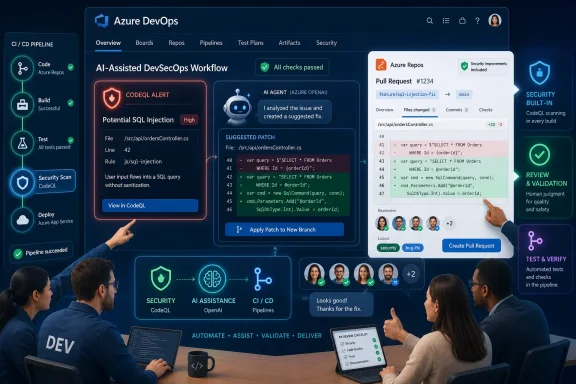 Microsoft Is Moving the Security Conversation from Alerts to Patches
The most important word in Copilot Autofix is not Copilot. It is Autofix. Static analysis has never lacked confidence in its ability to generate work for developers; the problem is that every new alert becomes another item in a queue already crowded with feature work, production incidents, flaky tests, dependency churn, and review debt.GitHub Advanced Security for Azure DevOps already brought familiar GitHub security capabilities into Azure Repos: code scanning with CodeQL, secret scanning, dependency scanning, and dashboards. Those features helped Azure DevOps customers see more of their software risk without leaving the platform. But seeing risk and reducing risk are different disciplines.
Copilot Autofix is Microsoft’s attempt to collapse that distance. When CodeQL identifies a supported vulnerability or coding error, the system can generate a proposed remediation, create a branch, and open an Azure Repos pull request. The developer still reviews the change, but the blank page is gone.
That is a subtle but meaningful shift in the economics of secure development. A security alert used to arrive as an obligation: understand the query, map the finding to the codebase, research a fix, make the patch, run tests, argue with reviewers, and hope the next scan closes the alert. Now Microsoft is trying to make the alert arrive with a first draft attached.
Azure DevOps Gets the GitHub Treatment Without Becoming GitHub
This release is also about platform politics. Microsoft owns both GitHub and Azure DevOps, but the two products do not occupy the same emotional space inside enterprises. GitHub is the center of Microsoft’s developer future; Azure DevOps remains deeply embedded in organizations that standardized on Azure Repos, Azure Pipelines, Boards, and enterprise governance years ago.For those customers, “just move to GitHub” is not a product strategy. It is a migration program, an audit exercise, a retraining project, and often a procurement fight. Microsoft has therefore had to pursue a more pragmatic path: bring enough GitHub technology into Azure DevOps to keep those customers modern, while still making GitHub the showcase for the newest developer experiences.
Copilot Autofix fits that pattern. The feature is branded as part of GitHub Advanced Security for Azure DevOps, uses CodeQL as its analysis engine, and relies on GitHub Copilot’s coding agent to generate fixes. But the work surfaces where Azure DevOps teams already live: inside the Advanced Security alert experience and through Azure Repos pull requests.
That design choice is not cosmetic. Security tools fail when they require developers to leave the review path, copy advice from one portal into another, or translate a scanner’s abstract recommendation into a local coding convention. By opening a normal pull request, Copilot Autofix speaks the language of the existing engineering process.
The Last Mile of SAST Has Always Been the Hard Part
Static application security testing has been valuable for decades because it can inspect code at scale and catch recurring patterns of risk. CodeQL, in particular, is stronger than old-fashioned grep-like scanners because it treats code as data and can reason about flows across a program. That makes it well suited for finding classes of vulnerabilities that are easy to miss in manual review.But SAST also has a reputation problem among developers. Alerts can be noisy, explanations can be abstract, and the fix can require understanding a security concept that is adjacent to the developer’s immediate task. Even when the finding is valid, it may not be obvious how to remediate it safely in a mature codebase with conventions, legacy assumptions, and tests that only make sense to the team maintaining it.
Copilot Autofix is Microsoft’s answer to that practical bottleneck. The system does not merely point at the flagged line and say “sanitize this.” It analyzes the alert and surrounding code, then proposes a change that may span more than one file. That matters because real vulnerabilities often live in the relationship between input handling, validation, data flow, and output — not in a single guilty statement.
Still, the “last mile” cannot be fully automated away. A generated patch can compile and still be wrong. It can close the CodeQL alert while changing behavior. It can introduce a compatibility issue, violate an architectural boundary, or quietly replace a security flaw with a reliability bug. Microsoft’s documentation is explicit that Autofix suggestions are not guaranteed to be correct, complete, or secure.
The Pull Request Is the Safety Boundary
Microsoft’s most defensible design decision is that Copilot Autofix ends in a pull request, not a silent commit. That is where the feature’s enterprise viability lives. No serious organization wants an AI agent directly changing production-bound code because a scanner raised an alert.The pull request gives the system a familiar containment vessel. Developers can inspect the diff, request changes, run tests, require approvals, attach work items, and let branch policies do what branch policies already do. In other words, Autofix does not replace governance; it enters through governance.
That will not satisfy everyone. Some security leaders will want stronger assurances before they trust AI-generated remediation at scale. Some developers will treat the feature as another source of suspicious drive-by PRs. Some platform teams will worry that the volume of generated fixes could create a new kind of review fatigue.
Those concerns are reasonable. But they are also why the PR model is the right compromise. The feature is most useful when it shortens the time between detection and a reviewable candidate fix. It becomes dangerous only if organizations confuse candidate fixes with validated fixes.
Limited Preview Means the Real Test Has Barely Started
The public preview is limited, and Microsoft says not everyone who signs up will receive access. That caveat is important because previews are where polished demos meet messy repositories. The hard questions will not be answered by the announcement page; they will be answered by the first few thousand enterprise pull requests.The feature requires GitHub Advanced Security for Azure DevOps, or the standalone GitHub Code Security for Azure DevOps experience, with code scanning configured for the repository. CodeQL must already be producing alerts. Autofix must also be enabled per repository as part of code security settings.
That setup implies a relatively mature customer. This is not a feature for organizations that have not yet decided how they scan code, manage security debt, or enforce pull request review. It is aimed at teams that already have CodeQL findings and want to reduce the manual labor of remediation.
The supported language set follows CodeQL’s code scanning coverage, including C and C++, C#, Go, Java and Kotlin, JavaScript and TypeScript, Python, Ruby, and Swift. That is broad enough to cover a large share of enterprise application code, though not every language or custom analysis path will qualify. Fixes may also be unavailable for unsupported alert types, false positives, custom queries, or third-party scanner results.
AI Remediation Will Be Judged by Rejection Rates
The central metric for Copilot Autofix should not be how many pull requests it opens. It should be how many of those pull requests survive review, pass CI, close the underlying alert, and avoid follow-up damage. Anything less risks turning security debt into review debt.Recent research into AI-generated code changes has been sobering. AI agents can accelerate routine maintenance and produce plausible patches, but many proposed fixes are rejected because they misunderstand context, fail tests, solve only part of the problem, or make assumptions the project does not share. That does not make the technology useless. It means the win condition is assistance, not autonomy.
This is especially true in security. A fix that looks reasonable can be incomplete if it handles one input path but not another. A patch can remove the exact data flow that CodeQL reported while leaving the broader design vulnerable. A model can also overfit to the scanner’s complaint and optimize for making the alert disappear rather than making the system safer.
Microsoft appears to understand that risk. Its messaging frames Autofix as a starting point, not a final answer. That language may sound cautious, but it is the only credible posture for AI-generated security patches in 2026.
The Developer Experience Is the Product
For developers, the appeal is obvious. Instead of losing an afternoon to a vulnerability class they last studied during onboarding, they receive a diff that shows one possible path forward. Even if they reject half of the generated changes, the other half may save enough time to matter.For security teams, the promise is different. Autofix could make it easier to persuade developers to address findings quickly because the first remediation step is no longer a cold start. Security teams have spent years trying to shift left; AI remediation offers a more concrete bargain: if developers accept scanners earlier in the lifecycle, the tools will do more of the repair work.
For platform teams, the attraction is standardization. A consistent mechanism for generating and reviewing fixes inside Azure DevOps is easier to govern than a patchwork of IDE suggestions, chat prompts, wiki snippets, and manual security tickets. The pull request becomes the audit artifact.
But the developer experience will determine adoption. If Autofix PRs are frequently noisy, stylistically alien, or oblivious to project conventions, teams will turn the feature off or ignore it. If the fixes are usually close, developers will tolerate occasional misses because the tool reduces toil.
Microsoft’s Bigger Bet Is an AI-Native DevSecOps Loop
Copilot Autofix should be read alongside Microsoft’s broader push to weave AI into planning, coding, review, testing, and operations. The company is not merely adding a chatbot to Azure DevOps. It is trying to build a loop where machine analysis detects problems, generative AI proposes work, and human workflows validate the result.That loop is particularly attractive in security because the backlog is endless. Every large organization has old code, inconsistent dependencies, legacy patterns, and alerts that sit unresolved because they are real but not urgent enough to displace roadmap commitments. The dream is not that AI fixes everything. The dream is that AI makes low- and medium-complexity remediation cheap enough that it stops being deferred forever.
There is a risk in that framing. If organizations use AI remediation as an excuse to generate more code faster without investing in architecture, threat modeling, testing, and secure design, they will simply move defects around. Faster patch production is not the same as safer software.
The better interpretation is that Autofix is a pressure valve. It can help with known classes of vulnerabilities identified by static analysis. It cannot decide whether a permission model is appropriate, whether a business workflow can be abused, or whether a system’s trust boundaries make sense. Those remain human engineering problems.
Azure Repos Customers Are No Longer Waiting Outside the AI Tent
For years, Azure DevOps users have had to watch Microsoft’s developer story tilt toward GitHub. That tilt is understandable: GitHub is where Microsoft reaches open source communities, startups, and the modern developer zeitgeist. But enterprise reality is less fashionable. Azure DevOps remains central in many organizations, especially those with Microsoft-heavy tooling, mature pipelines, and years of process encoded into Boards and Repos.Bringing Copilot Autofix to Azure DevOps is therefore not only a feature update. It is a reassurance. Microsoft is telling Azure Repos customers that they can participate in the AI security workflow without first undertaking a platform migration.
That reassurance has limits. GitHub will almost certainly continue to receive some capabilities first, and Azure DevOps integrations may lag or arrive with different licensing and preview constraints. But the direction is clear: Microsoft wants GitHub’s security intelligence and Copilot’s agentic capabilities to flow into Azure DevOps where enterprise customers still work.
This convergence also makes commercial sense. GitHub Advanced Security for Azure DevOps lets Microsoft sell a higher-value security layer to existing Azure DevOps estates. Copilot Autofix makes that layer more tangible because it connects scanning to visible engineering output.
Security Teams Should Treat Autofix as a Workflow Change, Not a Feature Toggle
The worst way to adopt Copilot Autofix would be to enable it casually across repositories and wait for magic. AI-generated remediation changes how alerts become work, how reviewers spend time, and how security teams measure progress. That deserves planning.Teams should decide which repositories are appropriate for preview use. A well-tested service with active maintainers is a better candidate than a brittle legacy system whose test suite is aspirational. The point of the preview should be to learn where generated fixes help, where they fail, and how much review effort they really save.
Organizations should also decide who owns the generated PRs. If Autofix opens a branch, does the application team triage it? Does security engineering review it first? Does platform engineering monitor failed attempts? Without ownership, the feature could create a pile of unattended remediation drafts.
Most importantly, teams should resist changing their acceptance criteria. An AI-generated security fix should meet the same standards as a human patch: readable code, passing tests, appropriate reviewers, no hidden behavior changes, and evidence that the original alert is actually resolved. The model may draft the diff, but the organization still owns the risk.
The Patch Bot Arrives, but the Human Gate Remains
The concrete shape of Microsoft’s preview is more conservative than the surrounding AI rhetoric might suggest, and that is a good thing. Copilot Autofix is useful precisely because it is bounded: CodeQL finds a supported issue, Copilot proposes a fix, Azure DevOps opens a pull request, and humans decide what ships.- Copilot Autofix for GitHub Advanced Security for Azure DevOps is in limited public preview and is not automatically available to every organization that requests access.
- The feature works with Azure Repos and requires code scanning with CodeQL to be configured before it can generate fixes.
- Generated remediations are delivered as Azure Repos pull requests, allowing teams to use their existing review, testing, and approval workflows.
- Microsoft explicitly warns that AI-generated fixes may be incorrect, incomplete, or insecure, so developers must validate every proposed change.
- The feature supports the same broad language families that CodeQL covers for code scanning, but not every alert or custom query will produce an Autofix.
- The strategic value is not autonomous security repair; it is reducing the time and effort required to turn a valid alert into a reviewable patch.
References
- Primary source: infoq.com
Published: Tue, 30 Jun 2026 12:00:05 GMT
Microsoft Brings AI-Powered Vulnerability Remediation to Azure DevOps with Copilot Autofix - InfoQ
Microsoft has announced the limited public preview of Copilot Autofix for GitHub Advanced Security for Azure DevOps, extending AI-powered vulnerability remediation to teams using Azure Repos.www.infoq.com
- Official source: learn.microsoft.com
Copilot Autofix for code scanning in GitHub Advanced Security for Azure DevOps (Preview) - Azure Repos | Microsoft Learn
Use Copilot Autofix to generate AI-powered suggested fixes for CodeQL code scanning alerts in GitHub Advanced Security for Azure DevOps.learn.microsoft.com - Official source: docs.github.com
About Copilot Autofix for code scanning - GitHub Docs
Copilot Autofix provides targeted recommendations to help you fix code scanning alerts and avoid introducing new security vulnerabilities. docs.github.com
- Official source: devblogs.microsoft.com
Now Generally Available: GitHub Advanced Security for Azure DevOps is ready for you to use - Azure DevOps Blog
We’re excited to announce that GitHub Advanced Security for Azure DevOps is now generally available and is ready for you to use in your own Azure DevOpsdevblogs.microsoft.com - Official source: azure.microsoft.com
- Official source: techcommunity.microsoft.com
- Related coverage: labs.cloudsecurityalliance.org
CSA research note M365 Copilot CVE 2026 24299 20260505 csa styled
PDF documentlabs.cloudsecurityalliance.org