

Microsoft and Stripe this week pushed agent-led commerce from prototype to product: Copilot Checkout — a native, in-chat purchasing flow that lets U.S. users discover and buy items from retailers like Urban Outfitters, Anthropologie and independent Etsy sellers without leaving the Copilot conversation — and Stripe is the payment backbone powering that experience.
Microsoft introduced Copilot Checkout as part of a larger push to turn conversational AI into a full shopping surface where discovery, decision-making and payment happen in a single interaction. The capability is currently rolling out in the United States on Copilot.com and is enabled through partner integrations with payment platforms including Stripe, PayPal and commerce platforms such as Shopify. Microsoft characterizes this as part of its broader agentic commerce strategy: building “Brand Agents,” storefront templates and checkout primitives so merchants can appear natively inside AI-driven conversations. Stripe’s announcement — published the same week — explains its role: when Copilot surfaces a purchasable item, Stripe can embed a checkout inside the chat, collect payment credentials from the buyer, issue a Shared Payment Token (SPT), and pass that token to the merchant so the sale can be completed without exposing raw payment credentials. Stripe says sellers retain merchant-of-record status and can either process payments with Stripe or another processor while benefiting from Stripe’s fraud signals. The rollouts are coordinated with previously launched initiatives such as Instant Checkout in ChatGPT, which used the same Agentic Commerce Protocol (ACP) co-developed by Stripe and major AI platforms.
For consumers, the promise is faster shopping and a more assistant-like experience. For merchants, the opportunity is new demand channels and simplified conversion funnels. For platforms and payment companies, the upside is platform-native monetization and deeper integration into the purchase lifecycle. For regulators and consumer advocates, the challenge will be ensuring these innovations preserve user control, privacy and fair competition.
Merchants should prepare by auditing onboarding terms, hardening fulfillment and fraud defenses, and ensuring product data is optimized for agentic discovery. Consumers should expect faster, more conversational shopping but should also demand clear consent and easy remedies for mistakes. For the industry, the central challenge will be balancing the friction-reducing benefits of native checkout with safeguards that protect consumers and merchants alike.
Source: LeapRate https://www.leaprate.com/payments/stripe-powers-new-shopping-checkout-inside-microsoft-copilot/
 Background
Microsoft introduced Copilot Checkout as part of a larger push to turn conversational AI into a full shopping surface where discovery, decision-making and payment happen in a single interaction. The capability is currently rolling out in the United States on Copilot.com and is enabled through partner integrations with payment platforms including Stripe, PayPal and commerce platforms such as Shopify. Microsoft characterizes this as part of its broader agentic commerce strategy: building “Brand Agents,” storefront templates and checkout primitives so merchants can appear natively inside AI-driven conversations. Stripe’s announcement — published the same week — explains its role: when Copilot surfaces a purchasable item, Stripe can embed a checkout inside the chat, collect payment credentials from the buyer, issue a Shared Payment Token (SPT), and pass that token to the merchant so the sale can be completed without exposing raw payment credentials. Stripe says sellers retain merchant-of-record status and can either process payments with Stripe or another processor while benefiting from Stripe’s fraud signals. The rollouts are coordinated with previously launched initiatives such as Instant Checkout in ChatGPT, which used the same Agentic Commerce Protocol (ACP) co-developed by Stripe and major AI platforms. What Copilot Checkout actually does
Inline discovery to purchase, without redirects
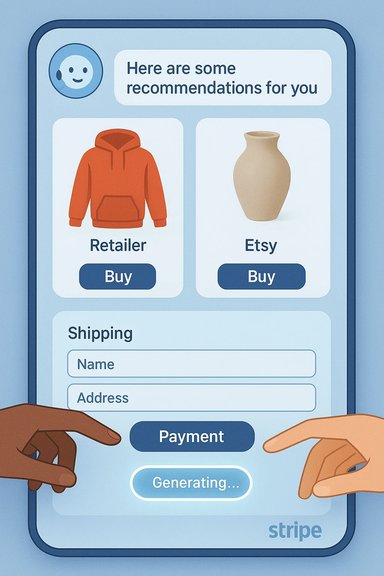
Copilot Checkout turns a product suggestion into a one-click transaction inside the conversation UI. Rather than redirecting users to an external retailer page, Copilot presents product details and a Buy action; tapping Buy opens a lightweight checkout flow that captures shipping and payment details in-context. This is designed to reduce friction and drop-off between discovery and conversion. Early partner merchants include major lifestyle brands and Etsy sellers, giving Copilot access to both mass-market inventory and long-tail handmade goods.The role of the Agentic Commerce Protocol and Shared Payment Token
Two technical primitives matter:- Agentic Commerce Protocol (ACP): An open standard for agent-led commerce that coordinates product discovery, order passing and fulfillment steps between AI agents, merchants and payment providers. ACP was co-developed and promoted publicly as a way to make agentic checkouts interoperable across platforms.
- Shared Payment Token (SPT): A tokenized payment primitive that Stripe describes as a way to let AI platforms initiate payments without storing or exposing the buyer’s raw credit card data. The SPT is scoped to a merchant and transaction and is passed to the merchant to complete authorization and capture. Stripe also says its fraud signals and risk scoring can be made available to merchants regardless of which processor they choose to use.
Why this matters to merchants and platforms
Reduced friction, higher conversion potential
By collapsing the journey from recommendation to checkout, Copilot Checkout aims to convert conversational intent into immediate revenue. Microsoft and partners argue that agentic commerce meets shoppers at their moment of intent, which — in theory — should increase conversion rates versus referrals that send users to external sites. Microsoft cites data showing a surge in AI-driven ecommerce traffic during the 2025 holiday season to underline the opportunity.Faster merchant onboarding (especially for Shopify sellers)
Microsoft’s rollout plan prioritizes merchant scale. Shopify merchants will be automatically enrolled in Copilot Checkout following an opt-out window, meaning a large set of online storefronts can appear in AI shopping surfaces with minimal action. For merchants not on Shopify, Microsoft and Stripe are accepting applications and provide integrations via Stripe’s Agentic Commerce Suite to help make product catalogs discoverable and to manage checkout, payments and fraud protection through a single integration. Etsy sellers are included through marketplace integrations that expose their inventory to Copilot.Platform revenue models and partner economics
Copilot Checkout is clearly positioned as an ecosystem play: Microsoft benefits by increasing Copilot’s utility and user engagement, platforms like Stripe and PayPal can monetize payment flows and merchants gain new demand channels. Historically, platform-driven checkout flows collect fees from merchants or take a share of transactions; while Microsoft and partners have not published a standardized fee schedule for Copilot Checkout, prior examples (such as Instant Checkout in ChatGPT) suggest platforms may take a merchant-side fee or a revenue share. That said, exact economics for Copilot Checkout remain opaque in public announcements. This is a point merchants should watch closely as enrollment plans mature.Technical workflow: step-by-step
- User asks Copilot for product recommendations (for example, “find a bedside lamp under $100”).
- Copilot recommends options and shows product details with a Buy button embedded in chat.
- When a user chooses to buy, Copilot surfaces a Stripe-powered in-chat checkout (if Stripe is the payment backbone for that merchant) or another partner’s checkout.
- The user provides shipping and payment details; Stripe issues a Shared Payment Token (SPT) scoped to the transaction.
- Copilot passes the SPT to the merchant via the Agentic Commerce Protocol.
- The merchant performs authorization and capture — either using Stripe or a different processor — and handles fulfillment, tax, returns and customer communications, remaining merchant of record.
Security, privacy and fraud: promise vs. reality
Tokenization reduces exposure, but does not eliminate risk
Tokenization with SPTs reduces the exposure of raw card data to intermediary platforms. In principle, tokens scoped to a merchant and basket total can limit the utility of stolen tokens. Stripe also promotes its fraud detection tools, built over years of ecommerce data, as an additional safety layer. However, important caveats remain:- Tokenized flows still need robust consent and UX guardrails to avoid accidental purchases.
- Tokens are only as secure as the systems that issue, transmit and store them; security practices across multiple third parties will determine actual risk.
- Fraud signals and machine-learning models are probabilistic; no system completely prevents chargebacks, social engineering, or sophisticated fraud rings.
Data minimization and merchant control
Microsoft and Stripe emphasize minimal data sharing: Copilot will pass only the data required to complete the order and merchants remain the owners of customer relationships. That model preserves merchant control over fulfillment and returns, which is important for brand experience and regulatory compliance (for example, VAT and sales tax obligations). But the specifics of what data flows to Microsoft, Stripe and any other intermediary — and how long that data is retained — are not exhaustively documented in the initial announcements. Merchants and regulators will want clearer, auditable data flows and retention policies.Consumer safety and consent: UX design questions
Conversational UIs change expectations about how purchases are expressed and authorized. Designers and regulators are focused on three UX problems:- Clear consent signaling: Users must unmistakably know when they are authorizing a purchase and which payment method will be charged.
- Prevention of accidental buys: Chat interfaces must avoid ambiguous phrasing or tap targets that convert casual exploration into purchases.
- Transparent returns and fees: Consumers must see the same information they would on a merchant site — tax, shipping, return policy and dispute channels — to avoid confusion.
Competition and market impact
Not the only game in town
Microsoft’s Copilot Checkout is part of a broader industry trend. OpenAI’s Instant Checkout, launched in collaboration with Stripe and initially available in ChatGPT, set early expectations for tokenized, in-chat payments. Google’s Gemini and other AI vendors are racing to add shopping features and monetization strategies, including personalized ads inside AI shopping flows. Big commerce platforms (Shopify), payments companies (PayPal) and retailers (Walmart, Target) are all building or integrating into agentic commerce in various ways. The result is a multi-player landscape rather than a single-vendor monopoly.Strategic implications for retailers
- Brands with strong ecommerce ecosystems (Shopify stores, marketplace integrations) will gain the fastest access to agentic channels.
- Large omnichannel retailers can use agentic channels to expand discovery while preserving fulfillment advantages.
- Small merchants who rely heavily on marketplace infrastructure (for example, Etsy sellers) will benefit from additional demand sources but may face new fee structures and the need to adapt fulfillment processes for short, conversational orders.
Potential winner-takes-all dynamics — but not inevitably
Platforms that can combine discovery, trust and low friction will be advantaged. Microsoft has Copilot as an operating-system–adjacent AI, Stripe has deep payments infrastructure, and Shopify can enroll millions of merchants quickly. Still, interoperability via ACP and the open-source aspirations of some players could prevent any single company from fully monopolizing agentic commerce. The economics will tilt toward platforms that balance merchant economics, consumer trust and regulatory compliance.Regulatory and policy considerations
Consumer protection and inadvertent purchases
Regulators will scrutinize whether conversational purchases are sufficiently transparent and reversible. Consumer protection authorities may require explicit, friction-based consent for purchases over a threshold, double-confirmations for certain categories of goods, or mandatory receipts and cancellation windows for in-chat buys. Past friction-reduction strategies in other contexts (in-app purchases, voice commerce) have triggered regulatory guidance; agentic commerce is likely to follow.Taxes, cross-border sales and merchant-of-record responsibilities
Because merchants remain the merchant of record, they retain obligations for taxes, customs and consumer rights. That keeps responsibility on sellers, but it also creates operational complexity for small merchants suddenly exposed to new geographic demand. Integration partners promise tax-handling and compliance tooling, but sellers should audit whether those tools meet their jurisdictional obligations.Platform liability and anti-fraud obligations
Platforms that facilitate purchases — particularly where they recommend or present products — may face legal scrutiny if they host counterfeit goods, engage in misleading advertising, or fail to prevent fraud. Shared-token architectures reduce direct card exposure but do not absolve platforms of due diligence responsibilities. Expect future policy guidance or case law to clarify these boundaries.Practical advice for merchants and developers
- Evaluate onboarding terms carefully: merchants should read fee schedules, dispute flows and data-sharing agreements before opting into Copilot Checkout.
- Test fulfillment at scale: in-chat purchases may convert at different rates and require different packaging or shipping priorities.
- Implement clear refund and returns workflows: conversational buyers will expect the same post-purchase support as web shoppers.
- Monitor fraud and chargebacks: tokenization helps, but early agentic commerce channels may attract novel fraud patterns.
- Prepare product data feeds: quality metadata (images, dimensions, stock levels) is critical to ensure accurate agentic recommendations and minimize cancellations.
Risks and open questions
- Opaque economics: Public announcements have not uniformly disclosed platform fees or revenue shares for Copilot Checkout; merchants should seek clarity.
- UX edge cases: How will Copilot handle multi-item carts, subscriptions, gift orders, or split payments? Early launches suggest single-item flows are the first priority; more complex commerce will require additional protocols.
- Regulatory lag: Rules for agentic commerce will trail product innovation, creating short-term legal uncertainty for cross-border or regulated goods.
- Dependency on platform trust: If a platform’s safety or privacy posture weakens, merchants relying on that channel could see reputational damage. Maintaining multi-channel resilience will be prudent.
How this changes the shopping landscape
Agentic commerce — the idea that an AI agent can both recommend and purchase on behalf of a human user — rewrites several long-standing assumptions about online retail. It reduces the need for human-driven navigation, raises the importance of metadata and structured product catalogs, and creates new points of negotiation between platforms, payment providers and merchants.For consumers, the promise is faster shopping and a more assistant-like experience. For merchants, the opportunity is new demand channels and simplified conversion funnels. For platforms and payment companies, the upside is platform-native monetization and deeper integration into the purchase lifecycle. For regulators and consumer advocates, the challenge will be ensuring these innovations preserve user control, privacy and fair competition.
The near future: what to watch
- Geographic expansion: Will Copilot Checkout move beyond the U.S., and what timelines will Microsoft and partners publish?
- Fee transparency: Whether Microsoft, Stripe or other platforms disclose standardized merchant fees or revenue-share models.
- Feature parity: When multi-item carts, recurring payments and B2B purchases are supported in agentic flows.
- Interoperability tests: Whether the Agentic Commerce Protocol gains broad adoption across AI platforms — a key determinant of whether agentic commerce remains open or becomes siloed.
- Security audits and regulatory guidance: Independent reviews of tokenization schemes and regulatory pronouncements on consent and consumer protection.
Conclusion
Copilot Checkout, with Stripe as a key payments partner, marks a pivotal step from experimental demos toward production-grade agentic commerce. The combination of in-chat discovery, tokenized payments and merchant-centered order flows answers many previous technical objections to AI-based shopping. Yet the model introduces new questions about UX safety, fee transparency and regulatory compliance — issues that will determine whether agentic commerce becomes a mainstream sales channel or a niche convenience for early adopters.Merchants should prepare by auditing onboarding terms, hardening fulfillment and fraud defenses, and ensuring product data is optimized for agentic discovery. Consumers should expect faster, more conversational shopping but should also demand clear consent and easy remedies for mistakes. For the industry, the central challenge will be balancing the friction-reducing benefits of native checkout with safeguards that protect consumers and merchants alike.
Source: LeapRate https://www.leaprate.com/payments/stripe-powers-new-shopping-checkout-inside-microsoft-copilot/
