

Microsoft’s Copilot is no longer just an adviser — it’s becoming a checkout lane, and Stripe has been named as one of the payments engines powering that shift as Microsoft rolls Copilot Checkout into U.S. users’ experiences. The announcement ties together Microsoft’s new agentic commerce direction — which includes branded shopping agents, catalog-enrichment templates and in-chat purchases — with payments and platform partners (Stripe, PayPal and Shopify) that provide the tokenized plumbing merchants need to accept payments without leaving the Copilot conversation. This feature-first rollout and partner strategy was outlined in recent coverage and in partner releases that show Stripe’s role in supplying the agentic payment rails while PayPal and Shopify contribute store sync and scale respectively.
Microsoft’s Copilot Checkout is part of a larger push to deliver agentic commerce — AI agents that do more than recommend products; they act to complete purchases on behalf of users when instructed. The architecture Microsoft describes places three coordinated layers center stage: structured catalog ingestion (machine‑readable feeds and catalog enrichment), conversational orchestration (Copilot runtime that maintains provenance and clarifying dialogs), and delegated, tokenized checkout (short‑lived payment sessions or tokens issued by a payment provider). Microsoft’s public materials and partner statements emphasize that merchants remain the merchant of record, while Copilot orchestrates the user experience. Stripe’s public announcement confirms that Copilot can surface a Stripe‑powered checkout natively inside a chat when a shopping flow is triggered, and that Microsoft communicates with Stripe via an integration that leans on the Agentic Commerce Protocol (ACP) — an open standard Stripe helped develop to standardize agent-to-merchant interactions. PayPal’s press release likewise details its Store Sync and agentic commerce services that can publish merchant catalogs into AI shopping surfaces like Copilot. Microsoft’s own launch materials list PayPal, Stripe and Shopify as launch partners; independent reporting also corroborates these relationships.
That said, the long‑term sustainability of agentic commerce depends on disciplined execution: precise catalog hygiene, robust fraud and dispute mechanics, clear contractual allocation of liability, and transparent merchant controls. Vendor-supplied uplift figures are promising but need independent evaluation. The approach is sensible from an engineering and distribution perspective, but the real test will be whether operational readiness and governance can scale to support millions of merchant interactions without producing systemic friction or regulatory scrutiny.
At the same time, real‑world success depends on the dark art of operational readiness: immaculate product feeds, hardened tokenized checkout tests, explicit liability contracts, fraud coordination and transparent opt‑in/opt‑out controls. Vendors and partners have built the scaffolding; now merchants, PSPs and regulators must validate, pilot and operationalize the model at scale before agentic commerce moves from promising experiment to reliable retail channel.
Source: SMBtech https://smbtech.au/news/stripe-powe...n-in-microsoft-copilot-with-agentic-checkout/
 Background / Overview
Microsoft’s Copilot Checkout is part of a larger push to deliver agentic commerce — AI agents that do more than recommend products; they act to complete purchases on behalf of users when instructed. The architecture Microsoft describes places three coordinated layers center stage: structured catalog ingestion (machine‑readable feeds and catalog enrichment), conversational orchestration (Copilot runtime that maintains provenance and clarifying dialogs), and delegated, tokenized checkout (short‑lived payment sessions or tokens issued by a payment provider). Microsoft’s public materials and partner statements emphasize that merchants remain the merchant of record, while Copilot orchestrates the user experience. Stripe’s public announcement confirms that Copilot can surface a Stripe‑powered checkout natively inside a chat when a shopping flow is triggered, and that Microsoft communicates with Stripe via an integration that leans on the Agentic Commerce Protocol (ACP) — an open standard Stripe helped develop to standardize agent-to-merchant interactions. PayPal’s press release likewise details its Store Sync and agentic commerce services that can publish merchant catalogs into AI shopping surfaces like Copilot. Microsoft’s own launch materials list PayPal, Stripe and Shopify as launch partners; independent reporting also corroborates these relationships. What’s being shipped and how it appears to shoppers
The user experience (UX) in plain terms
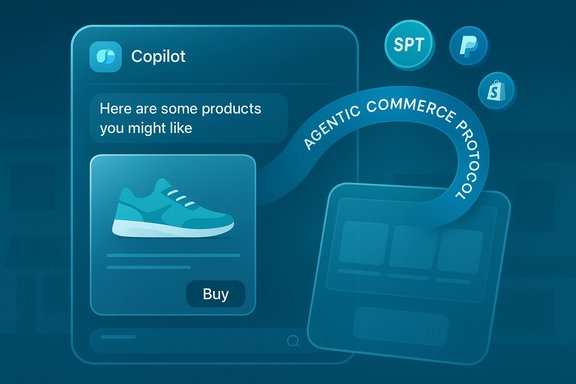
- When a Copilot conversation reaches shopping intent, Copilot surfaces curated product cards with Details and Buy actions.
- Selecting Buy opens a branded, compact checkout widget inside Copilot where users confirm shipping, payment and delivery choices — no full-page redirect required.
- Payment processing, settlement, and fraud checks are performed by the merchant’s chosen payment partner (Stripe, PayPal, Shopify’s checkout), while Copilot retains the conversational orchestration and logging.
Key product capabilities at launch
- In‑chat checkout widget: purchases can complete inside Copilot on supported merchants.
- Multiple payment rails: Stripe, PayPal and Shopify act as enabling PSPs (payment service providers) to process settlement and provide fraud telemetry.
- Copilot Studio templates: Brand Agents, personalized shopping templates, and catalog‑enrichment tools to help merchants deploy agentic experiences quickly.
- Shopify auto‑enrollment: Shopify merchants are slated to be automatically enrolled into Copilot Checkout after a brief opt‑out window, offering immediate scale to Microsoft’s surface.
The technical anatomy — how the plumbing fits together
1. Catalog ingestion and normalization
Agents must reference canonical product data to avoid hallucination and disputes. Microsoft and partners require machine‑readable product feeds (SKU, GTIN, images, inventory, shipping metadata), and provide catalog‑enrichment templates for merchants that need help normalizing attributes. PayPal’s Store Sync is explicitly positioned as a one‑to‑many ingestion layer to publish merchant catalogs to AI platforms.2. Conversational orchestration
Copilot’s runtime interprets intent, asks clarifying questions (size, color, delivery window), surfaces product cards, and logs provenance that links recommendations to canonical records. These logs are essential for analytics — and for dispute resolution when price or availability mismatches occur. Microsoft stresses the importance of auditable traces.3. Delegated, tokenized checkout
When a buyer confirms, Copilot requests a short‑lived checkout session or a Shared Payment Token (SPT) from the PSP. Stripe’s ACP and SPT model allow payment credentials to be scoped and passed to a seller’s payment stack so the assistant never stores raw card data. The PSP executes fraud checks, settlement and returns the outcome; merchants remain the merchant of record. Stripe’s documentation and newsroom statements confirm this flow and the use of ACP as the interoperability standard.Why partners like Stripe, PayPal and Shopify matter
- Stripe: supplies the programmatic payments and the Agentic Commerce Protocol implementation that enables token issuance and risk signals to be shared across agents and merchants. Stripe’s role is infrastructure-first: make the tokenized checkout reliable and routable to merchant backends.
- PayPal: supplies Store Sync and branded checkout capabilities, along with buyer/seller protections and wallet funding options; PayPal’s one-to-many catalog approach can reduce merchant integration overhead.
- Shopify: supplies scale and a rapid enrollment path for millions of small merchants via the Agentic Storefronts model; automatic enrollment of Shopify merchants into Copilot Checkout (subject to opt‑out) can drastically accelerate merchant coverage.
Strengths: Why this can work for merchants and consumers
- Reduced friction at point of intent: collapsing discovery and payment into one conversational surface shortens the path from inspiration to purchase and can materially lower cart abandonment for high‑intent flows. Vendor materials claim uplift in conversion and faster purchases after Copilot interactions; those claims are directional and backed by partner anecdotes.
- Merchant-centric design: Microsoft frames Copilot as preserving the merchant’s role — they remain the merchant of record, keep fulfillment responsibilities and own customer data, which reduces resistance compared with models that centralize fulfillment. This continuity is a practical design choice to maintain merchant trust.
- Interoperability via ACP: open standards like the Agentic Commerce Protocol let agents talk to different merchants and PSPs without bespoke integrations, lowering onboarding friction and preventing single‑provider lock‑in. Stripe and others have documented ACP implementations.
- Prebuilt merchant tooling: Copilot Studio templates (Brand Agents, personalized shopping, catalog enrichment) reduce go‑to‑market time for merchants and let brands preserve voice and policies inside AI-driven experiences.
Risks and limitations — what keeps this from being a slam dunk
Operational and data fidelity risks
Agentic commerce amplifies the cost of stale or inaccurate product feeds. If inventory, price, or shipping metadata are wrong, disputes and chargebacks follow. The solution is operational: merchants must maintain canonical, auditable product records and reliable syncs. Microsoft and partners repeatedly warn that catalog fidelity and SLAs with PSPs will determine success.Fraud, KYC and compliance
Faster, in‑chat purchases must still meet AML/KYC requirements and local payments law. Delegated token flows reduce exposure to raw card data but do not eliminate fraud risks. PSPs provide fraud telemetry, but merchants and platforms must coordinate on dispute windows, refund rules and fraud credits. Expect regulators and card networks to watch closely as agentic commerce scales.Liability and dispute boundaries
Who is liable when Copilot reports the wrong price or the wrong estimated delivery date? Microsoft’s design of merchant-of-record continuity helps, but the practical matters of who refunds, how disputes are routed and what governance applies across the Copilot‑PSP‑merchant chain are operationally complex and currently specified only at a high level in vendor materials. Vendors acknowledge these as open areas requiring contractual clarity.Privacy and transparency
Conversational surfaces aggregate intent and historical interactions that could be sensitive. Merchants, platforms and PSPs need clear disclosure flows, explicit consent mechanisms and robust audit logs. Automatic enrollments (Shopify’s opt‑out model) raise particular transparency concerns that merchants must manage proactively in their admin consoles.Vendor-sourced performance claims require independent validation
PayPal’s launch materials cite conversion and time-to-purchase metrics (for example: 53% more purchases within 30 minutes and 194% higher conversion in shopping-intent Copilot journeys). These figures come from vendor materials and early pilot anecdotes; independent verification is necessary before treating them as generalizable. Treat such claims as directional until independent studies validate them.What merchants and Windows-focused IT teams should do now
- Inventory & feeds: Ensure product feeds are canonical, machine‑readable and include GTIN/SKU, inventory levels, accurate images, shipping metadata, and return policies. Use the Microsoft Merchant Center or PayPal Store Sync where appropriate.
- Test tokenized checkout flows: Run delegated, tokenized checkout tests with PSPs (Stripe, PayPal) to verify SPT flows, signature lifetimes, and fraud signal handovers. Confirm SLA expectations for settlement and dispute resolution.
- Clarify contractual liability: Update merchant terms and CS scripts to reflect agent-origin orders, refund handling and dispute routing. Confirm whether automatic Shopify enrollment affects your store and plan opt‑out timing if needed.
- Harden observability and AgentOps: Add logging, provenance traces, and auditing to preserve the chain of evidence from recommendation → product record → checkout token → settlement. Build alerting for reconciliation mismatches.
- Pilot deliberately: Start with low-risk categories and measure uplift under controlled experiments. Vendor anecdotes are promising but contextual; your results will vary by product type, margins and customer base.
Regulatory and standards outlook
The Agentic Commerce Protocol (ACP) — co-developed by Stripe and OpenAI — is positioned as the interoperability standard that will enable multiple agents and merchants to interoperate. Documentation and private previews exist, and Stripe’s public announcements show ACP is already being used in ChatGPT and Copilot flows. Card networks are also developing agentic payment primitives, and regulators will likely review disclosures and liability arrangements as agentic checkout usage grows. Merchants and platforms should track card‑network guidance and local payments regulation closely.Competitive dynamics and market impact
- Platforms are in a fast race to own the moment of purchase. OpenAI, Google and Perplexity have demonstrated similar in‑chat checkout experiments; Microsoft’s Copilot Checkout is another major entrant in that competition, distinguished by its partner‑first approach that emphasizes merchant continuity.
- Shopify’s auto‑enrollment model is a powerful distribution lever that can quickly increase merchant coverage for Copilot. That scale, if used responsibly, can benefit merchants by providing access to high‑intent shoppers; used poorly (unclear opt‑out defaults or opaque fees) it could cause merchant pushback.
- Payments vendors that successfully supply reliable tokenization, fraud signals and cross‑platform interoperability (Stripe, PayPal) stand to capture primary revenue and control points for agentic purchases. Their approach of open protocols reduces single‑vendor lock‑in and helps merchants adopt multiple agentic surfaces with a single integration.
Balanced assessment: promise vs. friction
Copilot Checkout is a decisive, practical step toward making conversational assistants transactional. The technical building blocks — catalog feeds, conversational orchestration, and delegated tokenized checkout — are present and backed by mature payments firms. Early partner involvement (Stripe, PayPal, Shopify) and Microsoft’s Copilot Studio templates lower integration costs and speed merchant onboarding, making this more than an experiment.That said, the long‑term sustainability of agentic commerce depends on disciplined execution: precise catalog hygiene, robust fraud and dispute mechanics, clear contractual allocation of liability, and transparent merchant controls. Vendor-supplied uplift figures are promising but need independent evaluation. The approach is sensible from an engineering and distribution perspective, but the real test will be whether operational readiness and governance can scale to support millions of merchant interactions without producing systemic friction or regulatory scrutiny.
Practical takeaways for Windows Forum readers (merchants, developers, IT)
- Prioritize clean, machine‑readable product data and fast syncs; agentic agents amplify data mistakes.
- Validate token flows with your chosen PSP and insist on clear SLAs for chargebacks, refunds and fraud handling.
- If on Shopify, audit the Shopify admin’s Copilot settings and make an opt‑out plan if you prefer manual control over enrollment.
- Treat Copilot Checkout as a new channel in your analytics stack; instrument conversion, AOV, return rates and dispute volumes separately from existing channels.
- Start with measured pilots and treat vendor-claimed lifts as hypotheses to test in your store context.
Conclusion
Copilot Checkout — enabled by Stripe, PayPal, Shopify and Microsoft’s Copilot Studio — represents a meaningful evolution in how conversational AI and commerce converge. It reduces friction at the moment of purchase, provides interoperable payment and catalog standards, and leverages platform distribution to put merchants in front of high‑intent shoppers. The architecture intelligently separates conversational orchestration from payment settlement, preserving merchant control while offering customers one‑click-ish convenience.At the same time, real‑world success depends on the dark art of operational readiness: immaculate product feeds, hardened tokenized checkout tests, explicit liability contracts, fraud coordination and transparent opt‑in/opt‑out controls. Vendors and partners have built the scaffolding; now merchants, PSPs and regulators must validate, pilot and operationalize the model at scale before agentic commerce moves from promising experiment to reliable retail channel.
Source: SMBtech https://smbtech.au/news/stripe-powe...n-in-microsoft-copilot-with-agentic-checkout/
