

Microsoft’s Copilot has quietly graduated from answer engine to checkout lane: the company has launched Copilot Checkout, an in‑chat purchase flow that lets U.S. shoppers discover products, view details, and complete payments without leaving the Copilot conversation, and it arrives bundled with merchant tooling — Brand Agents and Copilot Studio templates — designed to make merchants quickly discoverable and purchasable inside conversational experiences.
The announcement crystallizes a trend that has accelerated through 2024–2026: platforms are racing to own the moment of purchase by embedding checkout directly inside AI assistants. This approach, often called agentic commerce or conversational commerce, moves beyond recommendation to execution — the assistant not only suggests items but can orchestrate multi‑step purchases on the user’s behalf. Major vendors are converging on similar patterns: in‑assistant buy buttons, machine‑readable product feeds, tokenized delegated payments and merchant orchestration layers. Independent reporting places Microsoft’s move squarely within that broader competitive context. Microsoft frames the release as more than a UX convenience: it is an attempt to stitch together enterprise‑grade primitives (catalog hygiene, governance, payment rails and observability) so Copilot can act as an auditable commerce surface — not a black‑box middleman. That story line appears repeatedly across early coverage and Microsoft’s own materials.
Copilot Checkout is not a monolith; it is an engineered stack of cooperating primitives designed to reduce hallucination, preserve merchant control, and limit sensitive data exposure:
Copilot Checkout is not merely another feature — it is a strategic move in the AI commerce race. How the industry balances convenience with accountability will determine whether the assistant era empowers merchants and shoppers alike or shifts the lion’s share of commerce value toward the new conversational middle layer.
Source: FourWeekMBA https://fourweekmba.com/microsoft-c...copilot-checkout-enters-the-ai-commerce-race]
 Background
The announcement crystallizes a trend that has accelerated through 2024–2026: platforms are racing to own the moment of purchase by embedding checkout directly inside AI assistants. This approach, often called agentic commerce or conversational commerce, moves beyond recommendation to execution — the assistant not only suggests items but can orchestrate multi‑step purchases on the user’s behalf. Major vendors are converging on similar patterns: in‑assistant buy buttons, machine‑readable product feeds, tokenized delegated payments and merchant orchestration layers. Independent reporting places Microsoft’s move squarely within that broader competitive context. Microsoft frames the release as more than a UX convenience: it is an attempt to stitch together enterprise‑grade primitives (catalog hygiene, governance, payment rails and observability) so Copilot can act as an auditable commerce surface — not a black‑box middleman. That story line appears repeatedly across early coverage and Microsoft’s own materials. What Microsoft announced — the essentials
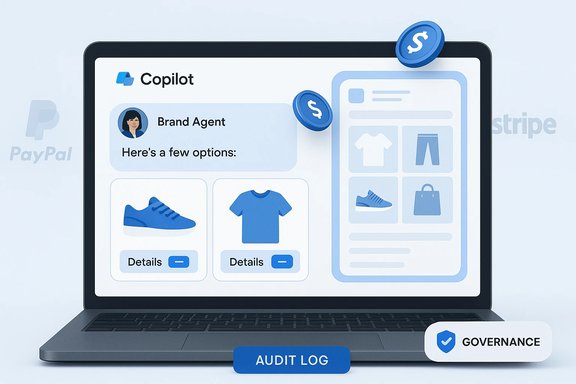
Microsoft’s public messaging and partner releases outline three headline elements:- Copilot Checkout: a native, embedded checkout widget surfaced directly inside Copilot conversations; shoppers can select “Details” or “Buy” on recommended product cards and complete shipping and payment confirmation inside the chat without a redirect. Microsoft says the featuree United States on Copilot.com at launch.
- Brand Agents: prebuilt, brand‑voiced assistants merchants can train on their catalogs and policy documents to deliver a consistent, on‑brand conversational shopping experience across Copilot surfaces and merchant touchpoints. These are positioned as fast, largely no‑code deployments (initially prioritized for Shopify merchants).
- Copilot Studio retail templates: no‑code/low‑code agent templates for catalog enrichment, personalized shopping agents, and store operations (inventory lookup, returns initiation, frontline associate tools). Microsoft is shipping a catalog enrichment agent in public preview and a store operations template to accelerate merchant readiness.
Copilot Checkout is not a monolith; it is an engineered stack of cooperating primitives designed to reduce hallucination, preserve merchant control, and limit sensitive data exposure:
1. Canonical, machine‑readable product data
The system expects merchants to expose structured product feeds (SKUs, GTINs, inventory, images, shipping metadata). Agents reference canonical records rather than scraped HTML to preserve traceability between a recommendation and the actual SKU. Microsoft’s catalog enrichment tooling is explicitly intended to help merchants with messy or incomplete metadata.2. Conversational orchestration (Copilot runtime)
Copilot interprets shopper intent, asks clarifying questions (size, color, delivery window), and maintains an auditable provenance trail linking each recommendation to its originating product record. That provenance is central to resolving disputes and avoiding hallucinated claims.3. Delegated, tokenized checkout
When a buyer confirms purchase intent, Copilot invokes a delegated checkout session or requests a short‑lived shared payment token from the merchant’s selected payment provider. Payment processors (PayPal, Stripe, Shopify checkout rails) handle PCI‑sensitive operations, fraud checks and settlement, so Copilot does not store raw card data. Stripe’s implementation explicitly leverages open agentic commerce primitives (Agentic Commerce Protocol and a Shared Payment Token pattern) to coordinate tokenized handoffs.4. AgentOps & governance
Copilot Studio and Azure AI Foundry provide orchestration, identity, observability, and policy controls — creating human‑escalation paths and audit logs for agent behavior. Microsoft positions these controls as essential to shipping an enterprise‑grade checkout surface rather than an experimental consumer toy.Partners, merchants and scale mechanics
Microsoft’s initial launch uses partner plumbing to accelerate coverage and reduce onboarding friction.- PayPal: announced as powering inventory surfacing, branded in‑chat checkout, guest checkout and card acceptance starting on Copilot.com; PayPal’s store sync is a key mechanism to make merchant catalogs discoverable to Copilot. Vendor materials include conversion uplift statistics (vendor‑sourced) tied to Copilot journeys — numbers that Microsoft and PayPal frame as promising but proprietary.
- Stripe: supports tokenized delegated payments via agentic commerce protocols; Stripe’s position is that standardized payment primitives help agents safely invoke merchant checkouts without handling credentials.
- Shopify: provides rapid merchant coverage through an automatic enrollment flow — Shopify merchants will be automatically enrolled for Copilot Checkout after an opt‑out window, which dramatically accelerates scale but raises questions about default inclusion. Microsoft says non‑Shopify merchants can apply to onboard using PayPal or Stripe tooling.
The business case: what Copilot Checkout promises
Microsoft and its partners pitch a straightforward value proposition for merchants:- Reduced friction, higher conversions: collapsing discovery‑to‑purchase into a single conversational flow reduces redirects and checkout friction, theoretically lowering cart abandonment and converting intent at the moment it forms. PayPal’s release quotes Microsoft observational data showing substantial lifts (for example, journeys with Copilot produced 53% more inutes and conversion rates 194% higher in vendor analyses). Those are vendor‑provided figures and Microsoft cautions they are observational, so results may vary by merchant and category.
- New discovery surface: Copilot becomes another distributionity to be discovered during high‑intent research moments that would otherwise be earned by search engines or marketplaces.
- Lower onboarding cost for smaller merchants: Shopify’s automatic enrollment and PayPal/Stripe store‑sync options aim to give smaller sellers fast access without heavy integration lift.
- Platform revenue opportunities: even when merchants stay merchant of record, the platform controlling discovery and checkout captures new monetization levers: referral fees, promotion placements, or premium Brand Agent services. Industry analysis frames this as a potential re‑allocation of value toward assistant layers.
Risks, operational friction and consumer protections
The upside is clear, but so are the hazards. The shape of agentic commerce amplifies known e‑commerce risks and introduces new dimensions.Fraud and disputes
Tokenized handoffs reduce raw card data, but delegating authorization to PSPs does not eliminate fraud, refund, or chargeback risk. Agent‑originated interactions complicate provenance: merchants and PSPs must reconcile which agent instruction produced which order and whether the represented price, inventory and shipping windows were accurate. Without robust audit logs and clear liability allocation, disputes could proliferate.Catalog fidelity and hallucination risk
Conversational recommendations require clean, canonical product data. If feeds are stale or mismatcriant), customers may receive incorrect offers. Microsoft’s catalog enrichment tooling helps, but merchants must invest in feed hygiene, product information management, and testing before scaling Copilot as a primary sales channel.Privacy, profiling and telemetry
Conversational shopping surfaces generate rich, behaviorally dense telemetry. The increased profiling potential invites stricter notice‑and‑consent regimes and regulatory scrutiny in some jurisdictions. Merchants and platforms should expect demands for clearer disclosures, opt‑outs, and auditability.Platform defaults and competitive concerns
Shopify’s automatic enrollment of merchants into Copilot Checkout (post opt‑out) accelerates catalog scale, but default inclusion can be controversial. Regulators and merchant advocates may question whether assistant surfaces are being favored or whether placement and discovery rules will be neutral. The industry has already seen similar concerns when platforms introduced assistant‑nativ in other ecosystems.Consumer protection and transparency needs
When an assistant executes a payment, explicit disclosures are essential: who is merchant of record, what protections apply, how returns are processed, and how to escalate disputes. Early vendor messaging emphasizes merchant‑of‑record continuity, but practical clarity in order receipts, emails, and dispute paths must match that message in real transactions.How Copilot Checkout compares to rival approaches
Copilot Checkout enters an already busy field. Two important comparators:- OpenAI / ChatGPT Instant Checkout: OpenAI partnered with Stripe and marketplace partners to enable Instant Checkout inside ChatGPT; the architecture similarly relied on tokenized flows and merchant integrations to avoid centralizing payment credentials. Microsoft’s offering is a parallel strategy with different distribution advantages (Copilot’s integration with Microsoft surfaces and enterprise tooling).
- Google’s AI shopping / Universal Commerce Protocol: Googcommerce protocols and buy buttons inside Gemini/Search to enable in‑search purchases. Google’s multi‑partner UCP effort highlights the same industry drive toward standardized agentic rails; Microsoft’s approach instead leans on Azure, Dynamics and partner PSPs to present a comprehensive enterprise path. Comparisons are instructive because they show vendors competing both by product features and by the breadth of commerce ecosystems they can marshal.
Practical checklist for merchants (pilot fivaluating Copilot Checkout, a pragmatic pilot checklist reduces blind spots:
- Audit product feed quality: SKU consistency, GTINs, images, weight/dimensions, shipping windows and tax treatments.
- Review enrollment status if on Shopify: locate the Copilot controls inside the Shopify admin and understand opt‑out mechanics.
- Coordinate with your PSP: confirm token semantics, fraud rules, and dispute workflows with PayPal or Stripe.
- Establish monitoring and logging: request sample audit logs and define attribution fields (agent ID, session ID, product record).
- Run controlled A/B tests: measure conversion lift, average order value, returns rate and chargebacks before broad rollout.
- Train Brand Agent voice and policies: configure human‑handoff triggers for high‑risk queries (claims, warranties, ambiguous returns).
- Prepations: ensure confirmations and receipts clearly state merchant‑of‑record, returns policy and dispute path.
Regulatory and market implications
Agentic commerce compresses many legal and regulatory questions into a single user action. Key areas to watch:- Consumer protection enforcement: regulators will scrutinize whether assistant‑originated purchases include timely disclosures, fair return rights and clear contract formation signals.
- Payment and data liability: when agents surface incorrect pricing or out‑of‑stock claims, courts and regulators will want clear accountability lines across platforms, PSPs and merchants.
- Competition scrutiny: automatic enrollment defaults, preferential placement inside assistant results, or closed‑loop commerce economics could attract antitrust attention if platforms leverage assistant surfaces to entrench market power.
- Privacy law compliance: robust consent flows and data minimization will be necessary as agentic telemetry accumulates.
What to watch next
- Independent merchant pilots and metrics: vendor‑sourced conversion lifts are promising but observational; independent replication across categories and geographies will determine how broadly assistant checkout changes merchant economics.
- Protocol maturity: the Agentic Commerce P standards like Google’s UCP) will need to resolve edge cases — multi‑item carts across merchants, returns and tax handling, cross‑platform token semantics. The speed of standardization will shape interoperability and merchant choice.
- Fraud tooling: PSPs and platforms will iterate on fraud detection and dispute orchestration tuned to agent‑driven purchases; robust risk tooling will be a gating factor for adoption at scale.
- Regulatory responses: consumer protection authorities and competition enforcers will be watching defaults, disclosures and marketplace effects closely; merchant and consumer advocacy will shape early enforcement priorities.
Conclusion
Copilot Checkout is a substantive, well‑engineered step in the industry’s push toward conversational commerce. By combining in‑chat discovery, catalog enrichment, and delegated, tokenized payments with enterprise‑oriented governance tooling, Microsoft presents a plausible answer to the practical objections that have been raised about in‑assistant purchasing. Early partner involvement (PayPal, Stripe, Shopify) and Microsoft’s enterprise stack are meaningful advantages that could accelerate merchant adoption. At the same time, the real test will be operational: merchants must manage catalog fidelity, fraud and dispute workflows, and the regulatory environment will demand clear, auditable provenance and consumer protections. Vendor‑sourced lift metrics are promising but proprietary; independent pilots will decide whether Copilot Checkout is a transformative channel or an incremental convenience. Until those tests are run, the smartest path for merchants is conservative experimentation: pilot, instrument, and demand transparent auditability and practical control over placement and data sharing.Copilot Checkout is not merely another feature — it is a strategic move in the AI commerce race. How the industry balances convenience with accountability will determine whether the assistant era empowers merchants and shoppers alike or shifts the lion’s share of commerce value toward the new conversational middle layer.
Source: FourWeekMBA https://fourweekmba.com/microsoft-c...copilot-checkout-enters-the-ai-commerce-race]
