

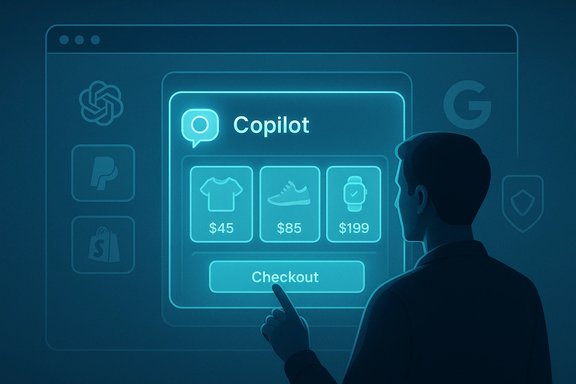
Microsoft’s new Copilot Checkout turns conversational browsing into a direct path to purchase, letting shoppers buy inside Copilot without being redirected to merchant sites — and it locks Microsoft into a high-stakes competition with OpenAI, Google and Amazon over who owns discovery, checkout and customer relationships in the age of agentic commerce.
Microsoft unveiled Copilot Checkout as part of a broader retail push at NRF 2026, positioning the feature as a way for retailers to let buyers “complete the purchase process without being redirected to external sites” while preserving the merchant as the merchant of record. The public rollout is U.S.-first and includes payment partners PayPal, Shopify and Stripe; Etsy sellers are among the first merchants surfaced, and Shopify merchants will be auto-enrolled following an opt‑out window. This move is far from experimental: it’s part of a clear industry trend toward agentic commerce — AI assistants that do more than advise and instead take multi-step actions (price checks, cart creation, delegated payments) and, in some designs, complete checkout on behalf of the user. Microsoft joins OpenAI’s Instant Checkout (built with Stripe and launched in late 2025) and Google’s agentic “Buy for Me” experiments, creating a multi‑front battle for shopper attention and transactional control.
The broader industry response — OpenAI’s Instant Checkout, Google’s Buy for Me and Amazon’s more controversial initiatives — demonstrates that the battleground is now the assistant layer where discovery, recommendations and checkout fuse. For merchants and shoppers alike, the advantages (convenience, conversion lift) will be real, but they come with tradeoffs that demand governance, transparency and operational discipline. Until those guardrails are visible and well-tested in the market, Copilot Checkout and its peers should be used as powerful convenience tools with caution rather than unquestioned authorities.
Source: GeekWire Microsoft debuts Copilot Checkout, joining AI shopping race vs. Amazon, Google and OpenAI
 Background / Overview
Microsoft unveiled Copilot Checkout as part of a broader retail push at NRF 2026, positioning the feature as a way for retailers to let buyers “complete the purchase process without being redirected to external sites” while preserving the merchant as the merchant of record. The public rollout is U.S.-first and includes payment partners PayPal, Shopify and Stripe; Etsy sellers are among the first merchants surfaced, and Shopify merchants will be auto-enrolled following an opt‑out window. This move is far from experimental: it’s part of a clear industry trend toward agentic commerce — AI assistants that do more than advise and instead take multi-step actions (price checks, cart creation, delegated payments) and, in some designs, complete checkout on behalf of the user. Microsoft joins OpenAI’s Instant Checkout (built with Stripe and launched in late 2025) and Google’s agentic “Buy for Me” experiments, creating a multi‑front battle for shopper attention and transactional control. What Copilot Checkout is (and what it isn’t)
The product in plain terms
- What it does: Surfaces products from partner retailers within Copilot search results and lets users finish purchases inside the chat experience, using integrated payment rails rather than sending the shopper off to another website. Microsoft says merchants remain the merchant of record — handling fulfillment, returns, and customer service.
- Who’s involved at launch: PayPal, Shopify and Stripe for payments and merchant plumbing; Etsy sellers among initial participants; selected brands (reported examples include Urban Outfitters, Anthropologie and Ashley Furniture). Shopify merchants are slated to be automatically enrolled after an opt‑out period.
- Where it’s available: Rolling out now in the United States via Copilot.com and the Copilot surface in Edge/Windows, with staged regional expansion implied.
Important product limits and caveats
- Copilot Checkout’s value is tied directly to merchant participation and feed quality; if merchants are not onboarded or product metadata is poor, the experience will be inconsistent.
- Microsoft has emphasized permissioned behavior — proactive in-chat nudges and cross-tab context require explicit opt-ins — but centralizing order history and checkout metadata raises clear privacy and governance questions.
- Some claims in early reporting (coverage areas, cashback reliability, exact merchant lists) are region‑ and time‑gated; availability and behavior will vary by account, platform and merchant.
How Copilot Checkout fits into the emerging agentic commerce stack
Agentic commerce requires three engineered pieces to work reliably:- Machine-readable catalogs and robust merchant feeds so agents can find accurate product pages and inventory.
- Delegated payment primitives and secure tokens that let a conversational surface initiate purchases without exposing raw payment credentials.
- An orchestration runtime with provenance and observability so actions, decisions and order metadata can be audited for disputes and customer service.
The competitive landscape: where Copilot Checkout lands among rivals
OpenAI: Instant Checkout (ChatGPT)
OpenAI launched Instant Checkout in September 2025, enabling ChatGPT users in the U.S. to buy directly from Etsy merchants and, soon after, from many Shopify merchants — powered by Stripe and the Agentic Commerce Protocol. That rollout was notable for being model‑centric and for open-sourcing a commerce protocol that other agents could adopt. OpenAI has larger consumer chat traffic and a dominant install base for conversational shopping.Google: Gemini and Buy for Me
Google has been embedding agentic shopping into Search and Gemini, adding a “Buy for Me” workflow that can complete purchases (with approval) via Google Pay for select merchants. Google’s advantage is search-scale, an enormous shopping graph, and deep ad inventory — all powerful levers in discovery and paid placements.Amazon: marketplace-first agentic moves and merchant backlash
Amazon has leaned into agentic features (including a “Buy for Me”–style capability) that sometimes route purchases through third-party sites. Those experiments have provoked merchant backlash where brands report being surfaced without consent, inaccurate listings, or challenges accessing buyer contact details. The Amazon case is important because it demonstrates the merchant‑trust and legal friction that can erupt when platforms control discovery and checkout in opaque ways.Microsoft’s positioning
Microsoft brings a different pitch: it is not itself a retailer, it has long-standing enterprise and retail relationships (Azure, Dynamics 365, Microsoft 365), and it integrates Copilot into Windows and Edge — giving it system-level distribution that can reach users across desktop and browser surfaces. Microsoft is betting those relationships, plus promises to preserve merchant control and data rights, will win over retailers suspicious of being picked up by marketplace rivals.Why retailers might partner — and why some will hesitate
Benefits for retailers
- Friction reduction and higher conversion: in-chat checkout shortens the path from discovery to purchase, which can reduce cart abandonment.
- New distribution surfaces: being present in Copilot, ChatGPT or Gemini can expose merchants to high-intent buyers without extra ad spend.
- Integrated catalog tooling: Microsoft’s Brand Agents and catalog‑enrichment templates promise automation for product onboarding and metadata improvement — areas that traditionally cost retailers time and money.
Risks and reasons for skepticism
- Loss of direct customer relationship: Even if a merchant is officially the merchant of record, agents can interrupt the direct customer‑merchant dialog (email capture, loyalty signals), shifting influence to the platform unless controls are enforced.
- Discovery and ranking bias: platforms may prioritize partners or paid placements in conversational cards; unclear ranking logic risks favoring those who pay for prominence.
- Operational friction: cashback programs, payout timing (PayPal, for example), and inaccuracies in price or inventory create customer service headaches that land on merchants. Community reports indicate such friction already exists in cashback and redemption flows.
Privacy, data control and regulatory exposure
Centralizing order history, saved payment tokens, browsing context and purchase metadata in an assistant creates a valuable dataset — but it also raises privacy and regulatory risks.- Data minimization and retention: how long will Copilot retain order history and what downstream uses (ads, personalization, measurement) will be permitted? Microsoft emphasizes consented access and enterprise controls, but specifics on retention windows and cross‑product use are not yet universally published.
- Provenance and liability: AI-generated price or review summaries must carry provenance and uncertainty signals; when chat assistants recommend purchases or label an item as “good time to buy,” regulators and consumer advocates may demand clearer disclosures and audit trails.
- Competition and merchant consent: Amazon’s recent merchant complaints over “Buy for Me”–style programs highlight regulatory and reputational risks when merchants feel enrolled without consent. Microsoft’s opt‑out onboarding for Shopify merchants reduces surprise risk but still raises questions about informed consent and how easy opt‑out procedures truly are.
Technical and operational risks: where this can go wrong
- Inventory and price staleness: aggregators and assistants must reconcile near-real‑time inventory and price changes; errors can lead to failed orders or buyer disputes. Platforms frequently warn users to verify final prices on the merchant page because data freshness is an operational challenge.
- Hallucinations and summarization errors: review summarizers and “price insights” are probabilistic. They may omit edge-case product defects, misread review sentiment, or be gamed by manipulated reviews. These AI errors can harm trust and generate disputes.
- Fraud and abuse vectors: agentic flows that act on merchants’ sites can run into anti-bot defenses or be exploited for fraud if not architected with robust risk-scoring and tokenized payment primitives (Stripe’s Shared Payment Tokens are one approach).
- Cashback and payout delays: cashback programs routed through third parties (e.g., PayPal) have historically generated user complaints over delays and eligibility. Reliability there is operationally intensive and error-prone.
Business model and monetization: who pays whom?
Platforms can monetize agentic commerce through several channels:- Affiliate or referral fees when a sale is attributed to the assistant’s recommendation.
- Commissions on native checkout flows if the platform provides payment processing or orchestration.
- Sponsored placement or preferential ranking for merchants willing to pay for visibility.
Cross-checking key claims (verification and sources)
- Microsoft announced Copilot Checkout at NRF 2026 and confirmed partners PayPal, Shopify and Stripe, plus early participation from Etsy sellers; press coverage and Microsoft PR corroborate these details.
- OpenAI’s Instant Checkout (ChatGPT) launched in September 2025 with Stripe and Etsy/Shopify integrations; OpenAI published the feature and Stripe documented the Agentic Commerce Protocol. These are independently verifiable through OpenAI and Stripe sources.
- Google’s agentic shopping and “Buy for Me” capabilities have been rolled into Gemini/Search experiments and reported across multiple outlets, positioning Google as a distinct competitor with massive product indexing and Google Pay integrations.
- Market share figures vary by tracker. Recent Similarweb-derived reports show ChatGPT commanding the largest share of web traffic among chatbots, Google Gemini growing strongly, and Copilot holding a smaller share — but the exact percentages differ across datasets and time windows and should be treated as approximate traffic indicators rather than absolute market sizing.
Practical guidance — what shoppers, merchants and IT teams should do now
For shoppers
- Treat in-chat recommendations as aids, not final authority. Verify price, shipping and warranty details on the merchant’s checkout page when buying high-value items.
- Review Copilot/Edge privacy settings before enabling proactive tab‑aware modes that grant the assistant cross‑tab context.
- Keep purchase records until cashback claims are confirmed (PayPal redemptions can be delayed or have eligibility checks).
For merchants and marketplace operators
- Audit your product feed and metadata: accurate titles, images, inventory and return policies are essential for correct representation inside AI assistants.
- Decide participation policy thoughtfully: automatic enrollment may create short-term visibility but long-term risk if merchant consent is perceived as coerced.
- Instrument attribution and dispute flows: ensure your fulfillment and CS systems can handle orders originated via third‑party assistants and that provenance and customer details are retained for service.
For IT and enterprise admins
- Define governance for corporate purchasing: if employees use Copilot with corporate cards or devices, set policies and MDM/Intune controls to limit agentic financial actions on managed endpoints.
- Educate users about verifying orders and retaining receipts for reconciliation.
Strategic takeaways and what to watch next
- Copilot Checkout is a material escalation in the AI shopping race: Microsoft leverages its enterprise ties and system-level distribution to offer a commerce surface that is attractive to both retailers and consumers who prefer integrated experiences. Early value will come from low-consideration, frequent purchases and convenience-driven behaviors.
- The industry is converging on a new commerce architecture: agentic assistants + standardized commerce protocol(s) + tokenized payments. The interplay between openness (ACP-like standards) and platform-specific features will shape merchant strategy.
- The big risk is trust: merchant outrage (as seen with Amazon’s recent experiments), consumer confusion over provenance, and regulator interest in transparency and anticompetitive behavior could slow adoption or require more demanding disclosure and consent regimes.
Conclusion
Copilot Checkout places Microsoft squarely in the agentic commerce arena, offering retailers a path to turn conversational discovery into in-chat conversions while promising to keep merchants as the merchant of record. The move is strategically coherent — leveraging Edge, Windows and enterprise retail relationships — but success will hinge on execution: merchant onboarding quality, transparency in ranking and placement, operational reliability for payouts and refunds, and clear privacy and consent controls.The broader industry response — OpenAI’s Instant Checkout, Google’s Buy for Me and Amazon’s more controversial initiatives — demonstrates that the battleground is now the assistant layer where discovery, recommendations and checkout fuse. For merchants and shoppers alike, the advantages (convenience, conversion lift) will be real, but they come with tradeoffs that demand governance, transparency and operational discipline. Until those guardrails are visible and well-tested in the market, Copilot Checkout and its peers should be used as powerful convenience tools with caution rather than unquestioned authorities.
Source: GeekWire Microsoft debuts Copilot Checkout, joining AI shopping race vs. Amazon, Google and OpenAI
