

Microsoft announced on May 5, 2026, that Copilot Cowork, its Frontier-program agent for delegating multi-step work inside Microsoft 365, is expanding to iOS and Android while adding reusable skills, deeper Microsoft integrations, and upcoming third-party connectors for business systems. The important word is not Copilot, a brand Microsoft has already stretched across Windows, Office, security, development, and the web. The important word is Cowork, because Microsoft is now trying to make AI feel less like a search box and more like a junior operator inside the enterprise. That ambition is powerful, useful, and more than a little dangerous.
For most of the Copilot era, Microsoft’s AI pitch has been framed around assistance. Copilot could summarize a Teams meeting, draft an email, rewrite a paragraph, pull themes from a document, or answer a question grounded in company data. It was useful, but the human still had to turn the answer into work.
Copilot Cowork is Microsoft’s attempt to close that last mile. Instead of asking an assistant what should be done, the worker asks an agent to do it: prepare the briefing, coordinate the meeting, assemble the document, process the inbox, generate a report, or connect information across systems. That changes the psychological contract between user and software.
A chatbot can be wrong and still be dismissed as a tool. An agent that sends messages, creates documents, schedules meetings, posts in Teams, or touches customer and financial systems becomes part of the operating machinery of the business. The promise is less friction; the risk is that friction was sometimes the thing keeping bad decisions from propagating.
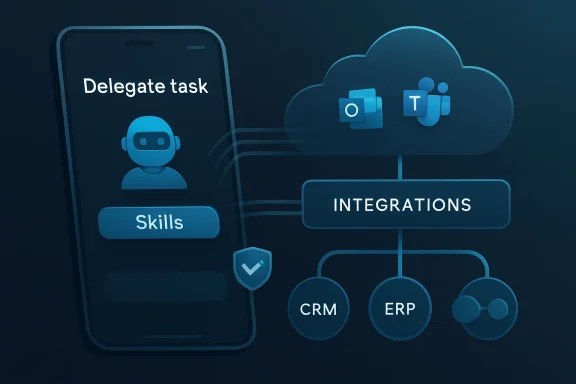
Microsoft’s announcement leans into that shift with three obvious vectors: mobile access, reusable skills, and integrations. None is surprising in isolation. Together, they reveal the company’s larger strategy: make Copilot Cowork an execution layer that follows work across devices, remembers how teams like things done, and reaches into the systems where business actually happens.
That is the scenario Microsoft is trying to capture. Cowork already runs in the cloud, so the device is not supposed to be the worker; it is merely the trigger. The phone becomes a remote control for background work.
This is not just convenience. It is habit formation. Microsoft wants delegation to become as natural as sending a Teams message or flagging an Outlook item. If Cowork can be invoked at the moment a task occurs to the user, the AI agent becomes less of a destination and more of an ambient work surface.
There is a reason this matters to Microsoft’s broader platform strategy. The company has spent decades winning by being present at the point where work begins: the document, the spreadsheet, the inbox, the meeting, the directory, the workflow. Mobile Cowork is an attempt to make that point of origin portable.
The challenge is that mobile delegation is also where vague instructions multiply. A hurried prompt from a phone is often less precise than a carefully written desktop request. If Cowork is going to do real work from casual mobile inputs, Microsoft must prove that the agent can ask clarifying questions, expose its plan, and stop before consequential actions.
That matters because the biggest limitation of workplace AI is not that users cannot write prompts. It is that organizations do not want every employee improvising the company’s tone, structure, approval path, and reporting format every time they ask AI for help. The enterprise does not run on clever prompts; it runs on repeatable procedures.
Skills are Microsoft’s bridge between the two. A team can encode how a weekly customer update should be formatted, how a research brief should weigh sources, how a meeting should be coordinated, or how a project handoff should be assembled. Once captured, that pattern can be reused instead of rediscovered.
This is where Copilot Cowork starts to resemble a process platform rather than a productivity feature. Microsoft is not merely selling the ability to generate content. It is selling a mechanism for turning tribal knowledge into executable instructions.
That should interest sysadmins and IT leaders because skills create a new governance surface. Who can create them? Who reviews them? Where are they stored? How are they versioned? What happens when a skill bakes in a bad assumption, an obsolete policy, or a manager’s personal preference masquerading as company procedure?
The old IT problem was shadow apps. The new one may be shadow workflows written in natural language.
That is Microsoft’s advantage over standalone AI services. Outlook knows the inbox. Teams knows the conversations. SharePoint and OneDrive know the documents. Entra ID knows people, groups, roles, and access. Dynamics 365 knows customers, cases, pipelines, orders, and business processes. Power BI knows the dashboards people actually use to argue about numbers.
If Cowork can safely stitch those signals together, it becomes far more useful than a model answering from public knowledge. A generic assistant can tell you how to prepare for a sales review. A Microsoft-grounded agent can, in theory, inspect the pipeline, read the account notes, summarize recent emails, check open support cases, draft the agenda, and prepare the follow-up document.
That is also why this is a lock-in play. The more Cowork learns through Microsoft 365, the more valuable it becomes to organizations already standardized on Microsoft’s stack. The deeper the agent reaches into daily work, the harder it becomes to treat Microsoft 365 as interchangeable infrastructure.
This is not necessarily sinister. Enterprises often want fewer platforms, not more. But it means Cowork should be understood as both a productivity product and a strategic moat around Microsoft’s cloud estate.
This is the difference between an impressive demo and a procurement conversation. A Copilot that drafts a memo is useful. A Copilot that can connect to financial data, operational dashboards, CRM records, planning boards, and industry data feeds starts to look like an enterprise work orchestration layer.
The named third-party integrations are revealing. LSEG and S&P Global Energy suggest use cases involving market, financial, and sector-specific data. Miro points toward collaboration and planning. monday.com points toward project and work management. Microsoft is not pretending work lives only in Microsoft 365; it is trying to make Microsoft 365 Copilot the place where work from many systems is coordinated.
For IT, this is where the security review becomes unavoidable. Each connector is a potential path between the agent and business-critical data. Each plugin is a question about authentication, permissions, logging, data residency, and user consent. Each successful automation raises the stakes for the next one.
Microsoft says organizations can build custom plugins, which is exactly what large enterprises will want. But custom plugins are also where elegant strategy meets messy reality. Internal systems have brittle APIs, inconsistent records, stale permissions, and undocumented exceptions. An AI agent that works beautifully against a clean demo tenant may behave very differently when dropped into a decade of accumulated enterprise plumbing.
Microsoft’s own documentation frames Cowork as prerelease, subject to change, and dependent on the right licensing and tenant configuration. That is not a criticism; it is a necessary warning label. Agentic systems are harder to ship than chat interfaces because the consequences of failure are broader.
A bad answer in a chat window is one kind of problem. A bad action taken across email, calendar, documents, Teams, or business systems is another. Cowork’s model of asking for approval before sensitive actions is essential, but approval dialogs are not a complete governance model.
Any WindowsForum reader who has managed Microsoft 365 knows how previews can drift into production by enthusiasm rather than design. A director gets access, shows a dramatic time-saving workflow, and suddenly the pilot becomes a business dependency. By the time IT catches up, the organization has already built informal processes around a moving target.
That is the tension at the heart of Cowork. Microsoft needs real usage to improve the system. Enterprises need stability before handing it real work. The Frontier program is where those two needs collide.
Cowork Skills could become the AI-era version of that pattern. Instead of recording spreadsheet actions or wiring together flow steps, users describe how work should be done. The barrier to automation drops dramatically.
That is good news for teams drowning in recurring administrative labor. It is also a compliance headache waiting to happen. When automation becomes conversational, more people can create it, fewer people may understand it, and the line between “helpful instruction” and “business process” becomes blurry.
The smartest organizations will not try to ban this. They will channel it. They will create review processes for shared skills, define which systems Cowork can touch, require audit trails for consequential workflows, and treat prompts that drive recurring work as operational assets.
Microsoft will need to help them do that. If Cowork becomes a real platform, admins will need lifecycle management for skills and plugins, not just enablement switches. They will need visibility into what agents are doing, which data sources they accessed, what actions they proposed, what users approved, and where outputs landed.
Agentic work requires a different rhythm from chat. The agent must plan, proceed, pause, ask, revise, and seek approval. Users need to see enough of the process to trust it without being forced to babysit every step. That is a delicate balance.
If Cowork interrupts constantly, it becomes slower than doing the work manually. If it interrupts too rarely, it becomes a liability. Microsoft’s challenge is to tune Cowork so that it understands the difference between low-risk productivity work and actions that carry reputational, financial, legal, or operational consequences.
This is particularly important for mobile use. A user delegating from a phone may not want to review every detail in the moment. But a tap-to-approve interface can become dangerous if the user does not fully understand what the agent is about to do. The same design patterns that make consumer apps frictionless can be reckless inside enterprise workflows.
The answer is not merely better warnings. It is contextual control. A draft email to an internal team is not the same as a message to a customer. A meeting hold is not the same as an order approval. A generated briefing is not the same as an updated CRM record. Cowork’s future depends on making those distinctions visible and enforceable.
That is an ambitious redefinition of productivity software. In the classic Office model, users opened apps to create artifacts. In the Copilot model, users describe outcomes and the system assembles artifacts, messages, meetings, and workflows around them.
The business case is obvious. Modern knowledge work is fragmented across too many tools, and much of the day is consumed by translation: turning meeting notes into emails, emails into tasks, tasks into documents, documents into presentations, dashboards into narratives, and conversations into decisions. Cowork is Microsoft’s argument that AI can absorb some of that translation layer.
But the political economy of office work is more complicated than the demo suggests. A lot of work exists because organizations have not clarified ownership, process, or decision rights. AI can accelerate a broken workflow just as easily as it can improve a healthy one.
That is why Cowork will test management as much as technology. If leaders use it to reduce drudgery and standardize high-quality work, it could be genuinely valuable. If they use it to pile more invisible coordination onto employees while pretending the agent has solved capacity, it will become another productivity tax.
That fits the broader direction of Microsoft’s ecosystem. Windows is still the front door for many workers, but Microsoft’s highest-value productivity experiences increasingly live in cloud services, identity, data graphs, and cross-device continuity. The PC becomes one surface among many.
This does not make Windows irrelevant. If anything, Windows becomes the place where complex review, editing, and oversight still happen. A phone may be where a task is delegated; a Windows workstation may be where the output is audited, refined, and approved.
The danger for Microsoft is that if the best parts of Copilot become cloud-first and device-neutral, Windows loses some of its privileged role. The opportunity is that Windows can become the richest control panel for agentic work: dashboards, histories, approvals, data views, local context, and admin tooling. Microsoft should lean into that rather than treating the desktop as merely another Copilot container.
That also means failures will be more visible. If a generated paragraph is mediocre, the user rewrites it. If an agent misses a dependency in an order approval flow, sends the wrong customer update, or bases a management briefing on stale dashboard data, the cost is organizational.
Microsoft knows this, which is why the company is wrapping Cowork in the language of grounding, Work IQ, enterprise data protection, approval, and Frontier preview access. The pitch is not “trust the model.” The pitch is “trust the system around the model.”
That system will be the real product. Models will change. Partners will change. Skills will multiply. Connectors will expand. What enterprise customers will care about is whether Microsoft can make agentic work observable, governable, reversible, and boring enough to rely on.
For organizations considering Cowork, the early lessons are practical:
Microsoft’s May 5 announcement is best read as a marker in the shift from conversational AI to operational AI. Copilot Cowork is still early, still tied to Frontier, and still carrying the usual preview caveats, but its direction is clear: Microsoft wants AI to stop merely answering workers and start working beside them. If it succeeds, the next version of office productivity will not be defined by the blank page, the empty spreadsheet, or the unread inbox, but by the moment a worker says what needs to happen and an agent begins turning that intent into action.
Source: Microsoft Copilot Cowork: From conversation to action across skills, integrations, and devices | Microsoft 365 Blog
 Microsoft Moves Copilot From Advice to Delegation
For most of the Copilot era, Microsoft’s AI pitch has been framed around assistance. Copilot could summarize a Teams meeting, draft an email, rewrite a paragraph, pull themes from a document, or answer a question grounded in company data. It was useful, but the human still had to turn the answer into work.Copilot Cowork is Microsoft’s attempt to close that last mile. Instead of asking an assistant what should be done, the worker asks an agent to do it: prepare the briefing, coordinate the meeting, assemble the document, process the inbox, generate a report, or connect information across systems. That changes the psychological contract between user and software.
A chatbot can be wrong and still be dismissed as a tool. An agent that sends messages, creates documents, schedules meetings, posts in Teams, or touches customer and financial systems becomes part of the operating machinery of the business. The promise is less friction; the risk is that friction was sometimes the thing keeping bad decisions from propagating.
Microsoft’s announcement leans into that shift with three obvious vectors: mobile access, reusable skills, and integrations. None is surprising in isolation. Together, they reveal the company’s larger strategy: make Copilot Cowork an execution layer that follows work across devices, remembers how teams like things done, and reaches into the systems where business actually happens.
The Phone Is Where Delegation Becomes Habit
Bringing Cowork to iOS and Android matters because mobile is where intent often appears before structure. A manager leaving a customer call remembers that a follow-up deck needs to be created. A salesperson on a train wants a pipeline update before the next meeting. An operations lead between site visits wants an order approval packet prepared before returning to a laptop.That is the scenario Microsoft is trying to capture. Cowork already runs in the cloud, so the device is not supposed to be the worker; it is merely the trigger. The phone becomes a remote control for background work.
This is not just convenience. It is habit formation. Microsoft wants delegation to become as natural as sending a Teams message or flagging an Outlook item. If Cowork can be invoked at the moment a task occurs to the user, the AI agent becomes less of a destination and more of an ambient work surface.
There is a reason this matters to Microsoft’s broader platform strategy. The company has spent decades winning by being present at the point where work begins: the document, the spreadsheet, the inbox, the meeting, the directory, the workflow. Mobile Cowork is an attempt to make that point of origin portable.
The challenge is that mobile delegation is also where vague instructions multiply. A hurried prompt from a phone is often less precise than a carefully written desktop request. If Cowork is going to do real work from casual mobile inputs, Microsoft must prove that the agent can ask clarifying questions, expose its plan, and stop before consequential actions.
Skills Turn Prompting Into Workplace Procedure
The most strategically important part of the announcement may be Cowork Skills. Microsoft describes a skill as a reusable set of instructions that tells Cowork how to complete a task or workflow. In plain English, it is a way to capture process.That matters because the biggest limitation of workplace AI is not that users cannot write prompts. It is that organizations do not want every employee improvising the company’s tone, structure, approval path, and reporting format every time they ask AI for help. The enterprise does not run on clever prompts; it runs on repeatable procedures.
Skills are Microsoft’s bridge between the two. A team can encode how a weekly customer update should be formatted, how a research brief should weigh sources, how a meeting should be coordinated, or how a project handoff should be assembled. Once captured, that pattern can be reused instead of rediscovered.
This is where Copilot Cowork starts to resemble a process platform rather than a productivity feature. Microsoft is not merely selling the ability to generate content. It is selling a mechanism for turning tribal knowledge into executable instructions.
That should interest sysadmins and IT leaders because skills create a new governance surface. Who can create them? Who reviews them? Where are they stored? How are they versioned? What happens when a skill bakes in a bad assumption, an obsolete policy, or a manager’s personal preference masquerading as company procedure?
The old IT problem was shadow apps. The new one may be shadow workflows written in natural language.
Work IQ Is Microsoft’s Real Moat
Microsoft’s announcement repeatedly invokes Work IQ, the company’s label for the intelligence layer that grounds Copilot in a user’s data, tools, and organizational context. The branding is clunky, but the idea is central. Cowork is not meant to be another web-connected assistant; it is meant to understand how work happens inside a Microsoft 365 tenant.That is Microsoft’s advantage over standalone AI services. Outlook knows the inbox. Teams knows the conversations. SharePoint and OneDrive know the documents. Entra ID knows people, groups, roles, and access. Dynamics 365 knows customers, cases, pipelines, orders, and business processes. Power BI knows the dashboards people actually use to argue about numbers.
If Cowork can safely stitch those signals together, it becomes far more useful than a model answering from public knowledge. A generic assistant can tell you how to prepare for a sales review. A Microsoft-grounded agent can, in theory, inspect the pipeline, read the account notes, summarize recent emails, check open support cases, draft the agenda, and prepare the follow-up document.
That is also why this is a lock-in play. The more Cowork learns through Microsoft 365, the more valuable it becomes to organizations already standardized on Microsoft’s stack. The deeper the agent reaches into daily work, the harder it becomes to treat Microsoft 365 as interchangeable infrastructure.
This is not necessarily sinister. Enterprises often want fewer platforms, not more. But it means Cowork should be understood as both a productivity product and a strategic moat around Microsoft’s cloud estate.
Integrations Are Where the Demo Meets the Budget
The new integrations point directly at Microsoft’s enterprise buyers. Fabric IQ with Power BI brings data into Cowork workflows. Dynamics 365 integrations target sales, customer service, and ERP scenarios such as pipeline reviews, case resolution, and order approvals. Third-party connectors for LSEG, Miro, monday.com, and S&P Global Energy are planned for the coming weeks.This is the difference between an impressive demo and a procurement conversation. A Copilot that drafts a memo is useful. A Copilot that can connect to financial data, operational dashboards, CRM records, planning boards, and industry data feeds starts to look like an enterprise work orchestration layer.
The named third-party integrations are revealing. LSEG and S&P Global Energy suggest use cases involving market, financial, and sector-specific data. Miro points toward collaboration and planning. monday.com points toward project and work management. Microsoft is not pretending work lives only in Microsoft 365; it is trying to make Microsoft 365 Copilot the place where work from many systems is coordinated.
For IT, this is where the security review becomes unavoidable. Each connector is a potential path between the agent and business-critical data. Each plugin is a question about authentication, permissions, logging, data residency, and user consent. Each successful automation raises the stakes for the next one.
Microsoft says organizations can build custom plugins, which is exactly what large enterprises will want. But custom plugins are also where elegant strategy meets messy reality. Internal systems have brittle APIs, inconsistent records, stale permissions, and undocumented exceptions. An AI agent that works beautifully against a clean demo tenant may behave very differently when dropped into a decade of accumulated enterprise plumbing.
The Frontier Label Is Doing a Lot of Work
Cowork remains available through Microsoft’s Frontier program, and that matters. Frontier is Microsoft’s channel for exposing customers to early AI capabilities while those features are still moving quickly. In practice, that means Cowork should be treated as promising preview technology, not as a settled enterprise substrate.Microsoft’s own documentation frames Cowork as prerelease, subject to change, and dependent on the right licensing and tenant configuration. That is not a criticism; it is a necessary warning label. Agentic systems are harder to ship than chat interfaces because the consequences of failure are broader.
A bad answer in a chat window is one kind of problem. A bad action taken across email, calendar, documents, Teams, or business systems is another. Cowork’s model of asking for approval before sensitive actions is essential, but approval dialogs are not a complete governance model.
Any WindowsForum reader who has managed Microsoft 365 knows how previews can drift into production by enthusiasm rather than design. A director gets access, shows a dramatic time-saving workflow, and suddenly the pilot becomes a business dependency. By the time IT catches up, the organization has already built informal processes around a moving target.
That is the tension at the heart of Cowork. Microsoft needs real usage to improve the system. Enterprises need stability before handing it real work. The Frontier program is where those two needs collide.
The Agent Is Becoming the New Office Macro
There is an old Microsoft analogy hiding in plain sight: the Office macro. For decades, power users used macros, scripts, templates, and eventually Power Automate flows to turn repetitive work into repeatable machinery. Some of that machinery was brilliant. Some of it was terrifying. Much of it was undocumented.Cowork Skills could become the AI-era version of that pattern. Instead of recording spreadsheet actions or wiring together flow steps, users describe how work should be done. The barrier to automation drops dramatically.
That is good news for teams drowning in recurring administrative labor. It is also a compliance headache waiting to happen. When automation becomes conversational, more people can create it, fewer people may understand it, and the line between “helpful instruction” and “business process” becomes blurry.
The smartest organizations will not try to ban this. They will channel it. They will create review processes for shared skills, define which systems Cowork can touch, require audit trails for consequential workflows, and treat prompts that drive recurring work as operational assets.
Microsoft will need to help them do that. If Cowork becomes a real platform, admins will need lifecycle management for skills and plugins, not just enablement switches. They will need visibility into what agents are doing, which data sources they accessed, what actions they proposed, what users approved, and where outputs landed.
Enterprise Trust Will Be Won in the Interruptions
The most important user experience in Cowork may not be the prompt box. It may be the interruption.Agentic work requires a different rhythm from chat. The agent must plan, proceed, pause, ask, revise, and seek approval. Users need to see enough of the process to trust it without being forced to babysit every step. That is a delicate balance.
If Cowork interrupts constantly, it becomes slower than doing the work manually. If it interrupts too rarely, it becomes a liability. Microsoft’s challenge is to tune Cowork so that it understands the difference between low-risk productivity work and actions that carry reputational, financial, legal, or operational consequences.
This is particularly important for mobile use. A user delegating from a phone may not want to review every detail in the moment. But a tap-to-approve interface can become dangerous if the user does not fully understand what the agent is about to do. The same design patterns that make consumer apps frictionless can be reckless inside enterprise workflows.
The answer is not merely better warnings. It is contextual control. A draft email to an internal team is not the same as a message to a customer. A meeting hold is not the same as an order approval. A generated briefing is not the same as an updated CRM record. Cowork’s future depends on making those distinctions visible and enforceable.
Microsoft Is Building the Post-Chat Office
The broader pattern is unmistakable. Microsoft is trying to evolve Office from a suite of applications into an environment where AI agents coordinate work across applications. Word, Excel, PowerPoint, Outlook, Teams, Power BI, Dynamics, SharePoint, and third-party systems become surfaces and data sources; Copilot becomes the conversational command layer; Cowork becomes the execution layer.That is an ambitious redefinition of productivity software. In the classic Office model, users opened apps to create artifacts. In the Copilot model, users describe outcomes and the system assembles artifacts, messages, meetings, and workflows around them.
The business case is obvious. Modern knowledge work is fragmented across too many tools, and much of the day is consumed by translation: turning meeting notes into emails, emails into tasks, tasks into documents, documents into presentations, dashboards into narratives, and conversations into decisions. Cowork is Microsoft’s argument that AI can absorb some of that translation layer.
But the political economy of office work is more complicated than the demo suggests. A lot of work exists because organizations have not clarified ownership, process, or decision rights. AI can accelerate a broken workflow just as easily as it can improve a healthy one.
That is why Cowork will test management as much as technology. If leaders use it to reduce drudgery and standardize high-quality work, it could be genuinely valuable. If they use it to pile more invisible coordination onto employees while pretending the agent has solved capacity, it will become another productivity tax.
Windows Users Should Watch the Boundary Between PC and Cloud
For Windows enthusiasts, there is another interesting angle: Cowork reduces the importance of the local PC as the place where work is executed. Microsoft says Cowork runs in the cloud, which means tasks can continue when a laptop is closed. The Windows desktop remains a powerful endpoint, but the agent’s labor happens elsewhere.That fits the broader direction of Microsoft’s ecosystem. Windows is still the front door for many workers, but Microsoft’s highest-value productivity experiences increasingly live in cloud services, identity, data graphs, and cross-device continuity. The PC becomes one surface among many.
This does not make Windows irrelevant. If anything, Windows becomes the place where complex review, editing, and oversight still happen. A phone may be where a task is delegated; a Windows workstation may be where the output is audited, refined, and approved.
The danger for Microsoft is that if the best parts of Copilot become cloud-first and device-neutral, Windows loses some of its privileged role. The opportunity is that Windows can become the richest control panel for agentic work: dashboards, histories, approvals, data views, local context, and admin tooling. Microsoft should lean into that rather than treating the desktop as merely another Copilot container.
The Cowork Bet Has Teeth Because It Touches Real Systems
Many AI announcements are easy to dismiss because they live in the realm of content generation. Cowork is harder to dismiss because it is aimed at the work businesses actually pay people to coordinate. Inbox workflows, deep research, structured documents, web pages, pipeline reviews, case resolution, order approvals, and cross-system plugins are not toys.That also means failures will be more visible. If a generated paragraph is mediocre, the user rewrites it. If an agent misses a dependency in an order approval flow, sends the wrong customer update, or bases a management briefing on stale dashboard data, the cost is organizational.
Microsoft knows this, which is why the company is wrapping Cowork in the language of grounding, Work IQ, enterprise data protection, approval, and Frontier preview access. The pitch is not “trust the model.” The pitch is “trust the system around the model.”
That system will be the real product. Models will change. Partners will change. Skills will multiply. Connectors will expand. What enterprise customers will care about is whether Microsoft can make agentic work observable, governable, reversible, and boring enough to rely on.
The Real Cowork Upgrade Is the Operating Model It Forces
The concrete news is simple, but the implications are larger than the feature list. Cowork is moving onto phones, gaining reusable skills, and connecting more deeply into Microsoft and third-party business systems. The less obvious news is that Microsoft is asking customers to rethink how work is delegated, standardized, and supervised.For organizations considering Cowork, the early lessons are practical:
- Cowork should be piloted on bounded workflows where the expected output, approval path, and risk level are well understood.
- Custom skills should be treated like business process artifacts, not disposable prompt snippets.
- Mobile delegation should be enabled with extra care because quick prompts and quick approvals can hide consequential actions.
- Plugins and connectors should go through the same security and compliance review as any other app touching enterprise data.
- IT should demand logs, ownership, and lifecycle controls before Cowork becomes embedded in recurring operations.
- Teams should measure whether Cowork reduces coordination work or merely increases the volume of work moving through the system.
Microsoft’s May 5 announcement is best read as a marker in the shift from conversational AI to operational AI. Copilot Cowork is still early, still tied to Frontier, and still carrying the usual preview caveats, but its direction is clear: Microsoft wants AI to stop merely answering workers and start working beside them. If it succeeds, the next version of office productivity will not be defined by the blank page, the empty spreadsheet, or the unread inbox, but by the moment a worker says what needs to happen and an agent begins turning that intent into action.
Source: Microsoft Copilot Cowork: From conversation to action across skills, integrations, and devices | Microsoft 365 Blog
